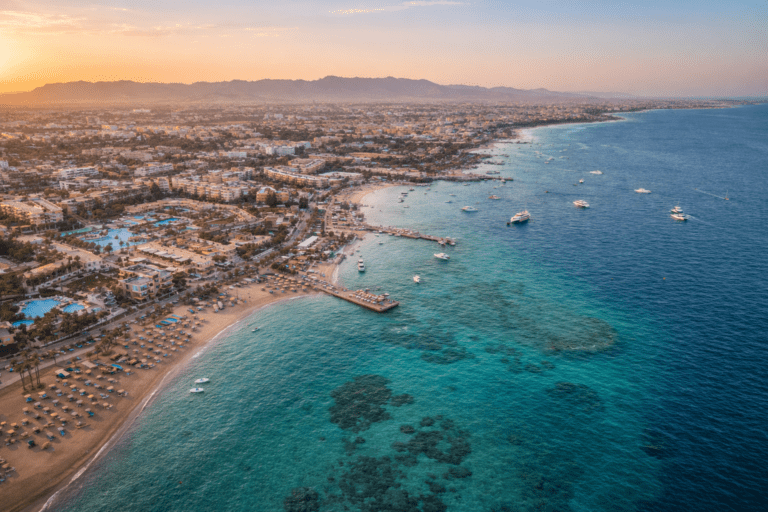
Christian Sites in Egypt: Churches, Monasteries & Biblical Places to Visit
Christian Egypt is much larger than Coptic Cairo.
For many first-time visitors, the historic churches of Old Cairo are their first encounter with Egypt’s Christian heritage. Travel beyond Cairo, though, and the story expands quickly. There are ancient monasteries in the deserts, early Christian remains near Alexandria, Holy Family traditions across the Delta and Nile Valley, important monastic sites in Sohag, and St. Catherine’s Monastery beneath the mountain traditionally identified as Mount Sinai.
You could build a trip around any one of those subjects. Someone following the Holy Family, for example, needs a very different itinerary from someone primarily interested in the origins of Christian monasticism.
If Christian history will be an important part of your trip, this guide will help you decide which places belong in it and where to go next for the more detailed guides.
Why Is Egypt Important to Christian History?
Egypt appears in the Christian story in the Gospel of Matthew, which records Joseph taking Mary and Jesus into Egypt to escape Herod and later returning after Herod’s death.
The Gospel does not say where they traveled within Egypt. The detailed route followed by pilgrims today comes from later Coptic Christian tradition and connects churches, monasteries, wells, trees, caves and other places from the Delta into Upper Egypt.
Christianity became established in Egypt during the early centuries of the faith. The Coptic Orthodox Church traces the Church of Alexandria to St. Mark, and Alexandria became an important center of early Christian thought and church life.
Egypt was also enormously influential in the development of Christian monasticism. Early ascetics withdrew into the desert, and communities that developed in places such as Wadi El Natrun and the Eastern Desert helped shape monastic traditions far beyond Egypt.
Many of the places connected with that history remain active religious sites. Historic churches in Cairo hold services. Monks still live in ancient monastic centers. Holy Family sites continue to receive pilgrims.
Those histories overlap, but they do not follow the same route through Egypt.
Coptic Cairo: The Best Starting Point for Most Visitors
For a first introduction to Christian Egypt, start with Coptic Cairo.
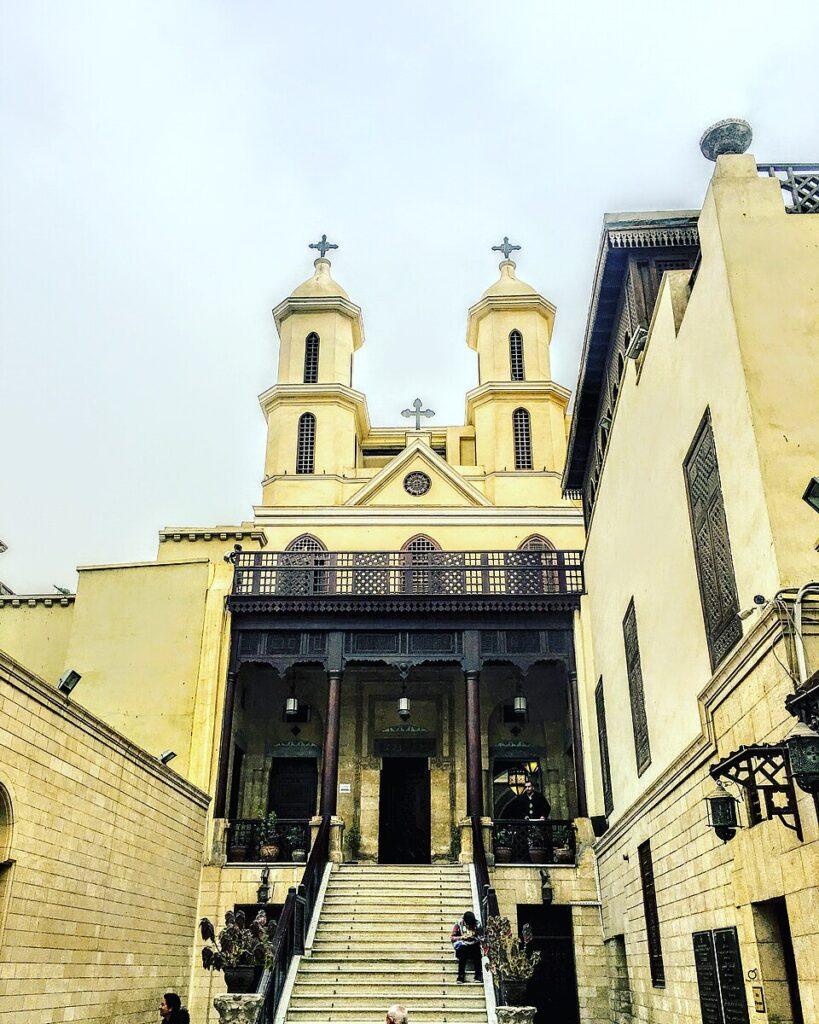
Several important sites are concentrated around the Roman Fortress of Babylon, making this one of the few places where you can explore a substantial part of Egypt’s Christian history on foot.
The Hanging Church is one of Egypt’s best-known Coptic churches. Abu Serga is important to the Holy Family tradition because of the crypt beneath the church. The Church of St. Barbara adds another historic church, while the Coptic Museum gives much more context to Christian art, manuscripts and material culture in Egypt.
Our guide to Coptic Cairo covers the district in detail.
Even if Christian history is only one part of your trip, Coptic Cairo is easy to include while you are in the city. If it is one of your main interests, give the district several hours rather than rushing through the Hanging Church and Abu Serga.
Explore ENA’s Coptic Cairo Walking Tour covers the principal heritage sites with a guide.
The Cave Church at Mokattam: Christian Cairo Beyond the Historic Churches
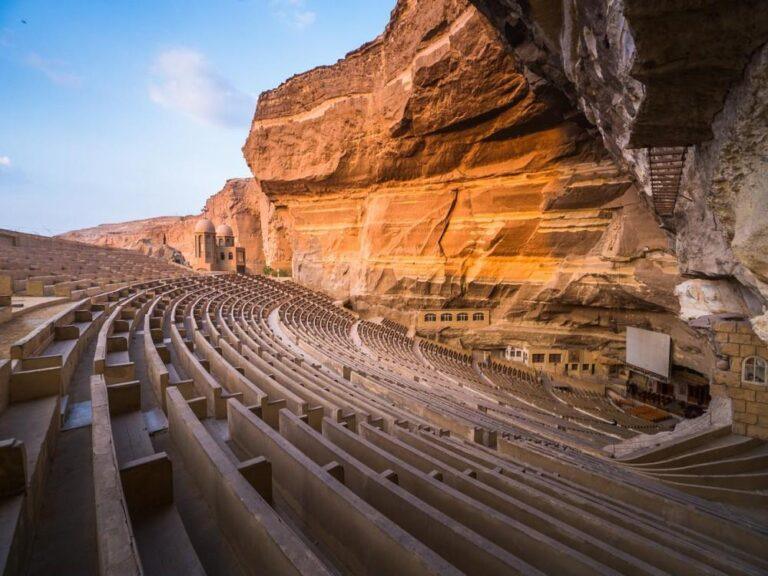
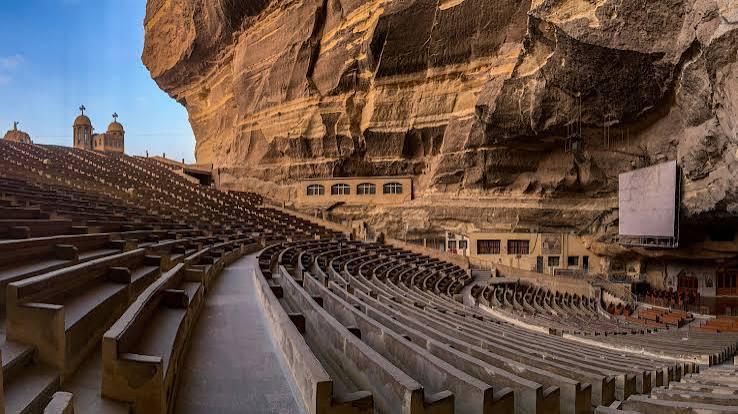
The Cave Church at Mokattam offers a very different view of Christianity in Cairo.
The Monastery of St. Simon the Tanner is built into the limestone cliffs above the community commonly known as Garbage City. Its enormous rock sanctuary and carvings can look ancient in photographs, but the present monastery complex developed in the twentieth century. Its religious story draws on the much older Coptic tradition of St. Simon the Tanner.
Mokattam is worth seeing after Coptic Cairo precisely because it is so different. The huge rock-cut spaces and modern carvings show a part of Cairo’s Christian story that you will not see among the historic churches of Old Cairo.
Our Cave Church Cairo guide explains the monastery, the St. Simon tradition and what to expect when visiting Mokattam.
Alexandria and Abu Mena: The Early Church and an Ancient Pilgrimage Center
Alexandria was one of the great cities of early Christianity, although far less of that early Christian city survives above ground than many visitors expect.
The tradition of St. Mark, the development of the Church of Alexandria and the city’s role in early Christian thought make Alexandria central to the story of Christianity in Egypt.
Modern visitors encounter that history through a mixture of living churches, later religious sites and archaeology rather than through one preserved early Christian district. St. Mark’s Cathedral represents the continuing Church of Alexandria, while other sites help place Christianity within the much longer history of the city.
Our Christian Sites in Alexandria guide looks at what survives and how to plan a Christian-focused visit.
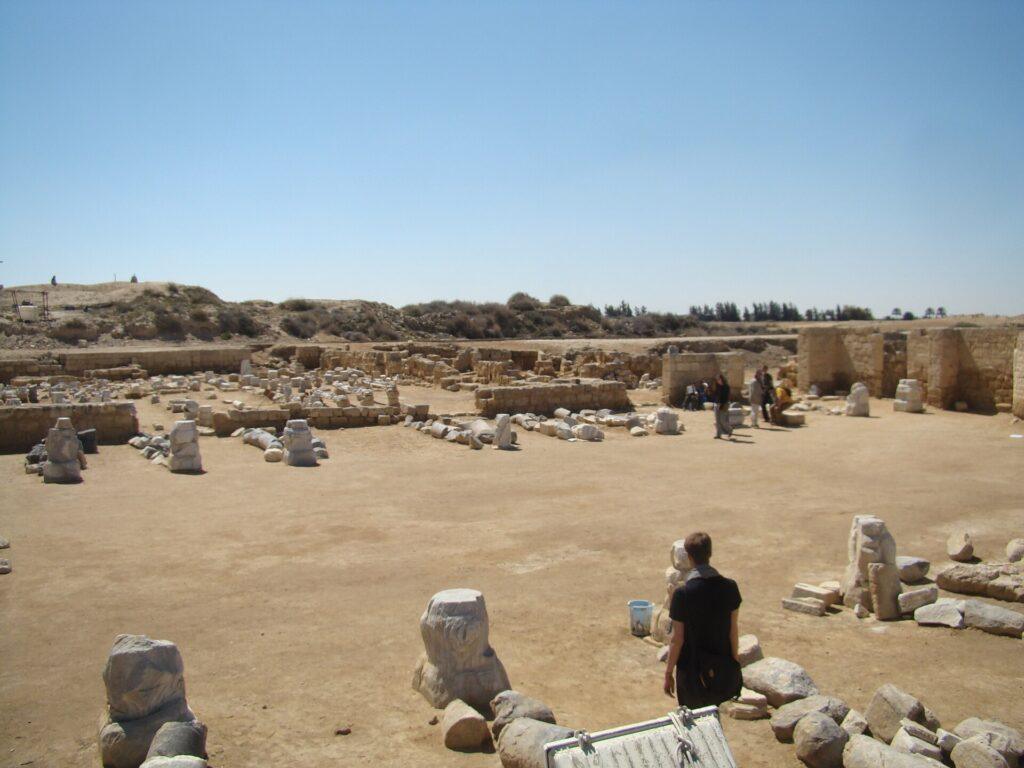
Outside the city, Abu Mena adds an important archaeological site. The ancient settlement developed around the tomb of St. Menas into a major pilgrimage center. UNESCO dates its principal development from the fifth to seventh centuries and identifies it as an important example of early Christian pilgrimage and monastic architecture.
Abu Mena requires a separate journey outside central Alexandria, so allow for that when deciding whether it belongs in your visit.
The Holy Family Trail: From the Delta to Upper Egypt
The Flight into Egypt is biblical. The detailed route through Egypt belongs to Coptic Christian tradition.
Some Holy Family locations preserve substantial churches or monasteries. Others are associated with a well, tree, cave or remembered stopping place. At several locations, later Christian archaeology adds another layer of history that can be studied independently of the Holy Family tradition.
The route is extensive enough that most travelers need to decide which part they want to follow.
Holy Family Sites in the Nile Delta
The northern traditions connect a series of communities across the Delta before reaching the Cairo area.
These places receive far fewer international visitors than Coptic Cairo, but they become much more relevant when the Holy Family tradition itself is one of the reasons for your trip.
Trying to pick off individual Delta sites while based in Cairo can also mean spending a surprising amount of the day on the road. A route planned specifically around the Delta works better.
Holy Family Sites in Cairo
Greater Cairo has several important traditional locations, including Musturud, Mary’s Tree in Matariya, Haret Zuweila, Abu Serga and the Church of the Virgin Mary at Maadi.
Unlike the churches of Coptic Cairo, these sites are spread across Greater Cairo. Abu Serga is easy to include while visiting Coptic Cairo, but reaching Musturud, Matariya, Haret Zuweila and Maadi turns the day into a cross-city route.
If you want to see several of them, give the Holy Family sites their own day rather than squeezing them around Giza, museums or Historic Cairo.
Minya and Asyut
The traditional route continues south through Middle Egypt, where the distances become much greater.
At Gabal al-Tair, a historic church stands above the Nile. Al-Ashmunein combines Holy Family tradition with substantial evidence of a later early Christian city. Al-Muharraq is a major living monastery, while Dronka remains an important pilgrimage center overlooking Asyut.
Our Holy Family Sites in Middle & Upper Egypt guide covers this section in detail.
The distances are much greater than they appear when the places are reduced to a list of names. If Minya and Asyut matter to you, build them into the route rather than trying to squeeze them between Cairo and Luxor.
Wadi El Natrun: Four Living Monasteries in the Desert
Wadi El Natrun is one of the most important places in Egypt for travelers interested in early Christian monasticism.
Four historic Coptic monasteries remain active: Al-Baramus, St. Macarius, St. Bishoy and the Monastery of the Syrians.
The valley became a major monastic center during the early Christian period, and monastic communities continue there today.
Our Wadi El Natrun Monasteries guide covers the four surviving monasteries and the practicalities of visiting from Cairo.
Wadi El Natrun also appears in the Holy Family tradition, but the monasteries themselves developed centuries after the period in which the Flight into Egypt would have occurred.
If your interest is monastic history rather than the Holy Family, Wadi El Natrun can stand entirely on its own.
St. Anthony and St. Paul: Monasticism in the Eastern Desert
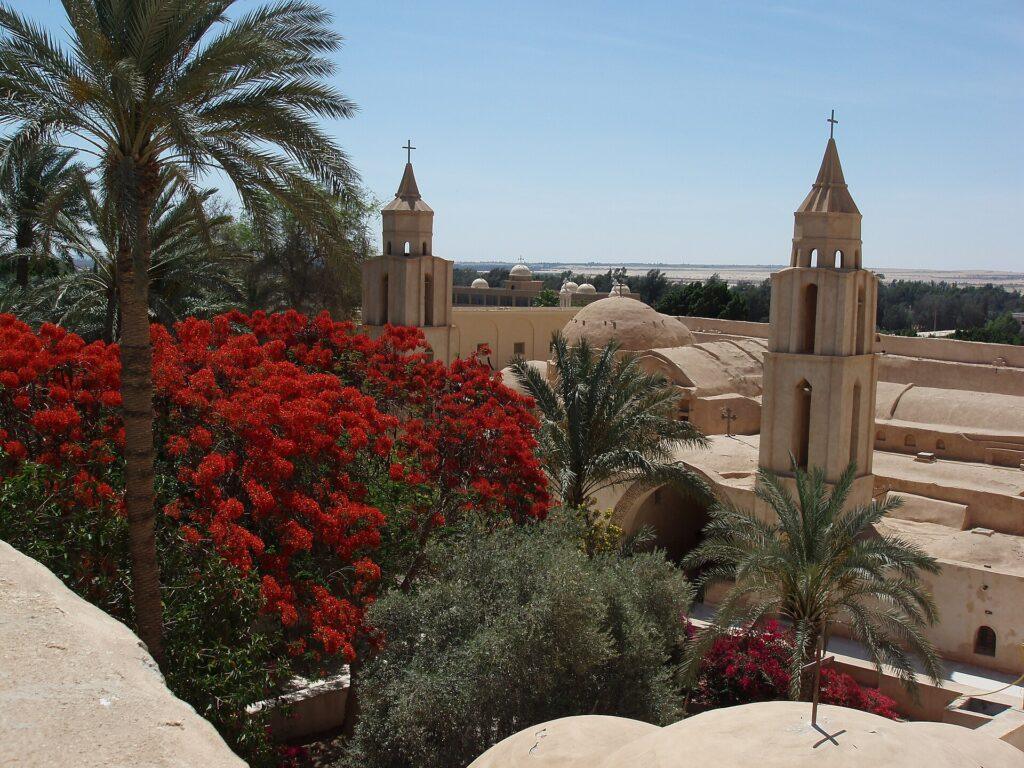
The monasteries of St. Anthony and St. Paul lie in the Eastern Desert near the Red Sea.
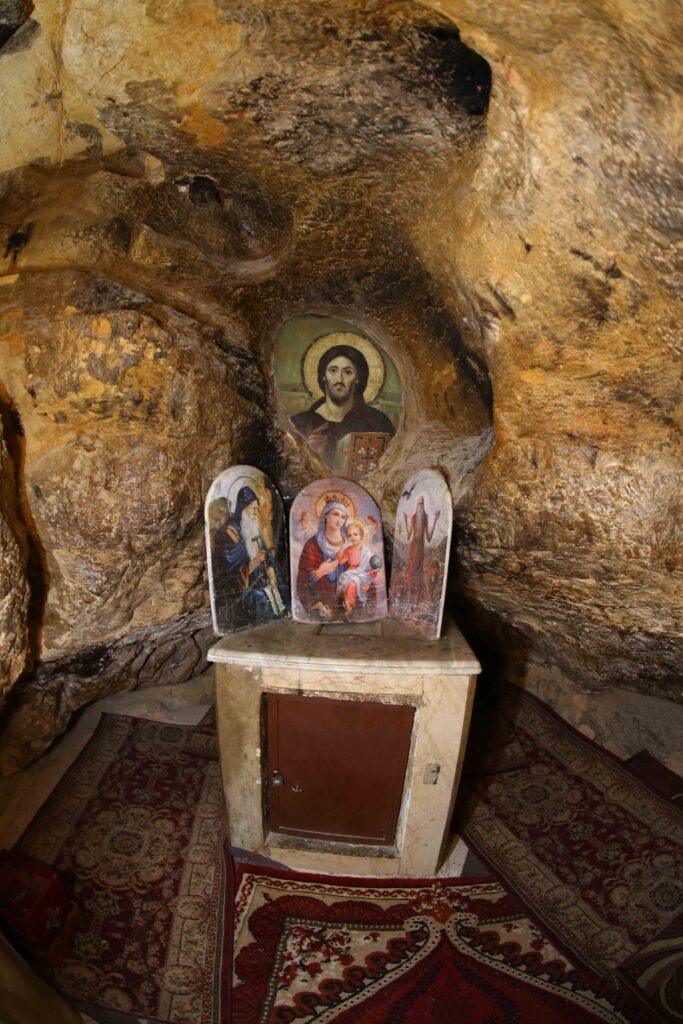
The Monastery of St. Anthony is associated with St. Anthony the Great, whose ascetic life in the Eastern Desert became enormously influential in Christian monastic tradition. The monastery stands below the mountain where his cave is located.
The nearby Monastery of St. Paul is associated with Paul of Thebes and another early eremitic tradition.
Visiting these monasteries is quite different from a day at Wadi El Natrun. The Eastern Desert setting is part of the experience, and St. Anthony’s connection with the mountain and cave gives the visit a different physical context from the monasteries west of the Delta.
Travelers building a trip around the history of monasticism may want both regions. For a conventional Cairo itinerary, however, the Eastern Desert requires a more deliberate detour.
Sohag: The Red and White Monasteries
Sohag adds another major chapter of Egyptian monastic history.
The Red and White Monasteries stand close enough to visit together, but their surviving features are very different.
The White Monastery is closely associated with Shenoute, one of the most important figures in Egyptian monasticism. Its surviving monumental church reflects the scale and importance the monastic community eventually achieved.
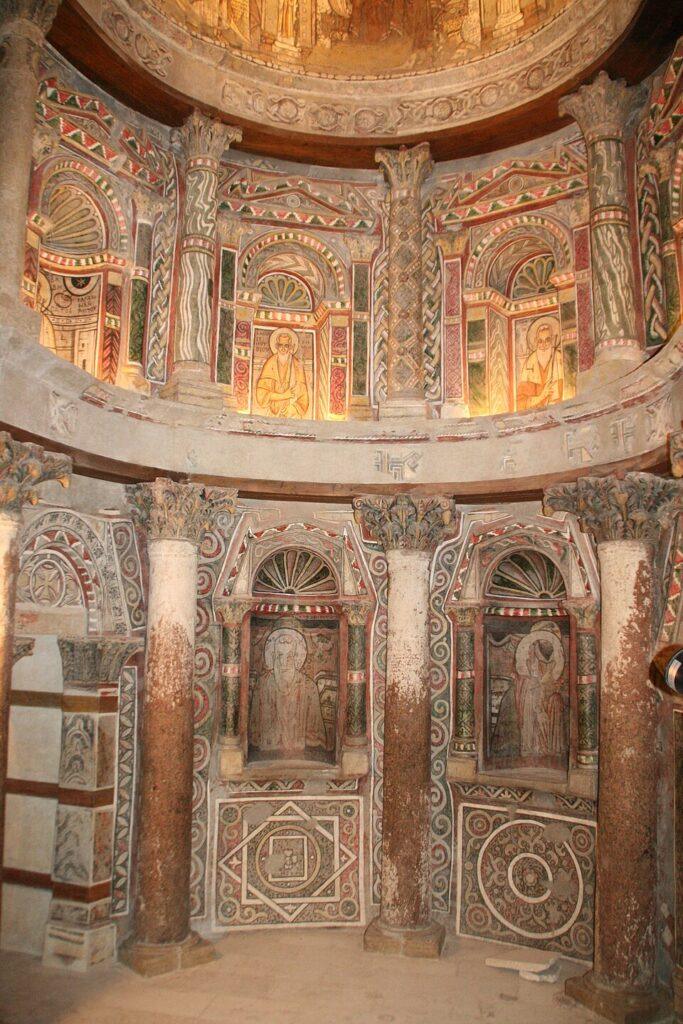
The nearby Red Monastery is particularly notable for its surviving painted sanctuary.
Our guide to the Red and White Monasteries of Sohag covers both sites and how they fit into a visit to the region.
Sohag makes particular sense for travelers interested in Christian art, architecture, monasticism or the less-visited Christian heritage of Upper Egypt.
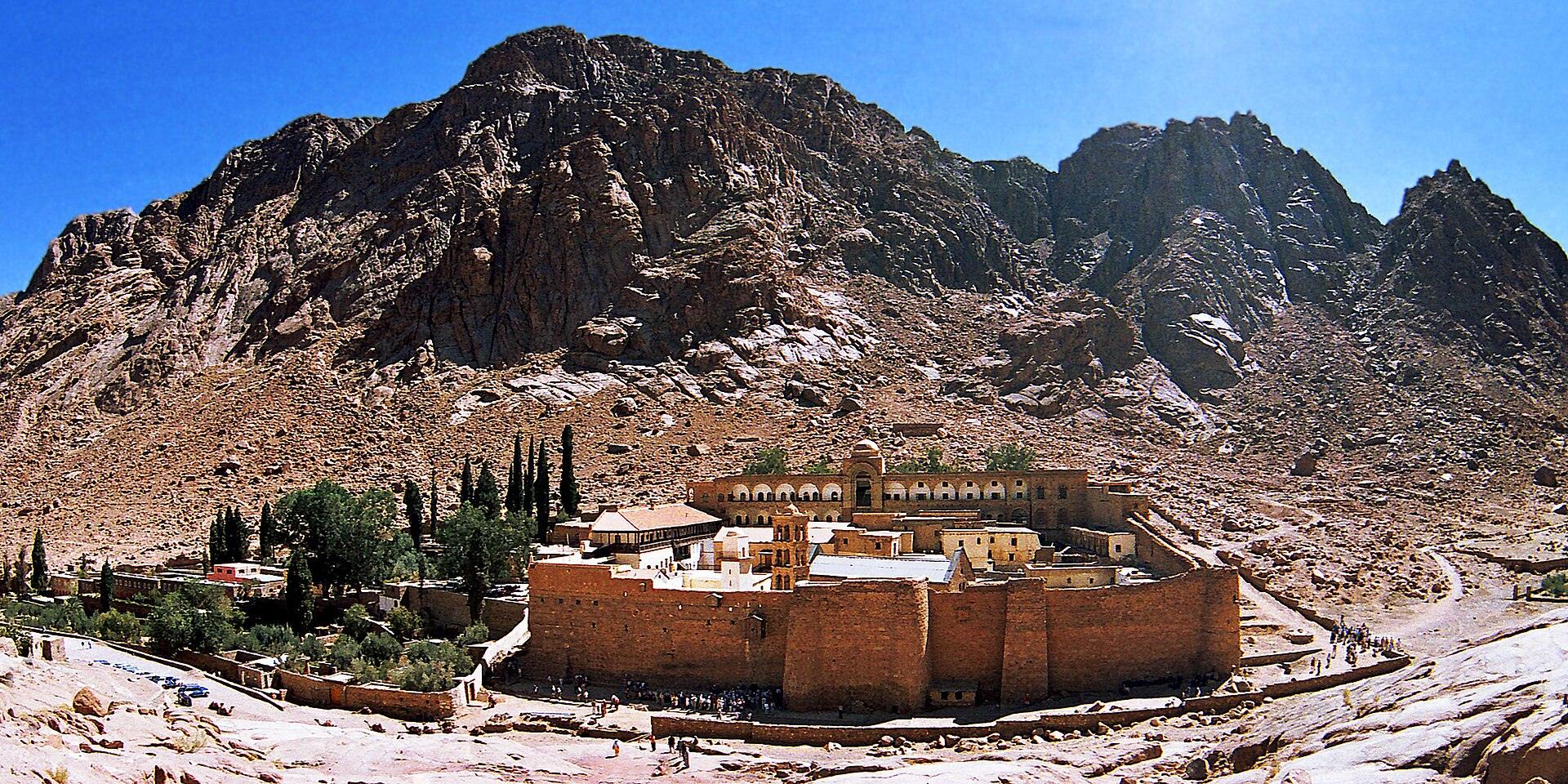
Mount Sinai and St. Catherine’s Monastery
South Sinai brings biblical tradition and Christian monastic history into the same landscape.
The Bible describes Moses receiving the law at Sinai and also associates Horeb with the burning bush. Jebel Musa is traditionally identified with the biblical Mount Sinai, although the biblical text does not provide enough geographical information to establish that modern identification conclusively.
At the foot of the mountain stands St. Catherine’s Monastery, founded in the sixth century.
UNESCO describes St. Catherine’s as the oldest Christian monastery still in use for its initial function. Its fortified complex also preserves an exceptional collection of early Christian manuscripts and icons.
You do not need to climb Mount Sinai to visit St. Catherine’s. Travelers who do plan the mountain climb should also leave time for the monastery rather than treating it simply as something at the bottom of the trail.
Our Mount Sinai and St. Catherine’s Monastery guide covers both experiences and the practical differences between them.
For authoritative historical background, UNESCO’s Saint Catherine Area documentation explains the monastery’s international heritage significance.
Biblical Places in Egypt
Biblical places in Egypt need a little more caution than simply matching an ancient name to a point on a modern map.
Mount Sinai is a good example. The biblical story belongs to Sinai, but identifying Jebel Musa as the mountain described in the text rests on longstanding religious tradition rather than a precise biblical location.
Heliopolis is different. The ancient Egyptian city known as Iunu became the biblical On and the Greek Heliopolis. Genesis identifies Joseph’s father-in-law Potiphera as a priest of On. Its location in the area of modern Matariya and Ain Shams is known, although very little of the ancient city remains above ground.
The Flight into Egypt presents another situation. Matthew tells us that the Holy Family went to Egypt but not where they traveled once they arrived. The individual stops visited by pilgrims today come from Coptic tradition.
Other biblical names connected with Egypt can be more difficult to place. Ancient geography changed, names changed, and in some cases scholars continue to debate which archaeological site should be associated with a name in the biblical text.
When visiting biblical places in Egypt, it is worth knowing whether you are standing at an archaeologically identified ancient city, a traditional religious location or a place whose modern identification remains uncertain. They can all be meaningful places to visit, but the evidence behind them is not always the same.
Christian History Hidden Inside Ancient Egyptian Sites
Christian history in Egypt is not confined to churches and monasteries.
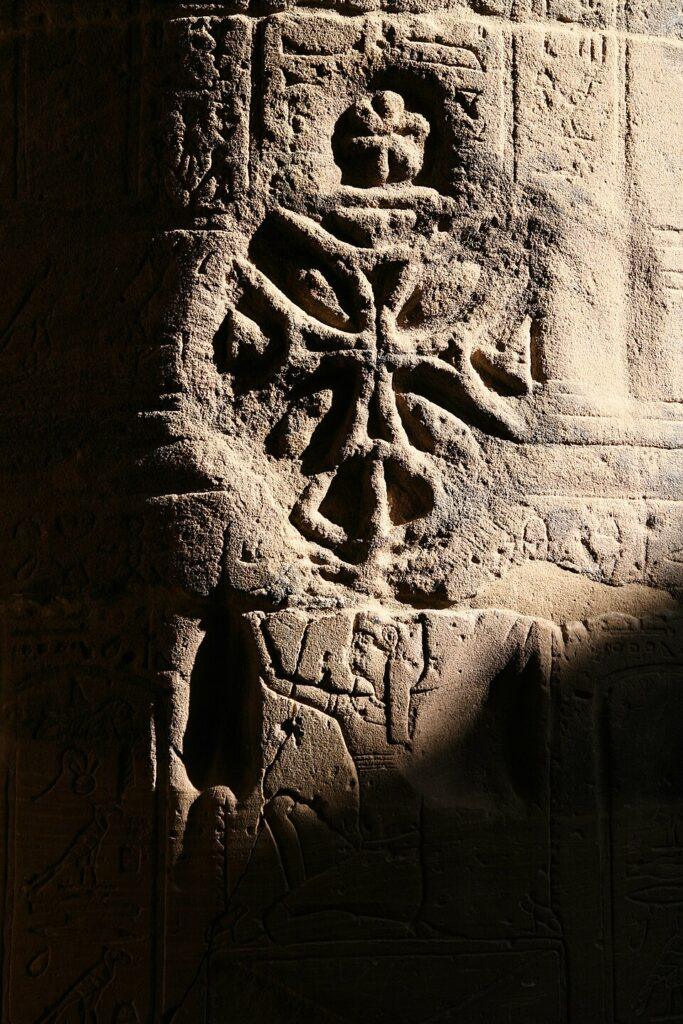
Christian crosses, inscriptions and evidence of later reuse survive at a number of ancient Egyptian monuments. The evidence is different at each site. At some places, Christian worship spaces developed within older complexes; elsewhere, crosses, inscriptions or other traces show a later Christian presence.
This happened because Christian communities lived among cities and monuments that were already centuries or millennia old.
Our guide to Christian crosses inside ancient Egyptian temples looks more closely at the evidence and the individual sites where it survives.
Once you know what you are looking for, these traces are easy to miss less often. They add another period of Egyptian history to monuments most visitors have come to see for their pharaonic past.
Which Christian Sites Fit Your Trip?
You do not need to cover every region to understand Christian Egypt.
| If you’re most interested in… | Prioritize |
|---|---|
| A first introduction to Christian Egypt | Coptic Cairo |
| The Holy Family tradition | Cairo sites, then the Delta or Minya–Asyut |
| Early Christian monasticism | Wadi El Natrun and St. Anthony & St. Paul |
| Early Church history | Alexandria and Abu Mena |
| Christian art and monastic architecture | The Red and White Monasteries at Sohag |
| Biblical tradition and pilgrimage | Mount Sinai and St. Catherine’s |
| Christian history preserved at ancient Egyptian sites | Upper Egyptian archaeological and temple sites |
Geography matters as much as interest.
Coptic Cairo and Mokattam fit naturally into time already being spent in Cairo. Wadi El Natrun takes you outside the city. Alexandria needs its own time. Minya, Asyut and Sohag pull the route south through the Nile Valley. The monasteries of St. Anthony and St. Paul take you toward the Red Sea, while St. Catherine’s is deep in South Sinai.
Once several of those regions are involved, you are planning a Christian heritage journey rather than adding a few churches to a conventional Egypt itinerary.
How Much Time Should You Allow?
If Christian heritage is only one interest within a first Egypt trip, half a day or a full day in Coptic Cairo can give you a useful introduction.
With another day available from Cairo, you could visit Wadi El Natrun or devote the day to the Holy Family sites scattered around Greater Cairo.
If you have more time, resist the temptation to add sites simply because they are Christian. Wadi El Natrun, Sohag and St. Catherine’s are all important, but they are in completely different parts of Egypt. Connecting them makes sense on a trip focused heavily on Christian history or monasticism; it makes much less sense as a series of detours from a conventional first-time itinerary.
The same is true of the Holy Family route. Once you continue beyond Cairo into the Delta or Middle Egypt, the pilgrimage starts determining the geography of the trip rather than fitting around it.
Alexandria, Middle Egypt, the Eastern Desert and Sinai can all be part of a longer Christian journey. Give them enough time to be destinations rather than stops between long drives.
Visiting Active Churches and Monasteries
Many of Egypt’s most important Christian sites are active religious communities.
Dress modestly, keep voices low around services and people praying, and follow local instructions about photography.
Access can vary within a site. A church may be open while a crypt or sanctuary is restricted. A monastery may receive visitors without opening every building. Services, religious observances, feast days and maintenance can all affect what is accessible.
This matters particularly if one specific feature is the reason you are traveling a long distance.
Check current access before making a special journey for a particular crypt, chapel, cave, collection or monastery interior.
Visitors should also remember that worship takes priority over sightseeing. A service taking place inside a historic church is part of the continuing life of the site.
Frequently Asked Questions About Christian Sites in Egypt
Do you need a guide to visit Christian sites in Egypt?
You can visit many of the major churches independently. A guide is more useful at places where very little is interpreted on site, when several periods of history overlap, or when you are visiting scattered sites in places such as Middle Egypt.
Can you visit Egyptian churches while a service is taking place?
You may encounter active services because many historic churches remain places of worship. Access to particular areas can be restricted during services, and sightseeing should not interrupt worship. Follow instructions at the church and avoid photographing people who are praying without permission.
Which Christian sites are easiest to include in a first-time Egypt itinerary?
Coptic Cairo is the easiest because it fits naturally into a Cairo stay. Alexandria’s Christian heritage can be included when visiting the city, while Christian traces at ancient sites in Upper Egypt can be noticed during a conventional Nile Valley itinerary. Wadi El Natrun, the wider Holy Family route, the Eastern Desert monasteries, Sohag and St. Catherine’s require more deliberate planning.
Are all Christian sites in Egypt Coptic Orthodox?
No. The Coptic Orthodox Church is central to Egyptian Christian history and many of the sites in this guide, but it is not the only Christian tradition represented in Egypt. St. Catherine’s Monastery, for example, belongs to the Eastern Orthodox tradition.
Is a Christian heritage trip the same as a pilgrimage?
No. Some travelers come for religious reasons, while others are interested in archaeology, art, architecture, biblical history or the development of monasticism. Many of the same sites are important both historically and religiously, and active places of worship should be treated accordingly regardless of why you are visiting.
Planning a Christian Heritage Journey Through Egypt
You can see an important part of Christian Egypt without making it the focus of your entire trip. Coptic Cairo alone gives a first-time visitor a strong introduction.
But if this history is one of the reasons you are coming to Egypt, it is worth going farther. Follow the Holy Family beyond Cairo, spend time in the desert monasteries, add Christian Upper Egypt, or make the journey into Sinai. Which route makes sense depends on the history that brought you to these places in the first place.
If Christian heritage, the Holy Family or biblical Egypt is one of the main reasons for your trip, contact Explore ENA about a custom Christian Egypt itinerary. We can build the route around the places you actually want to explore rather than trying to fit every Christian site in Egypt into one journey.