Holy Family Sites in Middle & Upper Egypt: Minya to Asyut
Cairo contains some of Egypt’s best-known sites associated with the Holy Family, but the traditional journey continues much farther south.
Once the route reaches Middle Egypt, the setting changes completely. The Nile Valley narrows between agricultural land and desert cliffs. Churches appear above the river, ancient cities preserve the remains of early Christian communities, and some of Egypt’s most important Coptic monasteries lie well outside the usual Cairo–Luxor tourist route.
According to Coptic tradition, the Holy Family’s journey through this part of Egypt passed through Minya and continued south into Asyut, with traditions associated with Deir al-Garnus, Bahnasa, Gabal al-Tair, Al-Ashmunein, the Mallawi area, Al-Muharraq and Dronka. Some locations have substantial churches, monasteries or archaeological remains, while others are important primarily within the traditional pilgrimage route.
The Coptic Orthodox Church’s Holy Family route traces this southern progression through Middle and Upper Egypt.
For travelers, the route becomes especially interesting because the sites do not all tell the same story.
At Gabal al-Tair, a historic church stands dramatically above the Nile. At Al-Ashmunein, Holy Family tradition overlaps with the archaeology of one of Egypt’s important early Christian cities. Near Mallawi, Kom Maria is emerging as a newly developed Holy Family Trail stop. Al-Muharraq remains one of Egypt’s most revered Coptic monasteries, while Dronka is a major living pilgrimage center overlooking Asyut.
This is not a route that benefits from being rushed as a collection of church stops.
It works much better when you understand how tradition, early Christian archaeology, living monastic communities and the landscape of the Nile Valley fit together.
Planning Note: You do not need to visit every traditional station to understand this part of the Holy Family route, but choose stops according to your interests rather than assuming the lesser-known names have little to see. Gabal al-Tair offers the cliffside church and Nile setting; Al-Ashmunein adds substantial early Christian archaeology; Al-Muharraq and Dronka are major living pilgrimage sites; while Bahnasa, Deir al-Garnus and the developing Kom Maria site can add depth for travelers following the route more closely.
Where Does the Minya–Asyut Route Begin?
After the Cairo-area traditions, the Holy Family route continues south toward Middle Egypt.
Deir al-Garnus, near Maghagha in northern Minya Governorate, is one of the first traditional stations in this stretch. Coptic tradition associates a well there with the Holy Family.
The route then continues through the Bahnasa area before reaching Samalut and Gabal al-Tair.
These northern Minya stops are considerably less familiar to international travelers than Coptic Cairo or St. Catherine’s Monastery, but that does not mean Christianity here is limited to names on a pilgrimage map.
For travelers trying to decide how deeply to follow the route, that distinction matters.
A complete pilgrimage and a Christian-heritage journey do not necessarily need exactly the same stops.
Gabal al-Tair: The Holy Family Church Above the Nile
One of the most visually memorable Holy Family sites in Egypt lies east of Samalut.
Gabal al-Tair, also written Gebel el-Tair or Jabal al-Tayr, rises above the eastern bank of the Nile. Its name is commonly translated as “Mountain of the Birds.”
The historic Church of the Virgin Mary stands high on the limestone escarpment.
The setting is a major part of the experience.
This is not a church surrounded by Cairo streets or enclosed inside a large archaeological complex. The site belongs to the cliffs and river landscape of Minya.
Standing above the Nile gives this stop a completely different character from the Christian sites farther north.
The church remains an active religious site rather than a monument preserved exclusively for tourism, and religious celebrations can significantly change the atmosphere and number of visitors.
ENA Tip: Don’t make the cave the only reason you visit Gabal al-Tair. Give yourself time to take in the church’s position above the Nile and the surrounding cliffs. The landscape is part of what makes the stop memorable and helps connect the Holy Family tradition with the geography of the Nile Valley.
Al-Ashmunein: Where Holy Family Tradition Meets Early Christian Archaeology
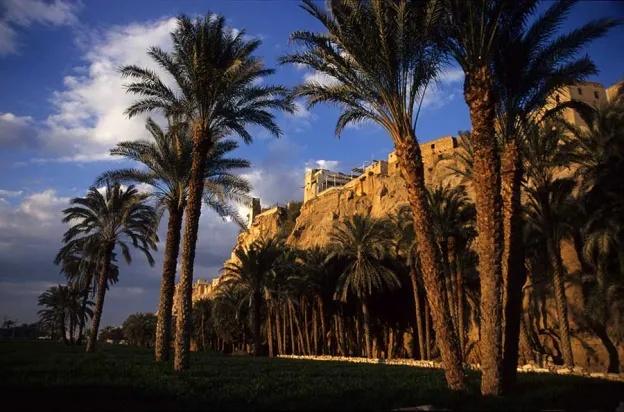
South of Gabal al-Tair lies Al-Ashmunein, the site of ancient Hermopolis Magna.
This is one of the most interesting stops on the route because its Christian importance extends well beyond the Holy Family tradition.
Hermopolis was a major city long before Christianity. In ancient Egyptian religion it was closely associated with Thoth, and it remained an important regional center through the Greek and Roman periods.
Christianity later became deeply established here.
Those histories should not be collapsed into a single story.
The Holy Family association gives Al-Ashmunein pilgrimage significance.
The archaeological evidence independently demonstrates that Hermopolis later became an important center of Egyptian Christianity.
Expert Insight: Al-Ashmunein is valuable even for travelers who are cautious about later Holy Family traditions. Its importance as an early Christian city does not depend on proving that the Holy Family stood at a particular spot. The basilica and other evidence show that Christianity had become an important part of Hermopolis centuries later in its own right.
That makes Al-Ashmunein different from a site whose importance rests principally on preserved religious tradition.
Here, there is also a substantial Christian archaeological story.
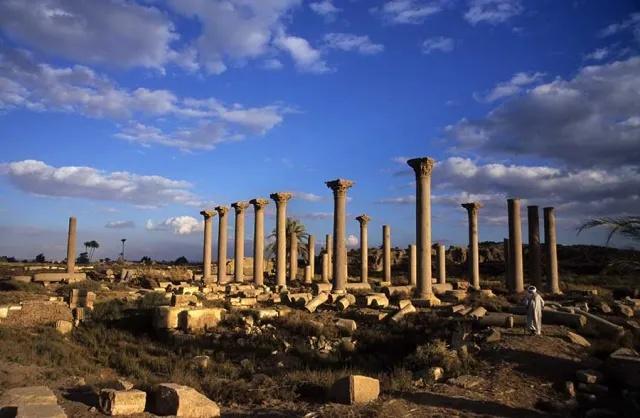
What Can You See at Al-Ashmunein?
The archaeological landscape at Al-Ashmunein preserves remains from several phases of the ancient city.
Among them are the remains of the fifth-century Christian basilica, constructed within an urban landscape that had already existed for centuries.
The site’s archaeology shows Christianity becoming another layer in the history of Hermopolis rather than appearing in a completely separate landscape.
That makes Al-Ashmunein a natural companion to Explore ENA’s guide to why Christian crosses and churches appear inside ancient Egyptian monuments.
Both illustrate a larger point that becomes increasingly clear when traveling through Egypt:
Christian Egypt did not develop somewhere separate from ancient Egypt.
Christian communities inherited cities, buildings and landscapes that were already centuries or millennia old.
At Al-Ashmunein, those layers sit unusually close together.
Kom Maria at Deir Abu Hinnis: A Newly Developing Holy Family Trail Site
The Mallawi area has another Holy Family site that has become much more relevant for travelers in 2026.
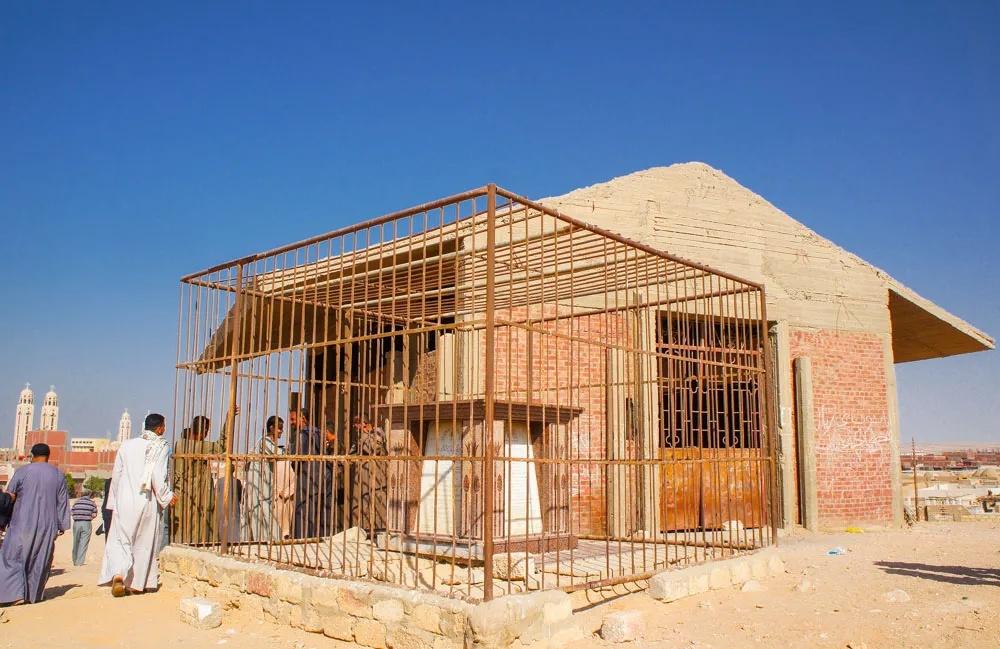
Kom Maria is an elevated site near the Church of St. Mary at Deir Abu Hinnis, in the Deir El-Barsha/Mallawi area.
Coptic tradition associates the location with the Holy Family’s journey through the region.
What makes Kom Maria particularly noteworthy now is that the site is actively being developed as part of the Holy Family Trail.
That means travelers planning this route now may encounter a site that is still changing.
Kom Maria is not yet the kind of long-established visitor stop where you should assume that every facility, approach or visitor arrangement has settled into a permanent pattern.
ENA Tip: Treat Kom Maria as an emerging pilgrimage and visitor site rather than assuming it operates like Gabal al-Tair or Al-Muharraq. The first phase of development only opened in September 2026, so check current access and what facilities are actually available before building the day around it.
The development itself is also worth noticing.
The Holy Family Trail is not simply a modern map connecting unchanged ancient attractions. Churches, local communities and government authorities continue to preserve, restore and develop locations associated with the tradition.
Other Stops Along the Minya–Asyut Route
The traditional journey includes several additional stations between the better-known destinations.
Deir al-Garnus near Maghagha is associated with a well in Holy Family tradition.
Bahnasa and the nearby Sandafa area are also included in the route, and the region has an active Christian and monastic presence today.
Farther south, the route includes Dayrout, Qusqam near Al-Qusiya, and Meir before reaching Al-Muharraq Monastery.
These locations can be important for travelers following the traditional journey in detail.
They do not necessarily need equal time in a broader Christian Egypt itinerary.
That is where itinerary design matters.
The useful question is not simply:
“Is this place on the traditional Holy Family route?”
It is:
“What does this stop add to the journey I am actually taking?”
A pilgrimage tracing the route as closely as possible may justify more of these locations.
A first Christian-heritage trip through Middle Egypt may benefit more from allowing substantial time at Gabal al-Tair, Al-Ashmunein, Al-Muharraq and Dronka rather than constantly getting back into the vehicle to collect another place name.
Al-Muharraq Monastery: One of the Most Important Holy Family Sites in Egypt
Near Al-Qusiya in Asyut Governorate stands Al-Muharraq Monastery, also known as the Monastery of the Virgin Mary.
Within Coptic tradition, this is one of the most important locations on the Holy Family route.
The monastery remains a living religious community rather than a reconstructed pilgrimage attraction.
Its oldest and most revered church is the Church of the Virgin, associated in monastery tradition with the Holy Family’s stay. The wider complex contains later churches, monastic buildings and other structures reflecting centuries of Christian life.
That continuity is one of the reasons Al-Muharraq deserves more than a quick stop.
This is not simply a location where a tradition has been commemorated with a modern marker.
Generations of Coptic Christians have worshipped within a monastic community that continues today.
Expert Insight: Al-Muharraq’s importance is broader than a single Holy Family tradition. A monastic community developed here in Late Antiquity, and the monastery has remained an important center of Coptic religious life for centuries. That continuity is what makes the visit especially valuable: you are seeing a living monastery whose identity has been shaped by the Holy Family tradition across generations.
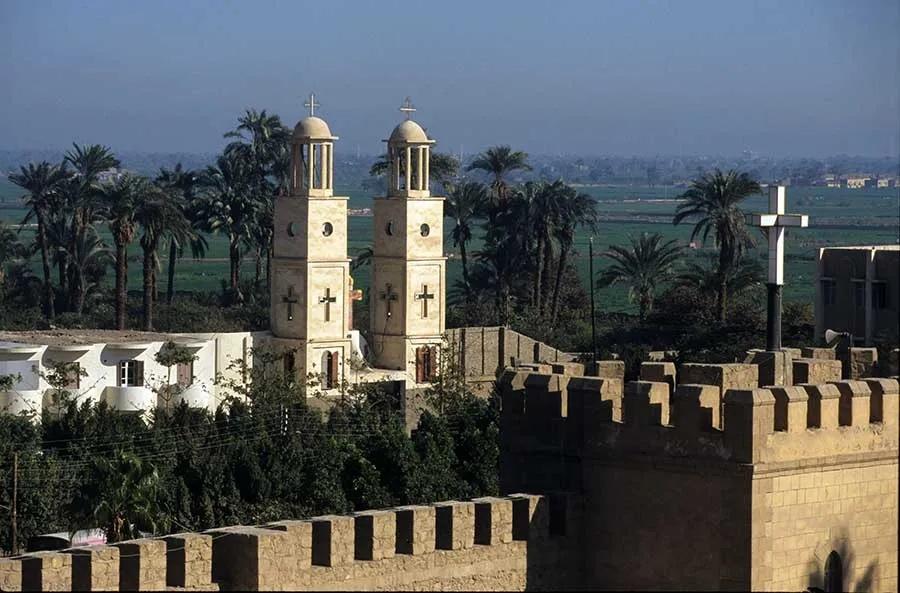
Why Al-Muharraq Deserves Time
Al-Muharraq can easily become the “major monastery stop” on an itinerary: arrive, see the historic church and move on.
That misses much of what makes it different.
The monastery is still inhabited and used.
Its importance lies partly in its historic structures but also in its continuing role within Coptic Christianity.
Compare that with Al-Ashmunein.
At Al-Ashmunein, archaeology helps reconstruct a major Christian city that largely disappeared.
At Al-Muharraq, Christian religious life continues within an active monastery.
Those two experiences belong on the same route precisely because they are not the same.
Dronka: A Major Living Pilgrimage Center Above Asyut
South of Al-Muharraq, the route reaches the mountains around Asyut.
The Monastery of the Virgin Mary at Dronka occupies a striking position against Mount Asyut, looking across the Nile Valley.
Dronka is particularly interesting because its importance is not confined to an ancient building or an archaeological ruin.
It is one of Egypt’s major living Christian pilgrimage centers.
That recent consecration is a useful reminder that Christian heritage in Egypt did not end in Late Antiquity.
Churches continue to be built and consecrated, pilgrimage traditions remain active, and major religious gatherings still shape these sites today.
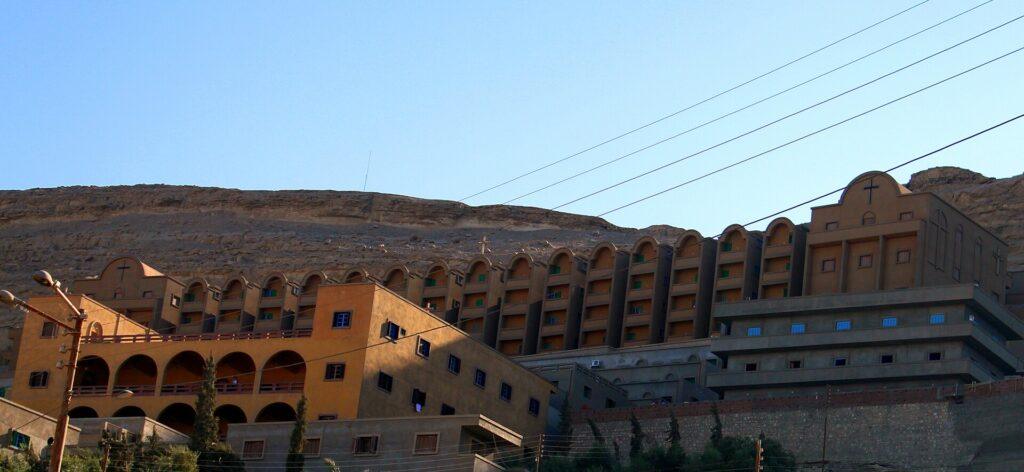
Dronka Is Not Just an Archaeological Stop
Travelers accustomed to Egypt’s pharaonic sites can easily fall into the habit of approaching every historic location the same way:
arrive, enter, look around, photograph, leave.
Dronka does not fit that pattern.
It is an active pilgrimage landscape.
Depending on when you visit, you may encounter worshippers, clergy, families, services or major gatherings.
ENA Tip: If Dronka is important to your itinerary, check whether your visit overlaps with a major church celebration. A pilgrimage period can make the site especially meaningful, but it also changes traffic, crowds, access and the time you need. Decide whether you want to experience that atmosphere or visit on a quieter day rather than discovering the difference after you arrive.
Is the Minya–Asyut Holy Family Route Worth Adding to a First Egypt Trip?
For most first-time visitors, not automatically.
A first Egypt itinerary already has enormous competition for time: Cairo, Giza, Luxor, Aswan and often a Nile cruise.
Minya and Asyut require a deliberate departure from the standard international tourist route.
But for the right traveler, that is precisely the attraction.
This route makes sense if Christian history or pilgrimage is a major reason for your trip, if you are returning to Egypt and want to go deeper, or if you deliberately want to understand parts of the Nile Valley that receive far fewer international visitors.
It also makes sense within a larger Christian Egypt journey.
Someone combining Coptic Cairo with the early Christian history of Alexandria may use Minya and Asyut to continue that story south.
A traveler also including Mount Sinai and St. Catherine’s Monastery encounters a completely different part of Christian Egypt: biblical landscape and early monasticism in Sinai rather than the Nile Valley’s Holy Family traditions.
Minya and Asyut add another layer again.
They bring together pilgrimage tradition, rural Christian communities, ancient Christian archaeology and living monasteries.
That makes them worthwhile when they are part of the reason for the trip, rather than something squeezed into the itinerary simply because they lie somewhere between Cairo and Luxor.
How Many Days Should You Allow?
For the principal Christian sites between Minya and Asyut, allow at least two days and preferably three if this heritage is a major interest.
Trying to leave Cairo, visit several Minya sites, continue through Asyut and treat the entire region as an extended transfer defeats much of the reason for coming.
A better route gives the Minya portion time for Gabal al-Tair and Al-Ashmunein, with Kom Maria or another traditional station added according to interest, before continuing south toward Al-Muharraq and Dronka.
That also leaves room for the realities of regional travel: road time, active church schedules, religious observances and sites that do not operate like mass-tourism attractions.
Planning Note: Think of Minya and Asyut as a short regional journey, not a collection of roadside stops between Cairo and Luxor. Two or three days changes the experience because monasteries, churches and archaeological sites no longer have to conform to a transfer-day timetable.
Can You Visit These Sites Independently?
Some individual sites can theoretically be reached independently.
For most international travelers, however, this is one part of Egypt where private transport and advance route planning make a substantial difference.
The sites are spread across different towns, rural communities and both sides of the Nile Valley. Visitor infrastructure and signage are not as consistent as they are at Egypt’s major international attractions, and identifying a site on a map is not the same thing as combining several of them efficiently in one day.
A knowledgeable guide can also add considerable value because this route crosses several different subjects:
Holy Family tradition, Coptic Christianity, early Christian archaeology, ancient Egyptian cities and active monasteries.
Without context, those layers can easily blur together.
The purpose of an organized route should not simply be to transport you from church to church.
It should help you understand what kind of site you are standing in and why that particular place matters.
Visiting Active Churches and Monasteries
Gabal al-Tair, Al-Muharraq and Dronka remain religious sites.
That should shape the way you visit.
Dress modestly, keep voices low around worshippers and follow local instructions regarding photography. Services, religious celebrations and monastery requirements can affect what visitors are able to enter.
Do not assume that a church exists primarily for sightseeing simply because it appears on a tourism route.
The same principle applies in Coptic Cairo, where historic churches also remain functioning places of worship.
The difference in Minya and Asyut is scale and setting.
Here, many of the sites are embedded within rural communities or large monastery and pilgrimage landscapes rather than concentrated into a compact urban district.
What Makes This Route Different From Coptic Cairo?
Coptic Cairo gives travelers a concentrated introduction to Egypt’s Christian history.
Within a relatively small district, you can move among historic churches, Roman remains and other sites connected with Christian Cairo.
Minya and Asyut are almost the opposite.
The journey between the sites is part of the experience.
You move through the Nile Valley between villages, agricultural land, cliffs, ancient cities and monasteries. The important locations may be separated by considerable distances, and their significance ranges from traditional Holy Family associations to independently documented early Christian archaeology.
That makes the route slower.
It also makes it much harder to reduce to a sightseeing checklist.
Where This Fits in the Larger Christian Egypt Story
The Minya–Asyut route is one branch of a much larger Christian landscape.
Coptic Cairo provides the most accessible concentration of historic Christian sites for many travelers.
Christian Alexandria tells a different story: the early Church of Alexandria, St. Mark tradition, Christian scholarship and the pilgrimage center of Abu Mena.
Mount Sinai and St. Catherine’s Monastery move the story into Sinai, where biblical tradition, mountain landscape and one of Christianity’s oldest continuously functioning monasteries come together.
Middle and Upper Egypt add something else.
Here, Holy Family tradition follows the Nile through villages, ancient cities, cliffside churches and living monasteries.
And this route makes one distinction especially clear:
Holy Family sites and early Christian archaeological sites are not always the same thing.
Al-Ashmunein matters both because of its Holy Family tradition and because archaeology independently documents a major early Christian community there.
Al-Muharraq and Dronka derive much of their significance from living Coptic tradition and continuing religious life.
Kom Maria shows that the modern pilgrimage route itself is still being developed.
Understanding those differences makes the journey much richer than simply following a line on a map.
Frequently Asked Questions
What are the main Holy Family sites between Minya and Asyut?
The traditional route includes Deir al-Garnus, Bahnasa, Gabal al-Tair, Al-Ashmunein, sites around Mallawi including the newly developed Kom Maria stop, Dayrout, Qusqam, Meir, Al-Muharraq Monastery and Dronka. Travelers do not necessarily need to visit every station; Gabal al-Tair, Al-Ashmunein, Al-Muharraq and Dronka provide particularly substantial visitor experiences, while the other stops can deepen a dedicated pilgrimage route.
Is Gabal al-Tair worth visiting?
Yes, particularly for travelers interested in Christian Egypt. Its significance combines the Holy Family tradition, an active historic church and a dramatic position above the Nile Valley rather than a conventional archaeological attraction.
Is Al-Muharraq Monastery associated with the Holy Family?
Yes. Al-Muharraq is one of the most important Holy Family locations in Coptic tradition and is associated with an extended stay by the family. It remains an active monastery and major Christian religious site.
Is Dronka the final Holy Family site in Egypt?
In the Coptic Orthodox route, Dronka is the principal southernmost station before the traditional return journey north. Its cave and monastery remain major pilgrimage sites today.
Can Minya and Asyut be visited between Cairo and Luxor?
Yes, but they work much better as a short regional journey than as quick stops during a long transfer. Travelers specifically interested in Christian history should allow at least two days, with three giving more room for the principal sites and regional travel.
Follow the Holy Family Route Beyond the Usual Egypt Itinerary
For travelers whose interest in Christian Egypt goes beyond adding one church to a standard sightseeing trip, Minya and Asyut deserve to be planned deliberately.
Gabal al-Tair, Al-Ashmunein, Kom Maria, Al-Muharraq and Dronka can be woven into a private journey that also connects naturally with Coptic Cairo, Alexandria, Luxor or the wider Nile Valley. The important part is building the route around the sites rather than trying to force them into an itinerary designed for something else.
Explore ENA creates private, customizable Egypt itineraries, including routes shaped around special interests. If Christian heritage and the Holy Family tradition are priorities for your trip, start with Explore ENA’s custom Egypt tours and itinerary planning and build the journey around the places you actually want time to understand.