Holy Family Sites in Cairo: Churches and Places to Visit
Cairo has several places associated with the Holy Family’s journey through Egypt, but they are not concentrated in Coptic Cairo.
The traditional route reaches across Greater Cairo, from Musturud and Matariya to Haret Zuweila, Old Cairo and Maadi. Some of these places are churches. Others preserve a tradition associated with a well, a tree, a crypt or the Nile. Seeing several of them in the same day means crossing a large part of Cairo, so this is a route that needs to be planned rather than added casually to an already full sightseeing day.
There is also an important distinction between the biblical account and the route followed by pilgrims today. Matthew 2 records Joseph taking Mary and Jesus to Egypt to escape Herod and later returning after Herod’s death. It does not name the places they visited in Egypt.
The detailed journey comes from Coptic Christian tradition. The Coptic Orthodox Church’s account of the Holy Family’s journey through Egypt traces that tradition across the country, including several places in the Cairo area. The churches standing at these locations were built later; their importance to the Holy Family story comes from the places and traditions they preserve.
Where Are the Holy Family Sites in Cairo?
For a first Holy Family-focused visit around Cairo, the main places to consider are Musturud, Mary’s Tree in Matariya, the Church of the Virgin Mary at Haret Zuweila, Abu Serga in Coptic Cairo and the Church of the Virgin Mary at Maadi.
The traditional route is not the most practical order for sightseeing today, so a Cairo visit is better planned around geography and traffic.
Musturud: The Church of the Virgin Mary and the Sacred Well
Musturud, also written Mostorod, lies on the northeastern side of Greater Cairo.
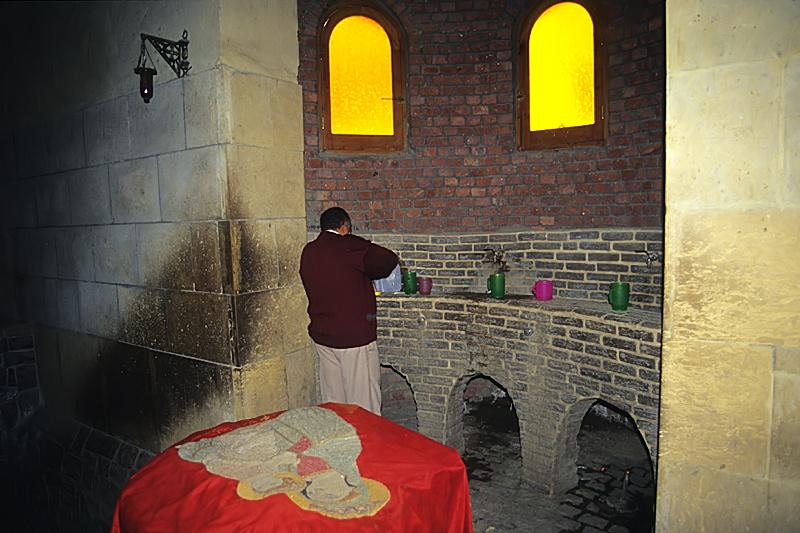
In Coptic tradition it was known as Al-Mahmah, a name associated with bathing. The tradition holds that Mary bathed the infant Jesus here and washed his clothes. A spring associated with the event remains at the site, where the Church of the Virgin Mary later developed.
Musturud appears relatively early in the traditional journey, before several of the Delta stations. The tradition also brings the family through Musturud again on their return from Upper Egypt.
If you are following the route as a pilgrimage, the well is an important part of the visit rather than simply a feature beside the church. Musturud is one of the places where the Holy Family tradition is tied as much to water and the remembered location as it is to the church built there later.
Mary’s Tree in Matariya
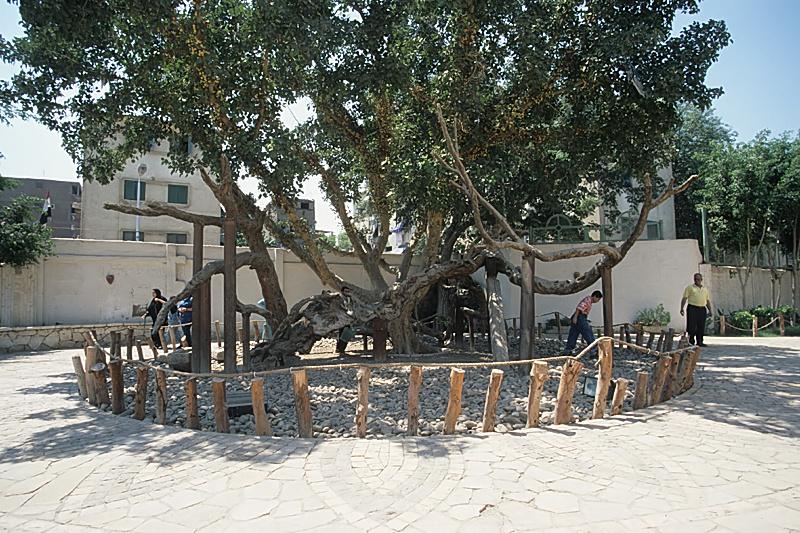
In Matariya, the Holy Family tradition centers on Mary’s Tree.
According to Coptic tradition, the family rested beneath a tree here after reaching the area of ancient Heliopolis. A spring at the site is also associated with their stay.
The tree seen today is not the same tree that stood here centuries ago. The earlier tree weakened and fell in 1656, and branches from it were subsequently replanted. The religious importance of Mary’s Tree therefore belongs to the location and the tradition preserved there, not to a claim that one individual tree has survived since the first century.
There is another reason Matariya is interesting. It occupies part of ancient Heliopolis, one of ancient Egypt’s major religious centers. The surviving Obelisk of Senwosret I elsewhere in the district is a reminder that this part of Cairo had a sacred history thousands of years before Christianity.
Mary’s Tree is a fairly focused visit. Do not arrive expecting the scale of Coptic Cairo or a large monastery complex. The reason to come is the place itself and its role in the Holy Family tradition.
Haret Zuweila: A Holy Family Stop in Historic Cairo
The Church of the Virgin Mary at Haret Zuweila is less familiar to international visitors than Abu Serga or Mary’s Tree, but it belongs to the traditional Holy Family route through Cairo.
The church has a broader importance in Coptic history, but on a Holy Family-focused day it works as a stop between Matariya and Old Cairo.
Whether you include it depends on how closely you want to follow the route. If time is limited, Coptic Cairo offers much more to see within a compact area. If you are deliberately visiting the traditional Holy Family stations around Cairo, Haret Zuweila is worth including.
Abu Serga: The Best-Known Holy Family Site in Coptic Cairo
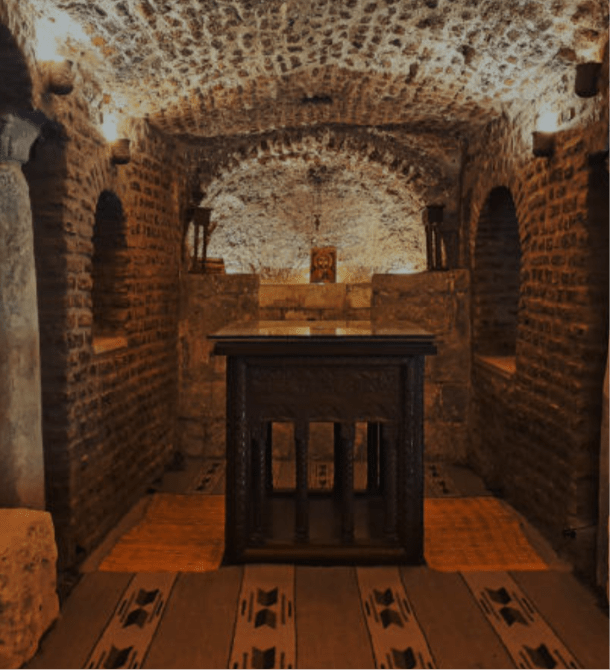
The Church of Saints Sergius and Bacchus—usually called Abu Serga—is one of Cairo’s best-known places associated with the Holy Family.
The church stands in Coptic Cairo, close to the Roman Fortress of Babylon and several of the city’s most important historic Christian sites.
Beneath it is a crypt traditionally associated with the Holy Family’s stay in the area. The church itself was built centuries later, but the association with the crypt has made Abu Serga an important Christian pilgrimage site.
Abu Serga is also the easiest Holy Family site to combine with a conventional Cairo itinerary because there is much more to see nearby. If you have already planned to visit Coptic Cairo, you do not need a separate cross-city journey just to reach it.
If you want to explore the district beyond the Holy Family connection, our guide to Coptic Cairo covers the Hanging Church, Coptic Museum, Roman remains and the wider Christian history of the area.
Explore ENA’s Coptic Cairo Walking Tour also includes Abu Serga along with the other principal heritage sites in Coptic Cairo.
The Church of the Virgin Mary at Maadi
At Maadi, the Cairo section of the story begins to connect naturally with the journey south.
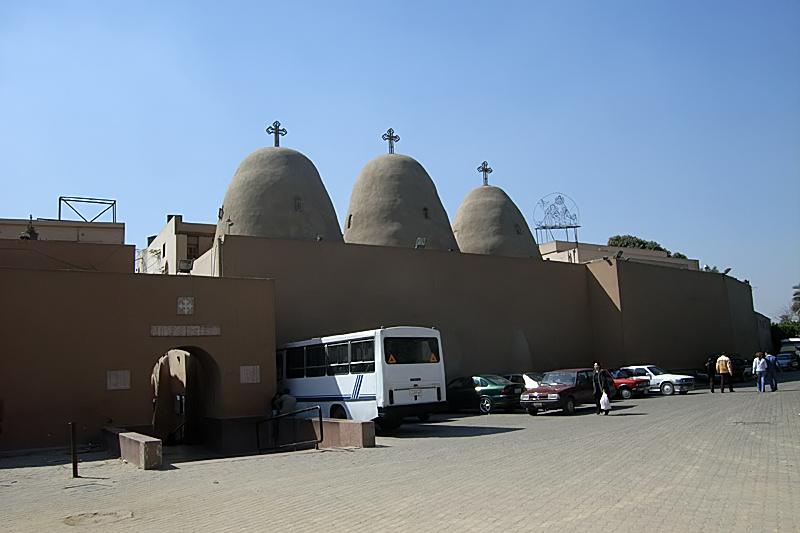
The Church of the Virgin Mary stands beside the Nile at the place associated with the family’s departure from the Cairo area. According to the tradition, they descended to the river here and continued south by boat.
Stone steps leading down toward the Nile are preserved within the church complex and are traditionally associated with that departure.
Standing beside the river also makes the next part of the route much easier to picture. From the Cairo area, the traditional journey continues south through Middle Egypt and eventually toward Asyut.
Our Holy Family Sites in Middle & Upper Egypt: Minya to Asyut guide covers the individual southern sites and the much greater distances involved in following that section of the route.
Is the Hanging Church a Holy Family Site?
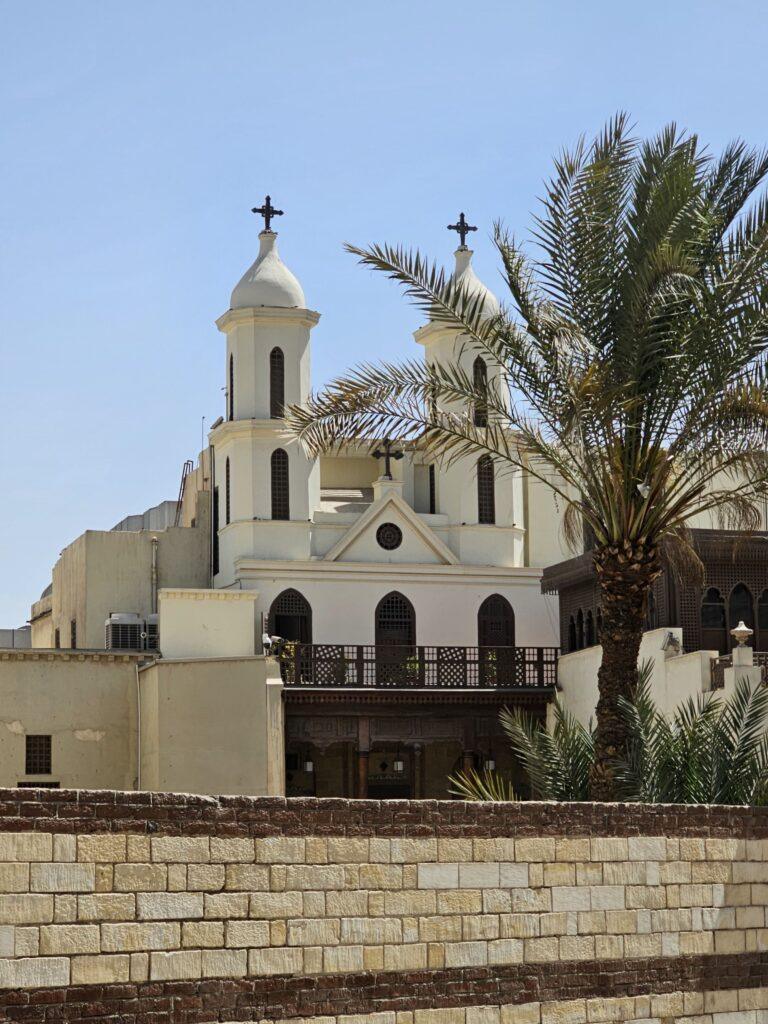
The Hanging Church is one of Egypt’s most important historic Coptic churches, but it is not a Holy Family site simply because it stands close to Abu Serga.
The same applies to St. George, St. Barbara and other churches in the district. They belong to the wider history of Christian Cairo and are worth seeing, but they should not all be presented as stops on the Holy Family route.
For the Holy Family story, Abu Serga is the important stop in Coptic Cairo because of its crypt.
That does not mean you should walk past everything else. If Christian history interests you, Coptic Cairo deserves several hours rather than a quick visit to one church.
What About Zeitoun?
Zeitoun also appears in discussions of Christian pilgrimage in Cairo, but the Church of the Virgin Mary there is particularly known for the reported Marian apparitions that began in 1968. That gives it a separate religious importance from the principal Holy Family sites covered here.
Pilgrims with a particular Marian interest may want to include Zeitoun. For a first visit focused specifically on the Holy Family tradition, Musturud, Matariya, Haret Zuweila, Abu Serga and Maadi make a clearer route.
Can You Visit the Cairo Holy Family Sites in One Day?
Yes, but this is not a practical walking route.
Musturud and Matariya are on the northeastern side of Greater Cairo. Haret Zuweila brings you into historic Cairo. Abu Serga is farther south in Coptic Cairo, and Maadi lies farther south again beside the Nile. Cairo traffic can consume a surprising amount of the day between them.
If you want to see several sites in one day, use a car and driver. Calling a new ride after every church is possible, but it wastes time on a day that already involves crossing large parts of Cairo.
A practical route can begin with Musturud and Matariya, continue through Haret Zuweila and Coptic Cairo, and finish at Maadi. This order works for today’s geography even though it does not reproduce the traditional journey chronologically.
The bigger question is how much of Coptic Cairo you want to see.
If the Holy Family is your priority, concentrate on Abu Serga and its crypt before continuing to Maadi. If you also want the Hanging Church, Coptic Museum, Babylon Fortress and the other historic churches, give Coptic Cairo more time.
Trying to explore the whole district properly while also crossing Cairo to visit every Holy Family site makes for a rushed day.
Should You Visit Coptic Cairo Separately?
If Christian history is an important part of your trip, I would.
There is enough in Coptic Cairo to justify several hours without treating it as one stop on a larger driving route. The Coptic Museum alone adds a much broader view of Christianity and Christian art in Egypt than you will get from concentrating only on places associated with the Holy Family.
Separating the visits also solves a practical problem. You can explore Coptic Cairo on foot without watching the clock for the drive to the next side of the city, then use another day for the more widely scattered Holy Family locations.
If your time in Cairo is limited and the Holy Family is the priority, keep Abu Serga within the larger route instead.
How Do Cairo’s Sites Fit Into the Full Holy Family Trail?
Cairo is only one section of the traditional journey through Egypt.
Before the Cairo portion, the route passes through northeastern Egypt, the Nile Delta and Wadi El Natrun. After Maadi, it continues south through Middle Egypt toward Asyut.
Our Holy Family Trail in Egypt guide gives the national overview and is the better place to start if you are deciding how much of the route you want to follow.
For the northern stations, see Holy Family Sites in the Nile Delta. Wadi El Natrun later became one of Egypt’s great centers of Christian monasticism, which we cover separately in our Wadi El Natrun Monasteries guide.
You do not need to follow the entire national trail for the Cairo sites to make sense. They can be the focus of a Christian day in Cairo or one part of a much longer pilgrimage through Egypt.
Visiting Active Churches and Sacred Places
Several places on this route are active churches and pilgrimage sites, not monuments maintained primarily for tourists.
Dress modestly, keep voices low around worshippers and services, and follow local instructions about photography. Access to crypts, sanctuaries and other areas can change during services, religious observances or maintenance.
If seeing one particular feature is important to you—especially the crypt at Abu Serga—check current access before crossing Cairo specifically for it.
Feast days and pilgrimage periods can also make a normally quiet church considerably busier. That may be part of the experience you are looking for, particularly if you are visiting as a pilgrim, but it is worth knowing before you plan the day.
Frequently Asked Questions About Holy Family Sites in Cairo
Which Holy Family site is easiest to add to a normal Cairo itinerary?
Abu Serga in Coptic Cairo is the easiest for most first-time visitors. Coptic Cairo is already a major historic area, and several important sites are within walking distance once you arrive. Musturud, Matariya, Haret Zuweila and Maadi require more deliberate routing across the city.
What should you wear when visiting Holy Family churches in Cairo?
Wear modest clothing suitable for an active church. Shoulders and knees should be covered, and avoid clothing that is particularly revealing. You may arrive during a service or while people are praying, even if you are visiting primarily for the history.
Can non-Christians visit the Holy Family sites in Cairo?
These sites receive Christian pilgrims as well as visitors interested in Egyptian history and religious heritage. You do not need to be Christian to appreciate them, but you should follow any instructions given at the individual church and respect areas being used for worship.
Can you take photographs inside the Holy Family churches?
Rules can vary between churches and even between different areas of the same church. Ask before photographing interiors, crypts or religious objects, and avoid taking photographs of people worshipping unless you have their permission.
Do you need a guide to visit the Holy Family sites in Cairo?
You can visit the churches independently. A guide becomes more useful if you want to understand why each place belongs to the Holy Family tradition and how that tradition relates to the much later churches you are seeing today.
Planning a Holy Family Route in Cairo
The main mistake is trying to squeeze these sites around an already full Cairo sightseeing schedule. They are too spread out for that.
If the Holy Family is a major reason for your visit, give the route its own day and decide how deeply you want to explore Coptic Cairo. If you are mainly interested in Christian history, spend more time in Coptic Cairo and choose the additional Holy Family sites that matter most to you.
Travelers continuing beyond Cairo can follow the tradition north into the Delta and Wadi El Natrun or south through Minya toward Asyut.
If you want to make the Holy Family tradition a meaningful part of your Egypt itinerary, contact Explore ENA about a custom Christian Egypt itinerary. We can build the route around the places you actually want to visit rather than trying to fit every traditional station into the same trip.