Christian Sites in Alexandria: Churches & Early Christian Heritage
Alexandria played an enormous role in the development of early Christianity, but travelers looking for that history today encounter a city very different from Coptic Cairo.
There is no compact Christian quarter where a collection of ancient churches survives within a few walkable streets. Much of ancient Alexandria has disappeared beneath the modern city, been destroyed by earthquakes and rebuilding, or lies underwater along the Mediterranean coast. The churches associated with Christianity’s earliest centuries have largely vanished as physical buildings.
What survives is a combination of living churches, archaeological evidence, places connected with early Christian history, and one extraordinary early Christian pilgrimage city outside modern Alexandria.
Expert Insight: Alexandria’s Christian importance is much greater than the number of early Christian monuments still standing today. Much of the ancient city has disappeared beneath later Alexandria, been destroyed or rebuilt, or lies underwater. Here, understanding what happened in the city is often just as important as seeing what physically survives.
According to early Christian tradition, St. Mark brought Christianity to Alexandria in the first century CE. The city subsequently became one of the major intellectual and ecclesiastical centers of early Christianity, associated with figures including Clement of Alexandria, Origen and Athanasius. The patriarchal see of Alexandria became one of the ancient Christian world’s most influential centers.
For travelers, understanding that history changes the way Alexandria looks. Roman ruins are no longer simply Roman. Byzantine remains belong to a city in which Christianity had become deeply established. And modern churches continue a Christian tradition associated with Alexandria for nearly two thousand years.
Why Alexandria Matters to Christian History
Alexandria was already one of the Mediterranean world’s great cities when Christianity appeared.
Founded by Alexander the Great in 331 BCE, it became the capital of Ptolemaic Egypt and later one of the Roman Empire’s most important cities. Its population was culturally and religiously diverse, and Alexandria developed a formidable intellectual tradition around its libraries, schools and philosophical communities.
Christianity emerged within that environment.
The New Testament does not record St. Mark preaching in Alexandria. His connection with the city comes from early Christian tradition, which holds that Mark brought Christianity to Alexandria in the first century and became the first bishop associated with the Alexandrian church.
That distinction matters, but so does what happened afterward.
By the second and third centuries, Alexandria had unquestionably become an important center of Christian thought. Clement of Alexandria taught there, and Origen emerged as one of the most influential Christian scholars of the early church.
The city’s Christian intellectual tradition developed in conversation—and sometimes conflict—with the Greek philosophical world around it. Questions about Scripture, theology and Christian teaching were being explored in a city already famous for scholarship.
Alexandria’s importance was therefore not based simply on having a large Christian population.
It became one of the places where early Christianity was being intellectually shaped.
St. Mark and the Church of Alexandria
For the Coptic Orthodox Church, Alexandria is inseparable from St. Mark.
Coptic tradition places his arrival in Alexandria in the first century CE and associates him with the establishment of the church there. The Coptic Orthodox patriarch consequently bears the title Pope of Alexandria and Patriarch of the See of St. Mark, even though the patriarchal headquarters eventually moved from Alexandria to Cairo.
The traditional story also identifies Anianus as Mark’s first successor in Alexandria.
St. Mark’s association with the city is therefore not a minor local tradition. It became central to the identity and apostolic lineage of the Coptic Orthodox Church.
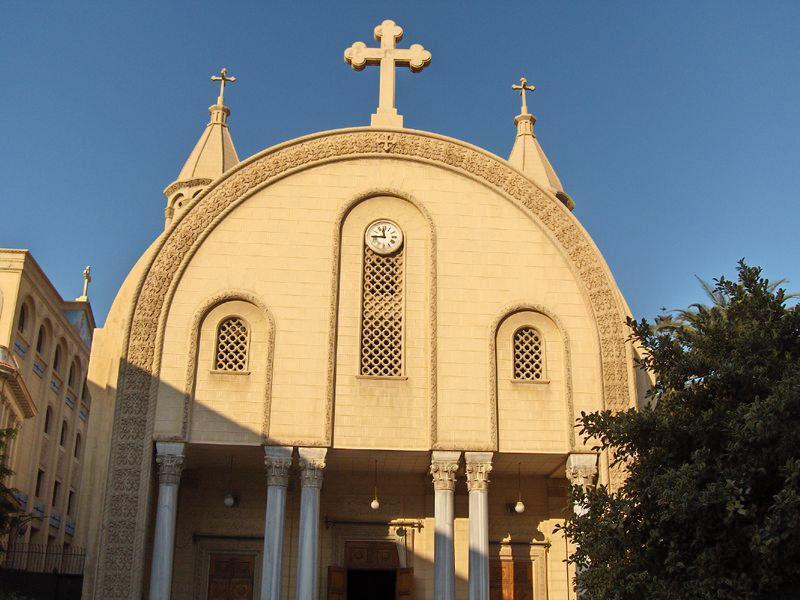
For travelers, the most important place to encounter that tradition today is St. Mark’s Coptic Orthodox Cathedral in central Alexandria.
St. Mark’s Coptic Orthodox Cathedral
St. Mark’s Cathedral stands in the Mansheya/Raml Station area, surrounded by the traffic and commercial life of modern Alexandria.
Its setting can be surprising.
This is not an isolated archaeological monument. It is a living church in the middle of the city, associated by Coptic tradition with the historic site of the Alexandrian church of St. Mark.
Church tradition holds that St. Mark was martyred in Alexandria in the first century and that his body was buried in the city. Centuries later, most of his relics were taken to Venice, where St. Mark became the patron saint and the Basilica of San Marco was eventually dedicated to him.
The connection between Alexandria and St. Mark, however, remained fundamental to the Coptic Church.
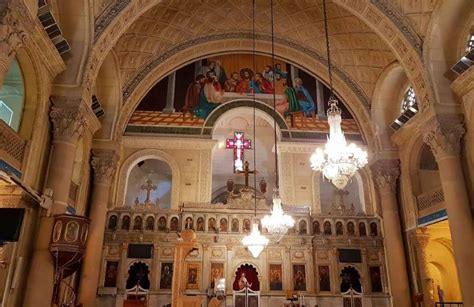
Today’s cathedral has undergone repeated destruction, rebuilding and expansion, so visitors should not approach it expecting an intact first-century church. Its importance lies instead in the continuity of the site and its association with the See of St. Mark.
That makes it one of the most meaningful Christian stops in Alexandria even though the building travelers see today is much later than Christianity’s beginnings in the city.
ENA Tip: St. Mark’s Cathedral is an active church, not an archaeological attraction operating around sightseeing hours. Services, religious events and church activity take priority, and access to particular areas can vary. Visit respectfully, and don’t build a tightly timed Alexandria itinerary around the assumption that every part of the cathedral will be accessible when you arrive.
Alexandria’s Catechetical School and Its Christian Thinkers
One of the most influential parts of Alexandria’s Christian history is also one of the hardest for travelers to see.
The city’s famous Christian teaching tradition does not survive as a single ancient school building that you can enter.
Yet Alexandria became associated with a catechetical school that played an important role in the development of Christian scholarship. Clement of Alexandria was one of its best-known teachers, followed by Origen in the early third century.
Their importance extended well beyond Egypt.
Clement worked within the highly educated Greek-speaking environment of Alexandria and attempted to explain Christian teaching in ways that engaged with Greek philosophy and intellectual culture. Origen became a prolific biblical scholar and theologian whose work influenced Christian thought far beyond Alexandria.
This is one of the reasons Alexandria deserves a place in a broader exploration of Christian Egypt, even though many of the buildings connected with its earliest Christian centuries no longer survive.
In Cairo, travelers can walk between historic churches in Coptic Cairo. Alexandria requires a different kind of visit.
Here, much of the significance comes from understanding what happened in the city, not simply from counting the ancient Christian buildings still standing.
Kom el-Dikka and the Alexandria of Late Antiquity
Kom el-Dikka is not primarily a Christian attraction, and it should not be presented as one.
It is, however, one of the best places in modern Alexandria to understand the city in Late Antiquity, the period during which Christianity became increasingly important and eventually dominant within the Roman Empire.
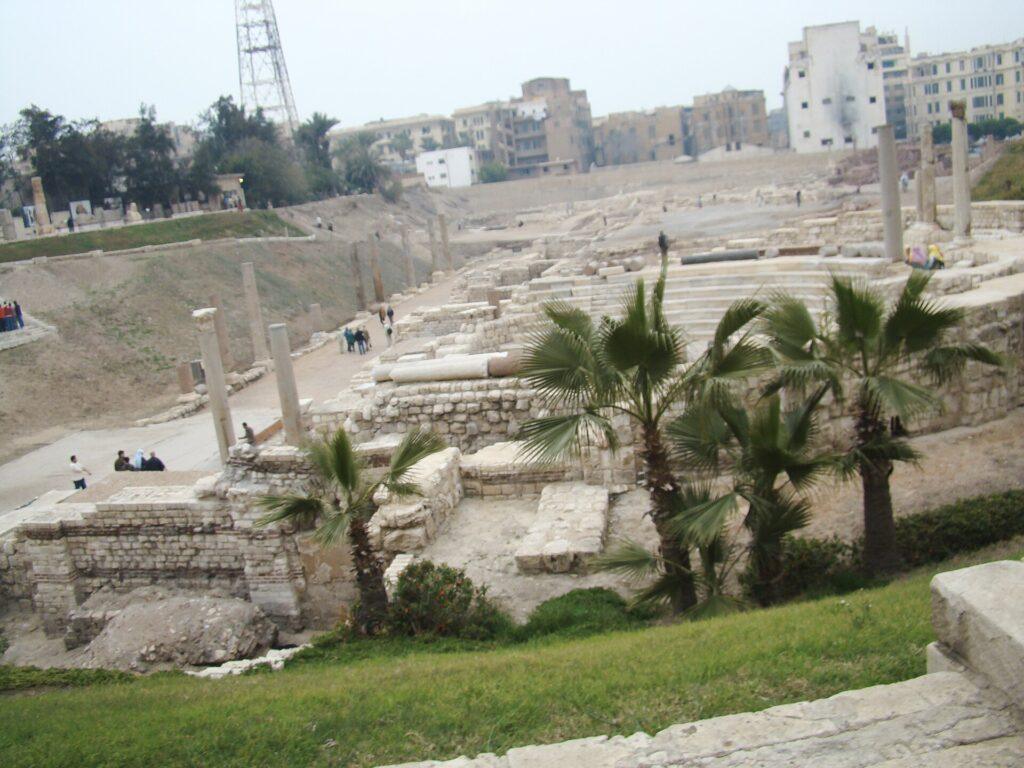
The archaeological site preserves remains dating through the Roman and Byzantine periods, including a theater building, bath complex, elite houses, workshops and a remarkable group of lecture halls or auditoria.
Those classrooms are particularly interesting in Alexandria.
This was a city famous for education and intellectual life, and the later remains at Kom el-Dikka provide a physical setting for understanding the scholarly environment of Late Antique Alexandria.
ENA Tip: Don’t visit Kom el-Dikka expecting to be shown “the Catechetical School of Alexandria.” Its Late Antique lecture halls provide valuable evidence of Alexandria’s educational and intellectual life, but archaeology does not establish these particular classrooms as the famous early Christian Catechetical School.
What Kom el-Dikka does give travelers is something equally useful: a surviving piece of the city in which Alexandria’s later Roman and Byzantine population actually lived, studied, worked and gathered.
For someone following Alexandria’s Christian history, that context matters.
Christianity did not develop in an empty landscape. It developed within one of the Mediterranean’s most intellectually active cities.
What Happened to Alexandria’s Earliest Churches?
This is the question that often makes Alexandria confusing for travelers interested in Christian history.
If the city was so important to early Christianity, where are all the ancient churches?
Much of ancient Alexandria simply has not survived above ground.
The city endured earthquakes, changes to its coastline, periods of destruction, reuse of building materials and continuous rebuilding. Modern Alexandria also sits directly over much of its ancient predecessor.
That means the archaeological experience here is very different from places such as Luxor, where enormous ancient complexes remained visible above the surrounding landscape.
Alexandria’s early Christian importance survives more clearly in historical sources, church tradition, archaeological fragments and the wider Christian landscape surrounding the city than in a large collection of standing fourth- or fifth-century churches downtown.
That absence should not be filled with invented identifications.
A modern church may preserve an important tradition or occupy a historically significant location without the present building itself dating to Christianity’s earliest centuries.
Understanding the difference makes the surviving sites more meaningful, not less.
The Serapeum and the Religious Transformation of Alexandria
One place where Alexandria’s changing religious world becomes particularly visible is the ancient Serapeum.
The Serapeum was a major sanctuary dedicated to Serapis, a deity whose cult became especially important during the Ptolemaic and Roman periods. The enormous column commonly called Pompey’s Pillar still dominates the site.
By the late fourth century CE, the religious landscape of Alexandria had changed dramatically.
The Serapeum was destroyed in 391 CE during conflict surrounding the suppression of traditional pagan worship under the Christian Roman Empire. The episode has become one of the most frequently retold—and frequently oversimplified—stories about the end of ancient religion in Alexandria.
For travelers interested in Christian history, the value of the site is not that it is a Christian monument.
It isn’t.
Its importance is that it helps explain the religious transformation of the city in which Christianity moved from a persecuted faith to an increasingly powerful institution within the Roman world.
That transition was neither instant nor simple, and Alexandria was one of the cities in which those tensions became particularly visible.
Abu Mena: Alexandria’s Extraordinary Early Christian Pilgrimage City
The most substantial early Christian archaeological experience in the Alexandria region is not in the modern city center at all.
It is Abu Mena, southwest of Alexandria in the Mariut Desert.
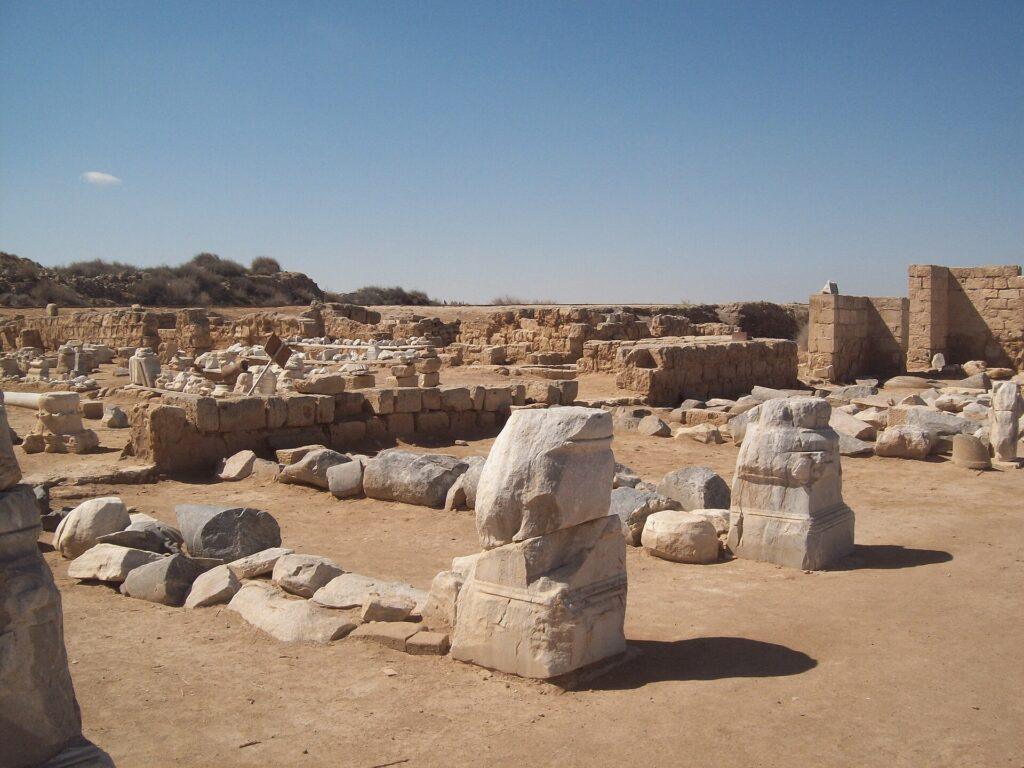
This UNESCO World Heritage Site developed around the tomb of St. Menas, a Christian martyr associated with the late third and early fourth centuries.
What grew around the burial place was far more than a single church.
Abu Mena became a major Christian pilgrimage center containing basilicas, a baptistery, monasteries, pilgrims’ accommodation, houses, workshops, baths, streets and other buildings. UNESCO describes it as an outstanding example of an early Christian pilgrimage and monastic center. UNESCO’s Abu Mena World Heritage listing provides the archaeological background and conservation history of the site.
At its height, pilgrims came from far beyond Egypt.
Small ceramic pilgrim flasks associated with St. Menas have been discovered across a wide geographical area, demonstrating just how widely his cult spread.
For travelers interested specifically in early Christianity, Abu Mena is arguably more important archaeologically than any individual Christian site in central Alexandria.
Planning Note: Abu Mena is not a normal stop on a standard Alexandria sightseeing day. It lies outside the city and deserves to be planned as a separate excursion rather than squeezed between the Catacombs, Qaitbay Citadel and Bibliotheca Alexandrina. Because conservation work can affect the archaeological site, verify current visitor access before building your itinerary around it.
Modern Christian Alexandria Is Still a Living Story
Focusing only on archaeological remains can create another misunderstanding.
Christian Alexandria did not end in Late Antiquity.
The city still has active Coptic Orthodox, Greek Orthodox, Catholic and other Christian communities. Churches are places of worship rather than museum pieces, and Christian life remains part of modern Alexandria.
That matters when visiting St. Mark’s Cathedral or any other functioning church.
Travelers are guests in a religious space.
Dress modestly, keep voices low and follow local instructions regarding photography. A service or religious event can also affect sightseeing access, and the needs of worshippers take priority.
That is particularly important in an article like this one because Alexandria’s Christian heritage is not simply an archaeological subject.
Some of the traditions that began here continue within living churches today.
Is Alexandria Worth Visiting Specifically for Christian History?
Yes—but expectations matter.
If your main goal is to walk through a concentrated district of historic churches, Coptic Cairo is the stronger experience. Its churches, Roman remains and Coptic Museum create a much more visible Christian landscape within a compact area.
Alexandria offers something different.
Come here to understand where one of Christianity’s major early centers developed, how the Church of Alexandria connects itself with St. Mark, how Christian scholarship grew within the city’s Greek-speaking intellectual environment, and how Alexandria changed as Christianity became increasingly established.
Then, if early Christian archaeology is a major interest, extend the story beyond the modern city to Abu Mena.
That combination—Alexandria plus Abu Mena—reveals far more than a checklist of churches.
It connects the intellectual, ecclesiastical and pilgrimage history of early Christianity in northern Egypt.
How Much Time Should You Allow?
Christian sites alone do not require several days in central Alexandria, but they fit naturally into a broader visit to the city.
For most travelers, two days remains the best overall amount of time for Alexandria, especially if you also want to see the Catacombs of Kom el-Shoqafa, Qaitbay Citadel, Bibliotheca Alexandrina, Kom el-Dikka and the waterfront. Our guide to how many days you need in Alexandria explains how those sights fit together without rushing.
St. Mark’s Cathedral can be incorporated into a city day.
Abu Mena is different. Travelers who specifically want to visit the archaeological site should treat it as an additional excursion and verify access before going rather than assuming it can be added casually to a standard Alexandria route.
That distinction is especially important for travelers building a trip around Christian Egypt rather than simply adding one church to a conventional Alexandria sightseeing day.
Christian Alexandria and the Larger Story of Christian Egypt
Alexandria represents one chapter of a much larger Christian landscape across Egypt.
Cairo preserves historic churches in Coptic Cairo and the modern Cave Church complex at Mokattam. Wadi El Natrun preserves one of Egypt’s great monastic landscapes. The Eastern Desert is home to monasteries associated with St. Anthony and St. Paul. Sinai holds St. Catherine’s Monastery and the traditional identification of Mount Sinai. Upper Egypt preserves monasteries, churches and Christian remains from Minya through Sohag and Asyut.
Ancient Egyptian monuments themselves sometimes preserve a later Christian chapter. Crosses, inscriptions, churches and other evidence of Christian reuse survive inside temples and tombs from Luxor to Philae.
Alexandria’s place in that larger story is distinctive.
It is not primarily the city of surviving desert monasteries or pharaonic temples reused as churches.
It is the city associated with the beginnings of the Alexandrian church and with one of early Christianity’s great intellectual traditions.
That is why its Christian history deserves to be understood even when much of the physical city in which that history unfolded has disappeared.
Frequently Asked Questions
Did St. Mark bring Christianity to Alexandria?
According to early Christian tradition, St. Mark preached in Alexandria in the first century CE and became the founder of the Alexandrian church. The New Testament does not record his ministry in Alexandria, so his connection with the city should be described as early Christian tradition rather than as a biblical event.
Can you visit St. Mark’s Cathedral in Alexandria?
St. Mark’s Coptic Orthodox Cathedral is an active church rather than an archaeological attraction. Visitors should approach it as a functioning place of worship, dress modestly and understand that services or church activities may affect sightseeing access.
Is Abu Mena in Alexandria?
Abu Mena is in Alexandria Governorate but outside the modern city, southwest of central Alexandria in the Mariut Desert. It should be planned as a separate excursion rather than treated as another downtown Alexandria stop.
Is Alexandria better than Coptic Cairo for Christian sites?
They provide different experiences. Coptic Cairo has a concentrated collection of historic churches and Christian monuments that can be explored on foot. Alexandria is more important for understanding the early Church of Alexandria, St. Mark tradition and Christian intellectual history, while Abu Mena provides the region’s strongest early Christian archaeological experience.
Explore Alexandria Beyond a Checklist of Sights
Alexandria makes more sense when its Greek, Roman, Christian and modern histories are understood together. St. Mark’s Cathedral and the city’s early Christian story can add another dimension to the archaeological sites, waterfront and Mediterranean landmarks most travelers already come to see.
Explore ENA’s Day Tour to Alexandria from Cairo provides a privately guided introduction to the city for travelers visiting from Cairo. If Christian heritage is a particular priority, tell Explore ENA when planning your visit so the route can be considered around your interests and current site access rather than assuming a standard sightseeing itinerary covers every Christian location.