The Red & White Monasteries of Sohag: A Visitor’s Guide
Most travelers moving through Upper Egypt are following the Nile toward temples and tombs. Just outside Sohag, two monasteries tell a very different part of the region’s history.
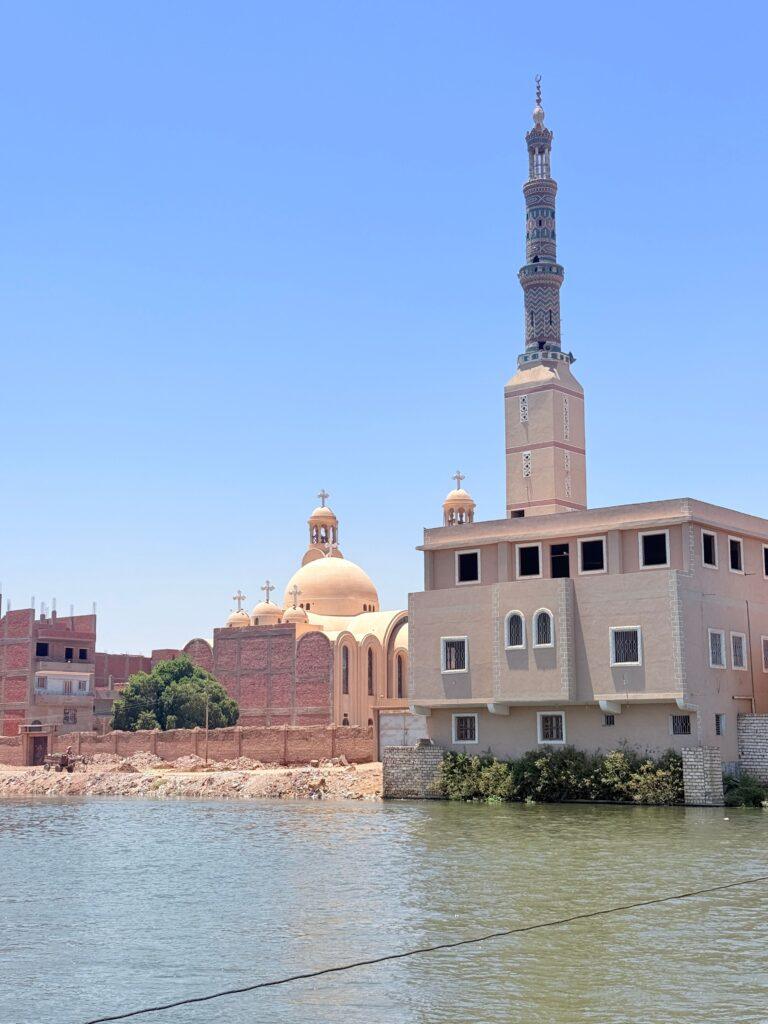
The Red Monastery and White Monastery stand only a few kilometers apart west of the city. Both grew from the remarkable monastic movement that developed here during late antiquity, and both remain active Christian places today.
They do not, however, feel like two versions of the same site.
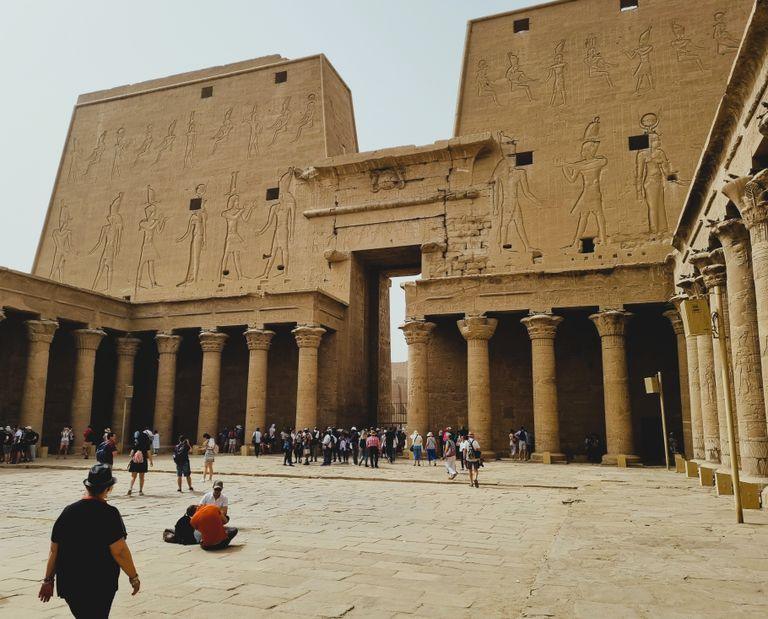
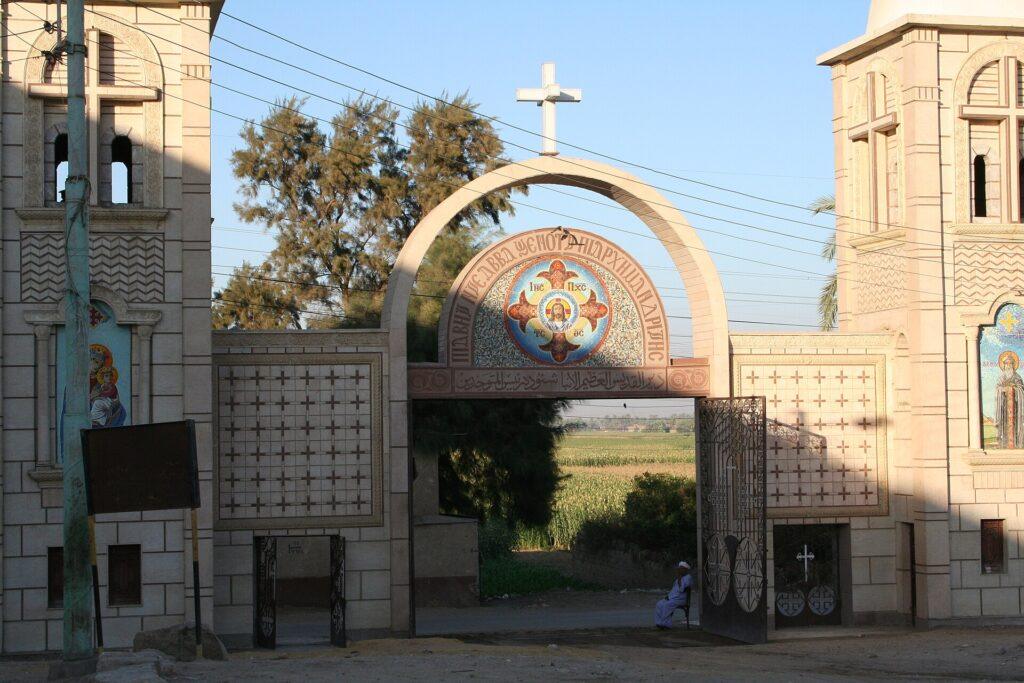
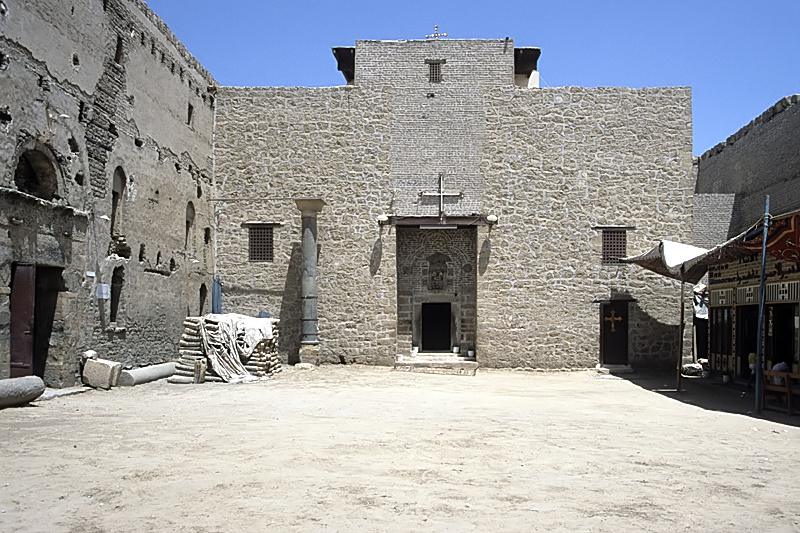
The White Monastery is dominated by the enormous limestone Church of St. Shenoute. From outside, its high sloping walls and curved cornice can look unexpectedly similar to an ancient Egyptian temple. Some of the stone used to construct it actually came from earlier pharaonic monuments.
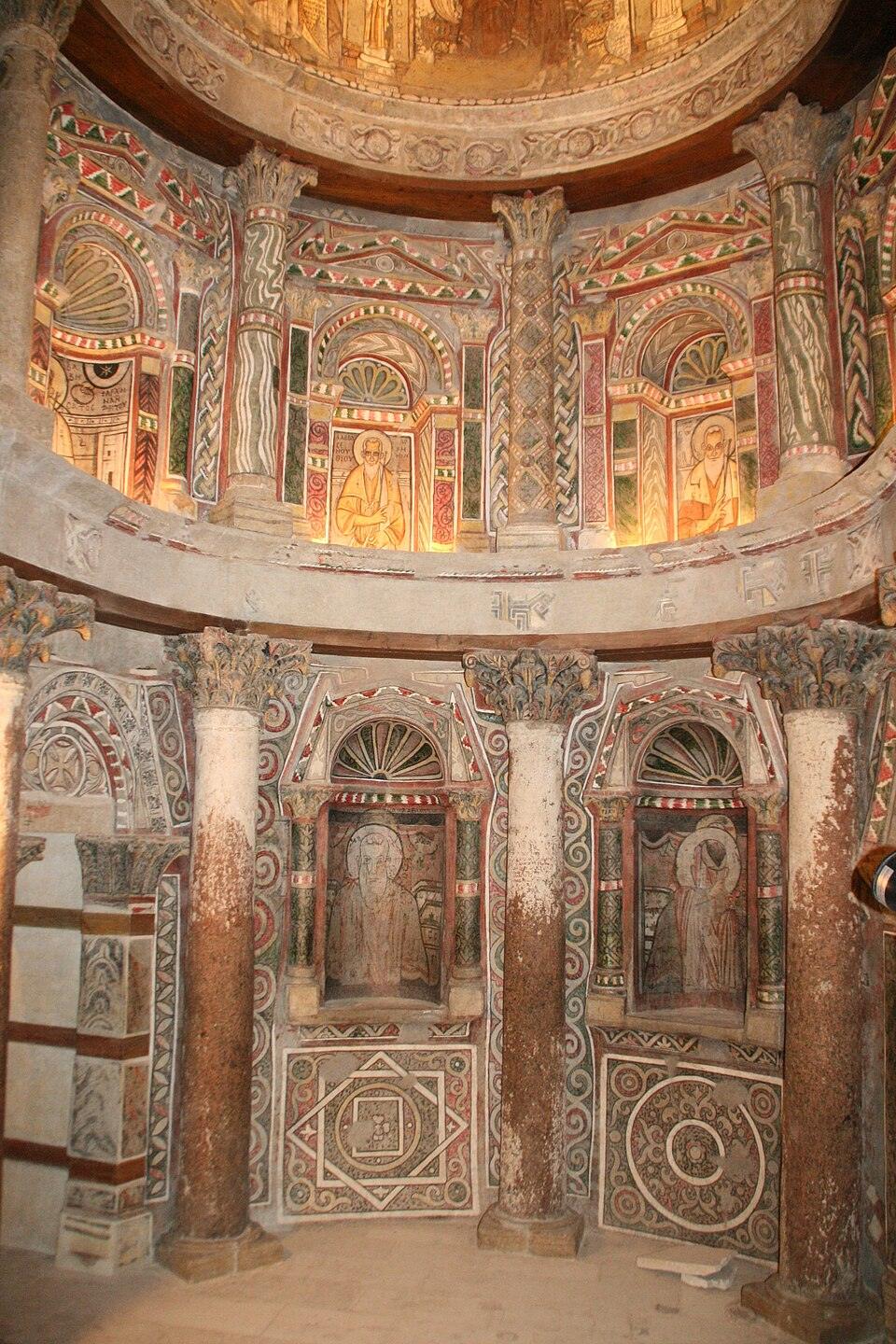
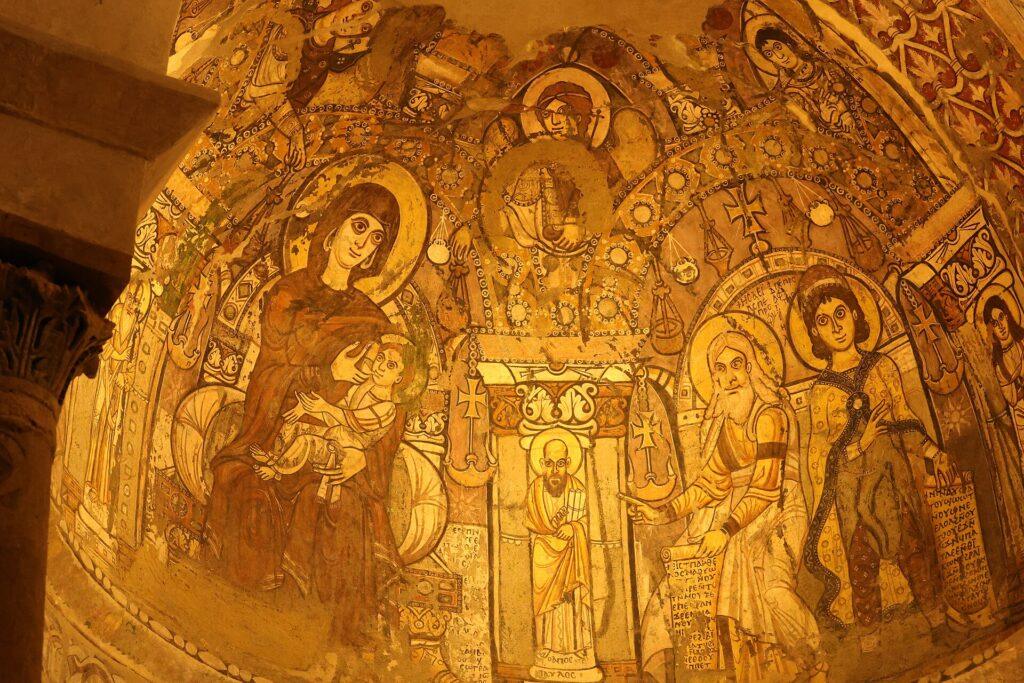
The Red Monastery is the visual surprise, although not because the entire complex appears red from outside. Its name comes from the red brick used in the ancient church, much of which is no longer visually dominant across the exterior you see today. The real burst of color is inside, where the sanctuary preserves an extraordinary program of Christian wall painting and architectural decoration whose colors were hidden beneath centuries of soot, dirt and deterioration before modern conservation.
If you make the journey to Sohag, visit both. Together they make far more sense than either monastery does on its own.
Where Are the Red and White Monasteries?
Both monasteries are west of Sohag in Upper Egypt.
The White Monastery, also known as Deir el-Abyad or the Monastery of St. Shenoute, stands at the edge of the desert roughly 8 kilometers west of the modern city. The Red Monastery, Deir el-Ahmar, lies a few kilometers farther north.
In late antiquity, these were not isolated religious foundations. They belonged to a larger monastic federation that included two men’s communities — the White and Red Monasteries — and a women’s community at nearby Atripe.
For today’s traveler, the geography is straightforward: once you have come out from Sohag, the two monasteries belong on the same excursion.
What does require more thought is getting Sohag into the itinerary in the first place. It lies well north of Luxor and outside the route followed by most standard Nile cruise programs. If you want to see the monasteries, it is better to plan Sohag as part of an overland Upper Egypt journey rather than treat it as an afterthought.
Planning Note: Allow at least half a day for the two monasteries. Travelers particularly interested in Coptic history, architecture or Christian art may easily spend longer.
The White Monastery: The Monastery of St. Shenoute
The name “White Monastery” comes from the pale limestone used to construct its monumental church.
Historically, the more important name is the Monastery of St. Shenoute.
Shenoute led a federation of monastic communities in the Sohag region from the late fourth into the fifth century. Under his leadership, the community became one of the major centers of Egyptian monastic life.
His importance survives in writing as well as archaeology. Thousands of pages from his works have survived, preserving an unusually rich record of monastic rules, religious arguments and life within these communities.
Most of the ancient monastery no longer stands above ground.
The great Church of St. Shenoute does.
Why Does the White Monastery Look Like an Ancient Egyptian Temple?
This is one of the details worth knowing before you arrive.
The church is huge — approximately 76 meters long, with exterior walls rising about 13 meters. Those walls slope slightly inward as they rise and end in an outward-curving cornice.
The result is unmistakably reminiscent of an ancient Egyptian temple.
There is another connection hidden within the walls themselves.
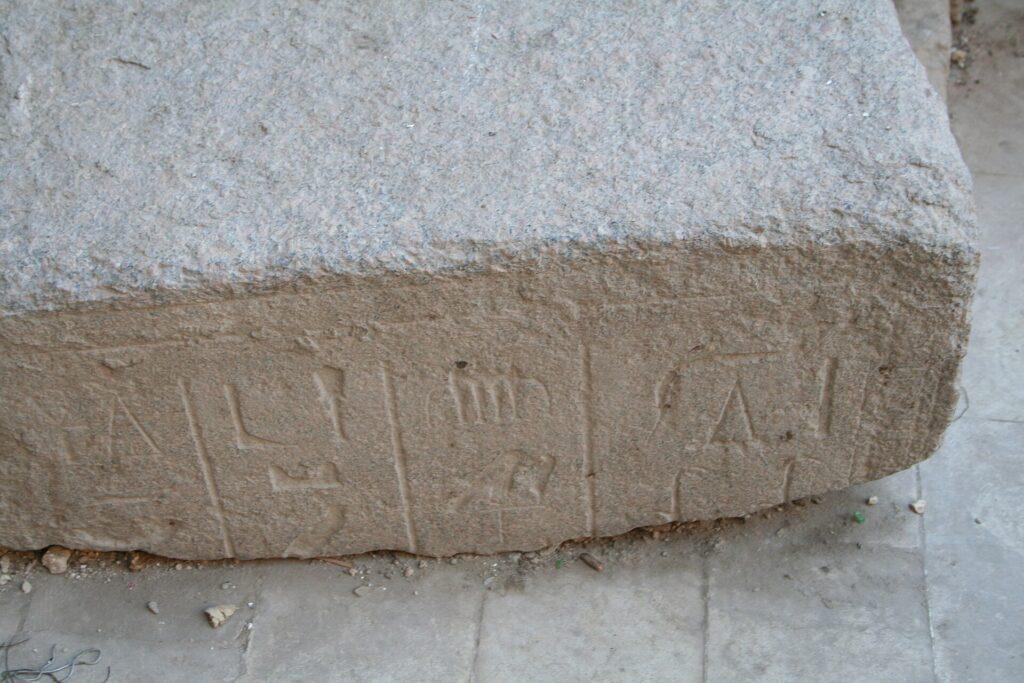
The church incorporates stone reused from earlier pharaonic monuments. Archaeological study has identified limestone and granite blocks bearing hieroglyphs and ancient decoration, with material traced to nearby Atripe as well as more distant Abydos.
That does not mean the White Monastery was simply an ancient temple converted into a church. The Church of St. Shenoute was constructed as Christian architecture, but some of its builders reused stone taken from much older Egyptian structures.
That overlap is particularly interesting if you have already started noticing Christian crosses and other evidence of Christian reuse inside Egypt’s ancient temples. At the White Monastery, the relationship works in another direction: pieces of the pharaonic landscape became part of a monumental Christian building.
Expert Insight: Don’t look only at the overall temple-like shape of the White Monastery. Some reused blocks still preserve hieroglyphic inscriptions or pharaonic decoration. The connection with ancient Egyptian architecture is therefore visible both in the church’s design and in some of the stone from which it was built.
What Will You See Inside the White Monastery?
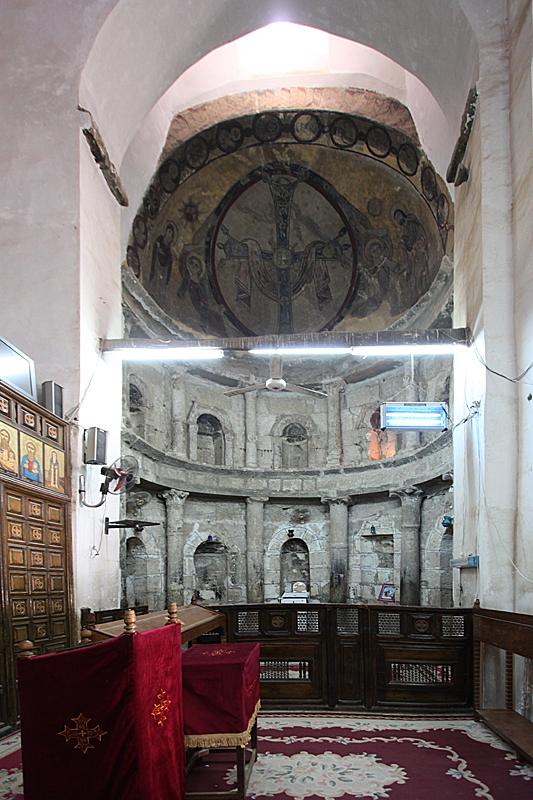
The fifth-century church was built as a three-aisled basilica, but centuries of damage, repair and rebuilding have changed it considerably.
The enormous nave once contained rows of granite columns supporting galleries. Only a few of those columns remain standing today, while other shafts and architectural fragments survive around the building.
The original roof over the nave disappeared centuries ago and was never replaced. That gives this part of the church a very different character from the sanctuary at the eastern end.
There, medieval Christian paintings still survive.
The eastern semi-dome contains an image of Christ in Majesty, painted in the twelfth century by an Armenian artist named Theodore. Other surviving decoration includes the Virgin Mary, John the Baptist and a cloth-draped cross representing the resurrected Christ.
The different dates matter.
You are not entering a fifth-century building whose interior has somehow remained unchanged for 1,500 years. The White Monastery carries evidence from different stages of its life — late antique construction, medieval Christian art, later repairs and modern conservation.
It is also a working monastery again. Coptic Orthodox monks returned to the site in the twentieth century, and the modern Monastery of St. Shenoute is an active religious community.
ENA Tip: Walk around the exterior before going inside. The scale, sloping limestone walls and temple-like cornice are much easier to understand when you see the whole building from outside.
Who Was St. Shenoute?
Shenoute was not the first person associated with the community that became the White Monastery, but he transformed it.
He headed the wider federation from roughly the late fourth century until his death in the fifth century. Under his leadership, the communities were governed by detailed rules and developed into a substantial religious institution with buildings, workshops, food production and other infrastructure.
His surviving writings are one reason historians know far more about this monastic world than the standing church alone could reveal.
They also make the White Monastery important beyond Egypt’s architectural history. Shenoute became one of the most significant authors in the Coptic language, and his writings remain a major source for understanding Egyptian Christianity and monastic life in late antiquity.
Knowing that before you visit changes the building.
The enormous church was not standing beside a handful of isolated desert monks. It belonged to a much larger organized Christian community whose influence extended beyond the monastery walls.
The Red Monastery
A few kilometers away, the Red Monastery presents a very different experience.
The name “Red Monastery” refers to the red fired brick used in the construction of its ancient church. Do not expect the monastery complex to appear bright red from outside today. Later masonry, plaster, repairs and restoration mean much of the exterior now appears in muted stone, beige and gray tones.
The monastery is traditionally associated with St. Pishay, or Bishoy. Historically, the Red Monastery was one of the two men’s communities within the monastic federation headed by Shenoute during the late fourth and fifth centuries.
The surviving ancient church shares architectural features with the Church of St. Shenoute.
But the reason to make time for the Red Monastery becomes clear when you reach the sanctuary.
Color is everywhere.
Columns, niches, arches and walls are covered with painted architectural decoration and Christian figures. Images include Christ, the Virgin Mary, apostles, evangelists and saints, surrounded by intricate patterns and architectural forms.
The effect is very different from the exposed limestone and open nave at the White Monastery.
Why the Red Monastery Paintings Matter
For centuries, visitors could see only a fraction of what survives here.
The paintings had not disappeared, but soot, dust, deterioration and earlier interventions obscured much of their color and detail.
Beginning in 2003, a major conservation effort supported through the American Research Center in Egypt began addressing the paintings. Conservation revealed a sanctuary far more colorful and elaborate than its darkened surfaces had suggested.
Painting conservation was followed by extensive work on the architecture and presentation of the church. The project had an additional complication that does not exist at an abandoned archaeological monument: the Red Monastery is an active place of worship.
Conservators therefore had to think about both preservation and religious use.
The American Research Center in Egypt’s Red Monastery conservation project documents that work and the challenges involved in conserving the church while returning the sanctuary to active liturgical use.
What visitors see today is not a modern recreation of an ancient Christian interior. The conservation work uncovered and stabilized decoration that had survived within the church itself.
Expert Insight: What makes the Red Monastery especially valuable is not one famous painting. It is the survival of so much decoration within the architecture for which it was created. Instead of encountering a Coptic painting isolated in a museum, you can see how color, figures, niches, columns and architectural design once worked together.
What Should You Look for Inside the Red Monastery?
The temptation is to start searching immediately for individual saints or biblical figures.
Give the room a minute first.
Stand back and look at the sanctuary as a complete space. Small columns frame niches. Painted architectural details interact with real stonework. Figures occupy different levels of the walls, while bands of color and ornament connect the separate elements.
Then move closer.
The decoration was not all produced in a single moment. Different phases survive within the church, adding another layer to a building that remained important across centuries.
That is part of what makes the Red Monastery so different from seeing Coptic objects displayed individually in a museum. Here, the art still has an architectural setting.
ENA Tip: If access permits, spend some time looking at the sanctuary from farther back before concentrating on individual paintings. The overall arrangement is part of what makes the Red Monastery exceptional.
Why You Should Visit Both Monasteries
The short distance between them is reason enough to combine the Red and White Monasteries, but their differences are the better reason.
At the White Monastery, the story is dominated by Shenoute, the scale of the monastic federation and a monumental limestone church whose architecture carries traces of Egypt’s much older pharaonic past.
At the Red Monastery, attention shifts toward Christian art and the extraordinary survival of a painted late antique sanctuary.
Seeing both also makes the ancient federation easier to understand.
These were communities within the same monastic landscape. The modern names “Red” and “White” can make them sound like separate attractions conveniently located near one another. Historically, their relationship was much closer.
That context would be easy to miss if you visited only one.
These Are Still Active Religious Places
The Red and White Monasteries are important archaeological and historical sites, but neither exists solely for visitors.
Both are active Christian places.
Dress accordingly. Shoulders and knees should be covered, and clothing suitable for entering a functioning church is appropriate.
Inside, worship takes priority over sightseeing. Keep voices low and avoid photographing clergy, monks or people praying without permission. If photography restrictions are unclear in a particular part of a church, ask before taking pictures.
Services and religious celebrations can also change what visitors are able to access.
The same approach is useful at other active Christian sites around Egypt, whether you are visiting the churches of Coptic Cairo or St. Catherine’s Monastery in Sinai.
Planning Your Visit
Egypt’s Ministry of Tourism and Antiquities currently lists the Red Monastery as open daily from 9:00 AM to 5:00 PM.
Use that as a planning guide rather than assuming every part of an active monastery will always be available throughout those hours. Worship, feast days and other monastery activities can affect access.
This is particularly important at the Red Monastery because the painted sanctuary is one of the main reasons to visit.
Do not plan to arrive shortly before closing. Even without an access delay, these are not places that benefit from being rushed.
For the monasteries themselves, three to four hours is a reasonable starting point once you include time at both sites and the short drive between them.
Someone with a strong interest in Christian art, Coptic history or architecture may want considerably longer.
Planning Note: Sohag works best when it has its own place in the itinerary. Trying to squeeze the monasteries into the edge of a long Cairo–Luxor or Asyut–Luxor transfer leaves little room for unexpected access changes or simply wanting more time once you are there.
Can You Visit the Red and White Monasteries From Luxor?
Geographically, yes. As an itinerary decision, it deserves more thought.
Sohag is north of Luxor, and the monasteries themselves are west of Sohag. They are not Luxor attractions that happen to require a slightly longer drive.
If your trip is already moving overland through Upper Egypt, the monasteries fit much more naturally.
A Christian heritage route can continue south from the Holy Family sites of Minya and Asyut into Sohag before continuing toward Abydos and Luxor. A broader Upper Egypt itinerary can do the same while combining Christian sites with pharaonic ones.
That route has another advantage: Sohag itself contains more than the two monasteries.
Ancient Athribis lies nearby, Akhmim has its own long history, and Sohag National Museum provides a broader introduction to the region. Travelers continuing south can connect Sohag with Abydos rather than treating the monasteries as an isolated round trip.
Where Do the Sohag Monasteries Fit in a Christian Egypt Trip?
They fill an important gap between Egypt’s historic urban churches and its desert monasteries.
In Cairo, travelers encounter Christian history through places such as the Hanging Church, Abu Serga and the churches within Coptic Cairo.
Minya and Asyut introduce another landscape: Holy Family traditions, cliffside churches, archaeological remains and living pilgrimage sites.
Sohag adds the world of Shenoute’s monastic federation.
The White Monastery shows the physical scale that Egyptian monastic communities could achieve. The Red Monastery preserves a very different part of that world through its painted sanctuary.
Farther away, Christian Alexandria tells the story through an early Christian city, while Mount Sinai and St. Catherine’s Monastery bring biblical tradition, pilgrimage and centuries of monastic history together in Sinai.
The Sohag monasteries do not repeat those experiences.
They add another part of the story.
Are the Red and White Monasteries Worth Visiting?
For someone following a tightly packed first trip built around Cairo, a Nile cruise and the best-known ancient sites, adding Sohag simply to say you have been there probably does not make sense.
The calculation changes if early Christianity, Coptic history, religious architecture or Christian art is one of the reasons you are traveling through Egypt.
The Red Monastery gives you the rare opportunity to experience extensive Christian painting within the ancient architectural space it was created to decorate.
The White Monastery places you inside the world of Shenoute and one of the most important monastic movements of late antique Egypt.
And because they stand so close together, you do not have to choose between those stories.
That is what makes Sohag worth the detour.
Frequently Asked Questions
Why are they called the Red and White Monasteries?
The names refer to the principal building materials associated with their ancient churches: red fired brick at the Red Monastery and pale limestone at the White Monastery. The names can be slightly misleading to modern visitors because the Red Monastery complex does not appear uniformly red today. Much of its exterior now reads as stone, beige or gray, while the historic red brick is part of the ancient church’s construction.
How far apart are the Red and White Monasteries?
They are only a few kilometers apart west of Sohag, so they should normally be visited during the same excursion.
Who is the White Monastery associated with?
The White Monastery is the Monastery of St. Shenoute. Shenoute headed the wider monastic federation during the late fourth and fifth centuries and became one of the most important writers in the Coptic language.
What is special about the Red Monastery?
Its ancient church preserves an extensive painted sanctuary. Modern conservation revealed vivid Christian figures, architectural decoration and color that had been obscured by centuries of soot, dirt and deterioration.
Are the Red and White Monasteries still active?
Yes. Both have major historical and archaeological importance but remain active Christian religious places. Visitors should dress appropriately and remember that worship takes priority over sightseeing.
Can Sohag be combined with Abydos?
Yes. Sohag and Abydos work naturally within a broader overland Upper Egypt itinerary. The monasteries deserve enough time, however, that they should not simply be added to an already overloaded transfer day.
Build Sohag Into a Wider Upper Egypt Journey
The Red and White Monasteries are much easier to appreciate when Sohag is treated as part of the journey rather than an excursion squeezed into the margins of a standard itinerary.
A private overland route can connect Minya, Asyut and Sohag with Abydos and Luxor, giving Christian sites enough time while still allowing them to sit naturally alongside Egypt’s ancient monuments.
Explore ENA creates private, customizable Egypt itineraries, including journeys built around special interests and places that standard routes often bypass. If the monasteries of Sohag are a priority for you, start with Explore ENA’s custom Egypt tours and itinerary planning and build the Upper Egypt route around the places you actually want time to explore.