Cave Church Cairo: Visiting the Monastery of St. Simon in Mokattam
Cairo’s Cave Church looks nothing like the historic churches of Coptic Cairo.
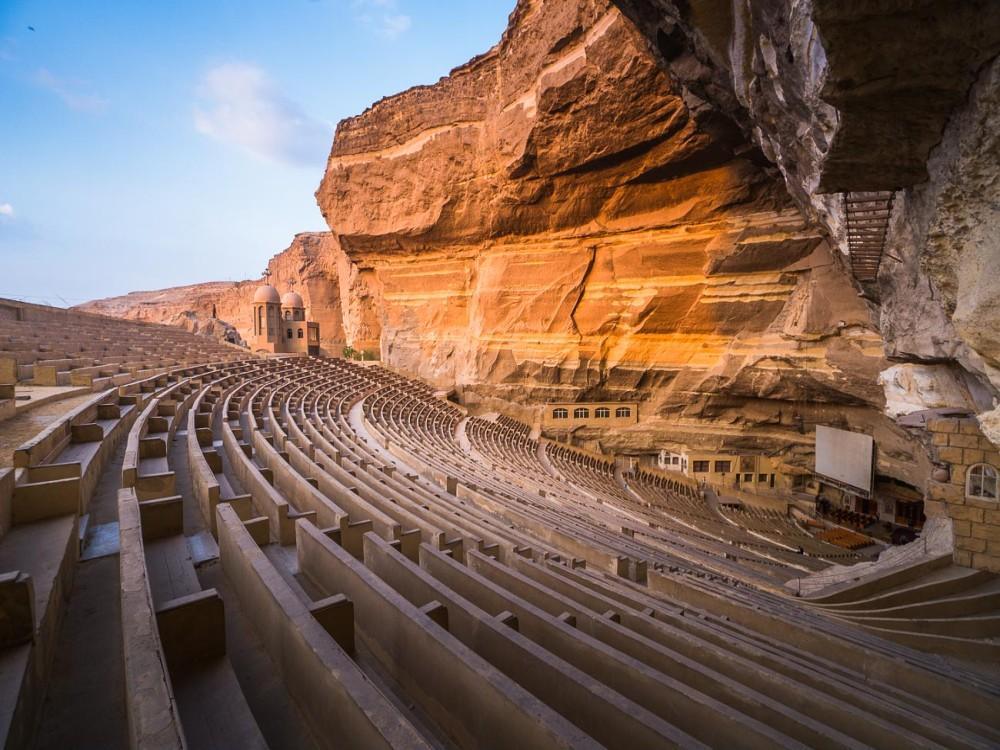
Instead of standing within an old quarter or behind the walls of an ancient religious complex, the Monastery of St. Simon the Tanner occupies the limestone cliffs of Mokattam. Its best-known church is an enormous amphitheater developed beneath the rock, while other churches and worship spaces are spread through the surrounding mountain complex.
Getting there is also part of understanding the place. The route passes through Manshiyat Naser, an area closely associated with Cairo’s Zabbaleen recycling community. The monastery developed alongside the Zabbaleen community at Mokattam during the second half of the twentieth century.
That last point surprises some visitors. Despite the dramatic cave setting and the monastery’s connection with the much older story of St. Simon the Tanner, the Cave Church is not an ancient church.
It represents a much more recent chapter of Christian Egypt — and that is part of what makes it worth seeing.
Where Is the Cave Church in Cairo?
The Cave Church is in the Mokattam area of eastern Cairo, within the Monastery of St. Simon the Tanner. You may also see the saint’s name written as St. Samaan, St. Simeon or Samaan el-Kharraz.
It is not in Coptic Cairo.
Coptic Cairo is the historic district around the Roman Fortress of Babylon, where the Hanging Church, Abu Serga, the Coptic Museum and several other religious sites sit within a relatively compact area.
Mokattam is across the city. Reaching the monastery takes you through Manshiyat Naser before the road climbs toward the limestone cliffs.
The two areas tell very different parts of Cairo’s Christian story, so it is better to think of them as complementary visits rather than extensions of the same walking route.
Planning Note: You can visit Coptic Cairo and Mokattam on the same day if Christian Cairo is the focus, but you will need a vehicle between them. Allow for Cairo traffic rather than planning the two as neighboring attractions.

Why Is It Called the Cave Church?
The popular name makes sense as soon as you enter the monastery complex.
The monastery developed around caves, rock openings and spaces beneath Mokattam’s limestone cliffs, with several of its churches integrated directly into the mountain.
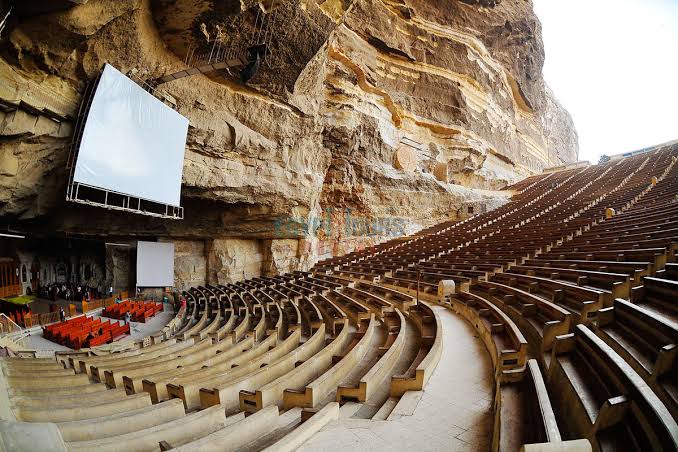
The largest church spreads beneath a massive rock overhang, with amphitheater-style seating descending toward the altar. The limestone is not simply a backdrop; it forms part of the architecture.
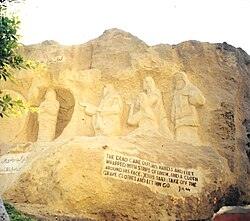
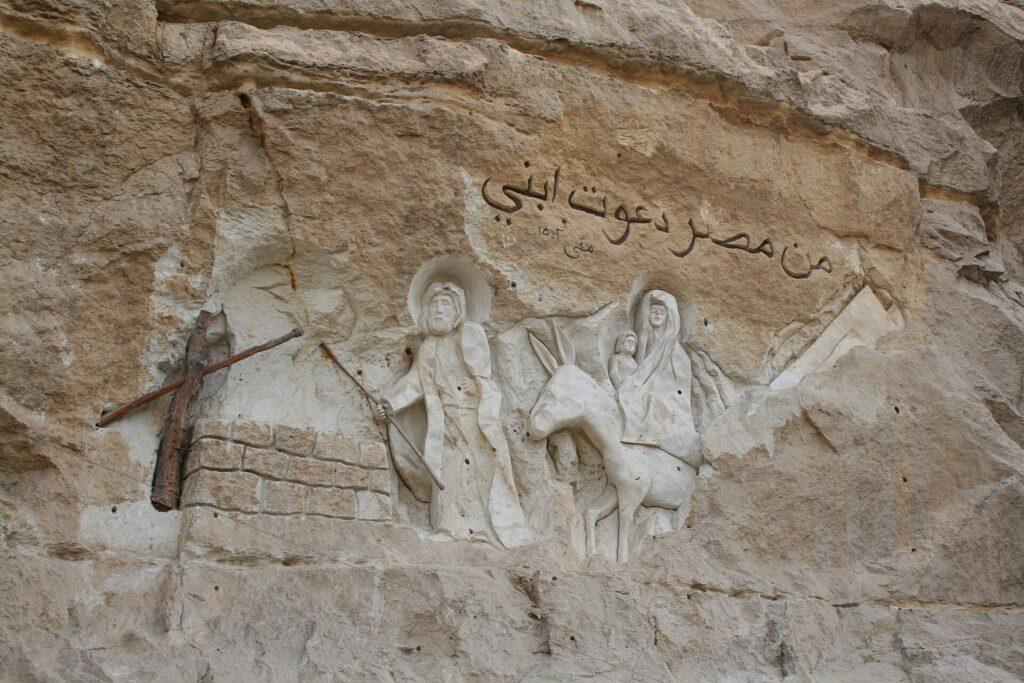
Around the complex, religious scenes have also been carved directly into the rock, making the mountain itself part of the visual experience.
The site’s formal name is the Monastery of St. Simon the Tanner, and the connection with Simon reaches back much further than the modern monastery.
Who Was St. Simon the Tanner?
St. Simon the Tanner — Samaan el-Kharraz in Arabic — is associated with one of the best-known traditions in Coptic Christianity.
The story is set in tenth-century Fatimid Cairo during the reign of Caliph al-Mu’izz.
According to Coptic tradition, the Coptic patriarch Abraham was challenged to demonstrate Christ’s teaching about faith moving a mountain. The tradition says that after three days of prayer and fasting, the Virgin Mary appeared to the patriarch and directed him to seek a man who would help him.
That man was Simon the Tanner, a Christian craftsman remembered for his humility and charitable work.
The tradition holds that Simon joined the patriarch and Christian community in prayer at Mokattam and that the mountain moved.
The story became closely associated with Mokattam Mountain and explains why the monastery that later developed here bears Simon’s name.
It does not, however, mean that the present monastery dates to the tenth century.
Expert Insight: The movement of Mokattam Mountain belongs to Coptic religious tradition. The monastery visitors see today developed in modern Cairo. Separating those two parts of the story prevents the saint’s much older tradition from being confused with the age of the buildings.
How Did the Cave Church Begin?
The monastery began taking shape in the 1970s, alongside the growing Christian community at Mokattam.
Cairo Governorate’s history of the Monastery of St. Simon records a 1974 search that uncovered a tomb, human remains and religious imagery in a cave at Mokattam. The remains were believed to be associated with St. Simon the Tanner, and the discovery became part of the development of the monastery that followed.
The complex grew gradually rather than appearing as one enormous finished monastery. Additional churches and gathering spaces were developed over the following decades as different areas beneath and around the mountain were adapted for worship.
That history makes Mokattam fundamentally different from Egypt’s ancient monasteries.
At the Red and White Monasteries of Sohag, the surviving monumental churches reach back to late antiquity. At Mokattam, you are seeing a modern Coptic community create a major sacred complex around the landscape in which it lives.
The Zabbaleen Community and Mokattam
You cannot really understand the Cave Church without understanding something about the community beneath it.
Many of the Zabbaleen families who settled at Mokattam were Coptic Christians whose roots were in Upper Egypt, and waste collection and recycling became central to the community’s economy.
The Zabbaleen have played a major role in Cairo’s waste collection and recycling system for generations. Families collect waste, separate reusable materials and feed plastics, metals, paper and other materials into an extensive recycling economy.
The work remains highly visible when traveling through Manshiyat Naser.
You will see collected material, sorting areas, workshops, vehicles and businesses connected with recycling. What can initially look chaotic to someone passing through for the first time is also a working economic system supporting families and businesses.
Travel websites frequently call the neighborhood “Garbage City.”
You will encounter that name online and may hear it used in Cairo, but it can reduce an entire community to the material its residents collect and process. For visitors, Manshiyat Naser or the Zabbaleen community is generally more useful when talking about the people and neighborhood rather than using “Garbage City” as though it were the community’s identity.
ENA Tip: The route to the monastery passes through a real residential and working neighborhood. Don’t photograph residents at close range simply because their work or surroundings look unusual. If a person is the subject of your photograph, ask permission.
The monastery makes considerably more sense when the neighborhood is treated as part of its modern history rather than as unusual scenery encountered on the drive uphill.

What Will You See at the Monastery of St. Simon?
The huge Cave Church shown in most photographs is only part of the monastery.
Cairo Governorate currently identifies six Coptic Orthodox churches within the complex, built into and around different areas of Mokattam Mountain.
The main cathedral — the Cathedral of the Virgin Mary and St. Simon the Tanner — is the space most visitors remember. Tiered seating spreads across an enormous amphitheater developed beneath the limestone cliffs, facing the altar with the mountain forming the dramatic backdrop.
According to Cairo Governorate, the cathedral can accommodate around 20,000 people. The scale can be difficult to appreciate in photographs, particularly when the seating is mostly empty.
Other churches occupy different parts of the complex, including St. Mark’s Church, which provides a much smaller and more enclosed contrast to the main amphitheater.
This is why the singular name “Cave Church” can be misleading. You are not visiting one church placed inside one cave. You are visiting a monastery containing several churches and worship spaces integrated into different parts of the mountain.
ENA Tip: Don’t stop after seeing the altar from the first viewpoint. Move far enough through the main amphitheater to look across the seating and back toward the cliffs. The relationship between the church and Mokattam Mountain is much easier to understand from more than one position.
The Rock Carvings Around the Monastery
Large Christian scenes carved into the limestone are another distinctive feature of the monastery.
Biblical subjects and Christian imagery appear across the surrounding rock, turning sections of the cliffs into enormous religious artworks.
These carvings are modern, not surviving examples of early Coptic art.
Their scale and weathered limestone setting can make them appear much older in photographs, but they belong to the modern development of the monastery and its religious landscape.
For comparison, Egypt also has places where Christian communities genuinely left their marks on structures built many centuries earlier. The crosses, inscriptions and alterations discussed in Why Are There Christian Crosses Inside Ancient Egyptian Temples? belong to a completely different historical context.
Mokattam’s carvings tell a much more recent story.
Is the Cave Church Ancient?
No. The Monastery of St. Simon developed in the twentieth century.
The confusion is understandable. The churches are integrated into Mokattam Mountain, and the monastery takes its name from a saint associated through Coptic tradition with events in the tenth century.
The monastery itself is modern.
That makes Mokattam very different from Egypt’s ancient and medieval Christian sites. Here, the interest is in seeing how a modern Coptic community created a major religious complex around a landscape already connected with a much older religious tradition.
Is the Cave Church the Same as Coptic Cairo?
No.
This is one of the easiest points to misunderstand when planning a Christian Cairo itinerary.
Coptic Cairo gives you a concentrated historic district. Roman remains, medieval churches, early Christian traditions and the Coptic Museum are all part of the experience.
Mokattam tells a modern story. Here, the focus shifts to the Zabbaleen community, the tradition of St. Simon the Tanner, churches built into the limestone mountain and the development of a major modern monastery.
If early Christian and medieval history is your priority, Coptic Cairo provides more historical depth within a compact area.
If you are interested in living Christian Cairo, unusual religious architecture and a part of the city far outside the standard monument circuit, Mokattam adds something very different.
For travelers particularly interested in Christian Egypt, the two are worth seeing precisely because they do not duplicate each other.
How Long Should You Allow for the Cave Church?
Allow roughly one to two hours at the monastery itself if you want time to see the main amphitheater, explore other accessible areas and look at the cliff carvings without treating the visit as a quick photo stop.
You will need longer if the purpose of the visit includes understanding Manshiyat Naser and the Zabbaleen recycling community rather than simply driving through the neighborhood.
Travel time is separate.
Cairo traffic can substantially change the transfer, so avoid building the visit around a tightly timed schedule.
How Do You Get to the Cave Church?
For most independent travelers, Uber or a private driver is the most practical way to reach the monastery.
When entering the destination, make sure you are heading to the Monastery of St. Simon the Tanner in Mokattam rather than simply selecting Mokattam, which covers a much larger area.
The final approach passes through narrow, busy streets in Manshiyat Naser where collection, sorting and recycling are part of everyday life.
The route can look confusing on a first visit, but it is the normal approach to the monastery.
You do not need a guide simply to enter the Cave Church. A knowledgeable guide becomes useful if you want to understand what you are seeing: the relationship between the monastery and surrounding community, the Coptic tradition of St. Simon and the development of the religious complex itself.
Planning Note: Do not plan to walk from Coptic Cairo to the Cave Church. They are separate areas of Cairo and require a vehicle transfer.
What Should You Wear?
The Monastery of St. Simon is an active Coptic Orthodox religious complex rather than a monument maintained solely for visitors.
Dress modestly. Clothing covering the shoulders and knees is appropriate for both men and women.
Comfortable shoes are also useful because visiting involves moving between different parts of the complex and changing levels rather than walking through a single flat church interior.
During services or religious events, remember that worship takes priority over sightseeing.
Can You Take Photos at the Cave Church?
Photography is generally possible around much of the monastery, including many of the rock carvings and exterior areas.
Conditions can change during services or religious events, so follow signs and any instructions given at the monastery.
The more important photography consideration is in the surrounding neighborhood.
Manshiyat Naser is residential and commercial. Avoid pointing cameras into homes, photographing workers at close range without permission or treating residents as part of the attraction.
There is plenty to photograph at Mokattam without making someone’s daily life the spectacle.
When Is the Best Time to Visit?
Morning is usually the easiest time to work Mokattam into a Cairo sightseeing day, particularly when the visit will be combined with other parts of the city.
It also leaves more flexibility if traffic takes longer than expected.
There is another consideration that matters more than choosing the perfect sightseeing hour: this is an active monastery.
Services, feast days and religious events can affect access to individual churches or areas of the complex. If seeing a particular part of the monastery is essential to your plans, verify access close to the date of your visit rather than relying on an old online schedule.
Can You Combine the Cave Church With Other Cairo Sites?
Yes, but geography matters.
For travelers specifically interested in Christian Cairo, combining Mokattam with Coptic Cairo creates a particularly useful contrast between the city’s historic and modern Christian landscapes. Just allow enough time for the vehicle transfer between them.
The Cave Church can also work as part of a day exploring areas of Cairo beyond the standard archaeological circuit.
What I would not do is casually add Mokattam to an already full Giza Plateau and Grand Egyptian Museum day. Cairo distances can look manageable on a map while traffic makes the actual day much longer.
If you are dividing several days across the capital, the Cairo travel guide can help you group attractions more sensibly instead of repeatedly crossing the city.
Planning Note: A Christian-focused Cairo day can reasonably connect Coptic Cairo and Mokattam. On a broader first-time Cairo itinerary, it can be better to combine each with places closer to it rather than forcing both into an already crowded sightseeing day.
Is the Cave Church Worth Visiting?
Yes, particularly if you want to see a side of Cairo that is missing from the city’s ancient-monument circuit.
The scale of the main church is impressive, but the visit becomes much more interesting once the monastery is understood in its surroundings.
This is not an ancient sanctuary rediscovered inside the mountain. It is a modern Coptic religious complex that grew alongside the community below it, carrying forward a much older religious tradition associated with St. Simon and Mokattam.
Coptic Cairo can show you centuries of Christian history preserved within Old Cairo. Mokattam shows you something different: a Christian community creating and using a major sacred place in modern Cairo.
Seeing both gives you a much fuller picture of Christian Cairo.
Frequently Asked Questions
Is the Cave Church in Coptic Cairo?
No. The Cave Church is in Mokattam, within the Monastery of St. Simon the Tanner. Coptic Cairo is a separate historic district around the Roman Fortress of Babylon and requires a vehicle transfer from Mokattam.
Is the Cave Church ancient?
No. The monastery complex developed in the twentieth century. Its dedication to St. Simon the Tanner connects the site with a much older Coptic religious tradition associated with Mokattam Mountain.
How long do you need at the Cave Church?
Allow approximately one to two hours for the monastery itself. Allow longer if you also want to explore the surrounding neighborhood with context rather than simply driving through it.
Can non-Christians visit the Cave Church?
Yes. The monastery receives visitors, but it remains an active Coptic Orthodox religious complex. Dress modestly, be respectful around worshippers and follow any current instructions regarding access and photography.
See More Than the Cave Church
It is possible to drive directly to the monastery, photograph the enormous amphitheater and leave. What that approach misses is the relationship between the church, Mokattam and the community that developed beneath it.
Explore ENA’s Cave Church & Mokattam Walking Tour explores the monastery and surrounding community with a licensed Egyptologist. Rather than treating the neighborhood as something to pass through on the way to the church, the experience adds context to the Zabbaleen recycling system, the development of the community, the tradition of St. Simon and the monastery itself.
For travelers who want to understand this part of Cairo rather than only photograph it, that context makes the difference.