Dendera Temple Guide (2026): Temple of Hathor, What to See & Day Trip from Luxor
Dendera asks more of a traveler than another morning on Luxor’s East or West Bank. The Temple of Hathor lies well north of Luxor, so visiting means committing several hours to the road rather than simply crossing the Nile to another archaeological site. The question is therefore not whether Dendera is impressive—it is whether it offers enough that is different from Karnak, Luxor Temple, Hatshepsut, and the West Bank to justify leaving Luxor for it.
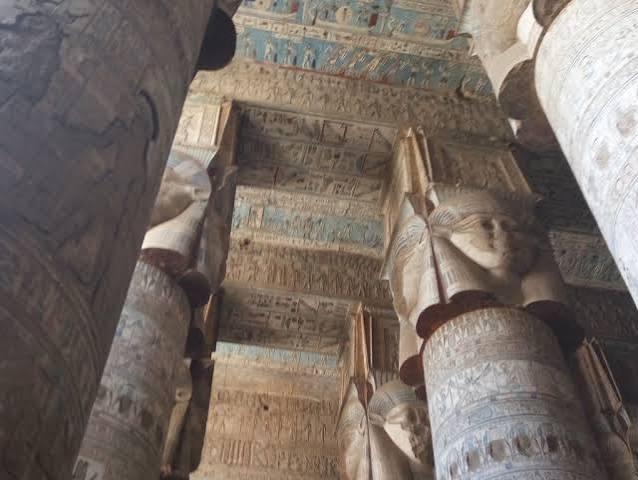
For travelers with at least three days around Luxor, it usually does. Dendera is one of Egypt’s best-preserved temple complexes, and its interior retains something many better-known monuments have largely lost: extensive painted ceilings and reliefs, monumental Hathor-headed columns, crypts beneath the temple, rooftop chapels, astronomical imagery, and architectural spaces that remain enclosed enough to give a much clearer sense of how richly decorated an Egyptian temple could be. Egypt’s Ministry of Tourism and Antiquities describes it as one of the best-preserved temples in Egypt.
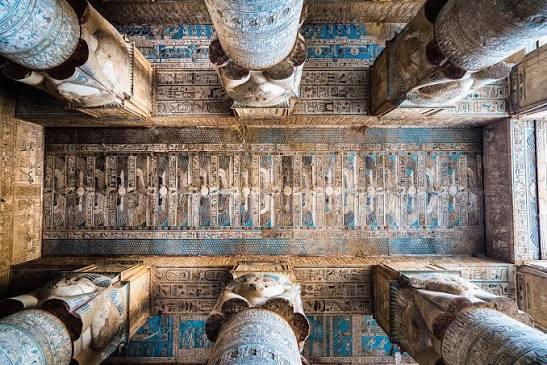
It also rewards looking up. The ceiling of the great hypostyle hall is covered with astronomical and religious imagery in deep blues and other surviving pigments, while the enormous columns are crowned by faces of Hathor. Below, narrow crypts contain some of Dendera’s most discussed reliefs. Above, the roof connects with the Osiris chapels associated with the famous Dendera Zodiac.
For a Dendera-only excursion from Luxor, allow roughly half a day door to door, with around two hours at the archaeological complex. Adding Abydos creates a genuinely long archaeological day and should be treated as such rather than marketed as two effortless stops.
Expert Insight: Dendera is worth leaving Luxor for because it does not duplicate Luxor’s temples. Its enclosed architecture, surviving pigment, accessible crypt and rooftop experiences, and extraordinary astronomical decoration reveal aspects of Egyptian temple design that are much harder to appreciate at more ruined sites.
Quick Planning
| Planning point | Best default |
|---|---|
| Location | Dendera, near Qena, north of Luxor |
| Main monument | Temple of Hathor |
| Current official hours | 7:00 AM–5:00 PM daily |
| Time at site | Around 2 hours; 2.5 hours for detail |
| From Luxor | Roughly 1.5–2 hours each way depending on road conditions |
| Best for | Reliefs, color, temple architecture, astronomy, photography |
| Heat | Significant outside and on roof; cooler inside |
| Guide value | High |
| Strongest extension | Abydos, only if you accept a long full day |
The Ministry currently lists the Temple of Dendera as open 7:00 AM–5:00 PM daily. These operational details can change, so check the Ministry listing before traveling.
Why Dendera Is Worth Leaving Luxor For
The strongest argument for Dendera is preservation.
Karnak overwhelms through scale and centuries of construction. Luxor Temple is particularly effective after dark. Hatshepsut is inseparable from the cliffs of Deir el-Bahari. Medinet Habu gives you exceptional Ramesside reliefs and surviving color.
Dendera does something different.
Its principal Temple of Hathor remains enclosed to an unusual degree. Roofs survive over major spaces, columns still support astronomical ceilings, stairways lead upward through the building, and accessible lower spaces reveal another level of temple architecture beneath your feet.
The Ministry dates the surviving main temple principally to the Ptolemaic period, while noting evidence for earlier sacred structures at the site extending back at least to Pepi I of the Sixth Dynasty.
That long religious history matters, but it should not dominate your visit. What makes Dendera exceptional on the ground is how much of the later temple still surrounds you.
Instead of repeatedly imagining missing ceilings, you can stand beneath them.
Hathor Defines the Entire Experience
Dendera was one of the principal cult centers of Hathor, one of ancient Egypt’s most important goddesses.
Her associations included music, joy, dance, motherhood, sexuality, and the sky. At Dendera, those identities appear throughout the temple’s architecture, inscriptions, ritual imagery, and astronomical decoration.
You encounter Hathor before entering the deepest parts of the building.
Six enormous columns dominate the façade of the hypostyle hall, their capitals bearing the goddess’s characteristic face. The Ministry specifically identifies this frontage as one of the temple’s defining architectural features.
These capitals deserve more than a photograph.
Unlike many Egyptian deities represented in profile, Hathor’s characteristic face confronts the viewer directly. Her imagery is also closely associated with the sistrum, a ritual musical instrument whose form influenced Hathoric architectural decoration.
Once you recognize that visual language, the building begins to make more sense.
The Hypostyle Hall Is Dendera’s Essential First Stop
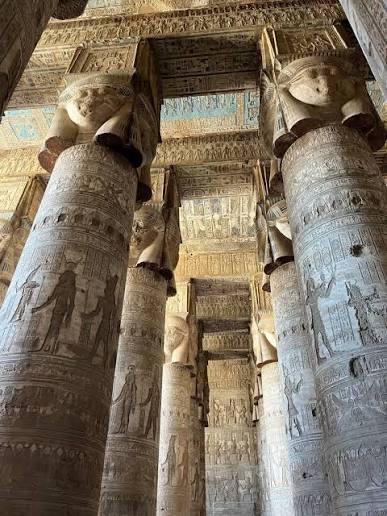
If you remember only one interior from Dendera, it will probably be the Great Hypostyle Hall.
The huge Hathor-headed columns immediately draw attention, but the ceiling above them is just as important.
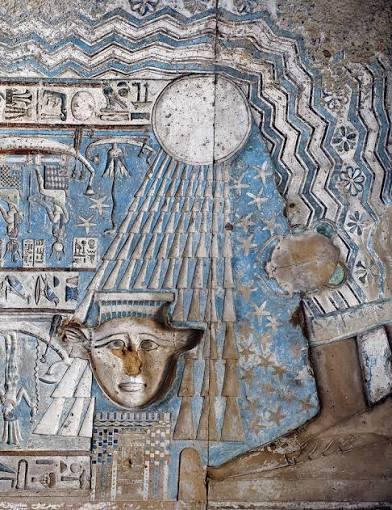
Astronomical and religious scenes spread across the surviving roof, including representations connected with the sky, celestial cycles, deities, and time. The Ministry specifically highlights Dendera’s astronomical ceiling imagery as one of the monument’s outstanding features.
The color is what changes the experience.
Deep blues remain visible across substantial areas, punctuated by figures and astronomical motifs. Conservation has revealed a visual richness that gives a much stronger idea of how dramatically different ancient temples once appeared from the sandstone ruins familiar today.
Give this hall time.
Moving through it in five minutes because your guide wants to reach Cleopatra’s relief wastes one of the strongest reasons for coming to Dendera.
Guide’s Note: Stand back from the columns and look upward before concentrating on individual reliefs. Dendera makes far more sense when you first understand the ceiling as a complete decorated surface rather than immediately photographing isolated zodiac signs or gods.
Dendera’s Astronomical Ceiling Is More Than the Famous Zodiac
The phrase Dendera Zodiac causes some confusion because visitors often expect to find the famous circular zodiac on the main hypostyle ceiling.
That is not where it came from.
Astronomical decoration appears extensively within the temple, but the famous circular Dendera Zodiac originated in an Osiris chapel on the temple roof.
The original is no longer in Egypt.
It was removed from the temple in 1821 and is now held by the Louvre Museum in Paris, where it is currently displayed in the Department of Egyptian Antiquities. The Louvre dates it to around 50 BC, during the period of Cleopatra VII and Ptolemy XIII.
The circular composition includes zodiac constellations alongside other Egyptian celestial imagery.
Its significance is therefore not that ancient Egyptians suddenly adopted a modern horoscope system. Dendera belongs to a Graeco-Roman environment in which Egyptian and Mediterranean astronomical traditions interacted.
A reproduction occupies the location associated with the original.
Knowing that before you arrive prevents the common disappointment of discovering that the famous stone disk in photographs is actually in Paris.
Go Up to the Roof If Current Access Permits
Dendera is unusual because the visitor experience can extend vertically through the temple.
The rooftop areas matter because they contain chapels associated particularly with the cult of Osiris and place the Dendera Zodiac in its proper architectural context.
The ascent also changes how you understand the building.
From below, the temple feels enclosed and shadowed.
Higher up, you emerge into direct Upper Egyptian sunlight and gain a much broader perspective over the temple precinct and surrounding landscape.
That contrast is excellent in winter.
In summer, it can be punishing.
Stone exposed to the sun heats quickly, and there is far less shade than inside the hypostyle hall. If you are visiting between May and September, do the exposed upper areas before spending too long in the cooler interior.
Current access can change because of conservation or visitor management. If a rooftop section is closed on your visit, do not argue from an old blog post showing somebody standing there several years earlier.
The Crypts Are One of Dendera’s Most Unusual Visitor Experiences
Dendera also lets visitors descend.
These are not spacious underground halls.
Expect tighter passages, confined spaces, and close proximity to carved walls. Travelers uncomfortable with narrow enclosed areas should consider that before purchasing additional access.
The crypts had ritual and storage functions connected with sacred objects and temple practice. Their reliefs include detailed representations of divine forms and cult objects that would have carried specific religious meanings.
One particular group has become famous online for entirely different reasons.
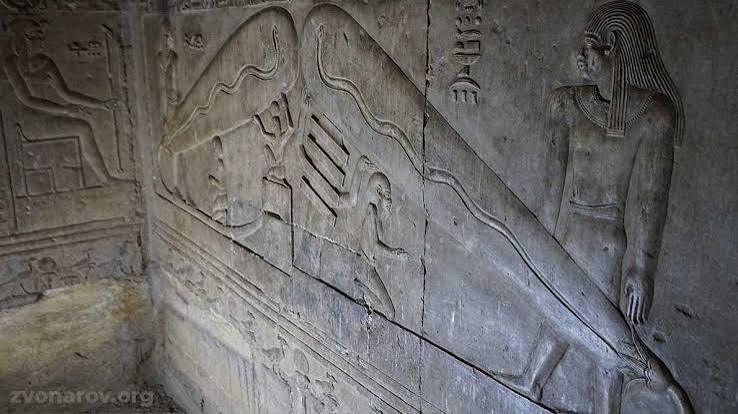
The “Dendera Light” Is Not Evidence of Ancient Electricity
Some crypt reliefs show an elongated oval form containing a serpent emerging from a lotus, accompanied by figures and a djed pillar.
To a modern eye, the composition can resemble an oversized light bulb.
That visual resemblance has generated claims that ancient Egyptians possessed electric lighting.
There is no accepted archaeological evidence that these reliefs depict electrical technology.
The inscriptions and related imagery place the scenes within Egyptian religious cosmology. The serpent represents Harsomtus, a divine form associated at Dendera with Horus and solar creation, emerging from a lotus. An academic review of Dendera temple texts likewise describes Harsomtus as a primeval serpent emerging from the lotus and connects the imagery with creation and solar theology.
The djed is an established Egyptian religious symbol associated with stability, not an electrical insulator.
The Institute for the Study of the Ancient World’s image archive similarly describes the crypt scene as a snake within a lotus-based religious composition rather than a technological device.
The relief is genuinely fascinating.
It does not need electricity to make it interesting.
Expert Insight: Dendera attracts more pseudoarchaeological claims than many Egyptian temples because some of its imagery looks unexpectedly familiar to modern eyes. The correct approach is to read unusual reliefs together with their hieroglyphic inscriptions and wider temple context—not to identify objects by visual resemblance alone.
The Famous Cleopatra Relief Does Not Show Cleopatra and Julius Caesar
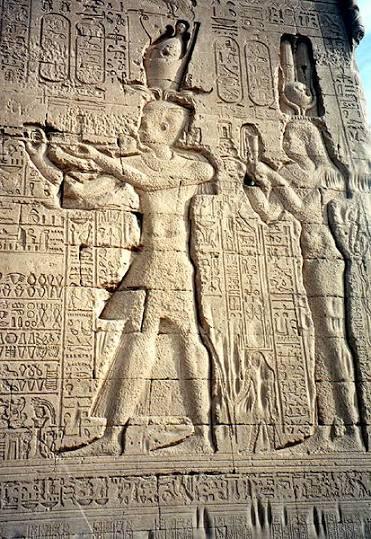
Another frequently misunderstood image appears on the exterior rear wall of the Temple of Hathor.
Here you can see Cleopatra VII with her son Caesarion, formally Ptolemy XV Caesar.
Caesarion was Cleopatra’s son and was presented as the son of Julius Caesar, but the adult male figure beside Cleopatra in this famous Dendera context is Caesarion—not Julius Caesar himself.
This distinction is routinely blurred in captions and social-media posts.
The relief presents Cleopatra and Caesarion within traditional Egyptian royal and religious imagery. Cleopatra does not appear as the glamorous Hellenistic queen familiar from modern cinema. She is shown performing the expected ritual role of an Egyptian ruler before the gods.
That is precisely why the relief matters.
It demonstrates how the last Ptolemaic rulers presented themselves within Egyptian temple tradition.
Do not expect a realistic portrait.
Ancient temple relief was communicating kingship and ritual legitimacy, not trying to provide a facial likeness for future historians.
The Sacred Lake Shows the Temple Was More Than Its Main Building
Dendera is a temple complex, not only the great Temple of Hathor.
The wider precinct includes the remains of a sacred lake, smaller religious structures, birth houses or mammisis, and monuments representing different periods of activity at the site.
The sacred lake was connected with ritual purification and temple practice.
Today, its masonry-lined basin is dry, so it lacks the immediate visual drama of the main temple interior.
It is still worth seeing if you have sufficient time.
Doing so reinforces an important point: large Egyptian temples functioned as religious institutions with subsidiary structures, ritual infrastructure, storage, priestly activity, and festival spaces.
The main sanctuary was only one part of that world.
The Mammisis Add Another Layer to Hathor’s Cult
Dendera preserves structures associated with the divine birth tradition commonly called mammisis, or birth houses.
These buildings were connected with rituals celebrating divine birth and renewal.
At a sanctuary centered on Hathor, ideas surrounding motherhood, divine family, regeneration, and royal legitimacy fit naturally into the broader religious landscape.
This is not the section to spend twenty minutes on if your driver is waiting and you still have the crypts to see.
But if you have two hours or more, the wider complex helps prevent Dendera from becoming “the temple with the blue ceiling.”
Two Hours Is the Right Target for Most Visitors
Allow around two hours at Dendera itself.
That gives enough time to understand the main façade and hypostyle hall, examine the astronomical ceiling, move through the inner temple, see Cleopatra and Caesarion, and add the crypt or upper areas where accessible.
Two and a half hours is better for travelers particularly interested in photography, Egyptology, astronomy, or temple architecture.
An hour is too short if you have driven from Luxor specifically for Dendera.
The journey is substantial enough that rushing the monument makes little sense.
Three hours is unnecessary for most first-time visitors unless you are examining inscriptions or the subsidiary buildings in detail.
Dendera From Luxor: The Road Journey Matters
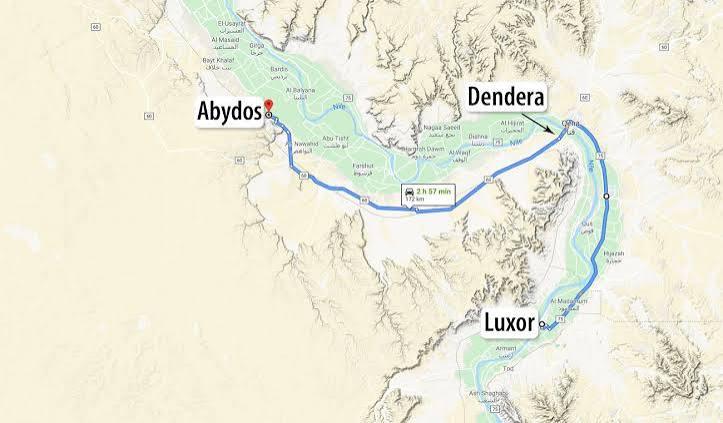
Dendera lies near Qena, north of Luxor.
In practical terms, plan on approximately 1.5 to 2 hours each way by road, depending on your starting point, traffic, road conditions, checkpoints, and the route being used.
That means Dendera is not a casual add-on after Karnak.
A private vehicle with a driver is the strongest default for most international travelers because it gives control over departure time, waiting time at the archaeological site, and the return to Luxor.
A guided excursion is particularly useful if Dendera is being combined with Abydos, where the longer road day and the amount of archaeological material make independent logistics less attractive.
Leave Luxor early.
Not because Dendera is guaranteed to become overwhelmed by crowds, but because an early departure protects your day from road delays and gets you onto exposed areas before the strongest heat.
Dendera Alone or Dendera + Abydos?
Dendera alone is the better choice for most travelers who want a comfortable half-day excursion.
You can leave Luxor early, spend roughly two hours exploring properly, and return without sacrificing the entire day.
Dendera + Abydos is the stronger choice for archaeology-focused travelers willing to commit a full day.
Abydos lies considerably farther north and adds the Temple of Seti I, extraordinary reliefs, the Abydos King List, and the Osireion. It is not a quick extension around the corner from Dendera.
Combining both makes geographical sense because they lie north of Luxor.
It does not make the day short.
Expect several hours in the vehicle plus two major archaeological visits. Start early and avoid planning a major Luxor temple for the evening unless you already know you handle long sightseeing days well.
Our Abydos Guide should be the next article to read before choosing the combined excursion. Its value is not simply whether Abydos is “worth it,” but whether you have enough time to see both temples properly instead of spending most of the day watching the clock.
Guide’s Note: Dendera + Abydos works because the sites complement one another, not because they are close. If a proposed itinerary gives you around an hour at each temple to get back to Luxor quickly, choose Dendera alone and see it properly.
Dendera Fits Best After You Have Seen Luxor’s Essential Sites
For a first visit to Luxor, I would not sacrifice Karnak or the Valley of the Kings for Dendera.
Those sites are fundamental to understanding ancient Thebes.
With three or more days in Luxor, Dendera becomes much easier to recommend.
A sensible structure gives the East Bank its own time, the principal West Bank monuments another day, and then uses a third day for Dendera or Dendera and Abydos.
That prevents the excursion from competing directly with Luxor’s core archaeology.
Your Luxor Travel Guide should handle that larger itinerary decision, including how many days the city actually deserves and how to divide East Bank, West Bank, and excursions beyond Luxor.
Heat Changes the Visit More Than Many Photos Suggest
Dendera’s surviving roof makes parts of the temple significantly more comfortable than exposed archaeological sites such as Hatshepsut Temple.
The hypostyle hall and inner rooms provide real shade.
That does not make Dendera a cool summer excursion.
You still have the temple approach, wider complex, exterior reliefs, sacred lake, and potentially exposed rooftop areas. Qena’s summer heat can be severe, and a long drive followed by midday walking drains energy quickly.
In warmer months, leave Luxor early and prioritize the roof and exterior areas before the heat peaks.
Then move deeper inside.
This is one archaeological site where the architecture itself can help you manage the day.
A Guide Adds More Value at Dendera Than at Many Smaller Temples
You can appreciate Dendera independently.
But the site contains enough unusual imagery that a good Egyptologist adds considerable value.
The astronomical ceiling needs context.
The Zodiac needs to be distinguished from the astronomical imagery still in Egypt.
The crypt reliefs need to be protected from pseudoarchaeological explanations.
Cleopatra’s image needs to be separated from modern ideas about portraiture.
The rooftop chapels, Hathor symbolism, festival architecture, and relationship between Ptolemaic rulers and Egyptian religious traditions all become clearer with selective explanation.
The key word is selective.
A guide who translates every deity and cartouche can turn two fascinating hours into exhaustion.
A strong guide should help you see why Dendera is unusual and then give you enough silence to look at it.
Photography at Dendera
Dendera is one of the strongest temple sites in Upper Egypt for architectural photography.
The Hathor columns give you immediate scale.
The astronomical ceilings reward wide-angle compositions.
Side light emphasizes carved relief.
Dark inner spaces create strong contrast with doorways.
And the rooftop, when accessible, provides perspectives unavailable at most Egyptian temples.
Avoid flash around painted surfaces and follow current site instructions. Professional equipment, tripods, commercial photography, and specialist shoots may be subject to separate rules or permits.
The strongest photograph is not necessarily the famous Cleopatra relief.
A carefully exposed image of the hypostyle hall showing both Hathor capitals and the blue astronomical ceiling tells the story of Dendera far better.
Common Mistakes at Dendera
The first is driving all the way from Luxor and allowing only an hour at the temple.
The second is assuming the famous circular Zodiac is still on the roof. The original is in the Louvre.
The third is spending so much time discussing the “Dendera Light” that the actual religious and architectural significance of the crypts disappears.
Another is confusing Caesarion with Julius Caesar in the famous rear-wall relief.
And perhaps the most common itinerary mistake is adding Abydos simply because a tour is available. Dendera and Abydos make an excellent combination for the right traveler, but the resulting day is long. If you dislike extended road journeys or have only two days in Luxor, stay focused on Luxor itself.
Frequently Asked Questions
Is Dendera worth visiting from Luxor?
Dendera is worth the journey once Luxor’s essential sites have enough time. Its preserved ceilings, Hathor columns, crypts, astronomical imagery, rooftop areas, and extensive color offer a temple experience that is genuinely different from Karnak or Hatshepsut. Travelers with only two days in Luxor should normally prioritize the city’s core East and West Bank sites first.
How long does it take to get from Luxor to Dendera?
Allow roughly 1.5–2 hours by road each way under normal travel conditions. Journey time varies with traffic, checkpoints, route, and your exact starting point in Luxor, so do not build a tightly timed evening commitment around the estimated return.
How long should I spend at Dendera Temple?
Around two hours is the strongest default. Add another 30 minutes if you are particularly interested in the crypts, roof, astronomical imagery, or photography. A one-hour visit is possible but poor value after the drive from Luxor.
What are Dendera Temple’s opening hours?
The Ministry currently lists 7:00 AM–5:00 PM daily.
Is the Dendera Zodiac still at the temple?
The original circular Zodiac is in the Louvre Museum in Paris. The Louvre records it as coming from the eastern Osiris chapel on Dendera’s roof and currently displays it in its Egyptian Antiquities collection.
Can you visit the crypts at Dendera?
The Ministry currently lists a separate serdab ticket, indicating visitor access to designated crypt space. Access may be altered for conservation or operational reasons, so confirm on arrival. The passages are confined and may not suit travelers uncomfortable in tight spaces.
Can you go onto the roof of Dendera Temple?
Controlled upper-level access is currently reflected in the Ministry’s separate Temple Panorama ticket. Specific accessible areas can change, so follow current site restrictions rather than assuming every rooftop chapel or staircase shown in older photographs remains open.
Did the ancient Egyptians have electric lights at Dendera?
The crypt reliefs are understood within Egyptian religious imagery, not as electrical diagrams. They show the deity Harsomtus in serpent form emerging from a lotus within a symbolic composition involving established religious motifs such as the djed pillar. Academic work on Dendera’s texts places the imagery within creation and solar theology.
Does the famous relief show Cleopatra and Julius Caesar?
The famous exterior relief depicts Cleopatra VII and her son Caesarion, Ptolemy XV, in Egyptian ritual imagery. It should not be described as a portrait of Cleopatra standing beside Julius Caesar.
Should I visit Dendera and Abydos on the same day?
Combine them when archaeology is a major priority and you are comfortable with a long day. The route makes geographical sense, but Abydos substantially increases driving and sightseeing time. Travelers wanting a more relaxed excursion should visit Dendera alone and return to Luxor after spending two unhurried hours at the complex.
Is Dendera suitable for children?
The large Hathor faces, colorful ceiling, narrow crypt experience, stairways, and rooftop perspectives can make Dendera more visually varied than some temple sites. The main limitation is the long road journey from Luxor and summer heat. Families should avoid turning Dendera and Abydos into an unnecessarily long day unless the children already cope well with extended archaeological excursions.
The mistake with Dendera is treating it as either another temple to collect or an effortless add-on to Luxor. It deserves the journey because its preserved interior, astronomical ceiling, crypts, Hathor columns, and surviving color show a side of Egyptian temple architecture that Luxor’s headline monuments cannot reproduce. Explore ENA’s itineraries to protect enough time for the road and the temple itself—and, if Abydos is added, to build a genuine full-day excursion rather than rushing two exceptional sites simply to be back in Luxor early.