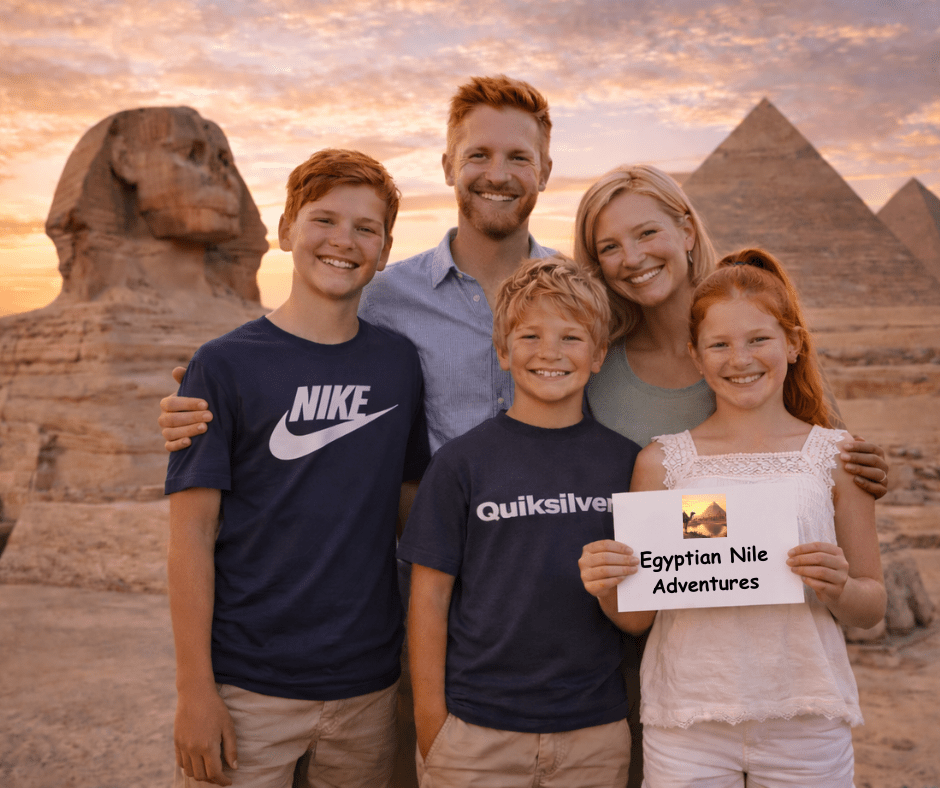
Cairo With Kids: How to Plan Family Days Without Burning Out
For most families, Cairo works best with 3 full days, sightseeing grouped by area, and no more than one or two demanding experiences in the same day.
Cairo has more than enough to keep a family busy. What makes it challenging is the combination of traffic, distance, large archaeological sites, museums, heat and the sheer amount happening around you. A day that looks reasonable as a list of attractions can feel very different after several hours at the pyramids and another drive through Greater Cairo.
Instead of counting how many attractions fit into a day, plan around where they are and how much energy they require. Put experiences together when the route makes sense, protect time for meals and breaks, and decide in advance which visit matters most if the day starts running long.
You may technically see fewer places that way. You are much more likely to have children who are still interested in what they are seeing.
How Many Days Does a Family Need in Cairo?
For most first-time families, 3 full days is the better default.
Two days can work when Cairo is one part of a tightly focused Egypt itinerary, but there is less room for a difficult traffic day, a child who needs a slower morning or a major attraction that takes longer than expected. Three days lets you separate the most demanding experiences instead of making every day depend on perfect timing and everyone’s energy holding up.
A third day also gives you choices. Depending on your children’s ages and interest in archaeology, you could venture to Saqqara and Dahshur, spend more time at one of Cairo’s major sights or simply keep part of the day deliberately light.
If Cairo is one part of a longer family trip, the Egypt With Kids guide looks at how to balance the capital with the rest of an Egypt itinerary.
Giza and GEM: One Day or Two?
For families with limited time in Cairo, Giza and the Grand Egyptian Museum are the strongest major sights to combine in one day.
They sit close to one another in Greater Cairo, and Egypt’s official tourism information describes the Grand Egyptian Museum as a short ride from the Giza Plateau. Keeping the two together avoids adding an unnecessary cross-city journey between major sightseeing stops.
Proximity does not make either experience small.
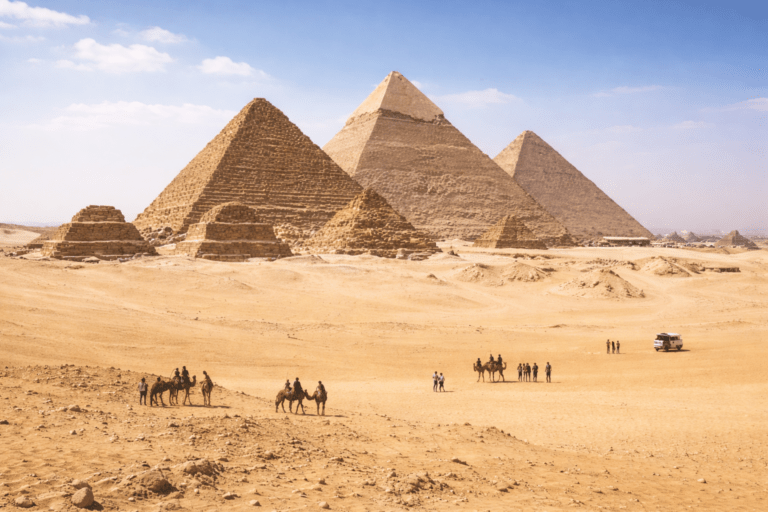
Giza is a large, exposed archaeological site, and GEM is an enormous museum that can occupy hours of its own. At Giza, do not plan the visit as though the family will simply walk between every major viewpoint. The plateau is large and uneven in places, and moving between different areas of the site can matter just as much as walking stamina—particularly with younger children or in hot weather.
For most school-age children and teenagers, Giza in the morning followed by a proper lunch and GEM later in the day is a sensible combination when Cairo time is limited.
If you have 3 or more full Cairo days, younger children, heat-sensitive family members or children who particularly enjoy museums, splitting Giza and GEM is the more comfortable choice. Nobody then has to rush through one major experience because another is waiting.
For the plateau itself, the Giza Pyramids Guide explains how much time Giza needs, how to move around the site and what is worth prioritizing. The Grand Egyptian Museum Guide covers how long to allow inside GEM and what to focus on rather than attempting to see everything.
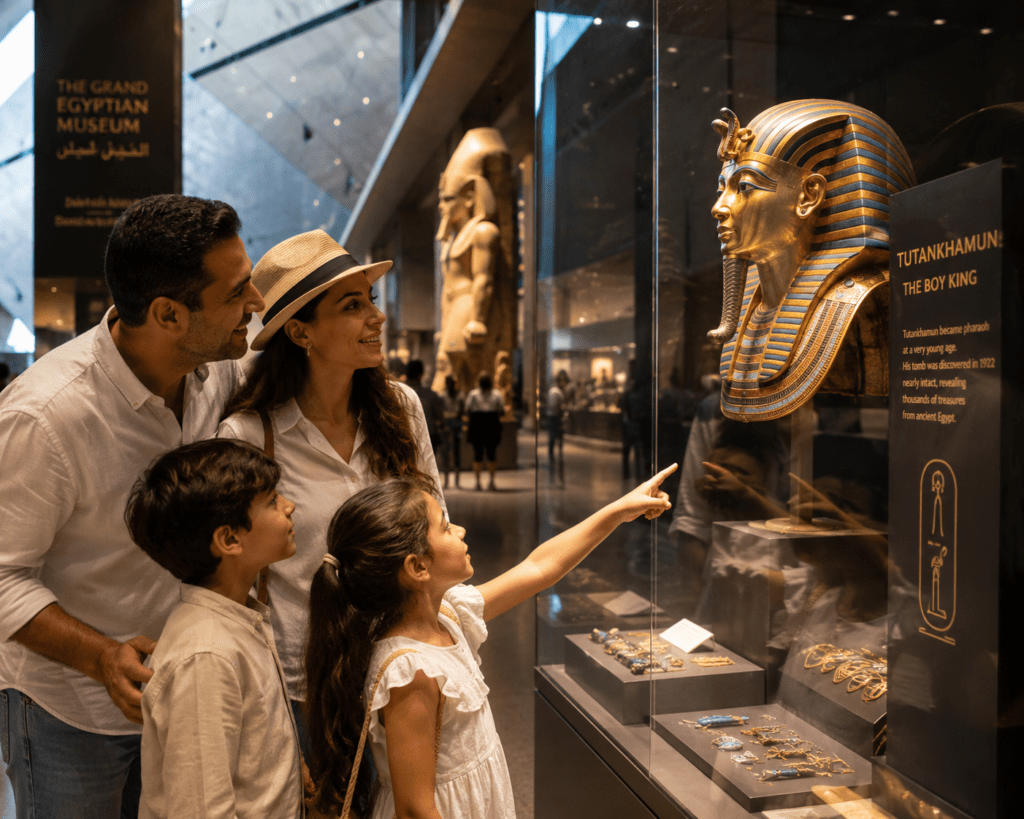
Protect the Break Between Major Experiences
If Giza and GEM are sharing a day, the break between them is part of the itinerary.
After several hours outside at Giza, children may already have walked over uneven ground, dealt with sun and heat, climbed in and out of vehicles and absorbed one of the biggest archaeological experiences of the trip. Going straight into another major attraction because it happens to be nearby can turn an otherwise sensible combination into an exhausting one.
Give lunch enough time to feel like a break. If someone needs to sit quietly for a while, let them.
That pause can make the difference between children entering GEM curious about what is inside and children entering because the adults have decided there is another attraction to finish.
The same thinking applies elsewhere in Cairo. Two places can belong together geographically without requiring every available minute between them to be filled.
Historic Cairo and Khan El Khalili Need a Different Rhythm
Historic Cairo and Khan El Khalili feel very different from Giza or GEM, and that change can work well for families.
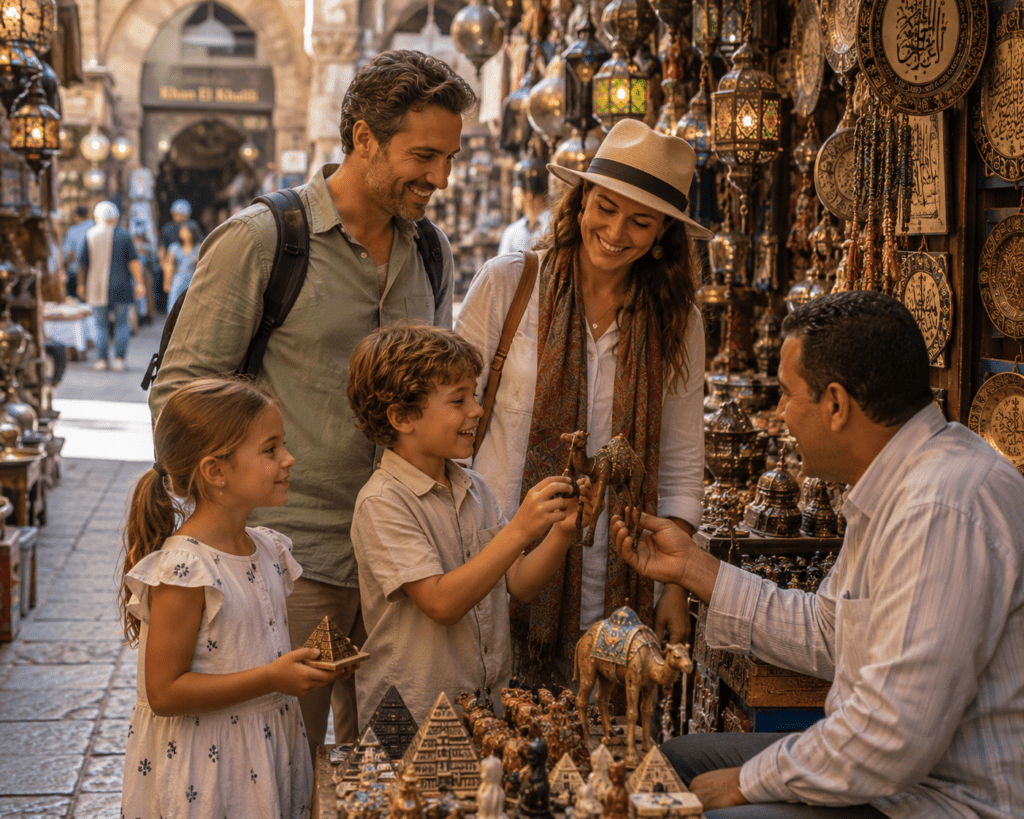
Instead of moving through another large archaeological site or museum, children are walking through streets, watching shops, noticing buildings and seeing city life happening around them. Older children and teenagers may enjoy having a small souvenir budget and deciding what they want to buy.
Timing makes a noticeable difference here.
Do not automatically save Khan El Khalili for the end of a day when everyone has already spent hours walking through monuments and museums. The crowds, noise and constant activity can be fascinating while children still have energy and overwhelming when they do not.
Keep younger children close in busy areas. With older children, give them something to participate in rather than asking them to follow another adult-led sightseeing visit. Choosing a souvenir, noticing architectural details or deciding where to stop can make this part of Cairo feel more like exploration.
Families who decide that combining Giza, GEM and Historic Cairo in one day suits their children’s pace can use Explore ENA’s private Cairo day tour combining the Giza Pyramids, Grand Egyptian Museum and Khan El Khalili. Having the day’s transportation and sequence arranged reduces the logistical work, although it remains a substantial sightseeing day.
Use the Nile as a Change of Pace
Not every memorable Cairo experience needs to be another major sight.
After museums, traffic and archaeological sites, time on the Nile changes the rhythm of the day. A short felucca sail gives children a chance to sit, watch the city and experience something different without immediately asking them to concentrate on another structured visit.
It also changes how they experience Cairo itself. The Nile stops being something the family repeatedly crosses in traffic and becomes part of the trip.
A felucca works particularly well as the slower half of a day—after sightseeing, before dinner or on an afternoon when everyone has seen enough monuments for the moment.

Choose Your Hotel for the Cairo Days You Are Actually Planning
There is no single best part of Greater Cairo for every family.
A family planning several mornings around Giza may value a location that reduces repeated travel to the western side of the city. Another family spending more time around central Cairo, the Nile and Historic Cairo may willingly accept a longer Giza transfer in exchange for easier city days.
Look at the actual itinerary before choosing the hotel.
A property can have excellent reviews, a beautiful pool and attractive family rooms and still be inconvenient for your particular trip. In a city as large as Cairo, repeatedly adding unnecessary cross-city drives can affect a family more than a small difference in hotel quality.
Room configuration matters too. If you need connecting rooms, an extra bed or a cot, confirm the arrangement rather than assuming the room description guarantees the setup you need.
For planning beyond the family-specific pacing and logistics covered here, continue with the Cairo Travel Guide.
Getting Around Cairo With Children
For international families, app-based ride services such as Uber or arranged private transportation are generally easier than relying on street taxis.
Private transportation becomes particularly useful on sightseeing days involving several stops because transportation remains part of the day’s plan rather than every transfer becoming a separate problem to solve.
If your child needs a restraint, arrange it specifically in advance. Do not assume the appropriate child seat will automatically be available in an ordinary ride-hailing vehicle.
Cairo traffic is also a poor foundation for a minute-by-minute itinerary. Leave enough margin that a slow drive does not force you to rush lunch, cut short the experience everyone cared about most or spend the rest of the day trying to recover lost time.
Food, Water and Bathroom Stops Need Time Too
Family itineraries often account for attractions and driving time but forget the smaller stops children actually need.
Carry water and a familiar snack during longer sightseeing periods. A child who becomes hungry at Giza does not care that lunch is scheduled an hour later.
Use suitable bathrooms when the opportunity appears rather than waiting until someone urgently needs one. Facilities and convenience vary between locations, particularly when a day moves between archaeological sites, historic streets and museums.
And let lunch be lunch. On a Giza-and-GEM day in particular, sitting down properly between the two visits can make the afternoon considerably easier.
Stroller or Carrier?
Whether a stroller works well depends on where you are going.
At archaeological sites, uneven surfaces, sand, steps and rough ground can make a carrier more practical for babies and toddlers. Historic streets and crowded areas create different difficulties.
A stroller is much easier to use in airports, hotels, malls and smoother modern spaces, and it can still be useful during a Cairo trip even when it is impractical for part of the sightseeing day.
With babies or toddlers, having both options is often more useful than expecting either a stroller or carrier to work everywhere.
A Better Way to Build a Family Day in Cairo
Start with the experience that matters most rather than a list of everything that might fit.
If that is Giza, decide what sensibly belongs around Giza. If it is GEM, consider how much attention your children are likely to have left afterward. If you are spending time in Historic Cairo, allow that neighborhood to be an experience instead of treating it as something that must be squeezed in after an unrelated full day elsewhere.
For many families, a useful rhythm is:
one major experience → proper break → one lighter experience
That is a framework, not a rule. Some children will happily manage two substantial visits. Others will enjoy Cairo much more when the second half of the day is deliberately slower.
For help choosing which experiences deserve those limited spaces in the first place, see Best Things to Do in Egypt With Kids.
A successful Cairo itinerary has enough margin for traffic, hunger, tired children and the occasional change of plan without making the whole day feel as though it has gone wrong.
Frequently Asked Questions
How many days does a family need in Cairo?
Three full days is the better default for most first-time families. Two days can work if Cairo is one part of a tightly focused Egypt itinerary, but three gives you more room to separate demanding visits and absorb an unexpected traffic delay or slower family day.
Is Cairo too chaotic with kids?
Cairo can feel intense because of traffic, crowds and the size of Greater Cairo. It becomes much easier when families group sightseeing geographically, use reliable transportation and avoid planning too many demanding experiences in one day.
Should families stay in Cairo or Giza?
Choose according to your itinerary rather than simply the name of the neighborhood. Families concentrating heavily on Giza may benefit from reducing repeated travel to western Greater Cairo, while those spending more time around central or Historic Cairo may prefer a base that makes those days easier.
Can we visit the pyramids and GEM in one day?
Yes. For families with school-age children or teenagers and limited Cairo time, it is a sensible combination because the sites are close to one another. If you have more time, younger children or a family that prefers slower visits, splitting them is more comfortable.
Is Khan El Khalili good for children?
It can be, particularly for older children and teenagers who enjoy markets, shopping and watching city life. Younger children need closer supervision in busy areas. Visit while the family still has energy rather than automatically adding it to the end of an exhausting day.
Is a stroller useful in Cairo?
Yes, but not everywhere. Strollers are useful in airports, hotels and smoother modern spaces, while a carrier may be more practical at archaeological sites or in areas with uneven ground and crowded streets.
Plan a Cairo Day That Your Family Can Actually Enjoy
Cairo does not become a better family experience because you fit one more attraction into the day.
Choose what matters, group the route sensibly and leave room for meals, traffic and rest. A family that finishes the day still curious about Cairo has probably gained more from it than one that managed another two stops but enjoyed none of them.
If Giza, GEM and Historic Cairo make sense as one full sightseeing day for your family, check out Explore ENA’s private Cairo day tour combining the Giza Pyramids, Grand Egyptian Museum and Khan El Khalili.