
Nile Cruise With Kids
Nile Cruise With Kids: Is It Worth It for Families?
For most families planning to visit both Luxor and Aswan, a Nile cruise is worth considering because it removes repeated hotel changes and turns the journey between Upper Egypt’s major sites into part of the trip. The important catch is that a Nile cruise is still an archaeology-heavy sightseeing experience—not a children’s resort cruise.
That distinction matters more than whether your children have enjoyed cruises elsewhere.
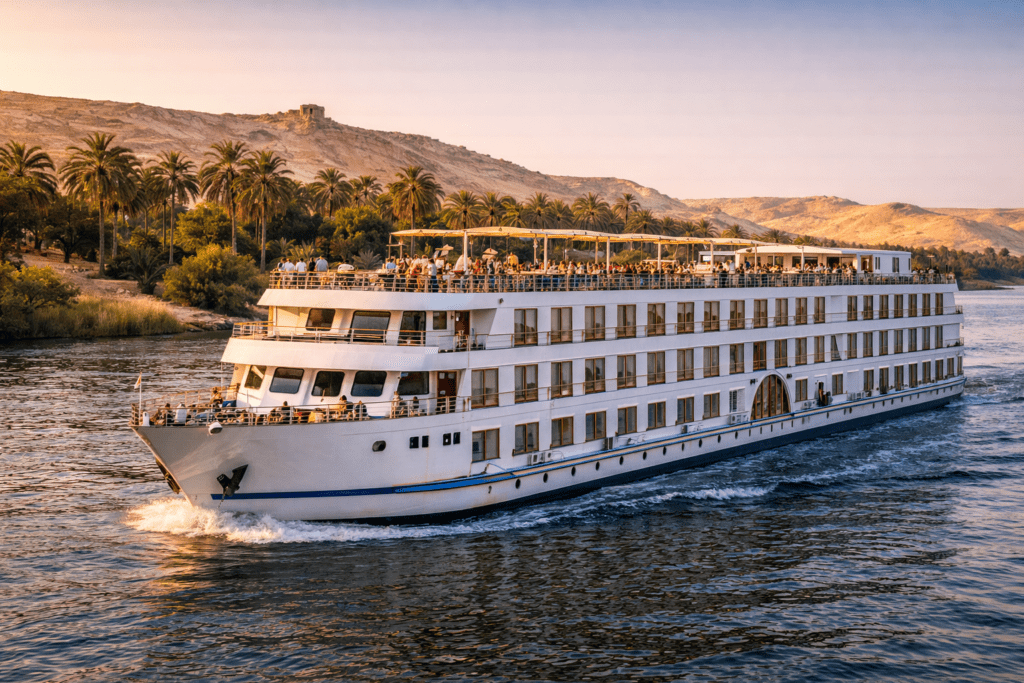
On a classic motor Nile cruise, your cabin becomes the family’s base while the ship moves between Luxor and Aswan. Stops along the route can include Edfu and Kom Ombo, with sightseeing in Luxor and Aswan arranged around embarkation, sailing and disembarkation.
For a family, this can be considerably easier than repeatedly packing, checking out of hotels and moving luggage between destinations. It does not eliminate early sightseeing, walking, temples or tired children. What it changes is how the family moves through Upper Egypt.
For the complete route, cruise mechanics and general planning questions, use the Nile Cruise Egypt Guide.
Why the Cruise Format Can Work So Well for Families
Once the family is onboard, you are not packing again every morning. There is no daily hotel checkout simply because the next temple is farther north or south. Some of the distance between places happens while the family is eating, sleeping or spending time onboard.
That continuity can make Upper Egypt feel much less fragmented with children.
Sailing also provides a natural contrast to the sightseeing. A temple visit may be followed by several hours when nobody has to get into another vehicle, walk through another archaeological site or concentrate on another explanation.
The precise rhythm varies by sailing and itinerary. Cruise schedules, excursion sequences and docking arrangements are not identical across every vessel, so one published schedule should never be treated as the timetable for every Nile cruise.
What families can reasonably expect is a repeated pattern of shore sightseeing and time onboard, rather than a sequence of hotel-to-hotel road transfers.
A Nile Cruise Is Not a Resort Cruise
This is one of the most important expectations to get right before booking.
Families familiar with large ocean ships may hear cruise and picture children’s clubs, waterslides, extensive entertainment and activities designed to occupy children throughout the day.
A classic motor Nile cruise is a different kind of experience. It is built around traveling the river and visiting Upper Egypt.
Do not assume that a particular children’s program, pool, entertainment schedule or other facility will be available simply because the accommodation is described as a cruise ship. Those features vary by vessel and should be checked on the actual ship being offered.
Egypt’s official tourism site describes cruising and sailing on the Nile around the river journey and access to Egypt’s ancient sites. That is a much more useful expectation for families: the sightseeing and the Nile itself are the experience.
What Is a Nile Cruise Day Actually Like With Children?
There is no single timetable that applies to every ship, but families should expect the sailing schedule to shape their days.
Some days include a substantial archaeological visit. Others combine sightseeing with longer periods onboard. Embarkation and disembarkation days may also include sightseeing rather than functioning as empty travel days.
This is why 3 cruise nights should not be read as 3 leisurely days on a boat.
The number of nights tells you how long you sleep onboard. It does not tell you how demanding the sightseeing will be or how much uninterrupted sailing time the family will have.
Before choosing a cruise, look at the actual day-by-day itinerary and ask where the early starts, major archaeological visits and longer sailing periods fall.
The What a Nile Cruise Day Is Actually Like guide looks more closely at that sightseeing-versus-sailing rhythm.
What Ages Are Best for a Nile Cruise?
There is no universal minimum age.
School-age children and teenagers may find the logistics easier because they can often manage more walking and engage more independently with the archaeological sites. Babies and toddlers bring different considerations: naps, carrying, feeding, stairs, sun exposure and the possibility that the child’s routine will occasionally need to take priority over sightseeing.
Age by itself does not tell you whether the cruise will work.
A child fascinated by ancient Egypt may happily spend much longer at archaeological sites than an older sibling who has little interest in them. A toddler who sleeps easily while traveling can present different challenges from a teenager who hates early mornings.
Think instead about your particular child. How much sightseeing can they enjoy before their attention disappears? How well do they handle early starts and changes in routine? Are the adults willing to adjust a day when the child has clearly had enough?
Those answers are more useful than looking for an arbitrary “best age” for a Nile cruise.
The Real Test Is How Much Archaeology Your Children Will Enjoy
A Nile cruise through Upper Egypt naturally concentrates archaeological sightseeing.
Edfu and Kom Ombo sit along the cruise corridor, while Luxor contains Karnak, Luxor Temple, the Valley of the Kings, Hatshepsut’s temple and other major sites. Aswan brings another set of experiences before or around the sailing schedule.
For a child fascinated by ancient Egypt, that can be extraordinary.
For another child, the third temple may simply look like another temple.
Parents do not need to turn every visit into a complete history lesson. Giving children one or two memorable things to notice can work better than trying to explain every relief, ruler and date.
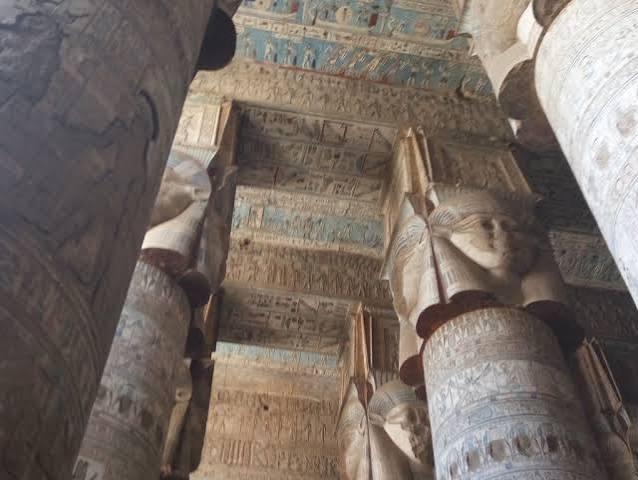
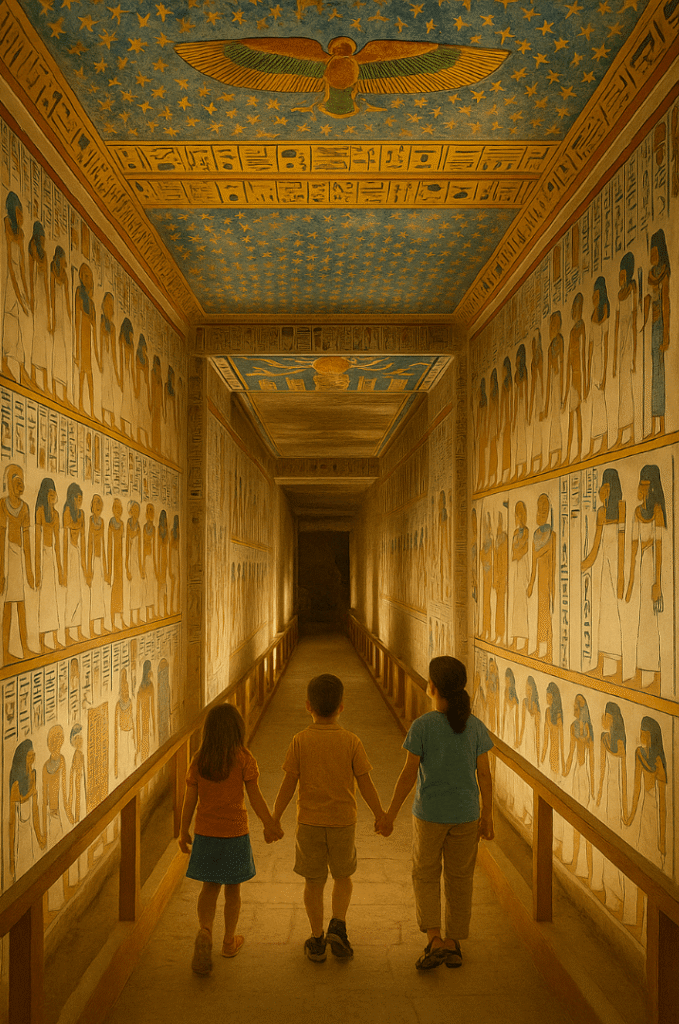
At Kom Ombo, the unusual double-temple design and connection with Sobek give children something specific to look for. At Edfu, the scale and remarkable preservation make an immediate impression. In Luxor, entering a decorated royal tomb offers a completely different experience from standing in another temple courtyard.
The aim is to help children recognize why this place is different from the one they saw yesterday, without making every excursion feel like a lesson they have to complete.
Sailing Time Is Part of the Family Experience
For families, the hours onboard can be just as important as the sightseeing.
Children can sit on deck, read, eat, talk or simply stop concentrating for a while. The family is still moving toward the next destination without having to pack, check out or spend the journey in a vehicle.
The river also shows children another side of Egypt.
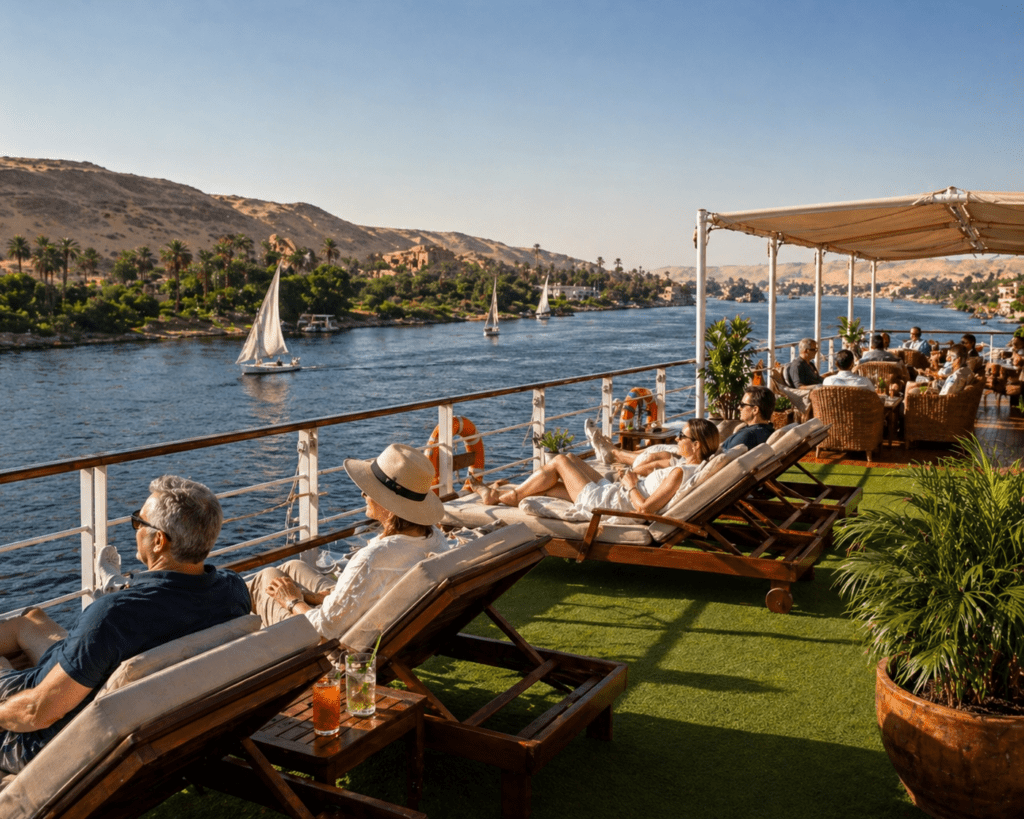
Fields, palms, villages and small boats appear along the banks, with the cultivated Nile Valley giving way to desert beyond it. Watching that landscape pass is part of experiencing Upper Egypt rather than empty time between attractions.
Resist the temptation to fill every sailing period. A few hours when nobody is expected to accomplish anything can make the next temple considerably more enjoyable.
Cabins and Sleeping Arrangements Need to Be Checked Before Booking
Family accommodation needs more attention than simply choosing a cabin category.
You may need an extra bed, cot, connecting cabins or two cabins close together. Those arrangements depend on the actual vessel and booking.
If connecting rooms matter, confirm that they are genuinely connecting rather than simply nearby. If an extra bed or cot is required, check how that affects the usable space in the cabin.
Ask about the exact arrangement being offered for your number of adults, children’s ages and required room configuration before committing.
A photograph or cabin description from another Nile cruise vessel does not establish what will be available on yours.
What About Stairs, Railings and Pools?
These are vessel-specific too.
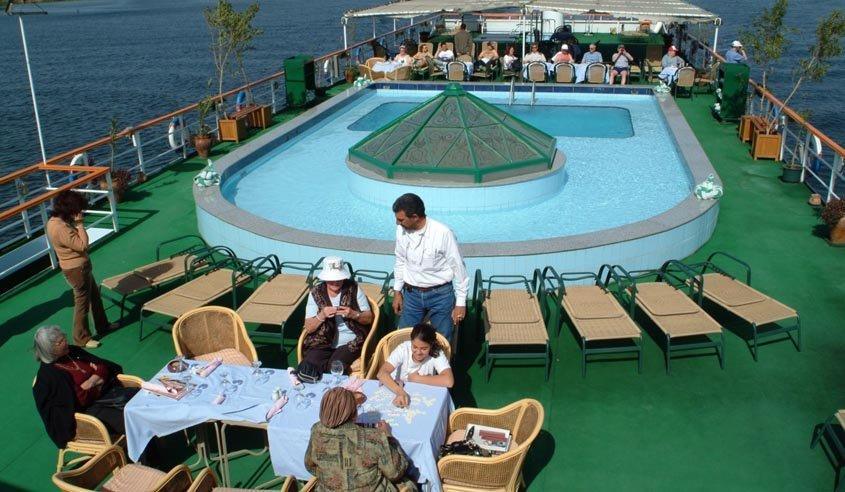
Parents traveling with younger children may want to know about stair access and deck railings. If a pool matters to your children, confirm that it exists on the actual vessel being offered and ask about its setup rather than treating it as a standard Nile cruise feature.
The same principle applies to cabin layout and other onboard facilities.
Children need ordinary close supervision around water, open decks and stairs, regardless of the vessel.
Should Families Choose 3 Nights or 4 Nights?
For Explore ENA travelers, the relevant motor-cruise patterns are currently 3- and 4-night sailings.
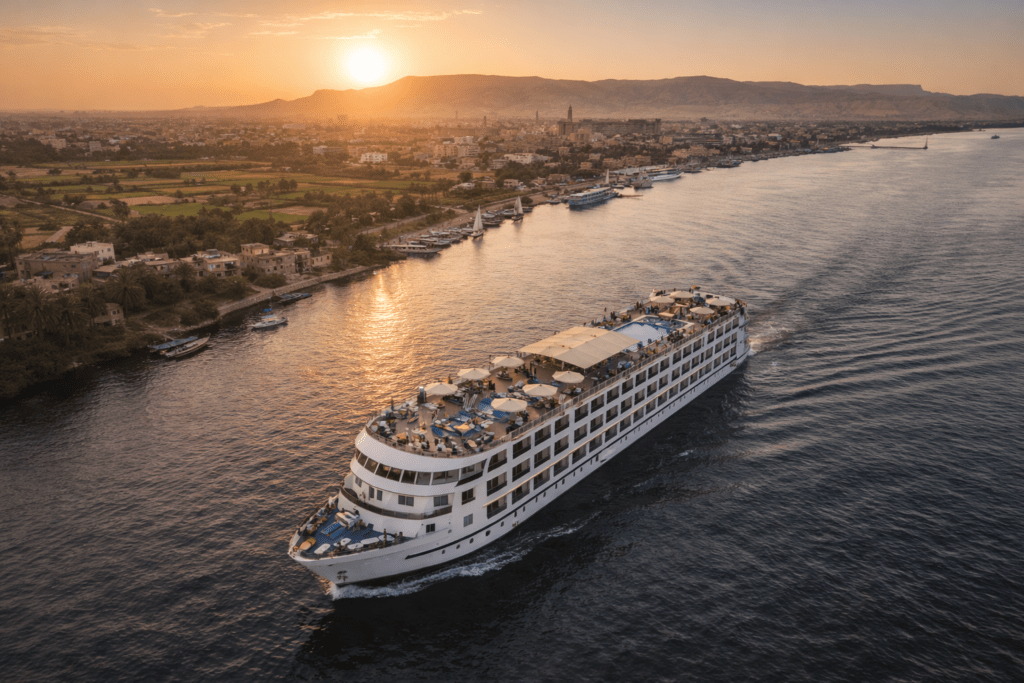
The choice is closely connected to sailing direction and the rest of the itinerary. Three-night cruises commonly operate from Aswan toward Luxor, while four-night patterns commonly operate from Luxor toward Aswan, but the actual sailing available for your dates needs to be checked.
For families, four nights should not automatically be treated as the better option simply because it is longer.
An extra night onboard does not necessarily mean an extra leisure day. Sightseeing is distributed according to the sailing program, and the more useful question is how the cruise fits with the family’s time in Luxor and Aswan, flights and the rest of the Egypt itinerary.
A 3-night sailing can work extremely well when the overall route naturally brings the family to Aswan first. A 4-night sailing may make more sense when the trip approaches the river from Luxor.
Use How Many Days Do You Need for a Nile Cruise? for the detailed duration decision.
Once you know a motor cruise fits the family, Explore ENA’s current Nile Cruise Tours let you compare the cruise itineraries actually available rather than choosing from a generic description.
Can You Skip an Excursion If the Children Need a Break?
Families do not need to approach every published sightseeing stop as though missing one would ruin the cruise.
Sometimes a child has simply had enough.
Choosing not to join an excursion does not mean the cruise itself stops operating around the family, however. The vessel still has a sailing schedule, and docking or meeting arrangements can vary.
If a child reaches the limit, speak with the guide or cruise team before deciding to miss an excursion so you understand the ship’s movements and where the group rejoins the vessel.
Prioritizing also helps. If one Luxor site matters particularly to your family, protect enough energy for it instead of exhausting everyone because every preceding stop felt compulsory.
Is a Nile Cruise Better Than Traveling Between Luxor and Aswan by Land?
For most first-time families who want to visit both Luxor and Aswan, I would start with the motor Nile cruise.
Keeping the same accommodation base for several nights removes some of the least interesting logistics of traveling with children. The journey itself becomes part of the experience rather than something that has to be completed between hotels.
Traveling by land has a genuine advantage: more control over the daily schedule.
A private land itinerary can allow a family to spend longer in one city, prioritize particular sites or build days more closely around naps and individual interests. That can be a better fit when children need very specific routines or when the family wants substantially more independent time in Luxor or Aswan.
For most first-time family itineraries covering the classic Upper Egypt route, the cruise’s continuity is a strong advantage. Families who value control over the daily schedule more than that continuity may prefer to stay on land.
What About a Dahabiya With Children?
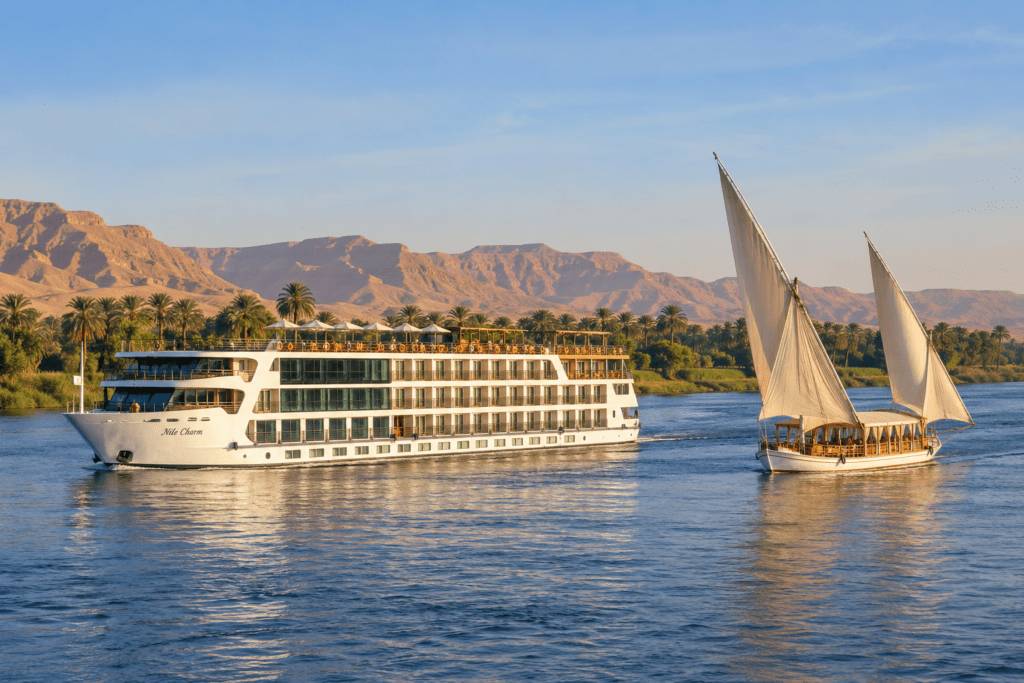
A dahabiya is a different type of Nile journey, not simply a smaller motor cruise. These vessels are smaller and follow a different sailing style, so the family considerations are not identical. Experience Egypt also treats dahabiyas separately from classic Nile cruises.
If you are considering that option, use the Nile Cruise vs Dahabiya guide for the full comparison rather than assuming the advice for a motor cruise transfers directly.
Frequently Asked Questions
Is a Nile cruise worth it with kids?
For many families, yes—especially when the trip includes both Luxor and Aswan. The strongest advantage is keeping the same accommodation base while moving through Upper Egypt. The main tradeoff is that sightseeing remains archaeology-heavy and follows the cruise’s operating schedule.
Do Nile cruises have kids clubs?
Do not assume they do. Children’s entertainment and facilities are vessel-specific. Choose a classic Nile cruise for the river journey and sightseeing rather than expecting the children’s programming associated with a large resort-style ocean cruise.
Are meals included on a Nile cruise?
Onboard meals are normally part of the motor-cruise basis, but the exact meal plan and other inclusions should always be confirmed on the product being booked. Do not transfer the inclusions from one cruise or package to another.
Is a 3-night or 4-night Nile cruise better with children?
Neither is universally better. The choice depends on sailing direction and how the cruise fits the family’s Luxor and Aswan time, flights and wider Egypt itinerary. An additional night onboard does not automatically mean an additional leisure day.
Will children get bored with the temples?
Some will. Interest depends on the child and the way visits are paced. Keep explanations selective, help children notice what makes each site different and allow sailing periods to remain genuine downtime.
Can toddlers go on a Nile cruise?
Yes, but suitability depends on the child, the actual vessel and the family’s tolerance for the cruise schedule. Confirm sleeping arrangements, stairs, railings and other important physical features before booking, and plan around naps, carrying and supervision rather than assuming every published excursion will suit a toddler’s routine.
Is a Nile Cruise Worth It for Your Family?
For most first-time families combining Luxor and Aswan, yes—the motor Nile cruise is the option I would start with.
It reduces repeated hotel changes, connects the major Upper Egypt stops naturally and creates periods when the family can stop sightseeing while still moving through the route.
It is less suitable when children need highly individualized daily timing, when several consecutive archaeological visits are likely to make the trip miserable, or when the available vessel cannot provide the sleeping or physical setup the family needs.
The deciding question is not whether Nile cruises are universally “family-friendly.” It is whether the sightseeing rhythm suits your children and the actual vessel meets your family’s practical needs.
If it does, compare Explore ENA’s current Nile Cruise Tours to see the live 3- and 4-night cruise options and cruise-based itineraries currently available.