Marsa Matrouh Travel Guide: Egypt’s Mediterranean Paradise
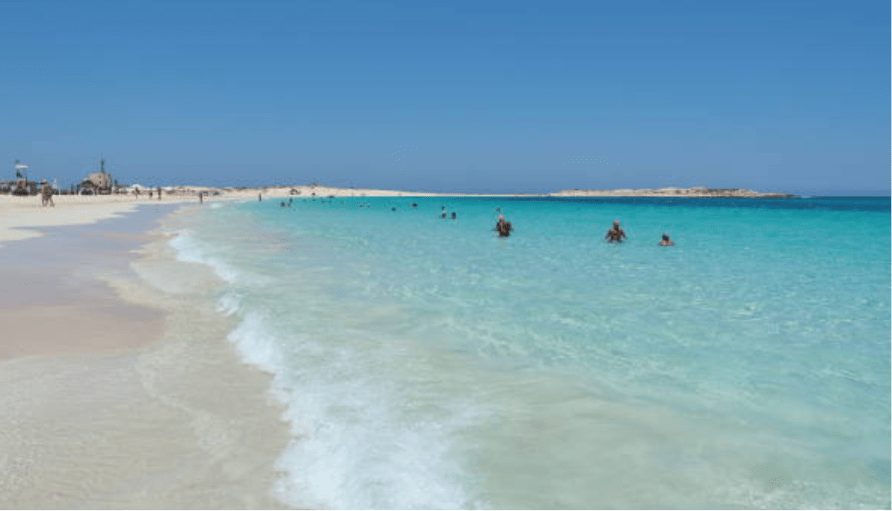
Marsa Matrouh is the place to choose when you want Egypt to slow down. Around 290 kilometers west of Alexandria, the Mediterranean changes character: pale sand meets remarkably turquoise water, rocky headlands shelter small coves, and summer evenings revolve around families walking the Corniche rather than international resort nightlife. Egypt’s official tourism authority calls Matrouh the country’s “classic summer getaway,” and that description is more useful than calling it another North Coast resort.
The strongest Marsa Matrouh trip is built around the coast rather than a packed sightseeing schedule. Spend mornings swimming, retreat from the strongest afternoon sun, and use late afternoons and evenings for viewpoints, seafood, markets, museums, and the city itself. Four or five nights is enough to understand the destination; a week works better for families who genuinely want a slow beach holiday.
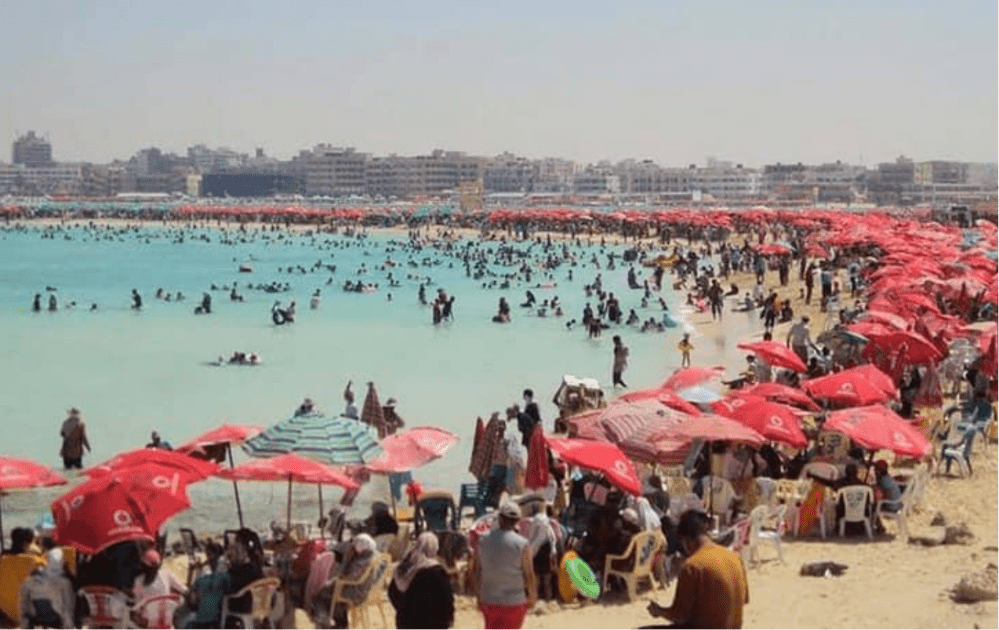
Timing matters. July and August deliver the full Egyptian summer atmosphere, but they also bring the heaviest domestic crowds and greater pressure on accommodation and popular beaches. Travelers with flexibility should look seriously at June or September. You still get the Mediterranean experience without having to fight peak-season conditions every day.
Expert Insight: Don’t approach Marsa Matrouh as a checklist of famous beaches. Agiba, Cleopatra, and Gharam are worth seeing, but the better holiday comes from choosing one convenient base, protecting your best morning swimming hours, and using the famous beaches selectively.
Why Marsa Matrouh Is Different From the Rest of Egypt’s North Coast
Matrouh belongs to the Mediterranean resort culture that Egyptians knew long before today’s gated North Coast developments.
Its coastline has been attracting visitors for generations. Official tourism material connects the city’s enduring popularity with classic Egyptian films from the 1950s and 1960s, while the State Information Service describes a seven-kilometer bay where natural rock formations protect sections of soft white sand and transparent water.
That history still affects how the destination feels.
You can stay in a resort, but you do not have to spend the entire holiday inside one. Central Matrouh has apartments, hotels, restaurants, markets, public beaches, museums, and a busy evening Corniche. Farther east and west, the experience becomes increasingly resort-oriented or secluded.
This flexibility is one reason Why Egyptians Choose Marsa Matrouh for Their Summer Vacation year after year. The destination accommodates different budgets and generations without depending entirely on the newest luxury development.
For international visitors, that also means Marsa Matrouh feels noticeably more domestic than Sharm El Sheikh or Hurghada. A 2025 visitor described encountering relatively few foreign tourists and singled out both the clear water and the locally Egyptian atmosphere as reasons the trip stood out.
The Best Beaches Should Not All Be Used the Same Way
The defining attraction is the Mediterranean, but choosing the right beach matters more than trying to visit every famous name.
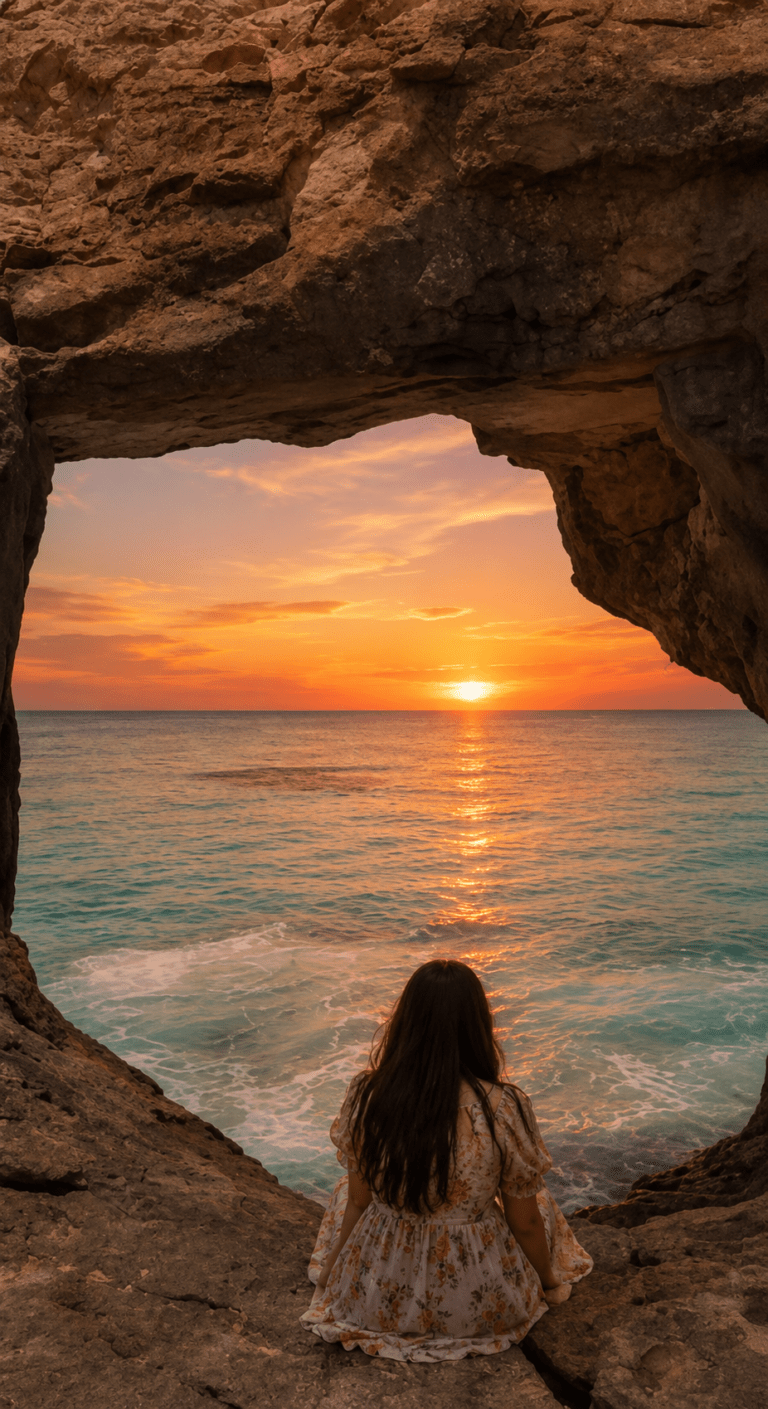
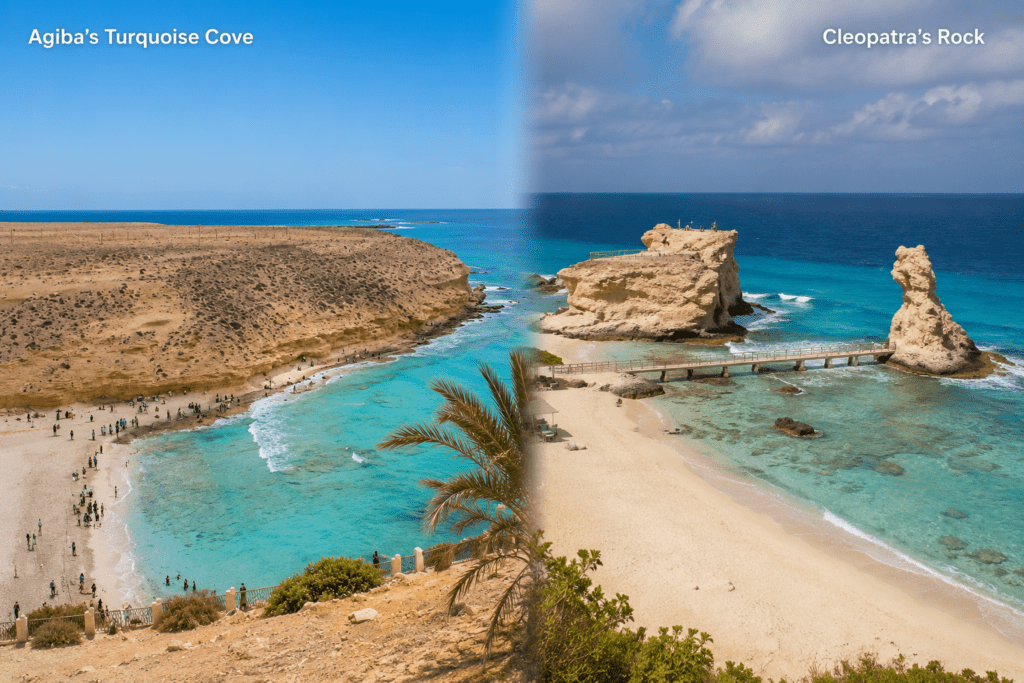
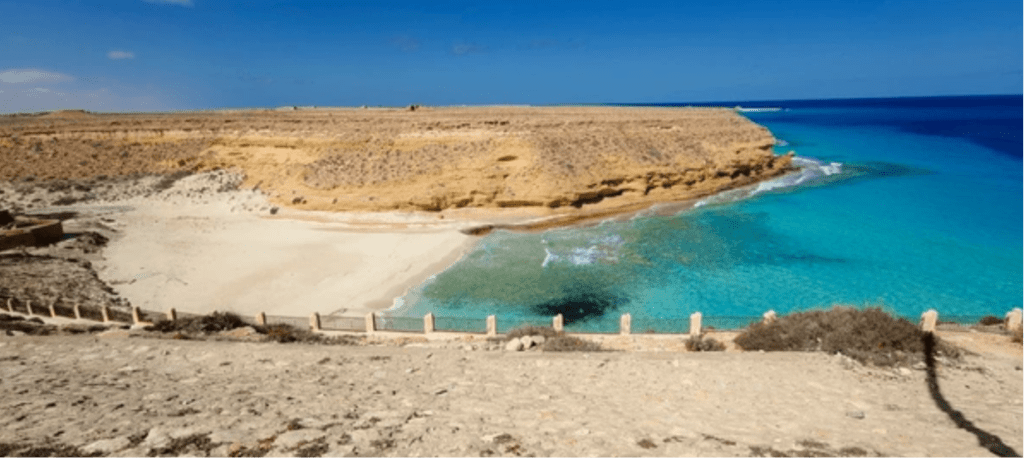
Agiba Beach deserves priority on a first visit. The compact cove sits below pale cliffs, creating the elevated turquoise-water view most closely associated with Marsa Matrouh. Its weakness is exactly what makes it beautiful: there is limited space. During peak summer, the small beach can become crowded quickly.
Cleopatra Beach should be approached differently. The rocky coastline and famous natural formation associated with Cleopatra’s Bath make it more compelling as a scenic stop than as your default all-day swimming beach.
Gharam Beach has a broader connection to Egyptian summer culture and classic cinema, while Rommel Beach combines the coast with the area’s World War II history.
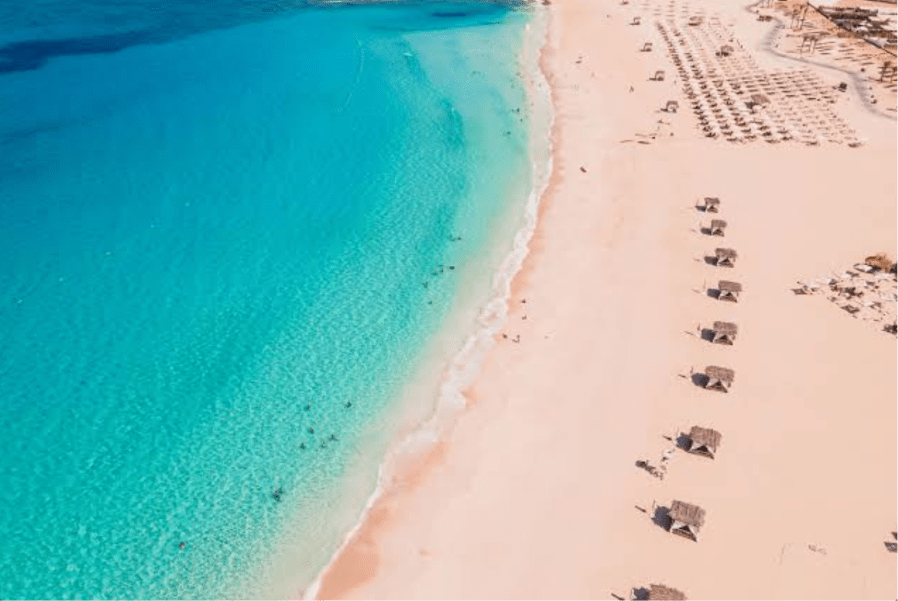
Then there is Almaza Bay, east of the city. This is a different proposition altogether: a polished resort environment with private white-sand beaches, pools, restaurants, and considerably more controlled facilities. Current Booking.com listings show several high-end properties in Almaza Bay, with recent guests repeatedly praising the beach, location, pools, and family facilities.
If you’re choosing beaches rather than simply collecting names, read our Best Beaches in Marsa Matrouh guide. It compares water, waves, facilities, access, families, photography, and crowd conditions.
Agiba or Cleopatra?
Choose Agiba if you can visit only one.
Agiba delivers the stronger combination of beach, water color, cliffs, and viewpoint. Cleopatra is worth adding because it offers a different rocky landscape, but it should not replace Agiba simply because the Cleopatra name is more famous internationally.
The best sequence is to reach Agiba early, before the cove fills, then visit Cleopatra later as a shorter coastal stop.
That becomes particularly important in July and August. Arriving at Agiba around midday and expecting the quiet cove seen in promotional photographs is one of the easiest ways to be disappointed.
Our Agiba Beach vs Cleopatra Beach: Which Should You Visit? comparison goes deeper into swimming, photography, families, access, and how to combine both without wasting the day.
The Mediterranean Is Beautiful, but Conditions Still Decide the Swim
One of the easiest mistakes in Matrouh is equating turquoise water with permanently calm water.
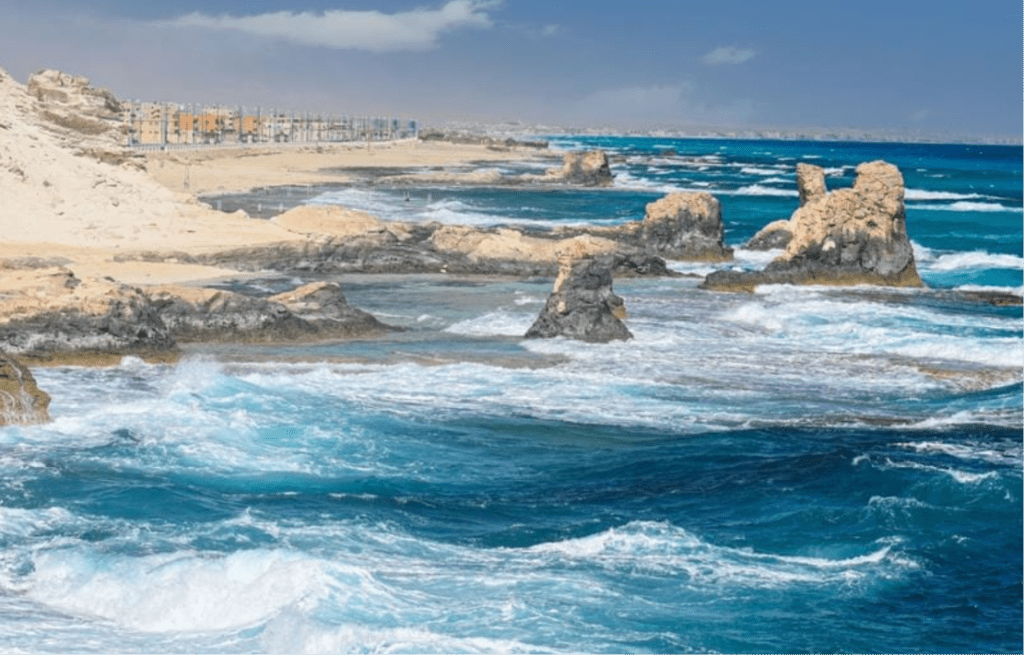
Protected bays can be exceptionally inviting, and natural rocky formations shelter parts of the coastline. The State Information Service specifically notes the role of the rock formations around Matrouh’s bay as natural wave breakers.
But this remains the Mediterranean. Wind changes conditions, exposed beaches behave differently from protected bays, and a swimming spot that was gentle yesterday can have noticeably stronger waves today.
Check conditions when you arrive rather than planning around photographs from another week. Families should prioritize beaches with active lifeguard supervision and follow warning flags or local restrictions immediately.
Guide’s Note: Never force the famous-beach itinerary on a rough-water day. Agiba’s viewpoint and Cleopatra’s landscape remain worth seeing without swimming, while a protected hotel beach may provide the better place to get into the water.
June and September Are the Smartest Months for Many International Travelers
Marsa Matrouh’s beach season is concentrated around summer in a way the Red Sea’s is not.
June brings warm days and the beginning of the main swimming season before domestic holiday pressure reaches its height. July and August are the classic Egyptian summer months: beaches, accommodation, restaurants, and the Corniche are at their liveliest.
September is the strongest overall choice for many international travelers. The sea has absorbed summer warmth, while the coast begins to become easier once the most intense domestic vacation period recedes.
The distinction is important because Matrouh’s atmosphere is heavily shaped by Egyptian rather than international travel patterns. If you want to experience the destination at full energy, July or August makes sense. If you want turquoise water with less competition for beach space and hotel rooms, September is the better decision.
Our Best Time to Visit Egypt’s Mediterranean Coast gives the full June-to-September comparison, including sea temperatures, weather, crowds, families, budget considerations, and photography.
Families Should Choose the Hotel Before the Famous Beach
Marsa Matrouh can be an excellent family destination, but convenience matters more with children than Instagram scenery.
A family with toddlers will usually benefit more from direct beach access, reliable shade, bathrooms, pools, breakfast, and the ability to return to the room quickly than from staying somewhere simply because Agiba is nearby.
This is where resort areas such as Almaza Bay become compelling. Booking.com currently lists multiple family-oriented properties around Matrouh, and guest reviews repeatedly emphasize private beaches, children’s pools, spacious accommodation, and resort facilities.
Central Matrouh can work equally well for families who want restaurants, shops, and evening life close by, particularly if they have private transport for beach outings.
Agiba is worth seeing with children, but it does not need to become the family beach every day. Cleopatra works better as a short excursion when children are young because rocks and changing water conditions demand more supervision.
Our Family Guide to Marsa Matrouh explains which decisions make the trip easier with children, including accommodation, beach timing, evening activities, and peak-season crowds.
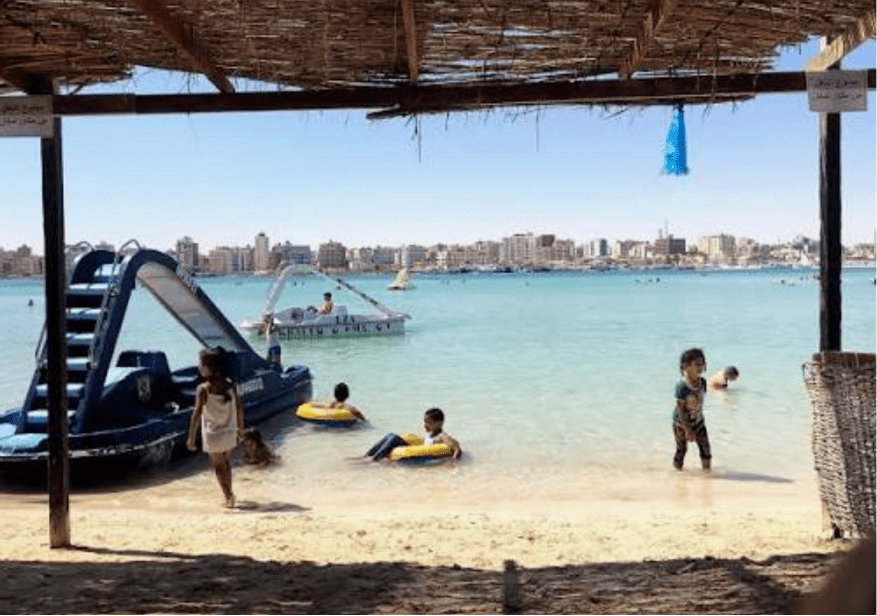
Choose Central Matrouh for Local Life, Almaza Bay for Resort Convenience
Accommodation location changes the entire trip.
Staying in or near central Marsa Matrouh makes sense if you want to walk the Corniche, eat in local restaurants, visit markets, and experience the city rather than only its coastline. You’ll have a greater sense of ordinary Egyptian summer life, but beach quality and hotel standards vary more.
Staying around Almaza Bay is the stronger choice if your priority is a polished resort holiday. Current listings show properties with private white-sand beaches, pools, landscaped grounds, fitness facilities, and resort dining. Verified reviews from 2025 and 2026 repeatedly praise the sea and beach quality, although value-for-money scores can be weaker at the premium end.
Families and travelers who want to unpack once and minimize daily logistics often benefit from that convenience.
Couples or repeat Egypt visitors wanting a more locally rooted trip may prefer staying closer to Matrouh itself and using a car or driver for the coastline.
There is no advantage in booking a remote resort and then spending every evening driving into town. Decide first whether you want Matrouh the city or Matrouh the resort coast, then choose accommodation.
Marsa Matrouh Has More to Do Than Swim—But Don’t Overstate It
Matrouh is not Luxor beside the sea.
The beach remains the central reason to travel here, and any itinerary pretending otherwise is working against the destination. Even local advice to a recent visitor interested in history and culture was straightforward: Matrouh is mostly about its beaches, with Bedouin experiences, food, and the Rommel Museum providing useful additions.
That said, several experiences are worth leaving the sand for.
The Marsa Matrouh Museum is the strongest cultural starting point. Its collection explains the region’s role in trade, fishing, desert culture, neighboring Mediterranean connections, science, and history. The museum operates in morning and evening sessions, with a daily 3:00–5:00 p.m. break.
Rommel’s Cave adds a World War II dimension, while Souq Libya provides a more everyday local shopping experience. The Corniche becomes one of the easiest places to spend an evening once temperatures fall.
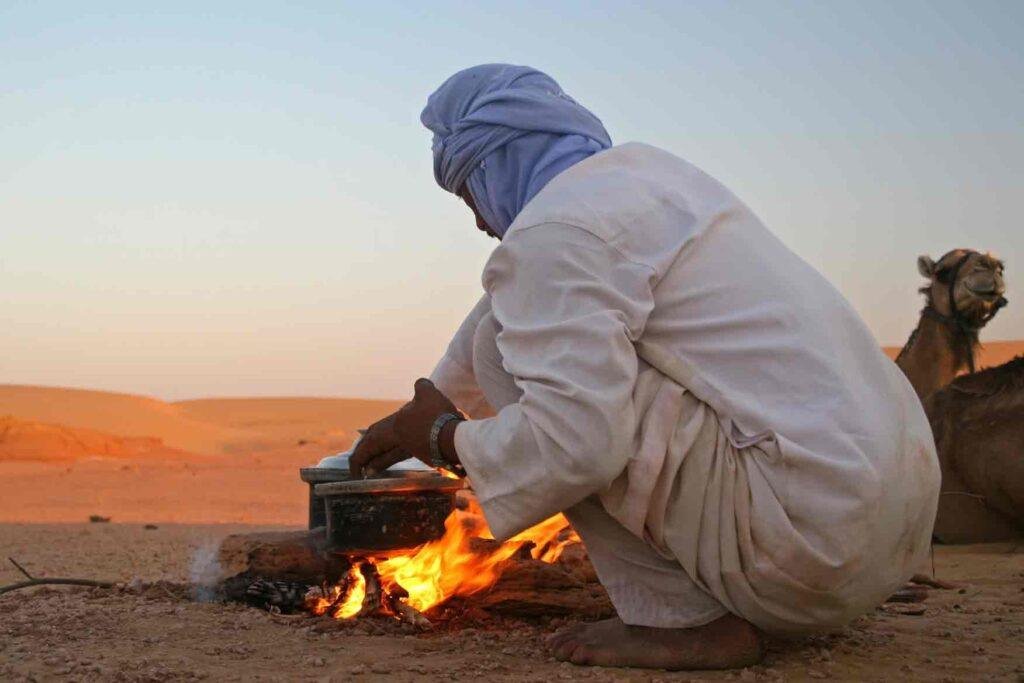
Bedouin desert experiences can also add variety, particularly during a longer stay.
For the full non-beach side of the destination, see What to Do in Marsa Matrouh Besides the Beach.
Evenings Are When the City Makes More Sense
Do not judge Marsa Matrouh at 2:00 p.m.
Summer afternoons are for getting out of the strongest sun. The city becomes more sociable after sunset, when families emerge, cafés fill, restaurants get busier, and the Corniche turns into an evening gathering place.
This rhythm can initially feel late to visitors accustomed to eating dinner at 6:00 p.m. Trying to maintain an early northern-European or North American schedule can mean missing the hours when Matrouh is most enjoyable.
Use the morning for the sea. Rest or eat during the hotter part of the day. Go out again in the evening.
It sounds simple because it is. The mistake is fighting the destination’s rhythm rather than adopting it.
Seafood Deserves One Proper Evening
Marsa Matrouh’s relationship with the Mediterranean extends directly onto the dinner table.
Local advice to visitors repeatedly highlights seafood as part of the Matrouh experience. The better meal is not necessarily the most elaborate restaurant in the most expensive resort. Look for somewhere with a strong turnover of fish and local diners.
At traditional seafood restaurants, you may choose fish or shellfish before it is prepared. Confirm the price—particularly when sold by weight—before cooking, then decide whether you want it grilled or fried.
Allow more time than you might for a quick resort buffet. A seafood dinner followed by a walk along the Corniche is one of the easiest ways to experience Matrouh beyond the famous turquoise-water photographs.
Getting to Marsa Matrouh From Cairo Requires a Real Travel Day
Marsa Matrouh is not a casual extension of Cairo.
Official Cairo Governorate information gives an approximate road distance of 439 kilometers between Cairo and Marsa Matrouh, although distances vary by route and starting point. The State Information Service places Matrouh approximately 290 kilometers west of Alexandria.
For most international travelers, private road transport is the simplest option when Matrouh forms part of a larger Egypt itinerary. Having a vehicle also makes it easier to reach Agiba, Cleopatra, and beaches outside the city.
Seasonal rail connections can be useful for domestic travelers, but schedules vary and should be checked directly before travel.
Flying can occasionally be an option depending on seasonal service, but Marsa Matrouh should not be planned on the assumption that convenient year-round international flight schedules will exist.
The practical lesson is more important than the exact kilometer count: do not travel from Cairo, check into a hotel, and expect to have a full productive beach day afterward. Treat arrival and departure as part of the itinerary.
Alexandria Fits Naturally Before or After Matrouh
Alexandria and Marsa Matrouh make sense together because they show two very different versions of Mediterranean Egypt.
Alexandria is urban, historic, crowded, architectural, and culturally dense. Matrouh is slower and dominated by the coast.
The road distance between them is manageable enough that international travelers can use Alexandria as the cultural half of a northern Egypt journey before continuing west for several beach days.
This works better than trying to visit Alexandria as a rushed day trip from Matrouh. If Alexandria matters to you, give it its own nights rather than spending much of a Matrouh day sitting on the road.
Siwa Should Be a Separate Destination, Not a Day Trip
Siwa often appears beside Marsa Matrouh on maps and itineraries because both sit in western Egypt.
That does not make Siwa a sensible excursion.
Recent firsthand driving reports describe the Matrouh–Siwa road as undergoing upgrades in 2026, with sections reduced to single carriageway during construction; the traveler specifically preferred making the journey in daylight. Conditions can of course change as roadworks progress.
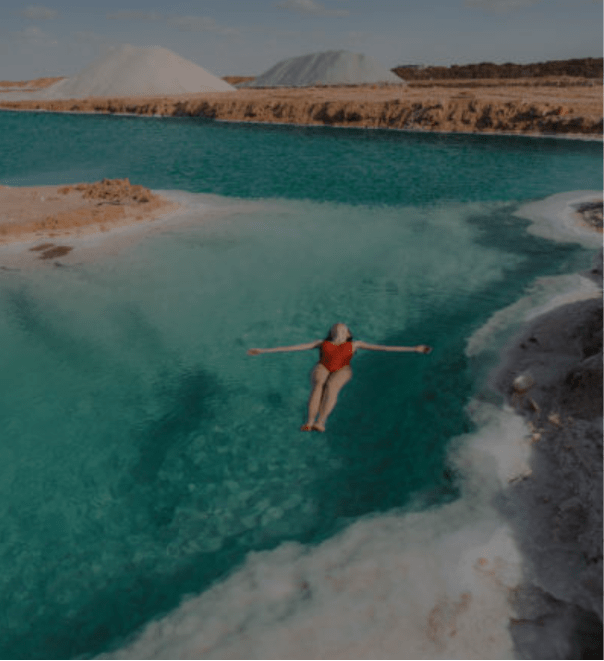
More importantly, Siwa deserves time. Salt lakes, Shali, the Great Sand Sea, hot springs, archaeological sites, and oasis culture cannot be compressed into a hurried out-and-back drive.
If you want both destinations, structure the trip as Marsa Matrouh + Siwa, not Marsa Matrouh with “a quick Siwa day.”
Marsa Matrouh and the Red Sea Solve Different Travel Problems
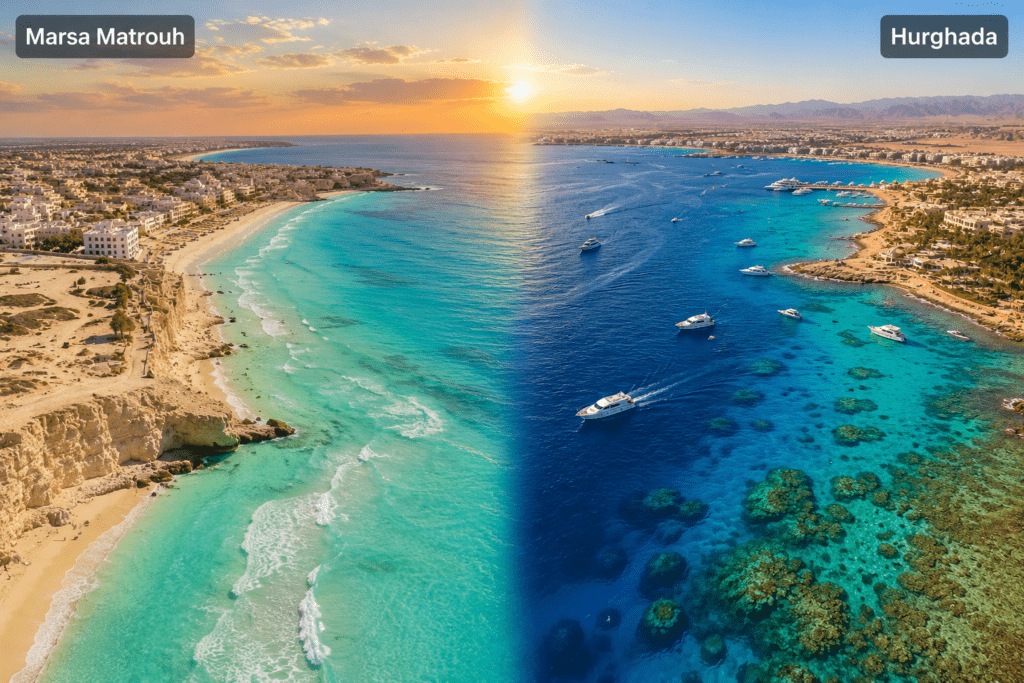
Choosing between Matrouh and Hurghada, Sharm El Sheikh, or Marsa Alam should be straightforward once you decide what you want from the water.
Choose Marsa Matrouh for white sand, Mediterranean-blue water, family beach culture, local summer atmosphere, and a trip that works particularly well between June and September.
Choose the Red Sea when snorkeling, diving, coral reefs, marine life, and year-round resort infrastructure matter more.
A traveler expecting Marsa Alam-style house reefs in Matrouh will be disappointed. A traveler expecting Marsa Matrouh’s broad pale sand from every Red Sea resort may be equally surprised.
Our Mediterranean Egypt vs Red Sea Egypt: Which Is Right for You? comparison explains the differences in beaches, water, marine life, resorts, families, nightlife, cost, and accessibility.
How Long Should You Stay?
Four to five nights is the strongest default for most international travelers.
That gives you time for a relaxed arrival, two or three substantial beach days, Agiba and Cleopatra, one cultural or local afternoon, and evenings in Matrouh without turning the destination into a race.
Three nights can work if Matrouh is one stop in a longer itinerary, but road travel consumes enough time that the stay begins to feel short.
Seven nights works particularly well for families or travelers who genuinely enjoy beach holidays. Recent verified accommodation reviews around Almaza Bay include families staying substantially longer, reflecting the area’s suitability for resort-based summer stays.
If you become restless after two days on the beach, do not book a week simply because resort packages make it convenient. Use those extra nights in Alexandria, Cairo, Siwa, or elsewhere in Egypt.
A Better Four-Day Marsa Matrouh Rhythm
On your first full morning, choose an easy beach close to your accommodation rather than immediately racing between landmarks. Get used to the water, understand how your hotel logistics work, and go into Matrouh after sunset.
Use the second morning for Agiba, arriving early enough to enjoy the viewpoint and cove before peak visitor numbers. Add Cleopatra afterward, then return for lunch and a midday break.
The third day should be the slowest: a resort or broad swimming beach in the morning, followed by the Marsa Matrouh Museum or another cultural stop later in the day and seafood in the evening.
Keep the fourth day flexible. Return to the beach you liked most, try a quieter stretch of coastline, or simply stay at the hotel if everyone is enjoying it.
That flexibility is not wasted itinerary space. It is the point of coming to Matrouh.
Practical Expectations Before You Arrive
Marsa Matrouh is more conservative and domestically oriented than Egypt’s major international Red Sea resorts. That does not require foreign visitors to mimic local dress exactly, but modest swimwear and clothing may feel more comfortable on heavily local public beaches than in private resort environments. One international visitor specifically remarked on the more modest atmosphere compared with Western beaches.
Carry Egyptian pounds for small purchases, markets, beach services, and places where card acceptance may be inconsistent.
Arabic is naturally dominant. Resort staff frequently work with international guests, but a few basic Arabic phrases become more useful once you move into local restaurants and markets.
During summer, book accommodation before arrival rather than assuming the large number of apartments means the property you actually want will remain available.
Most importantly, leave room in the schedule. Marsa Matrouh becomes frustrating only when you try to operate it like a monument-heavy sightseeing destination.
Frequently Asked Questions
Is Marsa Matrouh worth visiting?
Travelers looking for a genuine Mediterranean beach break within a broader Egypt journey will find Matrouh particularly worthwhile between June and September. Its strongest advantages are clear turquoise water, pale sand, Egyptian summer atmosphere, and the ability to combine resort comfort with a functioning local city. Travelers whose main priority is coral reefs or diving should choose the Red Sea instead.
Is Marsa Matrouh good for international tourists?
International travelers comfortable with a more locally Egyptian destination can find Matrouh more distinctive than an international resort enclave. English is easier at larger hotels than in local markets and restaurants, and the overall tourism environment is more domestic than Hurghada or Sharm El Sheikh. Recent foreign visitors have specifically highlighted that difference as part of Matrouh’s appeal.
What is the best month to visit Marsa Matrouh?
September is the strongest overall choice for travelers with flexible dates. The Mediterranean has retained its summer warmth while the pressure created by Egypt’s peak domestic holiday period begins to decline. June is another strong option. July and August make more sense if experiencing Matrouh at its liveliest matters more than avoiding crowds.
What is the best beach in Marsa Matrouh?
Agiba is the first beach I’d prioritize for scenery, but the best beach for an entire day depends on access, sea conditions, family needs, and facilities. Travelers staying at a quality resort may find their private beach far more relaxing for repeated swimming days.
Is Marsa Matrouh good for families?
Families who enjoy traditional beach holidays are particularly well suited to Matrouh. The strongest setup is accommodation with convenient beach access, shade, pools, bathrooms, and food nearby. Famous beaches such as Agiba and Cleopatra are better used as outings rather than automatically becoming the family’s everyday swimming location.
Can I visit Marsa Matrouh from Cairo for a weekend?
It is possible, but the road distance makes a very short trip inefficient for most international visitors. Three nights should be treated as the practical minimum, while four or five nights gives the destination enough room to feel like a beach break rather than two long transfers with one day of swimming between them.
Is Marsa Matrouh better than Alexandria for beaches?
Choose Matrouh for the beach holiday and Alexandria for the city experience. Matrouh’s turquoise bays and pale sand are the stronger reason to swim and relax, while Alexandria offers considerably more history, architecture, museums, restaurants, and urban culture. Combining them is stronger than expecting either destination to perform the other’s role.
Do I need a car in Marsa Matrouh?
A vehicle becomes valuable if you intend to visit Agiba, Cleopatra, Almaza Bay, and beaches outside central Matrouh. Travelers staying centrally can manage many evening activities without one, while resort guests planning to remain largely on property may barely need transport at all.
Marsa Matrouh goes wrong when travelers try to see every famous beach, add Siwa as a rushed excursion, and treat the journey from Cairo as though it consumes no time. The stronger trip protects the best Mediterranean hours, chooses accommodation around how you actually want to spend the days, and gives Matrouh enough space to feel different from the rest of Egypt. Explore ENA’s tailor-made Egypt itineraries to place Marsa Matrouh naturally alongside Cairo, Alexandria, Siwa, or the Nile—without losing half your beach holiday to avoidable transfers and poor sequencing.