Tipping in Egypt: How Baksheesh Really Works
Tipping in Egypt — often called baksheesh — is a normal part of daily life, and understanding how it works can make your trip much smoother.
For many travelers, tipping in Egypt can feel confusing at first. When do you tip? How much is expected? And is it always required?
The short answer is that tipping is customary, but not complicated once you understand the context. In Egypt, tipping is less about obligation and more about appreciation — though it is expected in many situations.
Understanding how tipping works is just one part of planning your trip — it also helps to know how to book an Egypt tour without getting scammed.
What Is “Baksheesh” in Egypt?
The term baksheesh in Egypt refers to small tips given in exchange for service. It is a widely understood and commonly used part of everyday interactions, particularly in tourism and hospitality.
Baksheesh can apply in many situations — from hotel staff and drivers to guides, restaurant service, and small acts of assistance at historical sites. The amounts are usually modest, but the practice itself is deeply embedded in the local culture.
Unlike destinations where tipping is optional or occasional, in Egypt it is considered a normal and polite part of most service interactions. In many cases, it is not just appreciated — it is expected as part of how services are delivered.
Understanding this early helps travelers navigate interactions more comfortably and avoid confusion during their trip.
For a quick, practical breakdown — including when to tip, when not to, and typical amounts — see our guide to tipping and baksheesh etiquette in Egypt on our Community page.
Why Tipping Is So Common in Egypt
Tipping plays a larger role in Egypt than in many destinations because it forms a meaningful part of income across much of the service industry — particularly in tourism are supported by official organizations such as the Egyptian Ministry of Tourism and Antiquities.
Many workers, including hotel staff, drivers, guides, and service employees, rely on tips as a supplement to their base earnings. As a result, tipping is not just appreciated — it is an expected part of how services are delivered.
This is especially true in travel-related settings, where personalized service is a key part of the experience.
For travelers, this does not mean tipping excessively or in every situation. It simply means understanding when tipping is part of the local norm and responding accordingly.
Once you recognize this, tipping becomes less of a question and more of a natural part of interacting in Egypt.
When You’re Expected to Tip in Egypt
Tipping in Egypt is most common in situations where someone provides a direct or personal service.
In hotels, staff such as porters, housekeeping, and waiters are typically tipped for their assistance. In restaurants, a service charge may be included, but it does not always go directly to staff, so leaving an additional small tip is still customary.
Drivers and guides are also expected to be tipped, particularly on tours where they are responsible for transportation, coordination, and your overall experience throughout the day.
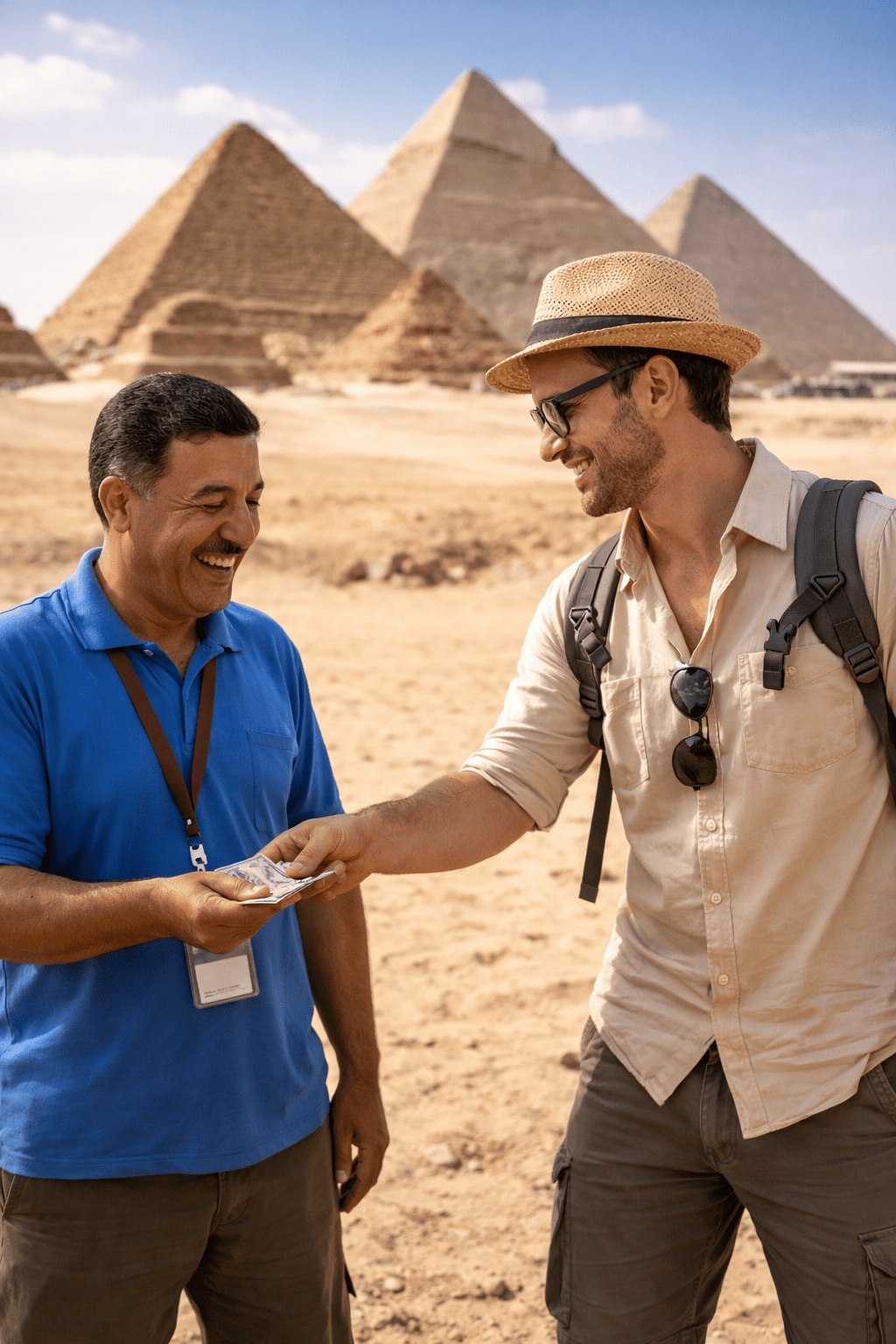
At historical sites, you may encounter attendants or guards who offer assistance — such as pointing out directions, helping with access, or allowing entry to certain areas. In these cases, a small tip is often expected.
The pattern is straightforward: when someone provides a service or assistance, a modest tip is considered appropriate.
How Much Should You Tip in Egypt?
Tipping in Egypt does not require large amounts — small, consistent tips are the norm.
For everyday services, modest tips are appropriate. Hotel staff, porters, and small assistance at sites typically receive a small amount, while in restaurants, leaving around 5–10% is standard if a service charge is not clearly included.
For guides and drivers, tipping is usually higher, reflecting the level of service, time, and responsibility involved throughout the day or trip.
Rather than focusing on exact numbers, it is more useful to think in terms of proportion. The more involved and personalized the service, the higher the tip should be.
Keeping small bills on hand and tipping consistently is far more important than the exact amount.
Knowing typical costs can also help you understand tipping expectations — especially when planning how much a trip to Egypt costs.
Tipping on Tours and Nile Cruises in Egypt
Tipping becomes more structured when you are on an organized tour or Nile cruise in Egypt.
In these cases, there is usually a recommended tipping range provided by your tour operator or guide, often at the beginning or end of the trip. This typically covers guides, drivers, and cruise staff, and helps standardize the process for travelers.
Some tours collect tips as a group and distribute them on your behalf, while others leave tipping to each traveler individually. In either case, it is standard practice to tip at the end of the service period — either at the end of the day, the tour, or the cruise.
On Nile cruises, tipping may also include multiple staff members working behind the scenes, which is why a pooled or suggested amount is common.
Because these teams play a central role in your experience — from logistics to daily service — tipping in this context is both expected and an important part of the overall travel culture.
This is particularly relevant on structured itineraries, where guides play a key role — something to consider when deciding do you need a guide in Egypt.
Situations Where Tipping Can Feel Confusing
One of the most common challenges travelers face when tipping in Egypt is knowing when a tip is optional versus expected.
In busy areas and at major tourist sites, you may encounter people offering unsolicited assistance — such as giving directions, pointing out features, or offering to take photos. While these interactions can seem helpful, they often come with an expectation of a small tip.
The key is to manage the interaction from the start. If you do not want assistance, a polite but firm “no, thank you” and continuing to walk is usually enough. Avoid engaging too much, as even brief interaction can sometimes be interpreted as acceptance.
If you do choose to accept help, it is reasonable to offer a small tip in return.
Understanding this dynamic in advance helps avoid awkward situations and allows you to move through busy sites with more confidence.
Do You Need to Carry Cash for Tipping in Egypt?
Yes — tipping in Egypt is almost always done in cash.
It’s important to carry small denominations of Egyptian pounds, as most tipping situations involve modest amounts. Having small bills readily available makes it easier to tip appropriately without overthinking or overpaying.
While some hotels and higher-end services may accept card payments, everyday tipping — including for drivers, guides, hotel staff, and small assistance at sites — is expected to be in cash.
Many travelers find it helpful to set aside a small daily tipping budget and keep it accessible throughout the day. This simplifies the process and avoids the need to search for change in the moment.
Is Tipping Mandatory in Egypt?
Tipping in Egypt is not legally required, but in many situations it is expected as part of the local service culture.
This is particularly true in tourism-related settings, where tipping is built into how services are delivered. Hotel staff, guides, drivers, and other service providers often rely on tips as part of their overall income, which is why tipping is considered standard practice.
For travelers, this means tipping is less about obligation and more about following local norms. While you are not required to tip in every situation, choosing not to tip in common service interactions can feel out of place.
In practice, most visitors treat tipping as a normal part of traveling in Egypt rather than an optional extra.
How to Handle Tipping Comfortably in Egypt
The best way to approach tipping in Egypt is with consistency and simplicity.
You do not need to overthink every situation or worry about exact amounts. Small, reasonable tips given at the right moments are more than enough and are widely understood within the local culture.
What matters most is being polite, respectful, and aware of the context. A calm, confident approach — combined with having small cash on hand — makes tipping feel natural rather than stressful.
Over time, it becomes part of the rhythm of travel in Egypt, not something that requires constant attention.
FAQ: Tipping in Egypt
Do you have to tip in Egypt?
Tipping in Egypt is not mandatory, but it is widely expected in many service situations, especially in tourism. In practice, most travelers treat tipping as a normal part of the experience rather than optional.
How much should you tip in Egypt?
How much to tip in Egypt depends on the type of service, but small amounts are standard. Everyday services require modest tips, while guides and drivers typically receive higher amounts due to their level of involvement and time.
Is tipping included in restaurants in Egypt?
Some restaurants in Egypt include a service charge, but this does not always go directly to staff. For this reason, leaving an additional small tip is still common practice.
Should you tip in US dollars or Egyptian pounds?
Egyptian pounds are preferred, especially for smaller tips. Using local currency makes it easier to give appropriate amounts and is more practical in everyday situations.
Do you tip tour guides and drivers in Egypt?
Yes — tipping guides and drivers in Egypt is standard practice, particularly on organized tours. Their role in managing logistics, timing, and your overall experience makes tipping both expected and appreciated.
Final Thoughts: Understanding Baksheesh in Egypt
Tipping in Egypt — or baksheesh — is part of the rhythm of travel, not something to stress over.
Once you understand how tipping in Egypt works, it becomes simple: small, consistent tips given at the right moments go a long way. The focus is not on exact amounts, but on recognizing service and responding appropriately.
Approached with awareness and respect, tipping becomes a natural part of the experience — helping everyday interactions feel smoother and more comfortable throughout your trip.
Planning Your Trip to Egypt?
At Egyptian Nile Adventures, we help travelers navigate every part of the journey — including practical details like tipping — so you can focus on enjoying the experience.
Our well-structured Egypt tours are designed to be smooth, well-paced, and fully supported from arrival to departure.
Explore our Egypt travel experiences and start planning your trip.