Hawara Pyramid and Egypt’s Lost Labyrinth: What Really Remains?
Herodotus was so impressed by Egypt’s Labyrinth that he claimed it surpassed even the pyramids. He described twelve courtyards, thousands of rooms and an extraordinary arrangement of stone passages and halls. For a building that once inspired such admiration, remarkably little is visible today.
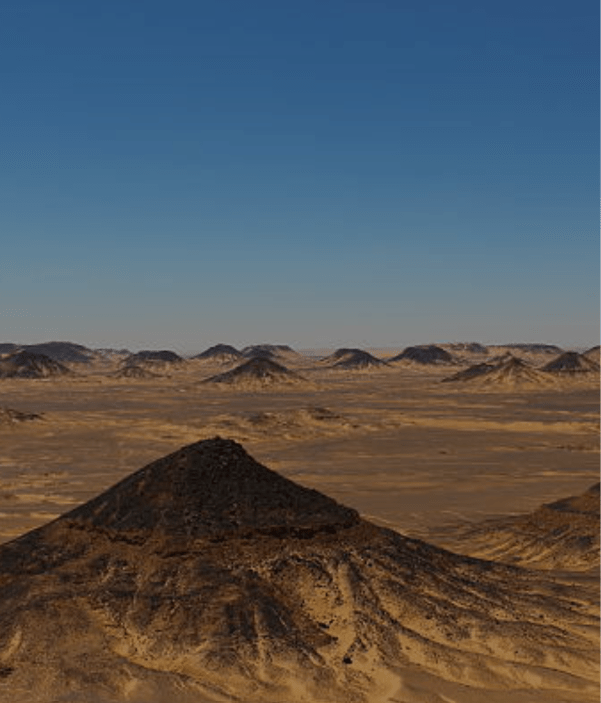
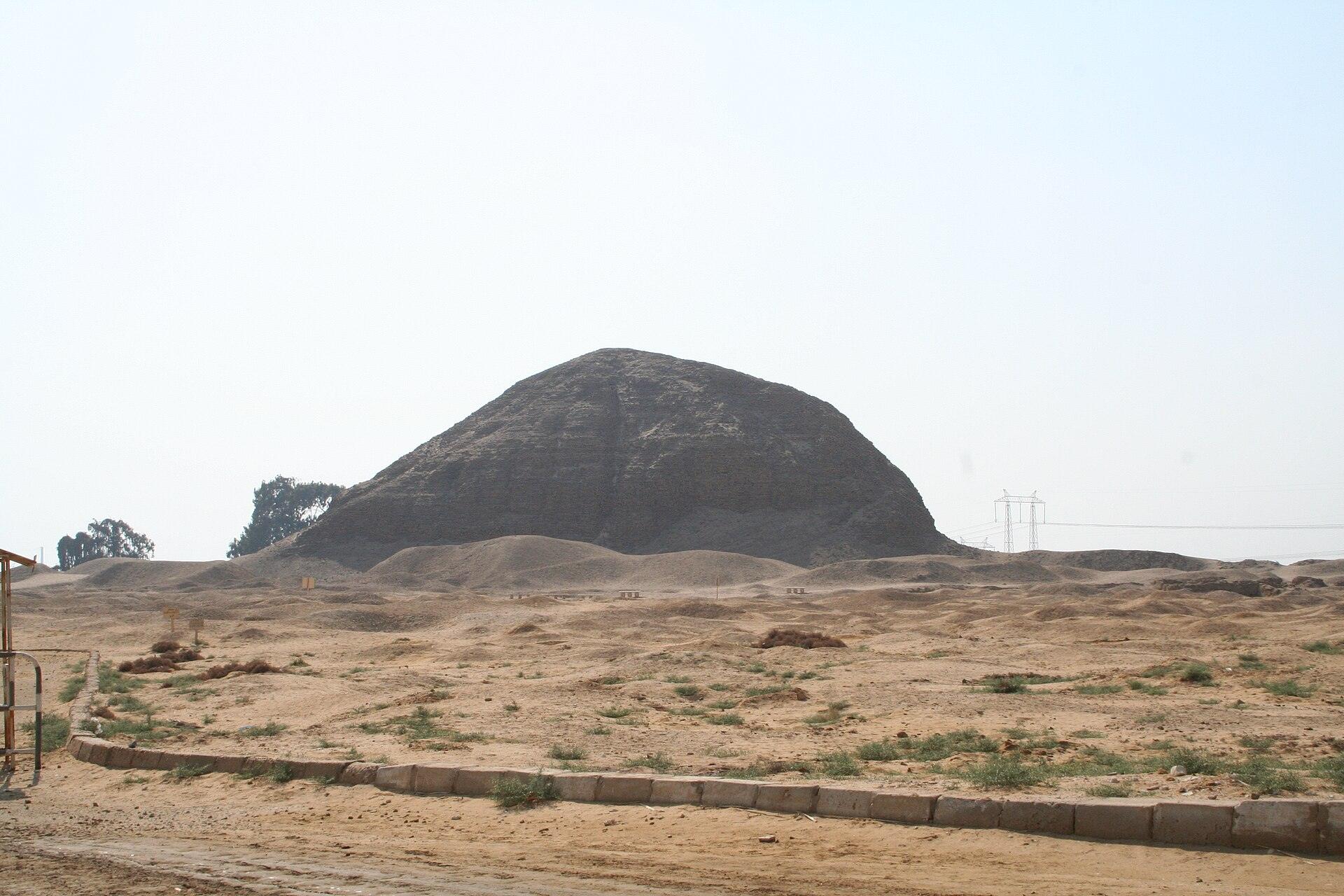
At Hawara, on the edge of Fayoum, the contrast is striking. Amenemhat III’s pyramid has weathered into an irregular mound of mudbrick, while the enormous temple complex that once stood beside it has almost entirely disappeared.
It’s easy to understand why the missing building has attracted so many theories. But Hawara doesn’t need an invented underground city to be interesting. Archaeologists have found evidence of a substantial monument, and the ancient accounts give us some idea of why it became famous. The difficulty is working out how much of those descriptions can still be supported by what survives.
Where Is Hawara Pyramid?
Hawara lies near the southeastern entrance to the Fayoum depression, southwest of Cairo. The pyramid stands close to the cultivated land that spreads out from the Nile Valley into this part of Egypt’s Western Desert.
During the Middle Kingdom, Fayoum became an important center of royal investment. Water flowing through the Bahr Yussef channel supported agriculture, and Egypt’s kings took an increasing interest in developing the region.
Amenemhat III’s pyramid was part of that wider activity. It stood in a landscape shaped by irrigation, farming, settlements and religious institutions rather than in an isolated stretch of desert.
Today, Fayoum is better known to many travelers for Lake Qarun, Wadi El Rayan and its desert scenery. Hawara offers a different reason to visit. While the lakes and natural attractions show off the region’s landscape, the pyramid takes you back to a period when Fayoum was becoming an important part of Egypt’s royal building program.
Our Fayoum travel guide explores the wider region, including its archaeological sites, lakes, desert landscapes and practical travel considerations.
Who Built the Hawara Pyramid?
The pyramid was built for Amenemhat III, a king of Egypt’s Twelfth Dynasty during the Middle Kingdom.
Amenemhat III had already undertaken a major pyramid project at Dahshur, where his earlier monument is now known as the Black Pyramid. Hawara was his second pyramid and is generally considered his final burial place.
The two projects show how much pyramid building had changed since the days of Khufu.
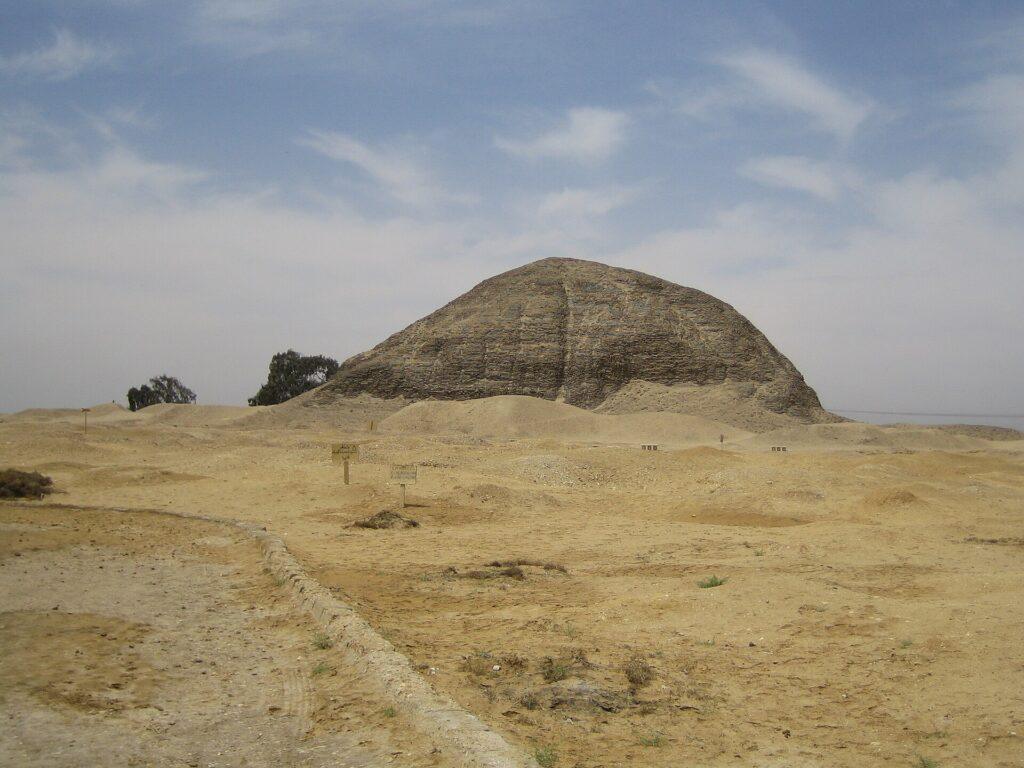
Rather than constructing Hawara primarily from massive limestone blocks, the builders used a mudbrick core covered with a protective limestone casing. That was a practical approach, but it left the pyramid vulnerable once its outer stonework disappeared.
Over the centuries, the exposed mudbrick deteriorated, and the monument lost much of its original shape. Its original height is usually estimated at approximately 58 meters, although the surviving structure is considerably lower.
From a distance, Hawara can look like an irregular mound rising from the surrounding landscape. Its appearance gives little indication of the engineering hidden within.
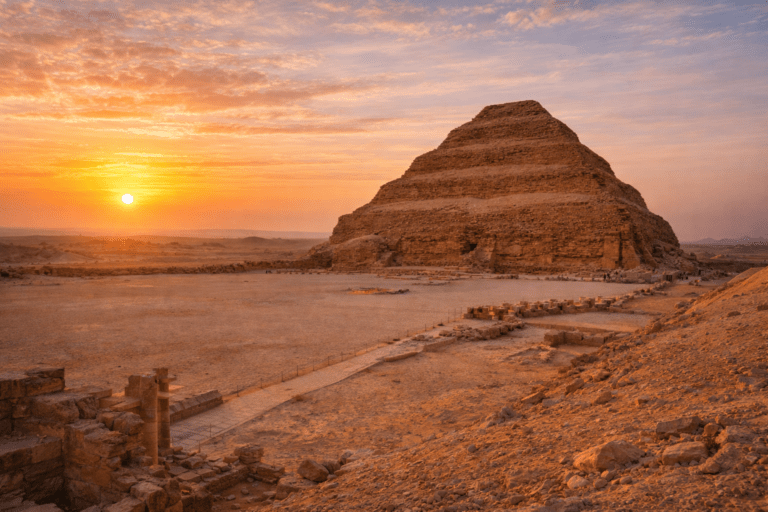
Amenemhat III’s earlier pyramid at Dahshur belongs to a much longer story of Egyptian royal tomb construction. Our Saqqara and Dahshur guide explains how pyramid design developed from Djoser’s Step Pyramid through the experiments of Sneferu and beyond.
Inside Amenemhat III’s Pyramid
The exterior may be badly damaged, but the internal construction was remarkably ambitious.
The builders placed the entrance on the southern side, departing from the northern entrances commonly used in earlier pyramids. Beyond it, they created a complicated route with changes of direction, concealed openings and massive stone barriers intended to prevent tomb robbers from reaching the burial.
The burial chamber was particularly unusual. It was carved from an enormous single block of quartzite and set within a larger limestone-lined space. Heavy stone slabs formed the roof above it, helping protect the chamber beneath the weight of the pyramid.
These elaborate precautions didn’t prevent the burial from being disturbed in antiquity. They do, however, reveal how much thought the builders put into securing a royal tomb.
Hawara’s underground structures have also faced a serious conservation problem: rising groundwater.
Research has identified water entering the pyramid from the surrounding irrigation system, including the nearby Bahr Selah canal. Dissolved salts carried by the water can damage ancient masonry as moisture moves through the structure and evaporates.
Groundwater remains an important concern for the pyramid’s long-term preservation, although it doesn’t mean the interior is permanently closed to visitors.
What Was Egypt’s Lost Labyrinth?
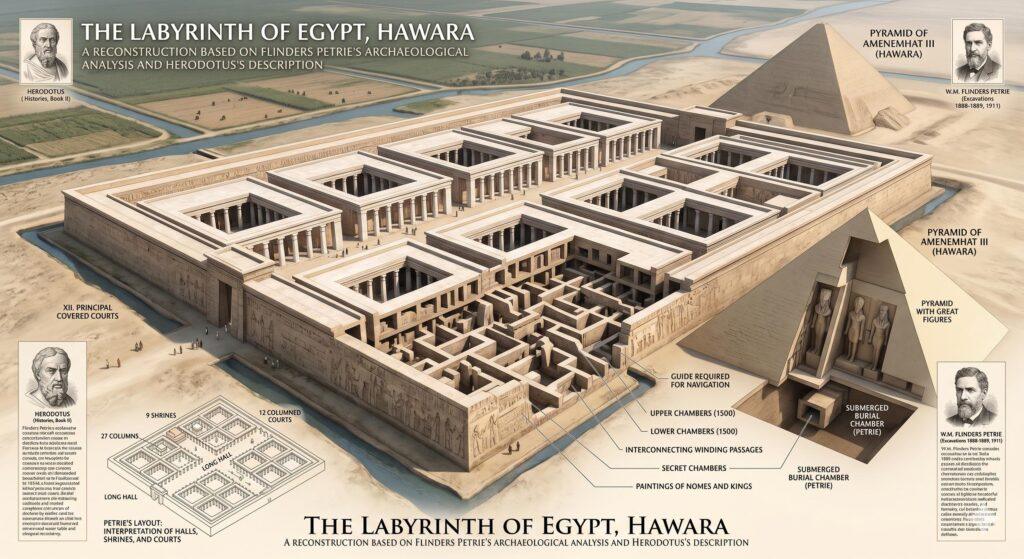
The building known as the Egyptian Labyrinth is generally identified with Amenemhat III’s enormous mortuary temple complex, which stood south of the pyramid.
Mortuary temples were places where rituals and offerings were performed for deceased kings. At Hawara, the complex appears to have been exceptionally large, with an arrangement of courts, halls and rooms that impressed visitors long after Amenemhat III’s reign.
The name Labyrinth comes from Greek writers and reflects the complicated arrangement of spaces described by people who knew the monument in antiquity.
By the time Herodotus wrote about it in the fifth century BCE, the complex was already more than a thousand years old.
Much of its stonework was later dismantled and reused, leaving archaeologists with foundations, scattered fragments and the descriptions recorded by ancient authors.
What Did Herodotus Actually Say About the Labyrinth?
Herodotus visited Egypt during the fifth century BCE and wrote about the Labyrinth in Book II of his Histories.
He placed it near Lake Moeris and Crocodilopolis, the Greek name for the city associated with the worship of the crocodile god Sobek.
According to his account, the building contained twelve roofed courts, arranged in two groups of six. He also gave a total of 3,000 chambers, with half above ground and half below.
He described carved walls, stone roofs, columns and passages connecting rooms and courtyards. The scale and complexity impressed him so much that he considered the Labyrinth more remarkable than the pyramids.
But there’s a detail often missing from modern retellings of his story: Herodotus never entered the underground chambers.
He said he had seen the upper rooms himself. Egyptian attendants, however, refused to take him below, explaining that the underground spaces contained royal burials and the remains of sacred crocodiles.
His description of those chambers therefore came from what he was told, not from personal inspection.
You can read his account in Herodotus’s Histories, Book II, Chapter 148.
Herodotus gives us valuable evidence that a remarkable building was known in the region during his lifetime. His account doesn’t establish that all 3,000 rooms existed exactly as he described them.
What Did Other Ancient Writers Say?
Herodotus wasn’t alone in describing the Labyrinth.
Strabo, writing centuries later, also discussed a large complex in Fayoum. His account emphasized its courts and halls and connected the arrangement with Egypt’s administrative districts.
Other classical authors repeated stories about the building, sometimes drawing on earlier descriptions rather than recording entirely new observations.
Their accounts help explain the Labyrinth’s reputation, but they don’t provide a consistent architectural plan.
The writers lived in different periods, and the building itself may have changed between their accounts. Repairs, alterations and the gradual removal of stone could all have affected what visitors saw.
This is why modern reconstructions can’t simply combine every ancient description into a single floor plan and present it as fact.
What Did Flinders Petrie Find at Hawara?
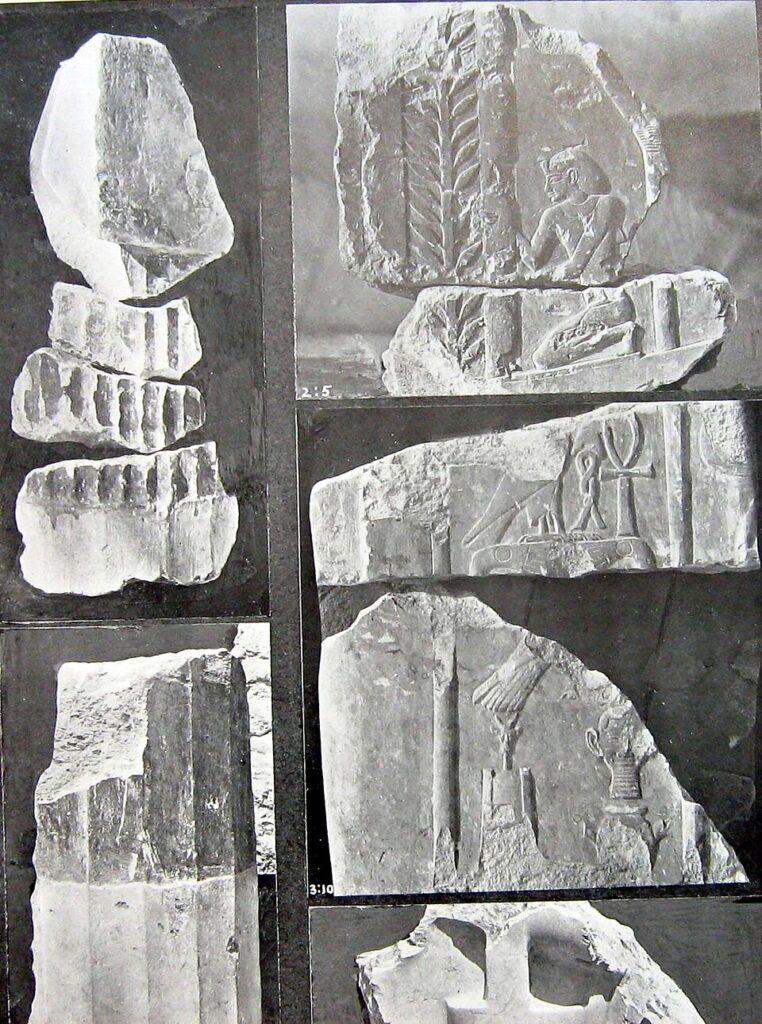
By the time Flinders Petrie investigated Hawara in the 1880s, the Labyrinth’s famous halls and courtyards had already disappeared.
Petrie worked south of the pyramid, where he found extensive deposits of broken limestone, architectural fragments and evidence of a substantial earlier building. He identified prepared surfaces and foundation remains beneath later material.
The spread of foundations and architectural debris indicated that the original complex occupied a substantial area, even though its walls and halls had largely disappeared.
In his excavation report, Petrie estimated that the remains extended across an area approximately 1,000 feet by 800 feet, or about 305 by 244 meters.
That wasn’t the measured footprint of an intact building. It was his estimate of the area represented by foundations and architectural debris.
Petrie identified the remains with the Labyrinth described by Herodotus, an interpretation that has remained influential.
What he couldn’t recover was the building’s complete arrangement. The surviving evidence didn’t reveal twelve intact courts, thousands of chambers or a network of underground halls.
The excavations established that a major monumental complex had stood beside Amenemhat III’s pyramid. Its precise layout remains uncertain.
Has Egypt’s Lost Labyrinth Been Found?
The site of the Labyrinth is generally accepted, and archaeologists have identified substantial remains associated with Amenemhat III’s mortuary complex.
What hasn’t been discovered is an intact building matching every detail of the classical descriptions.
Researchers have proposed different reconstructions using Petrie’s excavation records, surviving architectural fragments and ancient written accounts. None can be treated as a recovered original floor plan.
Modern technology has added another way to investigate the area.
Geophysical surveys can detect differences beneath the surface that may indicate buried masonry, voids or other archaeological features. One published ground-penetrating radar investigation identified anomalies near Hawara, but the researchers cautioned against identifying them as Herodotus’s Labyrinth.
An anomaly doesn’t tell archaeologists exactly what lies underground. Further investigation is needed to determine whether it represents a wall, a chamber, a change in soil or something else.
The Hawara conservation and virtual reconstruction project documented by the University of York used digital surveying and created a three-dimensional model to support conservation and interpretation of the site.
That work represents an advance in recording Hawara’s surviving structures and understanding the threats they face. It doesn’t mean archaeologists have recovered the complete original floor plan of the Labyrinth.
There may still be important archaeological remains beneath Hawara. For now, the surviving foundations and excavation records tell us more about the ancient complex than claims of a hidden underground city.
Why Was Hawara Built in Fayoum?
Amenemhat III’s choice of Hawara was closely connected to the Middle Kingdom’s development of Fayoum.
The region’s agricultural potential depended on water entering from the Nile through the Bahr Yussef channel. Royal investment helped expand cultivation and strengthen the area’s economic importance.
Amenemhat III’s reign is particularly associated with that development.
His pyramid and mortuary complex stood within a region that was becoming increasingly valuable to the Egyptian state. Fayoum’s agricultural land, settlements and religious centers were all part of that picture.
The region was also strongly associated with Sobek, the crocodile god.
Crocodilopolis, later known as Arsinoe, was an important center of Sobek worship. That religious background helps explain why sacred crocodiles feature in Herodotus’s description of the Labyrinth.
It doesn’t confirm the existence of the underground chambers he mentioned, but it places his story within a recognizable Egyptian religious setting.
Hawara’s significance is therefore about more than one pyramid or a missing temple. It belongs to a period when Egypt’s kings were reshaping the Fayoum region through agriculture, construction and royal investment.
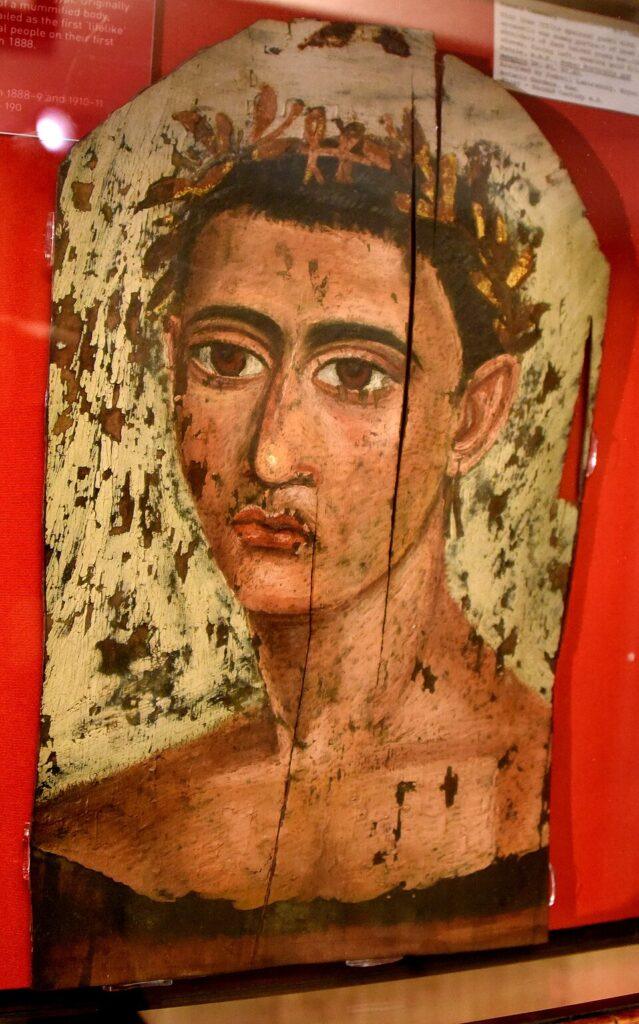
The Fayoum Mummy Portraits Discovered at Hawara
Hawara became famous for another discovery that had nothing to do with Amenemhat III’s Labyrinth.
During excavations of the cemetery, Flinders Petrie uncovered painted portraits placed over the faces of mummified individuals.
These portraits belong to Roman-period Egypt, more than a thousand years after Amenemhat III.
Many show individuals with carefully painted faces, hairstyles and clothing. Some were created using encaustic painting, in which pigments were mixed with heated wax, while others used different techniques.
Although portraits of this type have been found at several sites in Fayoum, Hawara was particularly important in bringing them to international attention.
They are now commonly known as Fayoum mummy portraits.
The discoveries show how long the area continued to be used after the Middle Kingdom.
What Can Visitors See at Hawara Today?
Hawara doesn’t have the dramatic appearance of Giza or Dahshur. Its pyramid has lost the limestone casing that once gave it a defined shape, leaving a weathered mass of mudbrick rising from the surrounding ground.
South of the pyramid is the area associated with the Labyrinth. Instead of recognizable halls and courtyards, you’ll find an archaeological landscape where most of the original structure has disappeared.
Visitors have been able to enter Hawara Pyramid and explore its ancient passages. Groundwater remains an ongoing conservation concern, and access arrangements may change when preservation work or site conditions require it.
For anyone expecting a grand monument, Hawara may initially seem underwhelming. Its appeal lies in understanding what stood here and how the site connects to Egypt’s Middle Kingdom history.
Is Hawara Worth Visiting?
Hawara is best suited to travelers who have already visited Egypt’s better-known pyramids or have a particular interest in Middle Kingdom history. It’s also a worthwhile archaeological stop for visitors exploring Fayoum beyond its natural attractions.
For a first-time visitor with limited time, Giza, Saqqara and Dahshur offer more impressive surviving monuments. Hawara is a better choice when you have time to explore the region’s history in greater depth.
How to Visit Hawara From Cairo or Fayoum
Hawara is best included in a planned Fayoum excursion rather than added to an already full Cairo pyramid itinerary.
A private vehicle with a driver is generally the most practical way to visit. The site has fewer visitor facilities than Egypt’s major archaeological attractions, and arranging return transport in advance is sensible.
Don’t rely on finding an Uber for the journey back.
If you’re exploring Fayoum’s archaeological sites, Hawara can be considered alongside other historical locations, depending on their current accessibility.
A day focused on ancient sites is quite different from one spent visiting Fayoum’s lakes, waterfalls or desert scenery. Trying to include everything in a single day can leave too little time to appreciate any of it.
If you’d also like to explore Fayoum’s natural attractions, our Wadi El Rayan guide explains what to expect from the lakes, waterfalls and surrounding desert.
Practical Tips for Visiting Hawara
Hawara is an exposed archaeological site with limited shade. Bring water, sun protection and comfortable shoes suitable for uneven ground.
Carry your passport for identification and possible site-entry requirements.
October through April generally offers more comfortable sightseeing conditions than the hottest summer months.
If entering the pyramid is important to you, confirm current access arrangements before traveling. Groundwater remains a conservation concern, and site conditions can change.
A knowledgeable Egyptologist guide is especially useful here. The original Labyrinth is no longer standing, and much of the site’s history isn’t obvious from looking at the remains.
Frequently Asked Questions About Hawara and the Lost Labyrinth
Where is Egypt’s Lost Labyrinth?
The ancient Labyrinth is generally identified with the remains of Amenemhat III’s mortuary temple complex south of his pyramid at Hawara, in Fayoum.
Did the Egyptian Labyrinth really exist?
Archaeological investigations have identified evidence of a substantial ancient building beside the Hawara Pyramid. Its complete layout, however, remains uncertain.
Did Herodotus see the Labyrinth himself?
Herodotus wrote that he saw the above-ground rooms and courts. He said he wasn’t allowed into the underground chambers and relied on information provided by others.
Have archaeologists discovered the 3,000 rooms?
No. Archaeologists have documented evidence of a large monumental complex, but not a complete network of 3,000 chambers.
Who built the Hawara Pyramid?
Amenemhat III, a king of Egypt’s Twelfth Dynasty during the Middle Kingdom.
Can visitors enter the Hawara Pyramid?
Yes. Visitors have been able to enter the pyramid, although access can change because of conservation work or local site conditions. Groundwater remains an ongoing concern.
Can tourists explore the Lost Labyrinth?
No. Most of the original building has disappeared, and there is no accessible underground labyrinth for tourists to explore.
Is Hawara part of Fayoum?
Yes. Hawara lies near the southeastern entrance to the Fayoum depression and is closely connected with the region’s Middle Kingdom history.
Planning a Visit to Hawara
Hawara is one of those Egyptian sites where the history is far more impressive than the ruins first suggest. The weathered pyramid is the main monument you’ll recognize, but the ground around it once held a royal complex that fascinated travelers for centuries.
If you’re exploring Fayoum and want to understand its Middle Kingdom history, Hawara deserves consideration. Contact Explore ENA if you’d like help including it in a private archaeological itinerary.