Edfu Temple Guide (2026): Temple of Horus, What to See & Nile Cruise Tips
Edfu presents an unusual problem for travelers: the temple itself is exceptionally easy to understand, but the way many people visit it is not. If you are traveling between Luxor and Aswan on a Nile cruise, Edfu will probably appear as a scheduled morning stop, often with dozens of other boats following a similar timetable. You may have only a limited window ashore, and a surprising amount of that time can disappear getting from the river to the temple.
Independent travelers face the opposite situation. Without a cruise departure dictating the schedule, you can spend longer inside and potentially avoid the heaviest concentration of groups, but you need to arrange your own transport to Edfu and then between the river, railway station, or road and the archaeological site.
Either way, the Temple of Horus is worth protecting time for. Built principally during the Ptolemaic period, it is one of Egypt’s most complete ancient temple buildings. Its monumental pylon, open court, successive hypostyle halls, dark sanctuary, surrounding passages, inscriptions, and ritual reliefs preserve the architectural progression of an Egyptian temple unusually clearly. Egypt’s Ministry of Tourism and Antiquities describes Edfu as one of the country’s most complete surviving ancient temples.
For a cruise passenger, 75–90 minutes inside is a good target. Independent visitors should allow around two hours if they want to examine the reliefs and outer passages without following the pace of a group.
Expert Insight: Edfu’s preservation is what makes it especially valuable. After visiting temples where walls, roofs, pylons, or sanctuary areas have disappeared, Edfu allows you to follow the transition from bright public courtyard to increasingly enclosed sacred spaces almost as the architecture was intended to work.
Quick Planning
| Planning point | Best default |
|---|---|
| Location | Edfu, west bank of the Nile, between Luxor and Aswan |
| Main monument | Temple of Horus |
| Current official hours | 6:00 AM–5:00 PM Sunday & Wednesday; 7:00 AM–5:00 PM other days |
| Temple time | 75–90 minutes minimum; around 2 hours independently |
| Cruise passengers | Protect your temple time from transport delays |
| Main priorities | Pylon, Horus statue, court, hypostyle halls, sanctuary, outer ritual reliefs |
| Walking | Moderate |
| Shade | Stronger inside the temple; exposed approach and courtyard |
| Guide value | High for inscriptions and ritual function |
| Natural itinerary connection | Nile cruise between Luxor and Aswan |
The Ministry currently lists current opening is listed as 6:00 AM–5:00 PM on Sunday and Wednesday and 7:00 AM–5:00 PM on the other five days. These details can change, so check the official listing shortly before your visit.
Why Edfu Is So Well Preserved
Edfu looks different from many earlier Egyptian temples because so much of its architecture remains standing.
The Temple of Horus was begun under Ptolemy III in 237 BC and completed under Ptolemy XII in 57 BC, meaning its construction and decoration extended across roughly 180 years. Although relatively late in the long history of Egyptian temple building, it followed traditional Egyptian architectural and religious forms.
Its remarkable survival is partly explained by what happened after antiquity.
As settlement developed around and above the abandoned temple, large portions became buried beneath sand and accumulated debris. That protected architectural and decorative elements that might otherwise have suffered much greater erosion or dismantling. Auguste Mariette began clearing the temple in the nineteenth century.
The result for today’s visitor is unusually useful.
At other archaeological sites, a guide may need to explain where a roof once stood or how a missing court connected with a sanctuary. At Edfu, much more of that spatial sequence survives.
You can actually feel the temple narrowing and darkening as you progress inward.
Start by Standing Back From the Pylon
Cruise groups often arrive with limited time, which encourages everyone to move directly toward the entrance.
Resist that for a moment.
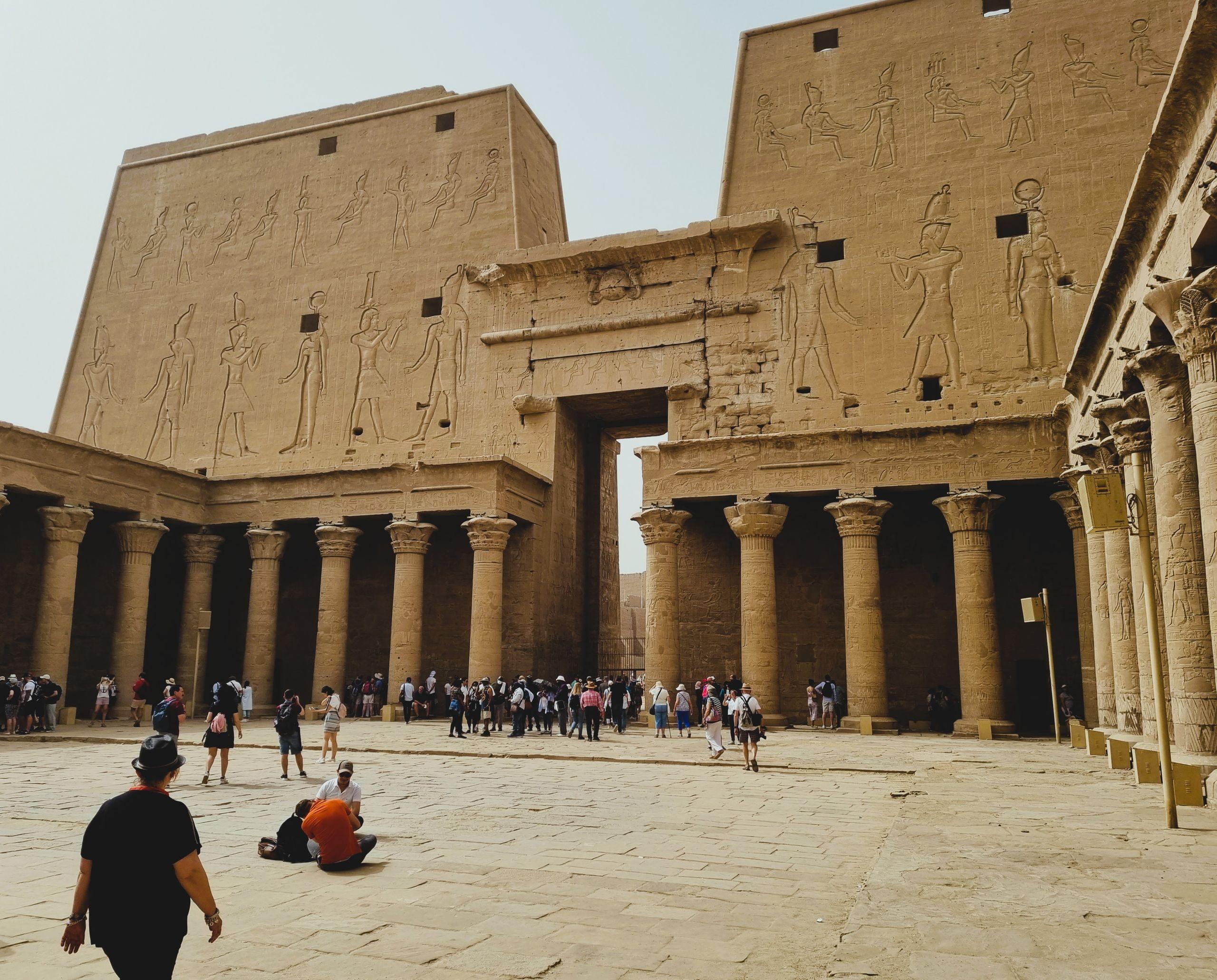
Edfu’s monumental pylon is one of the temple’s defining features and preserves huge reliefs showing Ptolemy XII defeating enemies and appearing before the gods. Two granite falcon statues associated with Horus reinforce whose sanctuary you are entering.
The imagery may look familiar if you have already visited other Egyptian temples. A ruler raises a weapon over defeated enemies in a pose that had existed in Egyptian royal art for thousands of years.
That continuity is precisely what makes it interesting.
Ptolemy XII ruled more than two millennia after Egypt’s first dynasties, yet he still presented himself through ancient Egyptian visual traditions. Edfu therefore shows how Egyptian temple culture continued under the Greek-speaking Ptolemaic dynasty rather than suddenly becoming culturally Greek.
Photographically, the pylon also benefits from distance. A close image from the doorway loses the scale of the façade.
The Courtyard Introduces Horus Properly
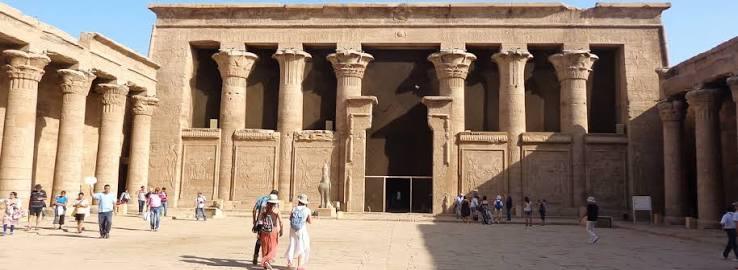
Passing through the pylon brings you into the large peristyle courtyard, surrounded by columns with varied plant-form capitals.
This is one of the brightest and most open parts of the temple.
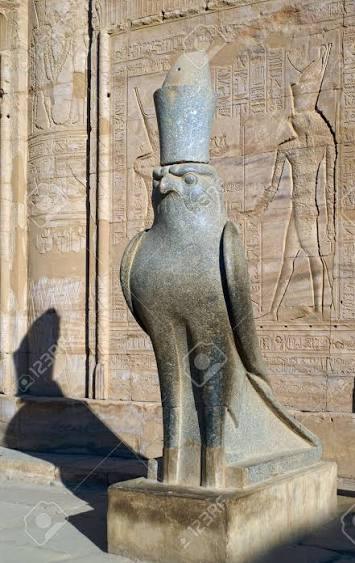
It also contains one of Edfu’s most recognizable objects: the black granite falcon statue of Horus wearing the Double Crown of Egypt. Experience Egypt specifically identifies it as one of the temple’s principal features.
This is worth more than a quick photograph.
Horus was closely associated with kingship, and Edfu was one of his major cult centers. The falcon imagery repeated throughout the temple therefore connects the god directly with the ruler whose ritual role dominates the wall scenes.
The courtyard is also where the practical difference between early and crowded cruise-stop conditions becomes obvious. Once several groups arrive together, guides tend to gather in the same open spaces before entering the narrower interior.
If your guide can explain the temple plan before the crowd reaches the doorway, the rest of the visit becomes easier.
The Hypostyle Halls Show How an Egyptian Temple Changes as You Move Inward
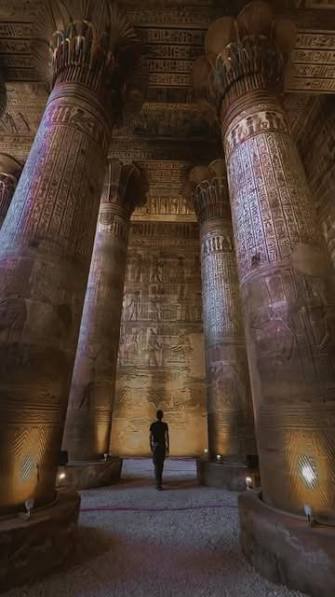
Beyond the open court, Edfu becomes progressively more enclosed.
This transition is one of the most important things to notice.
The first and second hypostyle halls retain their roofs and columns, producing a dramatic change from the sunlit courtyard outside. The Ministry notes that the larger hall preserves scenes relating to the temple’s foundation and royal worship, while the second includes imagery connected with the sacred journey of Horus and Hathor.
You do not need to inspect every relief.
Instead, notice what the architecture is doing.
The open exterior court gives way to roofed columned halls. Light diminishes. Spaces become smaller. Access in antiquity became increasingly restricted as one approached the divine sanctuary.
Because Edfu remains so complete, this progression is easier to understand here than at many more ruined temple sites.
Guide’s Note: If you have already visited Karnak, do not compare the size of Edfu’s hypostyle halls with Karnak’s Great Hypostyle Hall. Their value is different. Karnak overwhelms through scale; Edfu is useful because the complete architectural sequence around the halls survives so clearly.
The Sanctuary Is the Point the Entire Building Leads Toward
Eventually you reach the sanctuary, the ritual heart of the temple.
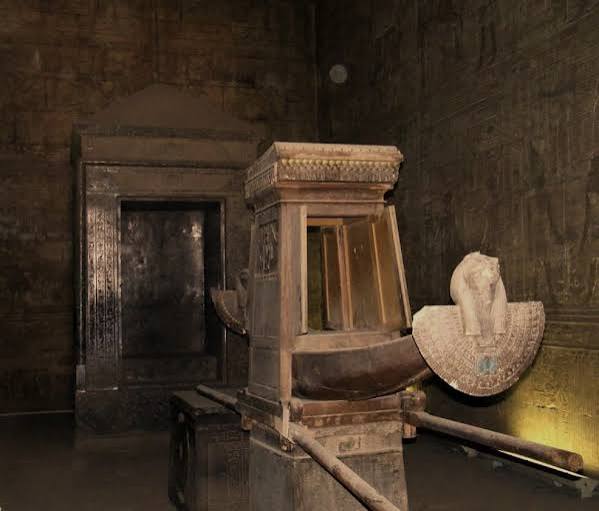
Experience Egypt identifies the surviving granite shrine here as the place associated with the cult image of Horus. A modern replica of a sacred wooden barque is also displayed in the chamber, helping visitors understand how divine images could be carried during religious processions.
The barque needs some context.
This was not an ordinary boat intended for transport along the river. Sacred barques functioned as ceremonial vessels for divine images during processions. The deity’s cult statue could leave the innermost sanctuary and participate ritually in festivals while remaining enclosed within a sacred shrine.
Edfu’s inscriptions preserve extensive information about its ritual calendar, which is one reason the temple is so important to Egyptologists. UNESCO notes that its texts provide unusually rich evidence about temple liturgies and religious festivals.
Stand here for a moment before beginning to work your way outward.
The relative darkness is not incidental. You have moved from an open public-facing entrance into the most restricted part of the temple.
The Sacred Barque Helps Explain Edfu’s Relationship With Hathor
One of Edfu’s important festivals involved Hathor of Dendera, whose cult image traveled south to meet Horus.
UNESCO describes this as the festival of the Happy Reunion, during which Hathor came from Dendera to Edfu. The Ministry’s visitor guide similarly highlights scenes associated with the festival and the sacred journey between the divine figures.
This is useful because it turns the sanctuary’s barque imagery into something practical rather than abstract.
Egyptian temples did not function as isolated stone buildings. Ritual movement connected sanctuaries, deities, priests, river journeys, and festival calendars.
You do not need a detailed mythology lecture to understand that.
Remember simply that Horus was worshipped here, Hathor was his divine consort, and religious festivals could physically connect temples separated by substantial distances along the Nile.
The Horus and Seth Reliefs Are Worth Finding
If you have time for one set of reliefs beyond the main architectural route, look for the scenes associated with Horus defeating Seth.
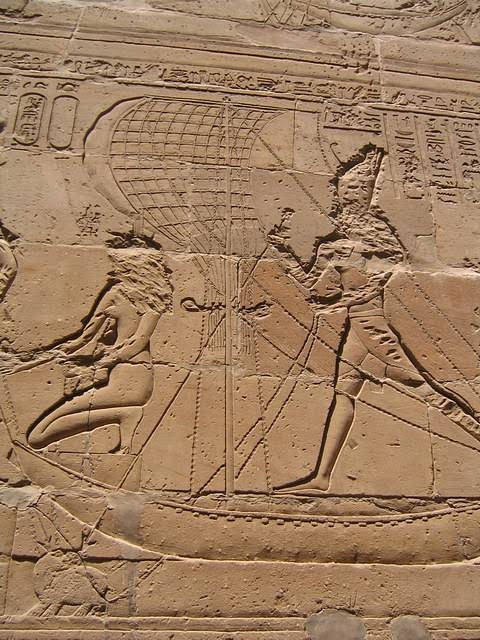
They appear along the inner passage around the rear portion of the temple. Experience Egypt specifically highlights the west wall, where Seth appears symbolically as a small hippopotamus being harpooned by Horus and the king.
You only need the basic mythological framework.
Osiris, father of Horus, is killed by Seth. Horus ultimately battles Seth and asserts his legitimate claim to kingship. The temple imagery turns that cosmic conflict into ritual victory over disorder and enemies.
At Edfu, the scenes are particularly useful because they survive as an extended visual sequence rather than a single isolated image.
The mistake is spending so long explaining the mythology that you no longer have time to see the sanctuary.
Don’t Ignore the Outer Passage
Cruise passengers are especially likely to miss this area.
After reaching the sanctuary, groups often reverse direction and begin moving toward the exit because the guide is watching the return time.
If your schedule allows, explore the passage running around the rear part of the temple.
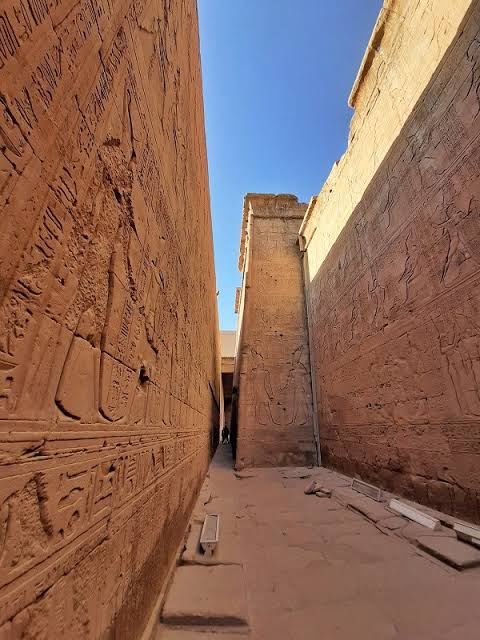
This is where some of Edfu’s most interesting ritual reliefs survive, including the Horus-and-Seth material. It also gives you a different perspective on the temple’s enormous exterior walls and the degree to which the sanctuary was enclosed within a protected sacred precinct.
With a 60-minute visit, it may need to be sacrificed.
With 90 minutes, it should be included.
With two hours, you can examine it properly rather than using it merely as a shortcut around the building.
How Long Do You Actually Need at Edfu?
Around 90 minutes inside is the best target for most travelers.
An hour is enough to follow the main route from pylon to sanctuary, but it leaves little time for the outer passages, reliefs, photography, or explanations that distinguish Edfu from another large temple.
Two hours is better for independent travelers.
The problem for Nile cruise passengers is that “two hours at Edfu” on an itinerary may not mean two hours inside the temple.
You have to disembark, travel from the docking area to the site, pass through ticketing and security, visit the monument, return through town, and reboard before the vessel’s sailing schedule requires departure.
Read your cruise itinerary accordingly.
Edfu as a Nile Cruise Stop
For many international visitors, Edfu is not a destination they independently selected. It appears as part of a Luxor–Aswan Nile cruise itinerary, often between visits to Luxor’s temples and the later stop at Kom Ombo.
That creates a distinctive visitor pattern.
Cruise vessels moving along the same section of the Nile often operate around similar navigation and sightseeing schedules. When several boats stop at Edfu in the same period, visitors can arrive in concentrated waves rather than evenly throughout the day.
Inside the wide courtyard, this is manageable.
Inside the hypostyle halls and narrower passages, it becomes much more noticeable.
The answer is not to skip Edfu because it is busy. It is to understand that the most crowded section may be the same main axis every group follows.
If your guide has flexibility, moving efficiently through the introductory explanations and protecting time for the sanctuary and outer passages usually gives a better visit than standing in the courtyard for a long lecture while several more groups arrive.
How to Make the Most of Edfu When Your Nile Cruise Gives You Limited Time
Cruise passengers should treat the sanctuary as the non-negotiable endpoint.
Start with the pylon, but do not spend fifteen minutes trying to photograph it without people. Once several coaches or cruise groups have arrived, that photograph may never happen.
Move through the courtyard, stop at the granite Horus statue, and use the hypostyle halls to understand how the temple becomes progressively darker and more restricted.
Then reach the sanctuary.
Only after those priorities are secure should you use remaining time for the Horus-and-Seth reliefs, outer passage, additional chambers, or extended photography.
If your guide is giving a long historical introduction outside, ask how much actual temple time remains. Edfu’s history makes much more sense while looking at the architecture than while standing near the entrance listening to twenty minutes of dates.
Most importantly, know the agreed meeting time and meeting point before separating from a group. A cruise ship operates to a sailing schedule; an independent archaeological visit does not.
Expert Tip: On a short Edfu cruise stop, do not measure success by the number of rooms entered. Understand the pylon, watch the temple become darker as you move inward, reach the sanctuary, and find the Horus-and-Seth reliefs if time remains. That gives you the logic of Edfu rather than a hurried inventory.
Getting From the Nile to the Temple
Edfu Temple is on the west bank of the Nile, but the exact docking position used by your vessel can vary.
Cruise passengers are commonly transferred through Edfu between the river and temple rather than walking the entire journey as part of the archaeological visit. Traditionally, horse-drawn carriages have been widely used for this transfer, although local vehicle arrangements and the precise drop-off system can vary.
This is one part of the Edfu experience where travelers should avoid assumptions.
If your cruise excursion is included, ask whether transport between the ship and temple is included as well. If you prefer not to use a horse-drawn carriage, tell your guide or cruise manager in advance and ask whether a motorized alternative can be arranged. Do not wait until the group is standing at the dock to discover that the standard transfer is not your preferred option.
Independent travelers arriving by road or rail should arrange local transport directly to the archaeological-site entrance.
Edfu is roughly midway between Luxor and Aswan. Experience Egypt places it about 105 kilometers from Aswan, which is why it works naturally as a Nile-route stop but is a more deliberate excursion when approached independently from either city.

Independent Visit or Cruise Excursion?
Cruise passengers should normally use the cruise’s Edfu stop rather than attempting to recreate it independently.
You are already in the right place, and the ship’s schedule is built around continuing along the Nile.
The limitation is pace.
Independent travelers gain control over arrival time and visit length. That matters if Edfu is a serious archaeological priority or you want time to photograph inscriptions without moving at group speed.
But independent travel also requires more road or rail logistics than visiting a temple within Luxor or Aswan itself.
The choice therefore depends less on guide quality than on how you are moving through Upper Egypt.
If you are taking a Nile cruise, use the scheduled stop intelligently.
If you are traveling overland, Edfu can justify a deliberate stop between Luxor and Aswan rather than a same-day out-and-back excursion.
Heat and Shade at Edfu
Edfu offers more interior shade than many archaeological sites in Upper Egypt.
That is one advantage of its preservation.
The roofed hypostyle halls, inner chambers, and sanctuary provide substantial relief from direct sunlight. The open courtyard and exterior passages, however, remain exposed, as does the journey between transport drop-off and the monument.
During summer, do not mistake shade for cool conditions.
Upper Egypt can exceed 40°C during the hottest months, and enclosed stone architecture can still feel warm even without direct sun. The transition into the darker halls is physically welcome, but you will repeatedly return to exposed areas.
Cruise schedules sometimes determine your timing, leaving little choice about the hour.
If you do have control, earlier is better.
Carry water, use sun protection, and avoid spending the limited cooler part of your visit waiting unnecessarily outside the pylon.
Is a Guide Particularly Useful at Edfu?
Yes—provided the guide explains the building rather than drowning it in mythology.
Edfu is physically easy to navigate. You are unlikely to become lost.
What is harder to understand independently is why particular scenes matter, how the sanctuary functioned, what the sacred barque represented, and why Ptolemaic rulers appear in visual forms that look thousands of years older than their own dynasty.
The extensive inscriptions also make selective interpretation valuable.
UNESCO notes that Edfu’s texts have provided scholars with substantial information about daily temple liturgies and the religious calendar.
A good guide should translate that scholarship into a few useful ideas you can actually see on the walls.
If the first twenty minutes become a family tree of Osiris, Isis, Horus, and Seth before you have entered the temple, the balance is wrong.
Edfu and Kom Ombo Should Not Blur Together
On many Nile cruises, Edfu and Kom Ombo appear close together in the itinerary.
They should not become interchangeable in your memory.
Edfu is principally a sanctuary of Horus and is remarkable for its architectural completeness. You progress through an unusually intact Egyptian temple plan toward a dark central sanctuary.
Kom Ombo is a different proposition: a double temple associated particularly with Sobek and Haroeris, with an unusual symmetrical arrangement and a dramatic riverside setting.
Your Kom Ombo Guide should therefore be the natural next article to read if your cruise visits both.
The strongest way to approach the two is not “another Ptolemaic temple tomorrow,” but to notice how differently temple architecture could respond to cult, location, and ritual purpose.
How Edfu Fits Between Luxor and Aswan
Edfu makes most sense as part of the journey rather than as an isolated destination.
North of it, Luxor presents the monumental religious landscape of ancient Thebes: Karnak, Luxor Temple, the Valley of the Kings, Hatshepsut’s mortuary temple, and numerous secondary sites.
South of it, Aswan introduces a different Nile landscape and sites such as Philae, Elephantine, the ancient granite quarries, and the gateway toward Nubia.
Edfu sits geographically and chronologically between many of those experiences.
That is why a Nile Cruise Guide is the most important internal link from this article. The larger planning question is not simply whether Edfu is worth seeing; it is whether a cruise gives you enough time in Luxor and Aswan while still making stops such as Edfu and Kom Ombo useful rather than rushed.
Your Luxor Travel Guide and Aswan Travel Guide should handle the destinations at either end rather than forcing city-level planning into this site guide.
Common Mistakes at Edfu
The first mistake is assuming that the time printed beside “Edfu” on a cruise schedule equals time inside the temple. Transfers and group organization take part of that window.
The second is listening to so much mythology outside that the actual architecture becomes rushed.
Another is reaching the sanctuary and immediately turning around. If time remains, the outer passages contain some of the temple’s most useful ritual imagery.
Independent travelers sometimes make the opposite mistake: assuming that because Edfu lies between Luxor and Aswan, it is automatically a simple half-day excursion from either. From Aswan alone, the official tourism material places Edfu roughly 105 kilometers away.
Finally, do not let Edfu become “the temple with the falcon statue.” The statue is memorable, but the real value of Edfu is the completeness of the entire building around it.
Frequently Asked Questions
What are Edfu Temple’s current opening hours?
The Ministry currently lists 6:00 AM–5:00 PM on Sunday and Wednesday and 7:00 AM–5:00 PM on Monday, Tuesday, Thursday, Friday, and Saturday. An older Ministry-produced Aswan guide lists the same pattern but outdated ticket prices, so use the current monument page for admission costs.
How long should I spend inside Edfu Temple?
Aim for 75–90 minutes as a minimum worthwhile visit. Two hours is better for independent travelers interested in the inscriptions, ritual reliefs, and outer passages. Cruise passengers should remember that transport between the ship and temple reduces the amount of their scheduled stop actually spent inside.
Why is Edfu Temple so well preserved?
Large parts of the temple became buried beneath sand and accumulated settlement debris after antiquity, protecting much of its architecture and decoration. Auguste Mariette cleared portions of the site during the nineteenth century.
What should I see if my cruise gives me only an hour?
Prioritize the pylon, granite Horus statue, courtyard, hypostyle halls, and sanctuary. If you still have time after reaching the sanctuary, find the outer passage reliefs showing Horus defeating Seth. Do not spend a large fraction of the hour waiting for crowd-free photographs at the entrance.
Is Edfu Temple included on Nile cruises?
Many standard Luxor–Aswan cruise itineraries include Edfu, but inclusions differ between cruise products. Some packages bundle guiding, site admission, and local transfers; others separate particular costs. Check the inclusions of your actual cruise rather than assuming every Nile cruise operates identically.
Can I visit Edfu without a Nile cruise?
Edfu can be visited independently by travelers moving overland between Luxor and Aswan or making a dedicated road or rail journey. The advantage is control over timing; the disadvantage is the additional transport planning. Experience Egypt places Edfu approximately 105 kilometers from Aswan.
Do I need a guide at Edfu?
The temple is easy to navigate without one, but an Egyptologist adds considerable value to the reliefs and ritual spaces. The best interpretation concentrates on what you can see—the Ptolemaic rulers, temple foundation scenes, Horus-and-Seth reliefs, sacred barque, and sanctuary—rather than turning the visit into an extended mythology lecture.
Is Edfu better than Kom Ombo?
They answer different questions. Edfu is the stronger site for understanding the architecture of a remarkably complete Egyptian temple. Kom Ombo is distinguished by its double-temple design, Sobek association, and riverside setting. On a Nile cruise, seeing both is worthwhile precisely because the experiences are not duplicates.
Is photography allowed at Edfu Temple?
Ordinary visitor photography is commonly possible in the temple, but restrictions can change and special rules may apply to professional equipment, commercial shoots, tripods, or other equipment. Follow the current signage and instructions at the archaeological site rather than assuming the policy matches another Egyptian monument.
Edfu is most easily weakened by the cruise schedule around it. Travelers arrive together, local transfers consume part of the stop, and the temptation is to follow the group from falcon statue to sanctuary without ever understanding why the building’s extraordinary completeness matters. Explore ENA’s Nile cruises and Upper Egypt itineraries to make the stop work around the temple rather than the other way around—protecting enough time to reach the sanctuary, read the architecture properly, and still return to the Nile without turning one of Egypt’s best-preserved temples into a race against the ship.