Meidum Pyramid: What Happened to Egypt’s Collapsed-Looking Pyramid?
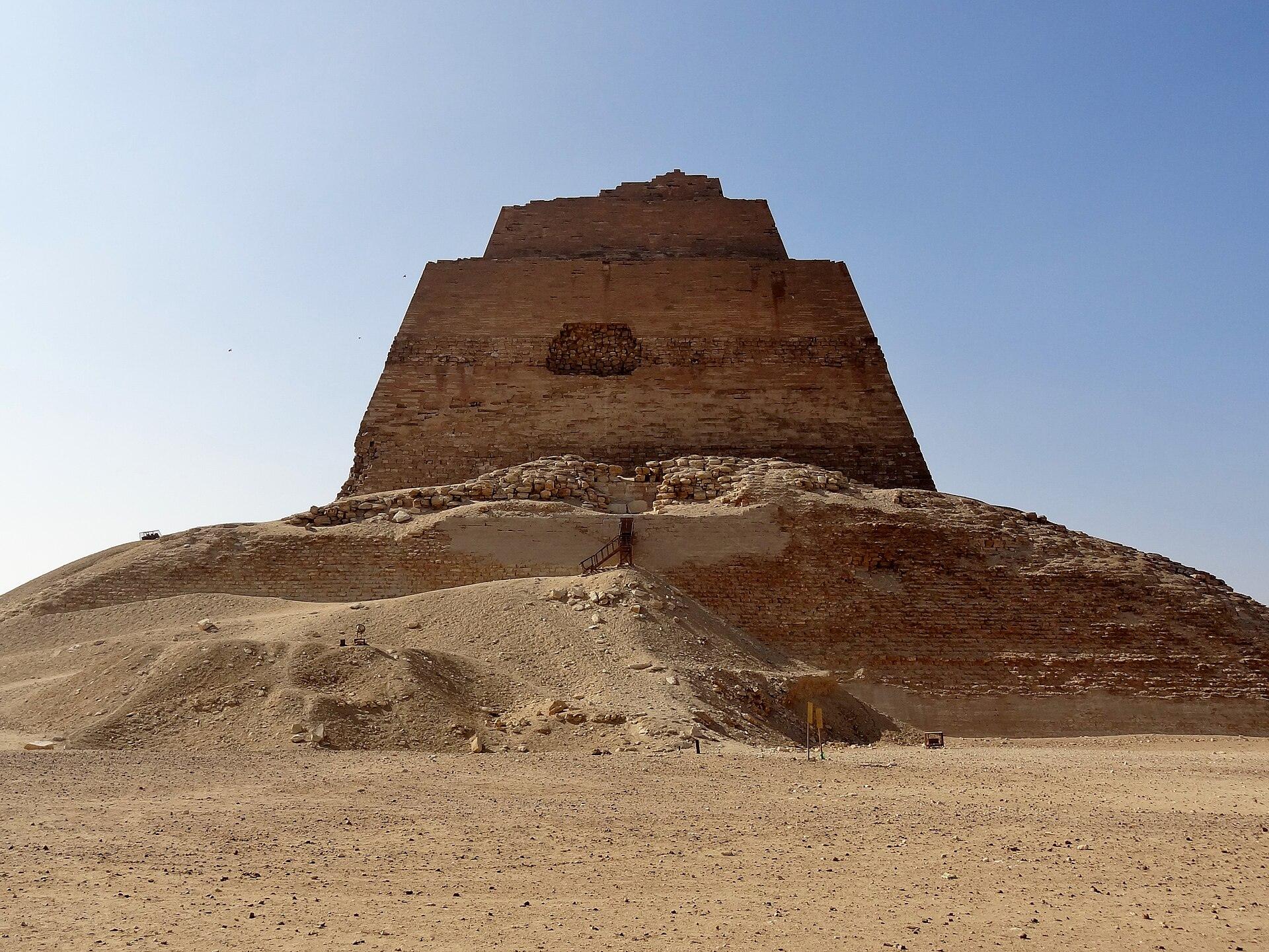
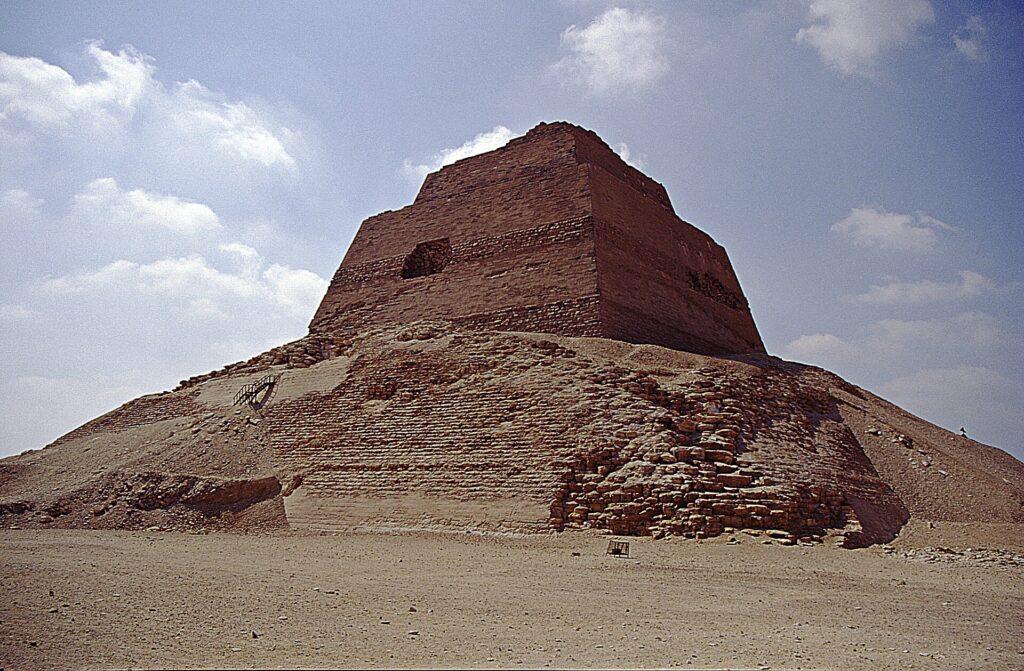
If you came across the Meidum Pyramid without knowing what it was, you might not recognize it as a pyramid at all. Instead of four sloping sides meeting at a point, there’s a massive stone tower rising from a mound of rubble. It looks as though someone removed most of the pyramid and left the middle standing.
That’s essentially what you’re seeing: the surviving core of a much larger monument.
Meidum was originally built as a stepped pyramid and later converted into one with smooth sides. Much of its outer masonry has since disappeared. For years, a popular theory blamed the damage on a catastrophic collapse during construction, but the archaeological evidence doesn’t establish that this happened.
Built during the reign of King Sneferu, Meidum belongs to the period when Egyptian builders were developing the techniques that would eventually make the Great Pyramid at Giza possible.
Where Is the Meidum Pyramid?
The Meidum Pyramid stands near the village of Meidum in Beni Suef Governorate, south of Cairo and northeast of Fayoum. It sits close to the edge of the Nile Valley, where cultivated fields give way to desert.
Unlike Giza, where several large pyramids dominate the landscape, Meidum stands relatively alone. Its unusual shape is visible from a considerable distance, with the surviving stone core rising above the surrounding debris.
It’s also outside the usual Giza, Saqqara and Dahshur sightseeing circuit. Most travelers visiting Egypt’s pyramids don’t make it this far south, although Meidum is particularly interesting if you’ve already explored the better-known sites.
Why Does the Meidum Pyramid Look Collapsed?
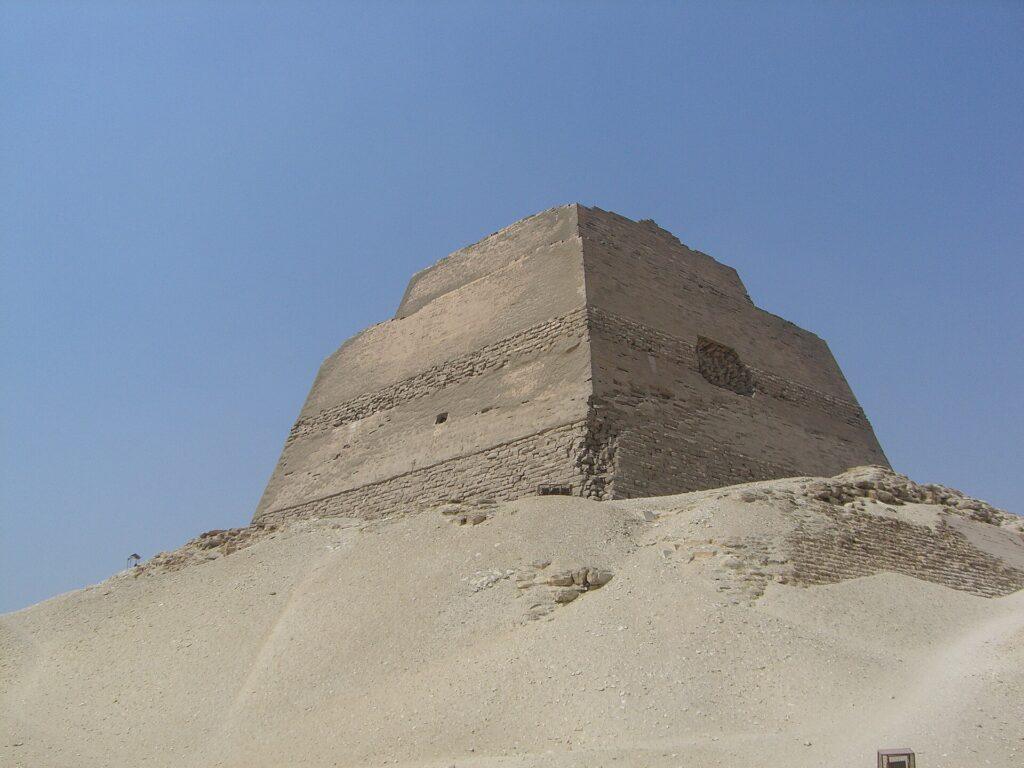
The tower visible today is part of the pyramid’s original stepped core. The enormous mound around its base contains material from the outer structure that once surrounded it.
Meidum wasn’t built to its final dimensions in one continuous project. Its builders enlarged it and eventually filled the steps to create a smooth-sided pyramid. Much of that additional masonry has disappeared, leaving the underlying structure exposed.
You can now see part of the stepped design that would normally be hidden inside a completed pyramid.
Did the Meidum Pyramid Collapse During Construction?
The sudden-collapse theory became popular because it offered an apparently straightforward explanation for the pyramid’s appearance.
The theory proposed that the outer masonry added during the conversion to a smooth-sided pyramid wasn’t sufficiently stable. If those layers weren’t securely supported, they could have fallen away under their own weight.
But the evidence doesn’t establish that Meidum suffered a catastrophic collapse while it was being built.
Egypt’s Ministry of Tourism and Antiquities describes distinct layers of debris around the monument. The Ministry interprets these as evidence of gradual destruction rather than a single sudden event.
Archaeologists have debated when the outer structure disappeared and what caused the damage. Structural weaknesses, long-term deterioration and the removal of stone for reuse have all been considered.
What we know is that Meidum lost much of its exterior. Exactly when that happened, and whether one cause or several were responsible, remains uncertain.
Was the Meidum Pyramid a Failure?
Not necessarily. The missing exterior doesn’t tell us whether the pyramid was structurally sound when its builders completed it.
Whatever happened to its exterior, Meidum’s surviving passages and burial chamber show that its builders were already tackling engineering problems that would become central to later pyramid construction.
Who Built the Meidum Pyramid: Huni or Sneferu?
Meidum is generally attributed to Sneferu, the first king of Egypt’s Fourth Dynasty and father of Khufu, who built the Great Pyramid at Giza.
Older accounts often credit Sneferu’s predecessor, Huni, with starting the pyramid. According to that interpretation, Sneferu inherited a stepped monument and later enlarged or converted it.
The Egyptian Ministry of Tourism and Antiquities identifies Sneferu as the builder and notes that attributing the earlier construction to Huni is no longer the prevailing interpretation. The question hasn’t disappeared entirely from archaeological discussions, but the evidence strongly connects Meidum with Sneferu.
The pyramid’s ancient name was Djed Sneferu, meaning “Sneferu Endures.” An inscription left by a visitor during the reign of Thutmose III, more than a thousand years later, also associates the monument with Sneferu.
Meidum was still a recognized royal monument long after the Fourth Dynasty.
How Was the Meidum Pyramid Built?
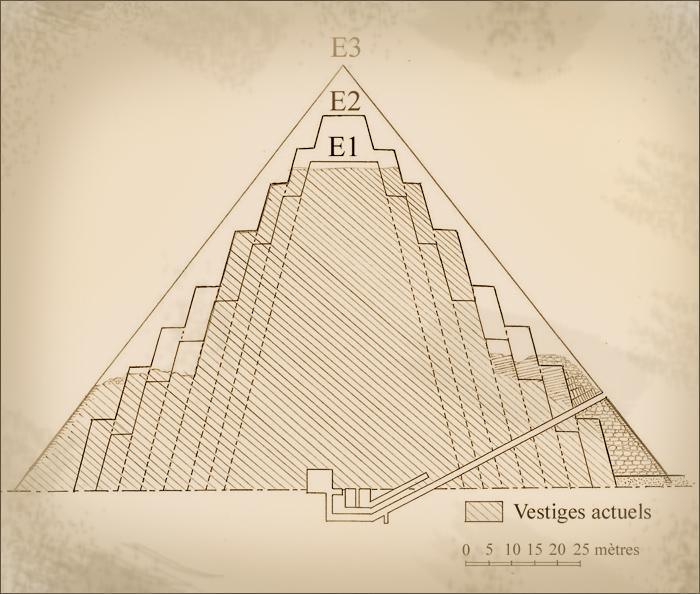
Meidum underwent three major construction phases, known to Egyptologists as E1, E2 and E3. Each phase changed the monument’s size or intended appearance.
First Phase: A Seven-Step Pyramid
The earliest design was a seven-step pyramid, reconstructed at approximately 65 meters high.
It followed the stepped tradition established by Djoser’s pyramid at Saqqara, although Meidum was built on a considerably larger scale.
Second Phase: An Eight-Step Pyramid
The builders enlarged the original monument to create an eight-step pyramid. This version would have reached approximately 85 meters, with a base measuring about 121 meters on each side.
Rather than dismantling the earlier pyramid, the builders expanded around it. Each enlargement enclosed much of the previous structure within a new outer layer.
Third Phase: Conversion Into a Smooth-Sided Pyramid
The final major change was the most dramatic.
The builders filled the spaces between the steps and added masonry to create continuous sloping faces. The completed design is reconstructed at approximately 92–95 meters high, with a base measuring around 144 meters.
Meidum would have looked much more like the familiar pyramids at Giza than the exposed stone tower visitors see today.
The Egyptian Ministry’s reconstruction places this final conversion after Sneferu had already begun building at Dahshur. That makes the familiar story of a Meidum construction disaster forcing the move to Dahshur difficult to sustain.
How Meidum Connects to the Bent and Red Pyramids
Sneferu is associated with three major pyramids: Meidum, the Bent Pyramid and the Red Pyramid.
The Bent Pyramid at Dahshur was designed with smooth sides from the beginning. Its lower section rises at a steep angle, but the slope changes partway up, giving the pyramid its unusual shape. The change reflects adjustments made during construction.
The nearby Red Pyramid has a consistent, shallower slope. It is generally recognized as Egypt’s first successfully completed large true pyramid.
Meidum followed a different approach. Its builders began with a stepped monument and later converted it into a smooth-sided one.
The three pyramids weren’t necessarily built in the order their appearances might suggest. According to the Ministry’s reconstruction, Meidum’s final conversion took place after work had already begun at Dahshur.
Sneferu’s building projects are best understood together. His builders were trying different designs, slopes and construction methods during a period of rapid architectural development.
For a closer look at Sneferu’s other pyramids and the surrounding archaeological sites, see Explore ENA’s guide to Saqqara and Dahshur.
Can You Go Inside the Meidum Pyramid?
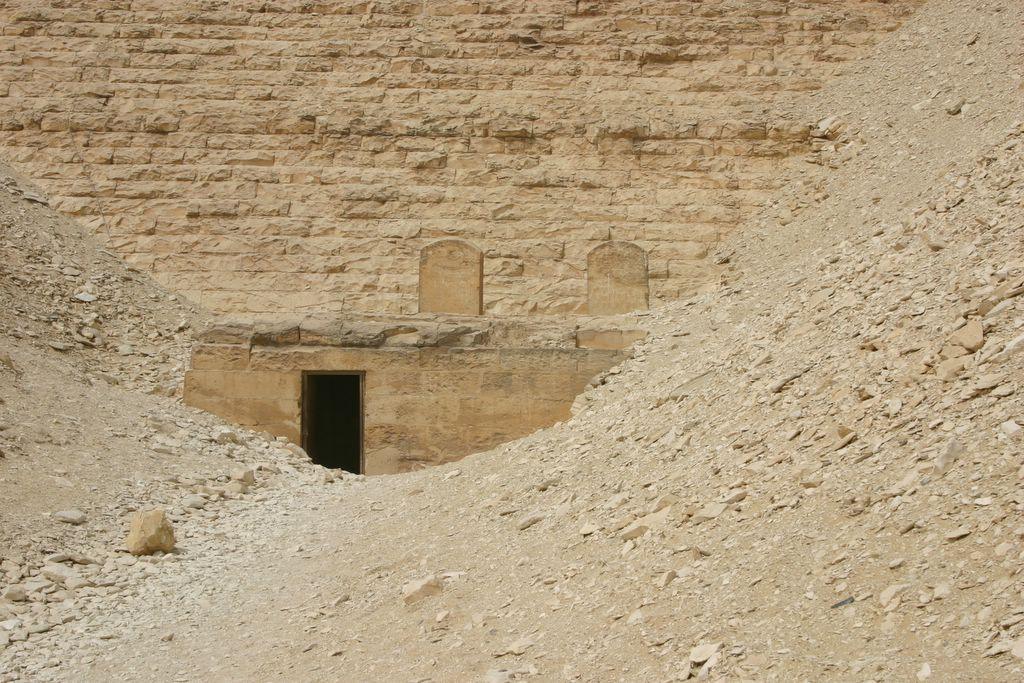
Meidum has an internal passage system leading to a burial chamber.
The entrance is on the northern face, approximately 15 meters above ground level. From there, a passage descends through the masonry and into the bedrock before continuing horizontally. It passes two niches and eventually reaches a vertical shaft leading upward into the chamber.
The chamber has a corbelled ceiling. Instead of placing a single flat stone across the opening, the builders arranged successive layers of masonry so that each projected slightly inward. This helped distribute the weight of the stone above.
Meidum contains one of the earliest known examples of stone corbelling used in a pyramid ceiling.
In 1998, researchers identified additional corbelled spaces above parts of the passage system. These helped relieve pressure on the passages below.
The interior isn’t suitable for everyone. The passages are narrow, and reaching the chamber involves descending and climbing through confined spaces. Anyone uncomfortable with restricted movement or enclosed areas may prefer to explore the exterior.
Check current access arrangements before traveling. The archaeological site may be open even when entry into the pyramid itself is restricted.
What Else Can You See at Meidum?
The pyramid was once part of a larger royal funerary complex, and the surrounding area contains remains of other ancient structures and tombs.
The Mortuary Temple
On the eastern side of the pyramid are the remains of a small mortuary temple. This was where rituals associated with the deceased king were performed.
The surviving structures are modest compared with the pyramid, and much of the original complex is no longer visible. Without an archaeological plan or guide, some of the remains can be difficult to identify.
The Mastaba Tombs
Meidum’s cemetery contains mastaba tombs belonging to members of the royal family and important officials.
Mastabas are rectangular tomb structures with flat roofs and sloping sides. They were commonly used for elite burials during the Old Kingdom.
One of the best-known tombs belonged to Nefermaat, a son of Sneferu. His tomb complex was associated with his wife, Itet, also written Atet.
Another belonged to Rahotep, also identified as a son of Sneferu. His mastaba produced the famous painted limestone statues of Rahotep and his wife Nofret.
The statues are remarkable for their lifelike faces and inlaid eyes. They are displayed at the Egyptian Museum in Tahrir Square, Cairo.
Not all the mastabas are necessarily accessible to visitors, so check which parts of the cemetery can be visited.
The Famous Meidum Geese
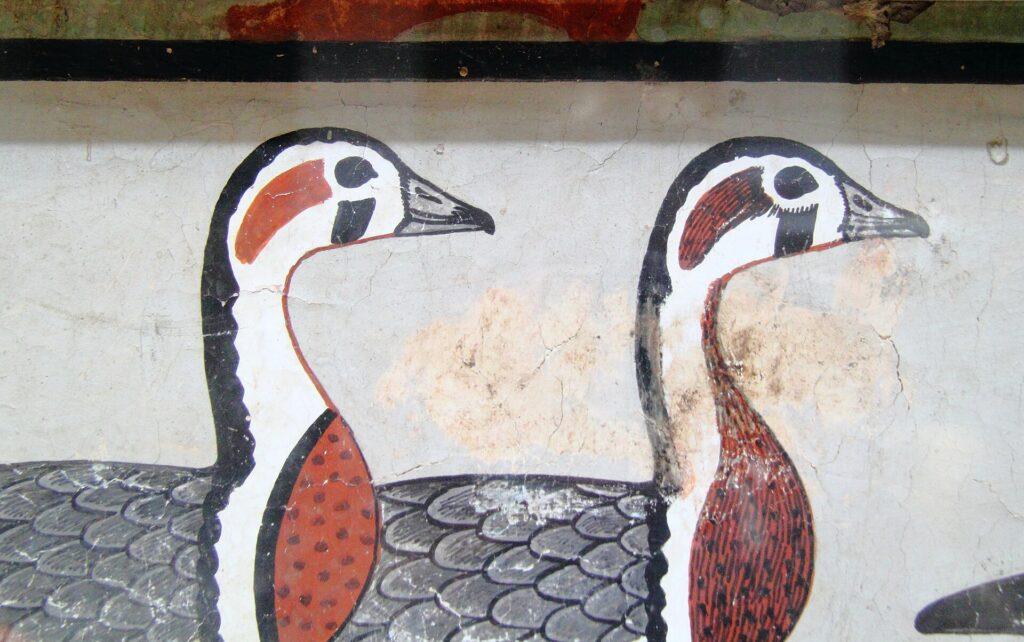
The Meidum Geese painting was discovered in the tomb complex of Nefermaat and Itet.
It shows six geese arranged in two groups of three, with careful attention to their feathers, markings and posture.
The painting dates to the early Fourth Dynasty and is one of the best-known examples of Old Kingdom painting.
The original is not at Meidum today. It is preserved at the Egyptian Museum in Tahrir Square, Cairo.
Is the Meidum Pyramid Worth Visiting?
That depends on how much time you have in Egypt and what interests you.
If this is your first trip and you have only one day for pyramids, Giza and Saqqara are better priorities. Dahshur is also easier to combine with Saqqara and offers two very different pyramids from Sneferu’s reign.
Meidum makes more sense if you’ve already visited those sites or want to understand how Egyptian pyramid construction developed.
The exposed core makes Meidum especially useful for understanding how builders enlarged a stepped pyramid. That’s something much harder to appreciate when standing outside the more complete pyramids at Giza.
The nearby cemetery adds another dimension, particularly if you’re familiar with the Meidum Geese or the statues of Rahotep and Nofret.
There are fewer monuments and visitor facilities than at Giza or Saqqara, so it’s worth knowing what to expect before making the journey.
How to Visit the Meidum Pyramid From Cairo
Meidum is south of Cairo, beyond the usual Giza, Saqqara and Dahshur sightseeing route.
A private vehicle with a driver is the most practical way to visit. The site is relatively isolated, and you shouldn’t count on finding an Uber for the return journey.
Meidum can be included in a longer archaeological itinerary, but it shouldn’t be treated as a quick addition to a standard Giza, Saqqara and Dahshur day. The extra driving can make an already full day unnecessarily tiring.
If you’re interested in several archaeological sites, it’s better to choose a manageable route than to spend most of the day moving between them.
Practical Tips for Visiting Meidum
Meidum has fewer visitor facilities than Egypt’s better-known pyramid sites. Bring drinking water, sun protection and comfortable shoes for uneven ground. Carry your passport for identification and possible site-entry requirements.
The archaeological area is exposed, with little shade. October through April is generally more comfortable for sightseeing than the hottest summer months, although sunny days can still feel warm.
If you hope to enter the pyramid, confirm access before traveling. Archaeological interiors can close temporarily for maintenance or conservation.
A knowledgeable Egyptologist guide is particularly useful here. Much of Meidum’s history is tied to its construction phases, and those details aren’t immediately obvious from looking at the surviving tower.
Model Code=58
F/W Version=1.17
Frequently Asked Questions About the Meidum Pyramid
Why does the Meidum Pyramid look collapsed?
Most of the outer masonry has disappeared, leaving the stepped inner core above a large mound of debris. The exact cause and timing of that destruction remain debated.
Did the Meidum Pyramid collapse during construction?
A sudden collapse during construction was once a popular theory, but it hasn’t been established as fact. Egypt’s Ministry of Tourism and Antiquities interprets the debris layers as evidence of gradual destruction.
Who built the Meidum Pyramid?
The pyramid is generally attributed to King Sneferu of the Fourth Dynasty. Older accounts credited its beginnings to Huni, but Sneferu is the preferred attribution today.
Was Meidum Egypt’s first true pyramid?
Meidum began as a stepped pyramid and was later converted into a smooth-sided monument. Sneferu’s Red Pyramid at Dahshur is generally recognized as the first successfully completed large true pyramid.
Can visitors go inside the Meidum Pyramid?
The pyramid contains passages leading to a burial chamber. Access depends on current site arrangements, so confirm whether the interior is open before visiting.
Where is the Meidum Pyramid located?
It stands near Meidum village in Beni Suef Governorate, south of Cairo and northeast of Fayoum.
Where can you see the Meidum Geese?
The painting was discovered in the tomb complex of Nefermaat and Itet at Meidum. It is preserved at the Egyptian Museum in Tahrir Square, Cairo.
Planning a Visit to Meidum
Meidum wouldn’t be a priority on most first-time Cairo itineraries. But if you’ve already visited Giza, Saqqara and Dahshur, or you’re especially interested in how the pyramids were built, it’s worth considering.
The journey takes planning, and it isn’t somewhere to visit as a quick detour. If you’d like to include Meidum in a private archaeological excursion, contact Explore ENA to arrange a route that gives you enough time at the site.