Hatshepsut Temple Guide (2026): History, Tickets, Highlights & How to Visit
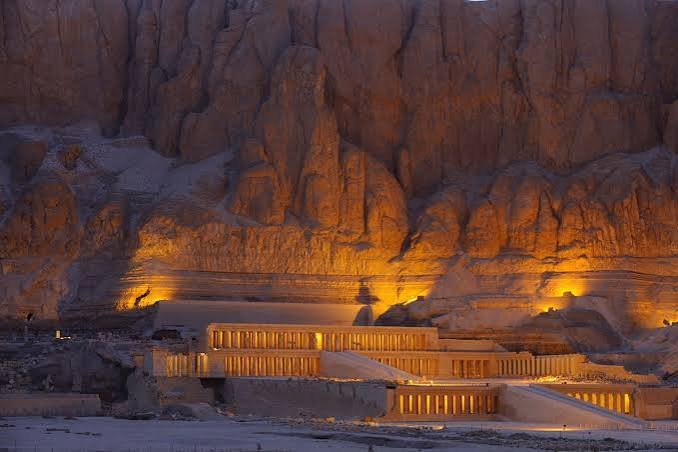
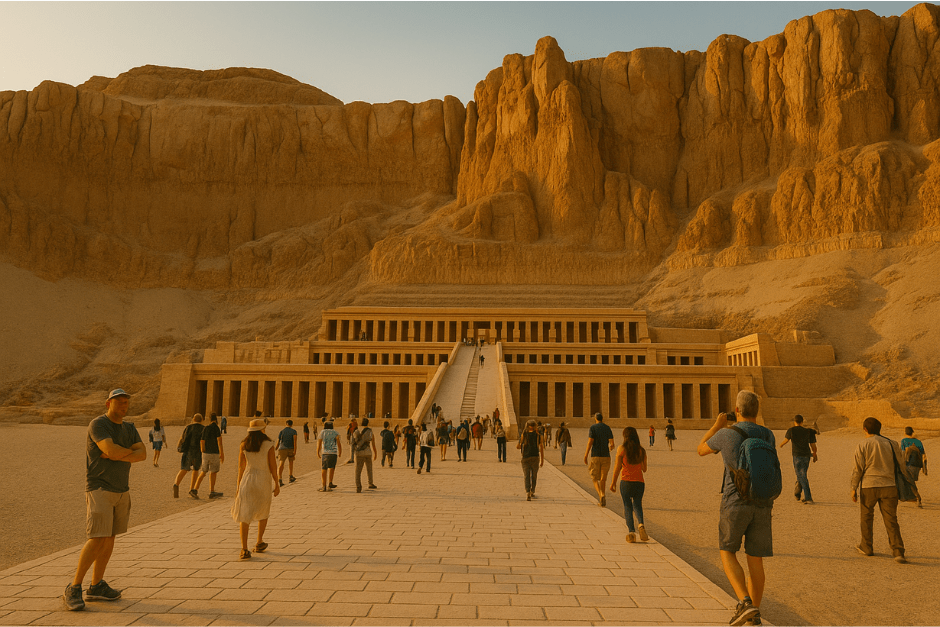
The Temple of Hatshepsut is one of the few monuments in Egypt where the landscape is inseparable from the architecture. Three terraces rise against the limestone cliffs of Deir el-Bahari on Luxor’s West Bank, their long colonnades and central ramps appearing almost to continue the horizontal lines of the mountain behind them. From a distance, it is one of ancient Egypt’s most immediately recognizable buildings. Up close, the real story is in the reliefs.
This was not simply a monument built by a famous female ruler. Hatshepsut used the temple to establish her legitimacy as pharaoh, connect herself with the god Amun, celebrate her expedition to Punt, and secure her place within Egypt’s religious order. The temple was called Djeser-djeseru, meaning “Holy of Holies,” and stood directly across the Nile from Karnak, Amun’s great sanctuary on the East Bank.
For most travelers, 60 to 90 minutes is the right amount of time at Hatshepsut Temple. The bigger decision is timing. Deir el-Bahari is intensely exposed, and the cliffs behind the temple radiate heat back across the terraces. Arrive early and the architecture is easier to appreciate; arrive after several hours in the Valley of the Kings on a hot day and the same ramps can feel considerably harder.
Expert Insight: Hatshepsut Temple is often treated as the second stop after the Valley of the Kings, but that automatically puts many visitors here as the heat and coach traffic build. In hotter months, protecting an early slot for Deir el-Bahari can matter more than following the conventional West Bank order.
Why Hatshepsut Built a Temple at Deir el-Bahari
Hatshepsut ruled during Egypt’s Eighteenth Dynasty, approximately 1473–1458 BC. She began as queen and regent for the young Thutmose III before assuming the full titles and imagery of kingship.
That created an unusual political problem.
Egypt had known female rulers before Hatshepsut, but kingship was overwhelmingly expressed through male royal traditions. Hatshepsut therefore needed more than political control. She needed to present her rule as divinely sanctioned and legitimate within the established religious system.
Deir el-Bahari became one of the places where she made that argument in stone.
The temple’s reliefs claim that Hatshepsut’s father, Thutmose I, had designated her as his successor. More significantly, the divine-birth narrative presents Amun himself as her divine father, reinforcing her right to rule.
That is why visiting with some historical context changes the experience. Without it, the temple is an impressive series of terraces. Once you understand what Hatshepsut was communicating, the building becomes a carefully constructed statement about authority.
The Architecture Is the First Thing You Should Stop and Look At
Do not rush straight toward the ramp when you arrive.
The strongest first view is from a distance.
Hatshepsut’s architect, Senenmut, designed the temple as three ascending levels terminating against the cliffs. Long colonnades run across the terraces, while a strong central axis draws the eye toward the sanctuary cut into the living rock behind the upper courtyard.
The setting is deliberate rather than incidental. Mortuary temples were built on the western side of the Nile, associated with sunset, death, and the realm of the dead. Hatshepsut’s temple also faced toward Karnak across the river, strengthening its religious relationship with Amun.
The broad approach is also one of the best photography positions. Once you reach the upper terraces, you gain detail but lose the full relationship between architecture and mountain.
Take the wide photograph first.
The Punt Reliefs Are One of the Temple’s Essential Highlights
If you remember only one set of reliefs at Hatshepsut Temple, make it the expedition to Punt.
The scenes record an Egyptian trading expedition to a region called Punt, generally associated with the Red Sea region of northeast Africa. They depict its inhabitants, houses, landscape, and the valuable goods brought back to Egypt.
The official Ministry description specifically highlights the Punt scenes because of their unusually vivid record of both the people and environment encountered by Hatshepsut’s expedition.
These are not simply decorative images.
They served a political and religious purpose. A successful expedition demonstrated that Hatshepsut could maintain Egypt’s prosperity and its connections beyond the Nile Valley. The exotic goods brought back also had religious significance, particularly materials associated with temple ritual.
UNESCO considers the Punt frescoes significant enough to single them out when describing Hatshepsut’s funerary temple within the World Heritage Site of Ancient Thebes and its Necropolis.
Guide’s Note: This is exactly the kind of section that becomes easy to walk past without an Egyptologist. The reliefs are visually attractive, but their importance lies in what they tell us about Egyptian trade, geography, religion, and Hatshepsut’s presentation of her reign.
The Divine Birth Scenes Explain Hatshepsut’s Claim to Power
On another part of the middle terrace, the political message becomes even clearer.
The temple presents Hatshepsut as the daughter of Amun. This was not simply a personal religious statement; it provided divine authority for her kingship.
The Ministry’s description of the temple explains that Hatshepsut presented both arguments for legitimacy: Thutmose I had chosen her as heir, and Amun was her divine father.
Look at these scenes alongside the Punt reliefs and the temple’s program begins to make sense.
One establishes who Hatshepsut had the right to be.
The other demonstrates what she achieved as king.
That combination makes Deir el-Bahari much more than a memorial temple.
Hatshepsut Appears as a King Because That Was the Language of Kingship
Visitors sometimes hear that Hatshepsut “pretended to be a man.”
That is an oversimplification.
Hatshepsut increasingly adopted the traditional visual vocabulary of Egyptian kingship, including male royal regalia and, in some representations, the ceremonial false beard. This was not a disguise in the modern sense. Egyptian royal art followed conventions that communicated status and authority, and Hatshepsut positioned herself within those conventions.
You can see this particularly clearly in the Osiride statues on the upper level. The Ministry describes mummiform figures of Hatshepsut as Osiris leaning against the pillars, reflecting the temple’s funerary role and her transformation after death.
Rather than looking at these statues and asking whether Hatshepsut appears male or female, ask what the imagery is doing.
It is telling the ancient viewer: this is the king.
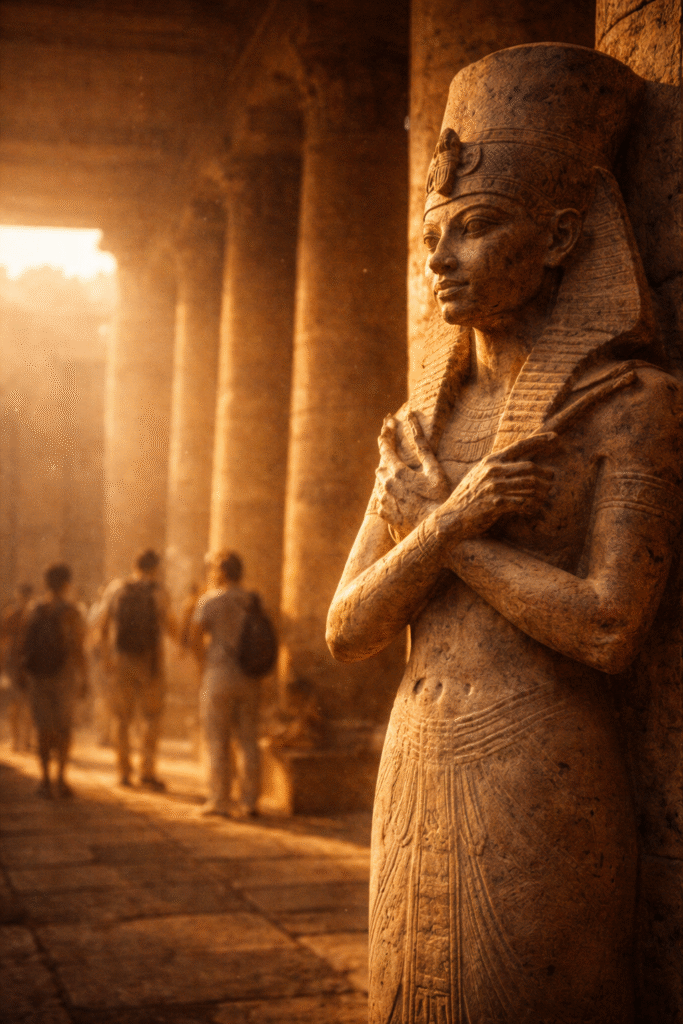
The Temple Was Not Dedicated Only to Hatshepsut
The name “Temple of Hatshepsut” can create the impression that the entire complex was designed simply to glorify one ruler.
Its religious function was broader.
The temple included spaces associated with Amun, Hathor, Anubis, Ra-Horakhty, Hatshepsut herself, and her father Thutmose I. At the far end of the central axis, a sanctuary of Amun was cut directly into the rock.
This connection with Amun also linked Deir el-Bahari to Karnak.
During important religious celebrations, divine images crossed the Nile from the temples on the East Bank and visited the royal mortuary temples on the western side. Ministry information identifies Hatshepsut’s temple as an important stop within this sacred landscape.
That makes Karnak Temple the most useful East Bank site to understand alongside Hatshepsut Temple. They were separated geographically by the Nile but connected religiously.
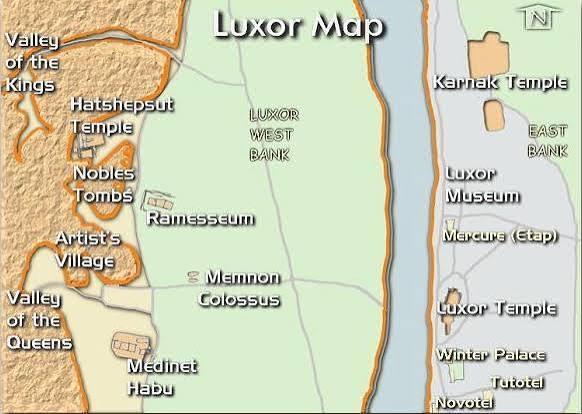
Look for the Chapels of Hathor and Anubis
The grand terraces naturally attract attention, but the smaller sacred spaces reveal more of the temple’s religious complexity.
The Hathor Chapel is particularly important because Hathor had strong associations with the Theban necropolis. Look for Hathoric imagery, including the distinctive cow-eared goddess.
The Anubis Chapel reflects the funerary dimension of the temple. Anubis, closely associated with embalming and the dead, was an entirely appropriate presence within a royal mortuary complex.
These spaces also provide a more intimate contrast to the enormous exterior terraces. Instead of looking at the building as one monumental façade, you begin to see it as a collection of ritual spaces with different purposes.
Give them time.
What Happened to Hatshepsut’s Images?
One of the most compelling parts of Hatshepsut’s story happened after her reign.
Many of her names and images were later damaged, erased, or replaced during the reign of Thutmose III. For years, this was popularly described as straightforward revenge by a resentful stepson who had been kept from power.
The reality is more complicated.
The destruction did not begin immediately after Hatshepsut died, which makes a simple burst of personal revenge difficult to sustain. Scholars have instead examined political, dynastic, religious, and succession-related motives for the later attack on her royal image.
At Deir el-Bahari, this history becomes physical. You can see places where images were deliberately damaged and compare them with surviving decoration.
Recent visitors still describe this layer of destruction and restoration as one of the features that gives the temple more depth once you understand what you are looking at.
This is another reason a good Egyptologist adds value. The damaged surfaces are evidence, not simply missing decoration.
How Much Time Do You Need at Hatshepsut Temple?
Allow 60 to 90 minutes.
An hour works if you are combining the temple with several West Bank sites and have an Egyptologist directing you toward the most significant reliefs and chapels.
Ninety minutes is better if you enjoy architecture, photography, or want to examine the Punt and divine-birth scenes properly.
Anything substantially shorter risks reducing the visit to the central ramp, upper terrace, and a photograph.
Two hours is unnecessary for most travelers unless you have a specialist interest in Egyptian history or archaeology.
The physical pace matters too. You are moving upward through terraces in a highly exposed setting. Even travelers visiting in the cooler season regularly comment on the heat around the temple and the effort of climbing once the sun is high.
Hatshepsut Temple Tickets in 2026
Ticket prices can change, so check the official Hatshepsut Temple visitor information shortly before your visit rather than relying on an older screenshot or blog post.
The Ministry also lists Deir el-Bahari separately at a lower ticket price, so pay attention to the exact ticket or site being displayed when checking online. For a traveler specifically visiting Hatshepsut’s monument, use the official Hatshepsut Temple listing rather than assuming every Deir el-Bahari price refers to identical access.
That small distinction can prevent unnecessary confusion at the ticket office.
Hatshepsut Temple Opening Hours
The Ministry currently lists Hatshepsut Temple as open daily from 6:00 a.m. until 5:00 p.m.
Opening at 6:00 a.m. is valuable because the first hours of the day are dramatically better during warmer months.
There is almost no useful shade across the broad approach and terraces. More importantly, the enormous limestone cliffs behind the temple absorb and radiate heat. A recent July traveler described Hatshepsut as a place where the cliff effectively throws the heat back toward visitors, while recent reviews repeatedly identify heat and late-morning crowding as the site’s main practical drawbacks.
Do not interpret a winter visit as proof that timing never matters here. Luxor in June and Luxor in January are physically different experiences.
Visit Early—But Think About Your Whole West Bank Day
The standard Luxor itinerary often starts with the Valley of the Kings and reaches Hatshepsut later in the morning.
That works well from a geographical and historical perspective, but it creates a trade-off.
The Valley of the Kings is also significantly better early because its exposed desert paths become hot and popular tombs become busier. Hatshepsut has the same problem.
If you’re visiting between roughly October and April, starting at the Valley of the Kings and continuing to Hatshepsut is usually reasonable.
In the hottest months, I would be more flexible. Starting at Hatshepsut near opening can protect you from the worst reflected heat, then you can continue through the West Bank with realistic expectations about rising temperatures.
Another option is to reach Hatshepsut later in the afternoon, after the largest morning groups have passed, provided current closing hours give you enough time. A recent April 2026 visitor specifically reported heavier crowds after arriving later in the morning following the Valley of the Kings and recommended either early morning or later afternoon for a calmer experience.
There is no universally perfect order. The right sequence depends on season.
Hatshepsut Temple and the Valley of the Kings Belong in the Same West Bank Day
These two sites are extremely close geographically but completely different experientially.
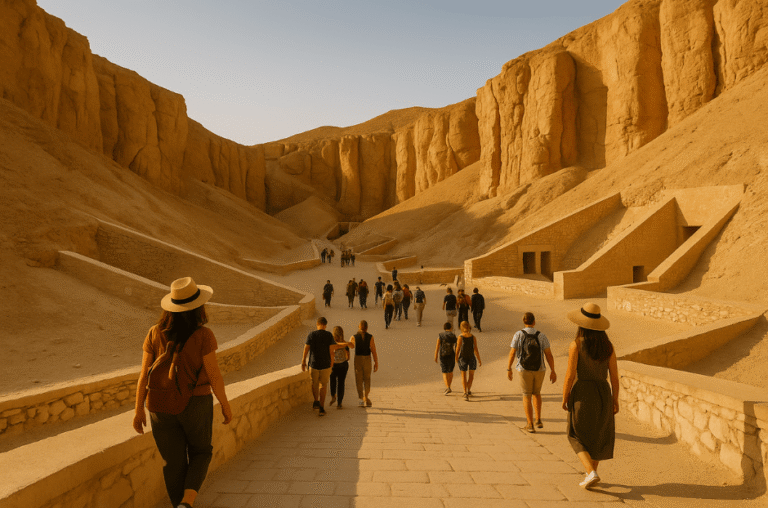
At the Valley of the Kings, you descend underground into royal tombs cut into the limestone.
At Hatshepsut, you move upward through an open architectural monument built against those same Theban cliffs.
That contrast is precisely why they work so well together.
Our Valley of the Kings Guide explains which tombs are worth prioritizing, how the standard and special tickets work, and why three or four excellent tombs produce a stronger visit than racing through as many entrances as possible.
A good West Bank day can then continue to the Colossi of Memnon and, depending on your interests and tolerance for heat, another archaeological site.
Do not keep adding monuments simply because they are geographically nearby. After several hours of tombs, temples, heat, and hieroglyphs, attention deteriorates long before the archaeological quality does.
Guide’s Note: If the Valley of the Kings is your highest priority, protect the first morning hours for the tombs and accept that Hatshepsut may be busier. If architecture and photography matter equally, adjust the sequence rather than automatically copying the standard coach-tour order.
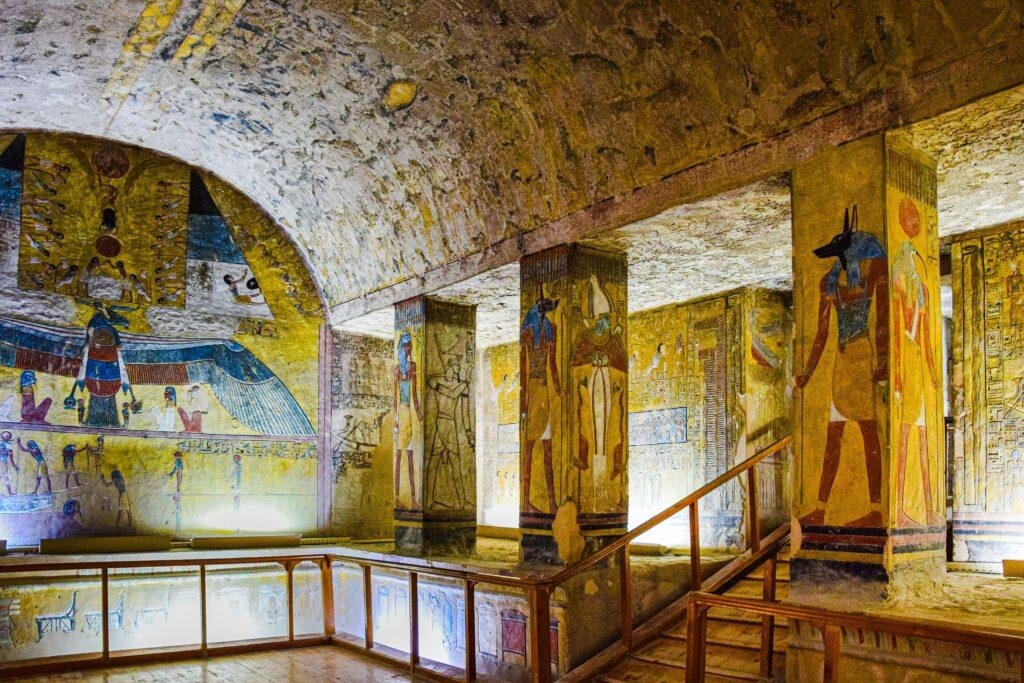
Should You Visit Hatshepsut Temple With a Guide?
An Egyptologist is particularly valuable here.
The building itself is easy to navigate independently. You do not need someone to tell you how to reach the next terrace.
What you need explained is why the decoration matters.
The Punt expedition, divine-birth narrative, Osiride imagery, Amun sanctuary, Hathor and Anubis chapels, and later damage to Hatshepsut’s representations form a connected political and religious story. Without explanation, it is easy to photograph the reliefs without realizing why they are exceptional.
Independent travelers should read about those elements before arriving rather than relying on the site to explain every scene in depth.
A good guide should also know when to stop talking. Deir el-Bahari’s architecture deserves a few minutes of silence and distance.
Photography Is Best Before You Reach the Temple
The classic Hatshepsut photograph is architectural rather than archaeological detail.
Stand back along the main approach and use the central ramp as a leading line toward the terraces and cliffs. This is the position that best communicates Senenmut’s design.

Earlier light generally gives a cleaner result and is more comfortable for the photographer. As the forecourt fills, achieving a symmetrical image without groups crossing the central axis becomes increasingly difficult.
Recent visitors have also reported periods of visible restoration or scaffolding around parts of the façade. Conservation work is part of visiting a living archaeological site, so do not build the entire visit around recreating one perfectly empty photograph.
Inside, prioritize details that support the story: Punt, royal imagery, Hathor, Anubis, and evidence of later alteration.
The Temple Is Accessible, but the Heat Changes the Equation
Compared with many West Bank tombs, Hatshepsut Temple is relatively straightforward physically.
The main route is broad and the terraces are connected by ramps, while transport at the visitor area reduces some of the approach on foot. Recent visitor reports specifically mention parking and shuttle access as making arrival easier.
That does not make the site effortless.
You still climb through multiple levels, spend significant time outdoors, and encounter almost no natural shade. Travelers with reduced mobility should confirm current on-site assistance before visiting because access to every interior area may not be equally straightforward.
For everyone else, the biggest physical challenge is usually temperature rather than distance.
Water, a hat, sunscreen, and shoes with reliable grip matter far more than dressing elegantly for photographs.
Hatshepsut Temple or Another Tomb?
If you have a full West Bank day, this is the wrong choice to make. Visit both Hatshepsut Temple and the Valley of the Kings.
If your time is genuinely limited, the Valley of the Kings takes priority because the royal tombs offer an experience found nowhere else on the West Bank.
But Hatshepsut should be the next major site added.
It provides something the tombs cannot: monumental architecture in the open landscape, a detailed account of one of Egypt’s most unusual reigns, and a visible link between royal power and the cult of Amun across the Nile at Karnak.
Skipping it because you have “already seen a temple” misunderstands Deir el-Bahari.
This does not feel like Karnak, Luxor Temple, Edfu, or Philae.
Hatshepsut Temple Makes Karnak More Interesting
Travelers commonly divide Luxor into East Bank and West Bank days, which is sensible logistically but can hide the connections ancient Egyptians themselves understood.
Hatshepsut’s temple was aligned religiously with Karnak, the principal sanctuary of Amun across the Nile.
The temple’s decoration even includes the transportation of obelisks from the quarry toward Karnak.
Seeing both sites helps reconstruct the sacred geography of ancient Thebes. The river did not simply divide a modern sightseeing itinerary into two convenient halves. It connected temples, festivals, gods, royal cults, and the worlds of life and death.
UNESCO recognizes this wider landscape as Ancient Thebes with its Necropolis, encompassing the great East Bank temple complexes and the royal burial and mortuary landscape to the west.
That broader context is the difference between visiting individual monuments and understanding Luxor.
Frequently Asked Questions
How much time should I spend at Hatshepsut Temple?
Allow 60 to 90 minutes for a first visit. An hour works with a knowledgeable guide who can take you directly to the essential architecture and reliefs, while 90 minutes gives photographers and history-focused visitors more breathing room. In hot weather, slowing down between terraces is more important than squeezing another monument into the schedule.
What are Hatshepsut Temple’s opening hours?
The official Ministry listing currently gives 6:00 a.m. to 5:00 p.m. every day. Early entry is particularly valuable from late spring through early autumn because the temple’s exposed terraces and surrounding cliffs become intensely hot later in the day.
Is Hatshepsut Temple close to the Valley of the Kings?
The two sites sit close together on Luxor’s West Bank and are naturally combined in the same sightseeing day. They should still be treated as separate visits: the Valley of the Kings involves walking between underground tombs, while Hatshepsut is an exposed terraced temple where heat and sunlight become the main physical factors.
Is Hatshepsut buried in her temple?
Hatshepsut’s mortuary temple was not her tomb. Her burial was associated with the Valley of the Kings. The temple at Deir el-Bahari maintained her royal funerary cult and honored deities including Amun, Hathor, Anubis, and Ra-Horakhty. Confusing mortuary temples with royal tombs is one of the easiest ways to misunderstand Luxor’s West Bank.
Why was Hatshepsut’s temple built on the West Bank?
Its western location reflected the funerary symbolism of sunset and death while also placing the temple within the Theban necropolis. It stood directly across the Nile from Karnak, creating an important relationship with Amun’s principal sanctuary and the religious processions that crossed the river.
Was Hatshepsut Egypt’s first female pharaoh?
Hatshepsut was not Egypt’s first known female ruler, although she became one of its most powerful and successful female pharaohs. Her significance lies partly in the length and authority of her reign and the sophisticated way she expressed kingship through monuments such as Deir el-Bahari.
Is Hatshepsut Temple suitable for children?
Families can navigate the main temple more easily than many steep or confined West Bank tombs, but the exposed heat is the deciding factor. Children will cope much better early in the morning, with water and sun protection, than during a long late-morning stop after several hours elsewhere on the West Bank.
Is Hatshepsut Temple worth visiting if I’ve already seen Karnak?
The two temples serve different purposes and look completely different. Karnak is an enormous sanctuary complex developed by successive rulers; Hatshepsut’s mortuary temple is a tightly composed terraced monument integrated into the cliffs of Deir el-Bahari. Visiting both also reveals the religious connection between Amun’s East Bank sanctuary and Hatshepsut’s royal cult on the West Bank.
The common mistake at Hatshepsut Temple is arriving after a rushed morning of tombs, walking straight up the central ramp, taking the famous façade photograph, and leaving without understanding the reliefs that explain why the temple exists. Explore ENA’s Luxor tours and Egypt itineraries to sequence Deir el-Bahari with the Valley of the Kings during sensible visiting hours and experience it with an Egyptologist who can connect Hatshepsut’s architecture, Punt expedition, divine kingship, and relationship with Karnak. Get the order right and the temple becomes one of Luxor’s clearest stories of royal power; get it wrong and it becomes another beautiful building seen at the hottest point of the day.