Alexandria Egypt Tours: The Complete Travel Guide to Egypt’s Mediterranean Capital
Alexandria is Egypt’s Mediterranean Counterpoint.
Alexandria feels different from the rest of Egypt almost immediately.
Cairo is intense and monumental. Luxor is defined by temples and tombs. But Alexandria carries the rhythm of the Mediterranean — slower, windier, and shaped by centuries of cultural exchange.
Founded by Alexander the Great in 331 BC, the city quickly became one of the most important intellectual centers of the ancient world. For centuries it was home to the famous Library of Alexandria, a legendary institution that symbolized the pursuit of knowledge across the Greek and Egyptian worlds.
Although much of the ancient city now lies beneath the modern streets and the Mediterranean Sea, Alexandria still preserves traces of its layered past. Roman ruins, Ottoman-era buildings, colonial architecture, and modern seaside neighborhoods all exist within the same urban landscape.
For travelers exploring Egypt, Alexandria offers something that the country’s other major destinations do not: a historic coastal city shaped as much by the Mediterranean as by the Nile.
Instead of desert monuments, Alexandria offers sea views, historic forts, cafés overlooking the water, and neighborhoods where Egypt’s ancient past blends with European and Middle Eastern influences.
Understanding Alexandria requires adjusting expectations.
It is not a city of massive temples or pyramids. It is a city of history, atmosphere, and coastal culture.
Why Alexandria Is Different from the Rest of Egypt
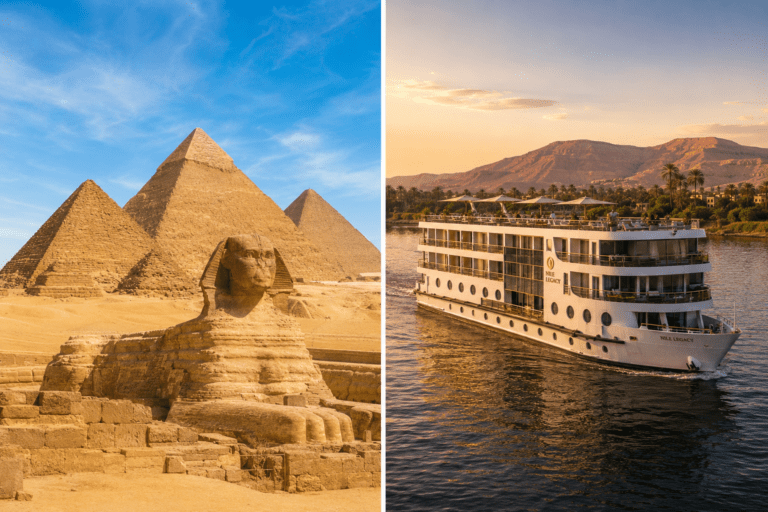
Most first-time Egypt itineraries follow a familiar route: Cairo, Luxor, Aswan, and often a Nile cruise or Red Sea extension. Those destinations focus heavily on Egypt’s Pharaonic past — pyramids, temples, and tombs built thousands of years ago.
Alexandria represents something very different.
Rather than telling the story of ancient Egypt’s earliest dynasties, Alexandria reflects the period when Egypt became deeply connected to the wider Mediterranean world. Its history is shaped less by pyramids and more by philosophers, scholars, merchants, and empires that linked Africa, Europe, and the Middle East.
The city was founded in 331 BC by Alexander the Great, who envisioned it as a strategic Mediterranean port and a center of cultural exchange. After his death, the Ptolemaic dynasty ruled Egypt from Alexandria and transformed it into one of the most influential cities of the ancient world.
During this period, Alexandria became famous for institutions that symbolized intellectual ambition on a global scale. The Library of Alexandria, once the largest library of the ancient world, sought to collect knowledge from across civilizations. Nearby stood the Pharos Lighthouse, one of the Seven Wonders of the Ancient World, guiding ships safely into Alexandria’s busy harbor.
Under Roman rule, Alexandria remained one of the empire’s most important cities, rivaled only by Rome and Constantinople in influence. Over the centuries, Greek, Roman, Egyptian, Ottoman, and European cultures all left their imprint on the city.
This long history of exchange is what gives Alexandria its distinctive character today.
Unlike Cairo, where ancient monuments rise from the desert landscape, Alexandria feels unmistakably Mediterranean. Sea breezes move along the Corniche, colonial-era balconies overlook busy streets, and cafés line the waterfront where locals gather late into the evening.
For travelers exploring Egypt, Alexandria provides an important contrast.
Cairo introduces the ancient world of the pharaohs. Luxor immerses visitors in monumental temple landscapes. Alexandria, by comparison, reveals a different chapter — a period when Egypt stood at the crossroads of the Mediterranean, shaping and absorbing cultures from across the ancient world.
When you visit Alexandria, you’re not simply adding another stop to an itinerary.
You’re stepping into a different layer of Egyptian history — one that connects the country not only to its ancient past, but also to the broader story of the Mediterranean world.
Alexandria’s Ancient Legacy: Library, Lighthouse, and Intellectual Power
No guide to Alexandria is complete without understanding the two legendary institutions that defined the city in antiquity: the Great Library of Alexandria and the Lighthouse of Pharos.
Together, they symbolized two ambitions that made Alexandria extraordinary — the pursuit of knowledge and mastery of the sea.
Founded by Alexander the Great in 331 BC, Alexandria quickly became one of the most influential cities of the ancient Mediterranean. Under the Ptolemaic dynasty, the city was designed not only as a political capital but as an intellectual and commercial center that connected Egypt with the wider world.
At the heart of that vision stood the Great Library of Alexandria.
The Library was far more than a collection of scrolls. It was part of a larger scholarly institution known as the Mouseion, where philosophers, scientists, and writers gathered to study and debate ideas. Ancient accounts describe scholars working on mathematics, astronomy, geography, medicine, and philosophy — fields that shaped the intellectual foundations of later civilizations.
Although the exact size of the Library remains debated, its ambition was clear: to gather and preserve the knowledge of the entire known world.
Whether every ancient story about the Library is historically precise or partly mythologized, its reputation became legendary. Alexandria was known throughout the ancient world as a city where scholarship flourished and intellectual curiosity was encouraged.
Just as important to Alexandria’s identity was the Lighthouse of Pharos.
Built during the 3rd century BC on the island of Pharos near the harbor entrance, the lighthouse was one of the tallest structures of the ancient world. Rising more than 100 meters high, it guided ships safely into Alexandria’s busy port and became one of the Seven Wonders of the Ancient World.
For sailors approaching the city across the Mediterranean, the lighthouse symbolized both safety and the immense power of Alexandria’s maritime influence.
Over centuries, earthquakes and political upheaval eventually destroyed both the Library and the lighthouse. Yet their influence never disappeared.
The idea of Alexandria as a city of knowledge continues today through the Bibliotheca Alexandrina, a modern library built near the ancient site that honors the legacy of the original institution.
This enduring connection to learning and exploration is part of what gives Alexandria its unique identity.
It is not simply a coastal city with historic ruins. It is a place whose reputation once rested on the ambition to illuminate the world — through both scholarship and engineering.
Top Things to Do in Alexandria Egypt
When travelers search for “things to do in Alexandria Egypt,” they are usually looking for the city’s essential highlights — the sites that reveal why Alexandria mattered for centuries as one of the Mediterranean world’s most influential ports.
Unlike destinations such as Luxor, where monuments dominate the landscape, Alexandria’s major attractions reflect the city’s Greco-Roman heritage, maritime importance, and intellectual legacy.
The best Alexandria experiences combine Roman archaeological sites, coastal fortress views, and modern cultural landmarks that connect the ancient city with the present.
Qaitbay Citadel: Built on the Site of the Ancient Lighthouse
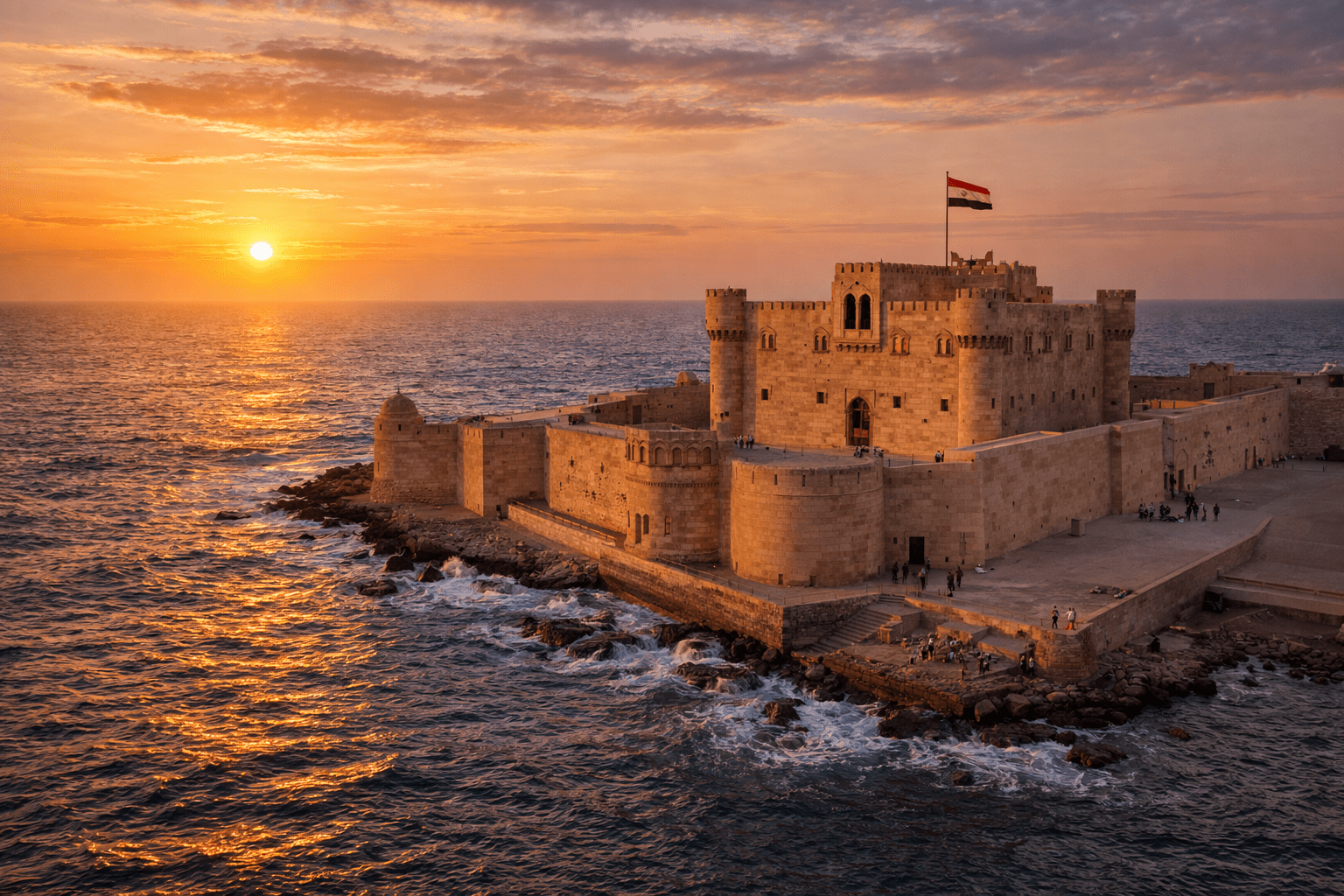
The Qaitbay Citadel stands on one of the most historically significant locations in the Mediterranean.
Constructed in 1477 AD by Sultan Qaitbay, the fortress was built to defend Alexandria’s harbor from naval attacks during the Mamluk period. Thick limestone walls, watchtowers, and defensive corridors still give the structure the feeling of a working coastal stronghold.
But what makes the site truly remarkable is its deeper history.
The citadel occupies the exact location where the Lighthouse of Pharos once stood — one of the Seven Wonders of the Ancient World. For centuries, the towering lighthouse guided ships safely into Alexandria’s harbor and symbolized the city’s maritime power.
Standing on the citadel’s outer walls today, visitors can look across the Mediterranean and imagine the same horizon ancient sailors once saw as they approached the city.
The experience here is as much about atmosphere as architecture: sea winds moving across the stone ramparts, fishing boats passing through the harbor, and the sense that this stretch of coastline has shaped Alexandria’s identity for more than two thousand years.
If you only have time for one major stop in Alexandria, Qaitbay Citadel is the place that best captures the spirit of the city.
Catacombs of Kom El Shoqafa: A Greco-Roman Underworld
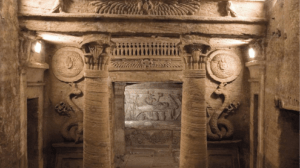
The Catacombs of Kom El Shoqafa, dating to around the 2nd century AD, are among the most unusual burial complexes in Egypt. Unlike the tombs of Luxor, which reflect purely Pharaonic beliefs about the afterlife, these catacombs reveal Alexandria’s multicultural identity during the Roman period.
Descending into the site, visitors enter a series of chambers and corridors carved deep into the rock. The architecture blends Egyptian motifs with Greek and Roman artistic styles in ways that feel both familiar and surprising.
Statues show Egyptian deities dressed in Roman armor. Decorative carvings combine classical Greek forms with traditional Egyptian symbolism.
This mixture reflects the reality of Alexandria during the Roman era: a city where multiple cultures lived side by side, influencing one another in everyday life.
Exploring the catacombs offers a rare glimpse into how Alexandria’s residents blended traditions, creating something entirely unique in the ancient world.
Pompey’s Pillar and the Serapeum
The massive granite column was actually erected in 297 AD to honor the Roman Emperor Diocletian, who supported Alexandria during a period of political unrest.
Rising more than 25 meters high, the pillar remains one of the largest ancient monolithic columns still standing in Egypt.
The surrounding area marks the location of the Serapeum, once one of the most important religious complexes in Alexandria. The temple was dedicated to Serapis, a Greco-Egyptian deity created to unify Greek and Egyptian religious traditions during the Ptolemaic era.
Although much of the temple complex has been lost, the site still offers insight into Alexandria’s religious diversity during the Roman period.
Standing beside the towering column, it becomes easier to imagine the scale of the structures that once surrounded it.
Bibliotheca Alexandrina: Modern Alexandria’s Tribute to Knowledge
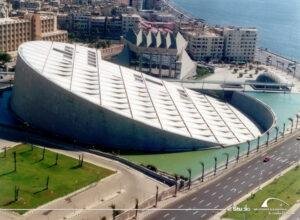
Opened in 2002, the library was designed as a cultural and intellectual center inspired by the legendary Library of Alexandria that once stood nearby.
Its architecture is striking: a massive circular structure tilted toward the Mediterranean, its granite exterior engraved with characters from dozens of languages representing the global exchange of knowledge.
Inside, the library houses reading rooms, museums, galleries, and research centers dedicated to preserving and sharing information across cultures.
Even travelers who are not typically interested in libraries often find the experience worthwhile. The building itself is impressive, and its location along Alexandria’s waterfront reinforces the symbolic connection between the city’s ancient intellectual heritage and its modern aspirations.
Visiting the Bibliotheca Alexandrina adds an important dimension to an Alexandria itinerary. After exploring ruins and historic monuments, the library shows how the city continues to embrace the identity that made it famous more than two thousand years ago — a place devoted to learning, culture, and exchange of ideas.
Alexandria Day Tour from Cairo: Is It Worth It?
One of the most common questions travelers ask while planning their Egypt itinerary is simple: is an Alexandria day tour from Cairo worth it?
For most visitors, the answer is yes — as long as the trip is planned well.
Alexandria sits roughly 220 kilometers (about 135 miles) north of Cairo along Egypt’s Mediterranean coast. In good traffic conditions, the drive usually takes 2.5 to 3 hours each way, making it realistic to visit the city in a single long day.
Because of this distance, Alexandria has become one of the most popular day-trip destinations from Cairo, offering travelers a chance to experience a completely different side of Egypt without changing hotels or disrupting a larger itinerary.
But the key to enjoying the trip is organization.
Unlike Cairo’s attractions, which are spread across a massive metropolitan area, Alexandria’s main sites are relatively close together. With the right route and timing, visitors can see the city’s highlights comfortably within a day.
Why Alexandria Works Well as a Day Trip
One of the reasons Alexandria works well for a day excursion is the contrast it provides.
Most Egypt itineraries focus on the Nile Valley — pyramids, temples, and desert landscapes tied to the pharaohs. Alexandria introduces a different historical layer entirely.
Here the story shifts to the Mediterranean world, where Greek, Roman, and Egyptian cultures blended together in one of antiquity’s most influential cities.
Travelers often notice the difference immediately. The air feels cooler near the sea, the city’s architecture reflects European and Ottoman influences, and the rhythm of life along the waterfront feels noticeably different from Cairo’s intensity.
For visitors who have already spent several days exploring pyramids and museums, Alexandria offers a refreshing change of perspective.
It’s often described as one of the best contrast days you can add to an Egypt trip: moving from desert landscapes to the Mediterranean coast, and from pharaonic monuments to Greco-Roman history.
What a Well-Planned Alexandria Day Looks Like
A typical Alexandria day trip begins with an early departure from Cairo, usually around 7:00 AM.
Arriving in Alexandria by mid-morning allows time to explore the city’s most important historical sites.
A well-structured route often includes:
• Qaitbay Citadel, built on the site of the ancient Lighthouse of Pharos
• Catacombs of Kom El Shoqafa, one of Egypt’s most unusual Greco-Roman burial sites
• Pompey’s Pillar and the Serapeum ruins, reflecting Alexandria’s Roman imperial period
• Bibliotheca Alexandrina, the modern tribute to the ancient Library of Alexandria
Many tours also include time for lunch along the Mediterranean waterfront, which adds a memorable coastal element to the day.
After exploring the major sites, travelers typically return to Cairo in the late afternoon or early evening.
When Alexandria Deserves More Than One Day
While a day trip works well for many travelers, Alexandria can also reward visitors who spend more time there.
Staying overnight allows you to experience the city’s Mediterranean atmosphere more fully — walking along the Corniche at sunset, visiting additional museums, or enjoying Alexandria’s famous seafood restaurants.
For travelers who enjoy slower exploration and coastal cities, spending a full day and night in Alexandria can reveal a side of Egypt that many itineraries overlook.
The Bottom Line
For most visitors, an Alexandria day trip from Cairo is a worthwhile addition to an Egypt itinerary.
The journey adds a completely different historical perspective — one shaped by Greek philosophers, Roman emperors, and Mediterranean trade routes rather than pyramids and temples.
With good planning and an early start, travelers can comfortably experience the city’s most important highlights in a single day.
And in doing so, they gain a deeper understanding of Egypt’s place within the broader story of the ancient Mediterranean world.
Who Should Visit Alexandria as a Day Trip
For many travelers, an Alexandria day trip from Cairo works perfectly.
It allows you to experience the city’s most important historical landmarks while keeping the rest of your itinerary focused on Cairo, Luxor, and the Nile Valley.
A day trip tends to work best for travelers who:
Are based in Cairo and prefer not to change hotels.
Alexandria’s proximity makes it one of the easiest long excursions from the capital.
Want to add Greco-Roman history to their Egypt itinerary.
Most Egyptian travel focuses on the pharaohs and the Nile Valley. Alexandria introduces a completely different historical chapter shaped by Greek and Roman influence.
Prefer a structured experience.
Because Alexandria’s highlights are spread across different parts of the city, a well-organized tour can make the day far smoother and more efficient.
Want a change of atmosphere.
After several days in Cairo’s busy streets, Alexandria’s coastal setting and Mediterranean breeze often feel refreshing.
For travelers with limited time, a well-planned day trip delivers a satisfying introduction to the city.
Who Should Stay Overnight in Alexandria
While a day trip works well for many visitors, Alexandria reveals a different side of itself when travelers stay overnight.
Spending the night allows you to experience the city beyond its historical landmarks.
An overnight stay may be a better choice if you:
Enjoy coastal cities and slower exploration.
Alexandria’s Mediterranean setting encourages a more relaxed pace than Cairo.
Want to experience sunset along the Corniche.
Evening light along the waterfront creates one of the city’s most memorable atmospheres.
Prefer to explore beyond the main highlights.
With more time, visitors can discover additional museums, gardens, cafés, and local neighborhoods.
Love food culture.
Alexandria is famous throughout Egypt for its seafood restaurants, many of which overlook the Mediterranean.
For travelers who enjoy soaking in a city’s atmosphere rather than simply visiting its landmarks, staying overnight often reveals Alexandria’s most appealing qualities.
One Day vs. Two Days in Alexandria: What Changes?
The difference between spending one day and two days in Alexandria is not simply the number of sites you visit.
It’s the pace of the experience.
A single day is enough to see Alexandria’s major landmarks and understand the city’s historical significance.
Two days, however, allow you to experience Alexandria as a living Mediterranean city rather than a checklist of monuments.
What a Great One-Day Alexandria Plan Looks Like
A strong one-day itinerary focuses on flow rather than volume.
Instead of rushing between unrelated stops, the day unfolds in a logical sequence that reflects the city’s historical layers.
Many well-planned Alexandria day trips follow a pattern similar to this:
Begin with the Catacombs of Kom El Shoqafa, descending underground into one of the most unusual Greco-Roman burial complexes in Egypt.
Continue to Pompey’s Pillar and the Serapeum ruins, which anchor Alexandria in the Roman imperial period.
Move toward the coast to visit the Qaitbay Citadel, built on the site of the ancient Lighthouse of Pharos.
Later in the afternoon, explore the Bibliotheca Alexandrina, the modern tribute to the legendary Library of Alexandria.
Finally, spend time along the Corniche waterfront, where the city’s Mediterranean atmosphere becomes most visible.
When organized well, this sequence creates a day that feels balanced and surprisingly complete.
What Two Days in Alexandria Unlock
Spending a second day in Alexandria introduces something that day trips often lack: breathing room.
With more time, visitors can enjoy the city at a slower pace and explore beyond the primary landmarks.
An overnight stay allows travelers to:
• enjoy a relaxed seafood dinner overlooking the harbor
• spend more time walking along the Corniche
• visit additional museums or cultural sites
• experience Alexandria’s cafés and evening atmosphere
Most importantly, two days allow Alexandria to feel less like a stop on an itinerary and more like a destination in its own right.
For travelers building a premium or slower-paced Egypt itinerary, adding an overnight stay often allows Alexandria’s Mediterranean character to shine.
Best Time to Visit Alexandria, Egypt
Alexandria’s Mediterranean location gives it a noticeably different climate from most of Egypt. While cities along the Nile such as Luxor and Aswan experience intense desert heat, Alexandria benefits from cooler temperatures and regular sea breezes from the Mediterranean.
Because of this coastal influence, Alexandria is generally comfortable to visit throughout the year, making it one of the easiest destinations to add to an Egypt itinerary regardless of season.
That said, some months offer a particularly pleasant balance of weather and sightseeing conditions.
Spring and Autumn: The Most Comfortable Seasons
For most travelers, the best time to visit Alexandria falls during the spring and autumn months, particularly:
March through June
September through November
During these periods, temperatures are warm but rarely oppressive, and the Mediterranean breeze helps keep the city comfortable for walking along the Corniche and exploring historic sites.
Spring visits often bring clear skies and moderate temperatures that are ideal for exploring outdoor attractions such as the Qaitbay Citadel or the harbor waterfront.
Autumn offers similarly pleasant conditions, with slightly cooler evenings and calmer tourism levels compared with Egypt’s peak winter travel season.
Visiting Alexandria in Summer
Summer in Alexandria is very different from summer in Upper Egypt.
While cities like Luxor and Aswan can reach 40°C (104°F) or higher, Alexandria’s coastal climate keeps temperatures noticeably lower. Daytime highs typically range between 28–32°C (82–90°F).
Humidity can increase during this time, but the sea breeze often makes the heat feel manageable.
Summer is also the time when Alexandria becomes a popular beach destination for Egyptians, meaning the waterfront and Corniche can feel lively and energetic.
Travelers visiting Egypt during the summer months often find Alexandria to be a refreshing break from the intense desert heat further south.
Winter in Alexandria
Winter in Alexandria is mild compared with many Mediterranean cities.
Temperatures usually range between 15–20°C (59–68°F) during the day, making sightseeing comfortable for visitors who prefer cooler weather.
The main difference during winter is that the city can occasionally feel windy or rainy, particularly along the waterfront. These conditions rarely disrupt travel plans, but they can create a noticeably different atmosphere compared with Egypt’s typically dry climate.
Despite the occasional winter storms, Alexandria remains a pleasant destination for exploring historical sites and enjoying the coastal scenery.
Why Alexandria Feels Cooler Than the Rest of Egypt
One of the most noticeable things travelers experience when arriving in Alexandria is how different the climate feels compared with Cairo or Luxor.
The reason is simple: the Mediterranean Sea moderates temperatures.
Sea breezes cool the city during the day, and the coastal location prevents the extreme heat swings common in desert regions.
For travelers combining Alexandria with a larger Egypt itinerary, this often makes the city feel like a welcome change of pace — especially after spending time exploring temples and tombs in Upper Egypt.
In many ways, Alexandria’s climate reflects its identity: less desert, more Mediterranean.
Alexandria vs Cairo: What You Actually Get in Each City
A common misconception among travelers is that Alexandria will feel like “Cairo by the sea.”
In reality, the two cities offer completely different travel experiences.
Cairo is Egypt’s dramatic center of power and history. It is intense, energetic, and filled with some of the most iconic archaeological sites in the world. The pyramids of Giza rise from the desert just outside the city, museums hold thousands of ancient artifacts, and historic districts such as Islamic Cairo reveal centuries of architectural and religious history.
Alexandria, by contrast, feels quieter and more atmospheric.
Rather than towering monuments from the age of the pharaohs, Alexandria’s identity comes from its role as a Mediterranean crossroads. Its story is shaped by Greek philosophers, Roman emperors, maritime trade, and the legendary pursuit of knowledge associated with the ancient Library of Alexandria.
This difference becomes clear as soon as visitors arrive.
Cairo’s skyline is dominated by mosques, crowded streets, and the vast scale of a megacity. Alexandria opens toward the Mediterranean, where sea breezes move along the Corniche and historic neighborhoods reflect centuries of cultural exchange.
Even the historical focus of each city is different.
Cairo introduces visitors to the Pharaonic foundations of Egypt, including the pyramids, early dynastic monuments, and museums that explain ancient civilization.
Alexandria reveals the period when Egypt was deeply connected to the Greco-Roman Mediterranean world, a time when scholars, merchants, and sailors shaped the city into one of antiquity’s most important cultural centers.
Because of these differences, travelers rarely choose one city instead of the other.
Instead, the two destinations complement each other.
Cairo tells the story of Egypt’s ancient origins and monumental achievements. Alexandria adds a different perspective — a coastal city where Egyptian history intersects with the broader story of the Mediterranean world.
Together, they create a richer and more complete understanding of Egypt’s past.
What to Eat and How Alexandria Feels
One of the most noticeable differences between Alexandria and other Egyptian cities is its relationship with the sea.
While Cairo is defined by the Nile and desert landscapes surround Luxor, Alexandria lives alongside the Mediterranean. This coastal setting shapes not only the city’s climate and architecture, but also its food culture and daily rhythm.
For many Egyptians, Alexandria is known as one of the best places in the country to eat seafood.
Restaurants near the harbor and along the Corniche specialize in freshly caught fish, shrimp, calamari, and other Mediterranean dishes. Meals often revolve around simple preparation — grilled fish seasoned with lemon, garlic, and herbs — allowing the freshness of the seafood to take center stage.
Dining in Alexandria is also about atmosphere.
Many restaurants offer views of the Mediterranean, where waves roll toward the harbor and fishing boats drift slowly along the coastline. Sitting down for a relaxed seafood lunch or dinner overlooking the water creates a completely different feeling from the faster-paced dining experiences common in Cairo.
Even if you are visiting Alexandria for only a single day, building time for a harbor-side meal can transform the experience.
Instead of moving quickly from one landmark to another, the city begins to reveal its personality.
The Corniche: Where Alexandria Comes Alive
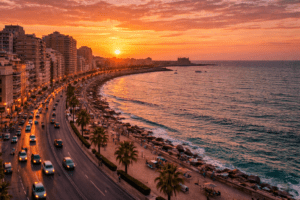
The Alexandria Corniche is the long waterfront road that curves along the Mediterranean shoreline, and it is the place where the city’s atmosphere becomes most visible.
Throughout the day, locals gather along the waterfront to walk, fish, meet friends, or simply enjoy the sea breeze.
Cafés and restaurants line the road, and the rhythm of the city feels noticeably slower than Cairo’s intense pace. The sound of waves against the harbor walls replaces the constant traffic noise that dominates Egypt’s capital.
At sunset, the Corniche becomes especially vibrant.
Families stroll along the promenade, fishermen cast lines into the water, and cafés fill with people watching the evening light fade over the Mediterranean.
For visitors, spending time along the Corniche offers something many historical sites cannot: a glimpse of everyday life in Alexandria.
It’s where travelers begin to understand that Alexandria is not just a place of ancient ruins and historical legends.
It is also a living coastal city, shaped by the sea and by the generations of people who have lived along its shores.
Why Book Guided Alexandria Egypt Tours?
It is certainly possible to explore Alexandria independently. The city is accessible from Cairo, and many of its major attractions can be visited on your own with basic planning.
However, many travelers find that a guided Alexandria tour significantly improves the experience.
The main reason is logistics.
Alexandria’s major sites — including the Catacombs of Kom El Shoqafa, Pompey’s Pillar, the Qaitbay Citadel, and the Bibliotheca Alexandrina — are spread across different parts of the city. Navigating between them efficiently can be challenging, especially for visitors unfamiliar with local traffic patterns.
A well-organized tour removes that complexity by structuring the day in a logical route, allowing travelers to focus on the sites rather than transportation.
Guides also add something even more valuable: historical context.
Many of Alexandria’s archaeological locations, particularly Greco-Roman sites, do not immediately reveal their significance. Without explanation, visitors may see columns, chambers, or ruins without understanding the deeper historical story behind them.
A knowledgeable guide connects those sites to the larger narrative of Alexandria — explaining how Greek, Roman, and Egyptian cultures blended in the city and why Alexandria became one of the most influential intellectual centers of the ancient Mediterranean world.
In that sense, a guide does more than lead a tour.
They turn a series of historical stops into a coherent story.
For travelers whose goal is simply to check landmarks off a list, independent exploration can work well.
But for those who want to understand why Alexandria mattered, guided Alexandria Egypt tours often provide a richer and more meaningful experience.
Frequently Asked Questions
Is Alexandria safe for tourists?
Yes. Alexandria is one of Egypt’s major cities and a long-established tourism destination visited by travelers from around the world. The main attractions—such as Qaitbay Citadel, the Catacombs of Kom El Shoqafa, Pompey’s Pillar, and the Bibliotheca Alexandrina—are well-known historical sites that regularly host visitors.
Like any large city, basic travel awareness is recommended. Using reputable transportation, keeping a structured itinerary, and visiting major sites during normal hours generally makes the experience smooth and comfortable.
Most travelers find Alexandria relaxed compared with Cairo, especially along the Mediterranean waterfront and the Corniche.
Can I do Alexandria in one day from Cairo?
Yes, and many travelers do exactly that. Alexandria is about 2.5 to 3 hours from Cairo by car, making it one of the most common day-trip extensions from the capital.
A well-planned day trip typically includes the Qaitbay Citadel, the Catacombs of Kom El Shoqafa, Pompey’s Pillar, and the Bibliotheca Alexandrina, along with a lunch stop near the Mediterranean.
The key to a successful day trip is leaving Cairo early and following a structured route so you avoid unnecessary travel across the city.
While one day covers the highlights, staying overnight allows you to enjoy Alexandria’s coastal atmosphere more fully.
Is Alexandria worth it if I’m already doing Luxor and Aswan?
Yes. Alexandria adds a completely different historical layer to an Egypt itinerary.
Luxor and Aswan focus on the Pharaonic world—temples, tombs, and monuments from ancient Egyptian religion and kingship. Alexandria represents a later chapter when Egypt became part of the Greco-Roman Mediterranean world.
The city was founded by Alexander the Great and became one of the most influential centers of knowledge and trade in the ancient world. Its landmarks—from the site of the Lighthouse of Pharos to the Roman catacombs—reflect this multicultural history.
For travelers interested in the full story of Egypt, Alexandria provides a valuable contrast to the Nile Valley.
What is Alexandria most famous for?
Alexandria is historically famous for two of the ancient world’s greatest achievements: the Great Library of Alexandria and the Lighthouse of Pharos, one of the Seven Wonders of the Ancient World.
Although both were lost over time, their legacy shaped the city’s reputation as a center of knowledge, scholarship, and maritime trade.
Today visitors explore landmarks connected to this history, including Qaitbay Citadel, built on the lighthouse site, the Catacombs of Kom El Shoqafa, and the modern Bibliotheca Alexandrina, which honors the spirit of the ancient library.
The city is also known for its Mediterranean atmosphere, seafood culture, and long waterfront Corniche.
How far is Alexandria from Cairo?
Alexandria is located about 220 km (135 miles) north of Cairo along Egypt’s Mediterranean coast. By car, the journey usually takes 2.5 to 3 hours, depending on traffic and the route used.
Because of this relatively short distance, Alexandria is one of the most popular day trips from Cairo. Many travelers visit the city as a long excursion that combines Roman archaeological sites, coastal views, and cultural landmarks such as the Bibliotheca Alexandrina.
For visitors who prefer a slower pace, staying overnight allows more time to enjoy Alexandria’s waterfront and food scene.
Final Take: What Alexandria Adds to Your Egypt Trip
Alexandria represents a different chapter of Egypt’s story.
While cities like Cairo, Luxor, and Aswan focus on the world of the pharaohs, Alexandria reflects the moment when Egypt became deeply connected to the Mediterranean. Greek philosophers, Roman emperors, sailors, scholars, and merchants all left their mark here.
It is a city where Egypt’s history expands beyond pyramids and temples.
The legacy of the Library of Alexandria, the harbor once guarded by the Lighthouse of Pharos, and the layers of Greco-Roman culture that shaped the city all reveal a different dimension of Egyptian civilization.
For travelers building a well-rounded itinerary, Alexandria adds something essential: contrast.
After exploring desert monuments and ancient temples, the Mediterranean coastline introduces a new atmosphere — sea air, harbor views, and a slower rhythm that feels distinct from the Nile Valley.
That contrast is what makes Alexandria so valuable in an Egypt itinerary.
It is not simply another destination on the map. It is the place where Egypt’s story connects to the wider world.
Plan Your Alexandria Experience
Interested in exploring Egypt’s Mediterranean side?
Our curated Alexandria Egypt tours combine the city’s most important highlights — including Qaitbay Citadel, the Roman Catacombs, and the Bibliotheca Alexandrina — in a well-paced itinerary that makes the most of a single day from Cairo.
You can also explore our Alexandria destination guide for travel tips, historical context, and ideas for building the perfect Alexandria visit into your Egypt itinerary.