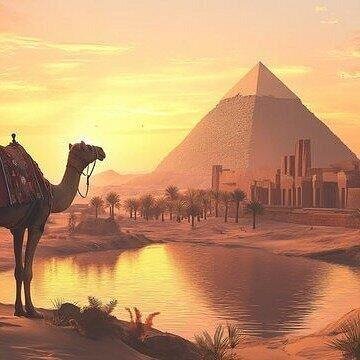
Scroll XVIII – The Child of Two Worlds
Alexandria & The Nile Valley — 47–44 BCE
Translated and restored for the modern traveler.
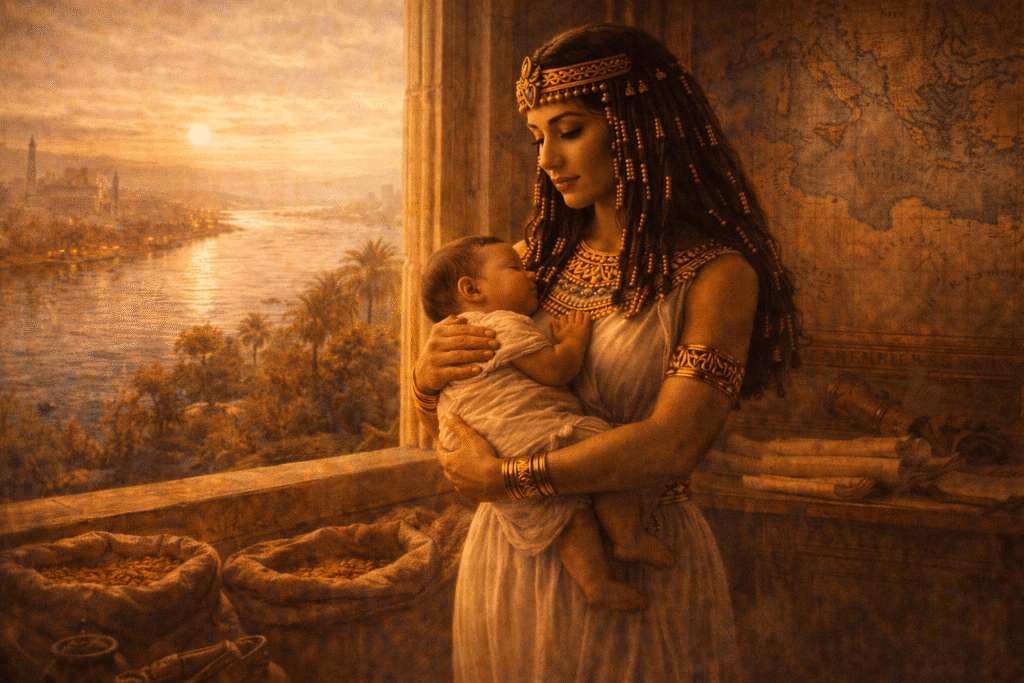
Prologue — A Birth Is Not a Beginning. It Is an Inheritance.
When my son was born,
the world did not change.
But the future did.
He was not a symbol of love,
as poets later claimed.
He was a symbol of possibility.
A child who bridged
the two greatest powers
of the ancient world:
Egypt
and
Rome.
Born in Alexandria,
raised in the palace,
watched by priests,
guarded by soldiers,
whispered about by diplomats.
Every breath he took
shifted the balance of empires.
This Scroll
is not the legend.
It is the truth.
My son’s birth
was not a scandal.
It was a strategy.
A blessing.
A responsibility.
A prophecy.
PART I — The Night I Knew
It was in the fourth month
after the restoration of Ma’at
when I first suspected.
I had been inspecting
the canal restoration
near the Fayum
when dizziness washed over me.
A priestess offered water.
“Majesty,”
she murmured,
“you must rest.”
“I am well,”
I insisted.
But inside,
I knew.
Life
had begun.
Not in a miracle.
In a moment
of clarity and alliance—
a moment
two rulers
understood
that their partnership
would shape Egypt
and Rome alike.
That night,
in my private chamber,
I placed a hand
over my abdomen
and whispered:
“You will be a child
of two worlds.”
The river breeze
shifted the curtains.
Not an omen.
Recognition.
PART II — The Silence Before Announcement
I told no one.
Not even my most trusted attendants.
Power
thrives in patience.
A queen
does not reveal her pregnancy
until she understands
what it means
for the throne,
the court,
and the world.
The priests
of Isis
were the first to know.
They sensed it
before I spoke.
Their leader bowed.
“A child of divine timing,”
she said.
“Not divine,”
I whispered.
“Human.”
She smiled.
“Human children
shape dynasties
more than gods.”
The next to know
was Caesar.
Not in a letter.
In person.
In the garden court
beneath palm shadows,
I told him.
He listened quietly,
eyes steady.
No shock.
No pride.
No hesitation.
Only clarity.
“This child,”
he said,
“will bind our futures.”
“Not bind,”
I corrected.
“Bridge.”
He nodded.
“Yes.
Bridge.”
PART III — The Roman Reaction
Rome
was a city of whispers.
Even across the sea,
rumors carried.
Some said
the child was a threat.
Others called him a miracle.
Still others dismissed him
as a political invention.
But Caesar
did not treat him
as rumor.
He acknowledged him.
Not publicly—
Rome’s politics
were too fractured.
But privately,
legally,
strategically.
He left gifts.
Letters.
Declarations written
in his own hand.
He wrote:
“This child will unite what war divides.”
Not flattery.
Vision.
Rome saw danger
in my son.
Caesar saw destiny.
PART IV — The Birth
My labor began
at dawn.
The Nile
glowed gold.
Birds lifted
from the papyrus beds.
The palace
grew quiet
as if the air
were holding its breath.
The priestesses
of Isis
surrounded me
with hymns.
My midwives
whispered reassurance.
Time
stretched.
Pain
became rhythm.
Rhythm
became purpose.
Purpose
became arrival.
When his cry
finally filled the chamber,
I felt the weight of the world
shift slightly—
a realignment
as subtle
as the movement
of a star.
They placed him
in my arms.
Dark hair.
Strong grip.
Eyes fierce
as the eastern sky.
My son.
Mine.
Egypt’s.
I whispered his name:
Ptolemy XV.
But in the palace
he was called something else:
Caesarion.
Little Caesar.
A name
Rome feared
and Egypt cherished.
PART V — The Ceremony of the Golden Milk
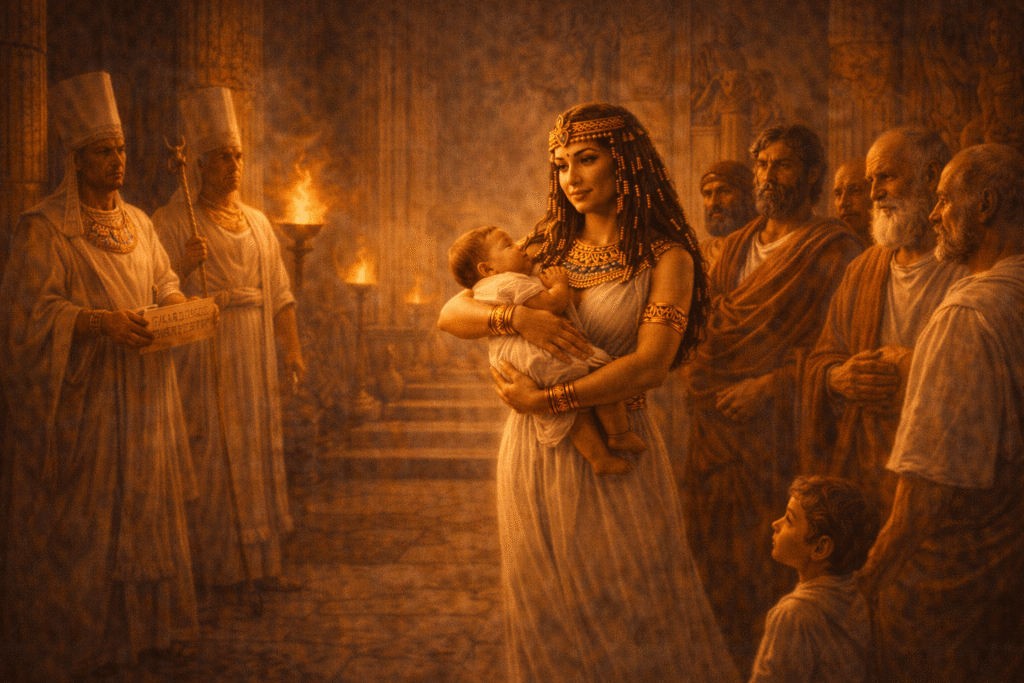
In the Temple of Isis,
we performed
the ancient rite:
The Offering of Golden Milk.
A priestess
anointed my son’s brow
with a mixture of:
milk
honey
lotus resin
and ground gold
while chanting:
“Child of the Two Lands,
Child of the River,
Child of the Morning Star,
May Ma’at guide you.”
I held him tightly.
“May you know balance,”
I whispered.
“And may you restore it
where others fail.”
The temple walls
absorbed the vow.
The pillars
seemed to lean closer.
Egypt
had received him.
Not as conqueror.
As continuity.
PART VI — A Son in the Palace Courts
As weeks became months,
Caesarion became
the center of the palace.
He giggled
at the sound of water wheels.
He gripped scrolls
as if instinctively
drawn to knowledge.
He watched
the Nile
with a seriousness
that startled the nurses.
One morning,
an elderly priest
observed him
and said:
“He sees far.”
I smiled.
“He sees everything.”
His existence
changed my rule.
Not because he was heir.
Because he was future.
And rulers
govern differently
when the future
has a face.
PART VII — The Diplomatic Shockwave
My son’s birth
sent ripples
through every court
in the Mediterranean.
Cyprus:
sent gifts
and subtle inquiries
about alliances.
Nabatea:
sent a delegation
to swear continued trade.
Judea:
sent scholars
to honor Egypt’s future.
Athens:
sent philosophers
to teach in the Mouseion.
Rome:
sent silence.
The Senate
was uneasy.
A child
born of Caesar
and a foreign queen
was a symbol
they feared:
The merging
of two worlds
without their permission.
Rumors
flew through Rome.
Some senators muttered:
“This child
must not reach power.”
But Caesar
did not flinch.
He sent a message
to my court:
“Raise him well.
His time will come.”
Not a prophecy.
A command.
PART VIII — Teaching a Son of Two Worlds
I did not raise my son
as a prince
shielded from struggle.
I raised him
as a Pharaoh
who would one day understand
the weight of the Two Lands.
His tutors
were chosen carefully:
— Egyptian priests
to teach ritual and balance
— Greek philosophers
to teach logic and reason
— Hebrew merchants
to teach diplomacy
— Arab traders
to teach geography and desert lore
— Nubian cavalrymen
to teach discipline and courage
He learned
to read Egyptian scripts
alongside Greek tragedies.
He learned
the constellations
and the Nile tides.
He learned
languages
the way other children
learned games.
When he laughed,
the palace brightened.
When he studied,
the palace hushed
with respect.
When he slept,
I watched him
and whispered:
“You will be greater than me.”
Not in conquest.
In continuation.
PART IX — The Night Caesar Returned to Rome
Caesar prepared to depart
for Rome—
and the court
filled with tension.
I walked with him
through the palm court
on our final night.
He looked at Caesarion,
sleeping in my arms.
“He has your eyes,”
he murmured.
“And your will,”
I said.
His expression
softened—
rare,
fragile,
fleeting.
“He carries peace
between our nations.”
“Will Rome accept that?”
I asked.
He exhaled slowly.
“Rome accepts
what it fears.”
“And they fear him.”
He nodded.
“They fear what he means.”
We fell silent.
Then Caesar placed
a hand on my shoulder.
“Raise him wise.
Raise him strong.
Raise him aware
of the world he inherits.”
I nodded.
“I will.”
He hesitated.
“Cleopatra…
if anything happens to me,
do not bring him to Rome.”
I met his eyes.
“I would never.”
We understood each other.
We understood
the danger ahead.
We understood
the future
rested in my arms.
When Caesar left,
the palace felt
emptier—
not from loss,
but from expectation.
The world
was changing.
And my son
was already
part of its shape.
PART X — What It Means to Be Mother and Pharaoh
Ruling Egypt
while raising a child
was not burden.
It was balance.
Ma’at
in its purest form.
Some nights,
after court judgments,
I held Caesarion
while studying scrolls.
Some mornings,
I brought him
to the council chambers,
letting leaders see
the future they were serving.
Egypt began to speak of him
as they once spoke
of Horus:
Protector.
Heir.
Symbol of renewal.
But I knew better.
He was not a god reborn.
He was a child.
A child who needed:
love,
guidance,
stability,
discipline,
knowledge,
and a mother
who would protect him
from every corner of the world
that wanted to use him.
I vowed
to be that mother.
And that queen.
Simultaneously.
Ancient Questioner’s Desk — The Child Edition
A student asked:
“Was Caesarion truly Caesar’s son?”
The elder replied:
“Cleopatra had no need to lie.”
Another asked:
“Did Caesar love him?”
The historian wrote:
“He respected what the child represented.”
A traveler wondered:
“What did Caesarion mean for Egypt?”
The scribe answered:
“He was the promise
that Egypt’s line
would not end.”
A final question came:
“Was Cleopatra a loving mother?”
The old master smiled.
“She was fierce,
which is the truest form of love.”
FINAL CTA — Walk the Birth of a New Dynasty
This Scroll ends here—
in the palace chambers
where a queen held her son,
in the temples
where he was blessed,
in the halls
where he was recognized
as the bridge between empires.
If you want to walk
the Egypt of Cleopatra’s motherhood—
the gardens,
the nursery chambers,
the ritual halls,
the places where a dynasty
was reborn—
walk them with ENA.
Journey with ENA.
Great queens raise
greater kings.