
Scroll XIX – The Queen Who Entered Rome
Rome, 46–44 BCE — Triumph, Suspicion, Reverence, and the Shadow of Destiny
Translated and restored for the modern traveler.
Prologue — A Queen Does Not Visit an Empire. She Confronts It.
When I traveled to Rome,
I did not go
for affection.
Or spectacle.
Or submission.
I went
because Egypt’s fate
required it.
Rome was an empire
hungry for expansion,
hungry for certainty,
hungry for rulers
they could predict.
I was not predictable.
And that made me
dangerous.
This Scroll
is not about a woman
entering a city.
It is about a queen
entering the center
of the world—
uninvited by the Senate,
summoned by Caesar,
feared by rivals,
watched by multitudes,
and destined
to change everything she touched.
PART I — The Journey to the Heart of an Empire
We left Alexandria
at dawn.
My son,
Caesarion,
slept in my arms
as the barge
slipped across the sea.
I did not bring
a fleet.
Just one vessel.
One symbol.
A queen
who traveled light
but carried a kingdom.
The sea
was tempered that season,
waves dark and calm
like polished stone.
At night,
I stood on deck
and watched
constellations shift
from Egyptian skies
to Roman ones.
Different names.
Different stories.
Same stars.
I whispered to my son:
“You will walk between worlds.”
PART II — The Tiber at Dawn
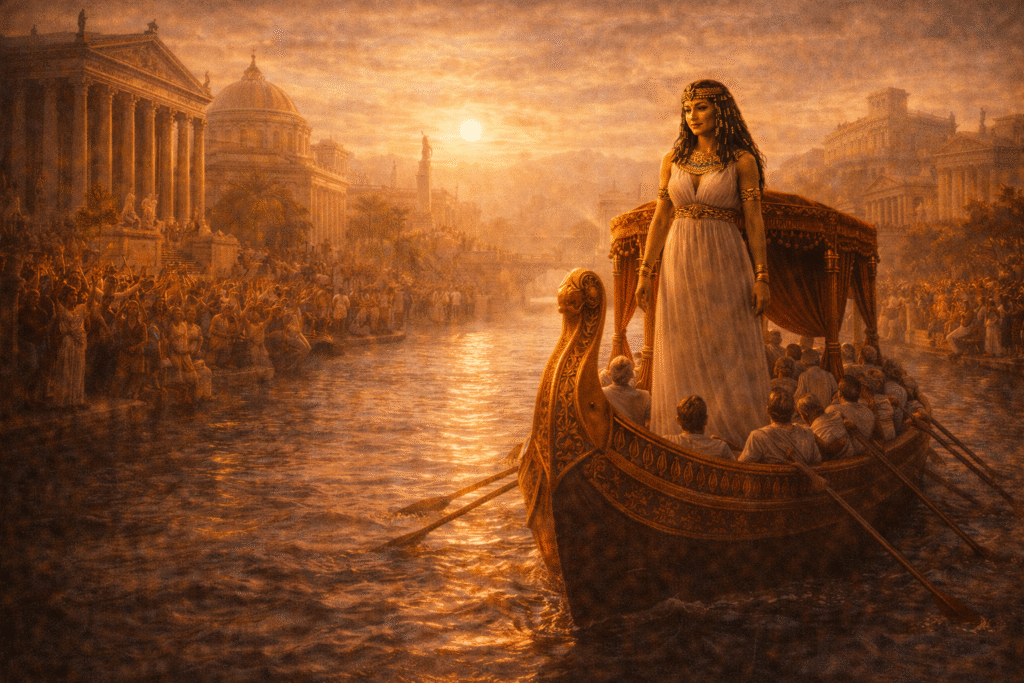
When the Tiber River
opened before us,
I felt the shift.
Not fear.
Recognition.
Rome
was ancient power
in masonry form.
A city that rose
with ambition in its bones.
On the riverbanks,
people gathered—
merchants,
nobles,
wives,
scribes,
children.
They had never seen
an Egyptian queen.
I did not wear
gold or jewels.
I wore
simple white linen.
Unadorned.
Unthreatening.
But the double crown
was packed in my chest.
Because I was here
not as a mistress,
not as a guest—
as a sovereign.
The crowds murmured.
“She is dark as the Nile.”
“She speaks nine languages.”
“She rules by intellect.”
“She is dangerous.”
“She is beautiful.”
“She is foreign.”
“She is queen.”
I stepped off the barge.
Rome
studied me.
And I
studied Rome.
PART III — The Villa in the Gardens of Caesar
Caesar did not house me
in the city center.
He placed me
in one of his private villas
beyond the Tiber—
close enough
for access,
far enough
to avoid insult
to the Senate.
The villa
was surrounded by gardens
richer than any in Rome:
laurel,
rose,
cypress.
But beneath the beauty
was strategy.
Privacy.
Safety.
Neutral ground.
Rome buzzed
with speculation.
“Why has he brought her?”
“Is she here for politics?”
“For alliance?”
“For herself?”
They were all wrong.
I was there
for Egypt.
And for my son.
Inside the villa,
Caesar greeted us first
in private.
He placed a hand
on Caesarion’s small head.
“He has grown,”
he murmured.
“Yes,”
I said.
“And he learns quickly.”
“He must,”
he replied.
“His life
will not be simple.”
We both understood.
My son
was not a Roman heir.
But he was not
merely Egyptian.
He existed
in the space
where two empires touched—
and feared each other.
PART IV — The Senate Learns My Name
Caesar invited me
to attend a session
of the Senate—
not inside the Curia
(where women were forbidden)
but from a balcony
overlooking the assembly.
It was enough.
When senators entered
and saw me above—
a queen observing them
as they debated law—
the chamber
shifted.
Ripples
of discomfort.
Curiosity.
Admiration.
Hatred.
Envy.
Whispers.
“That is Cleopatra.”
“The Egyptian.”
“The sorceress.”
“The intellectual.”
“The threat.”
“The ally.”
“The mother of Caesar’s child.”
“The future complication.”
Their reactions
were not about me.
They were about
their fear
of everything I represented:
Foreign power
with legitimacy.
Female power
with intelligence.
Egyptian power
with Rome’s greatest general
as ally.
In that moment,
I understood—
Rome
did not hate me.
Rome
feared me.
And fear
is leverage.
PART V — The Triumph That Revealed the Truth
When Caesar celebrated
his fourfold triumph,
I attended
from a high terrace.
Not as spectacle.
As witness.
Rome
roared for him—
streets overflowing
with red cloth,
gold laurels,
incense,
captives,
treasure.
He processed
on a chariot,
victorious over:
Gaul,
Egypt’s enemies,
Pontus,
and Africa.
But one detail
cut sharper
than any trumpet blast:
Pompey’s statue
stood again
in the Forum.
Not raised by Caesar
as honor—
but as warning.
Rome
worshiped its dead
as much as its living.
I watched senators
watch Caesar—
assessing
how far
he had risen.
And I knew then—
his power
and my presence
would provoke
a reckoning.
Not today.
Soon.
PART VI — The Statue of Isis
The most profound moment
of my time in Rome
was not in the Senate
or at the triumph.
It was in Caesar’s reform
of the Forum.
He built
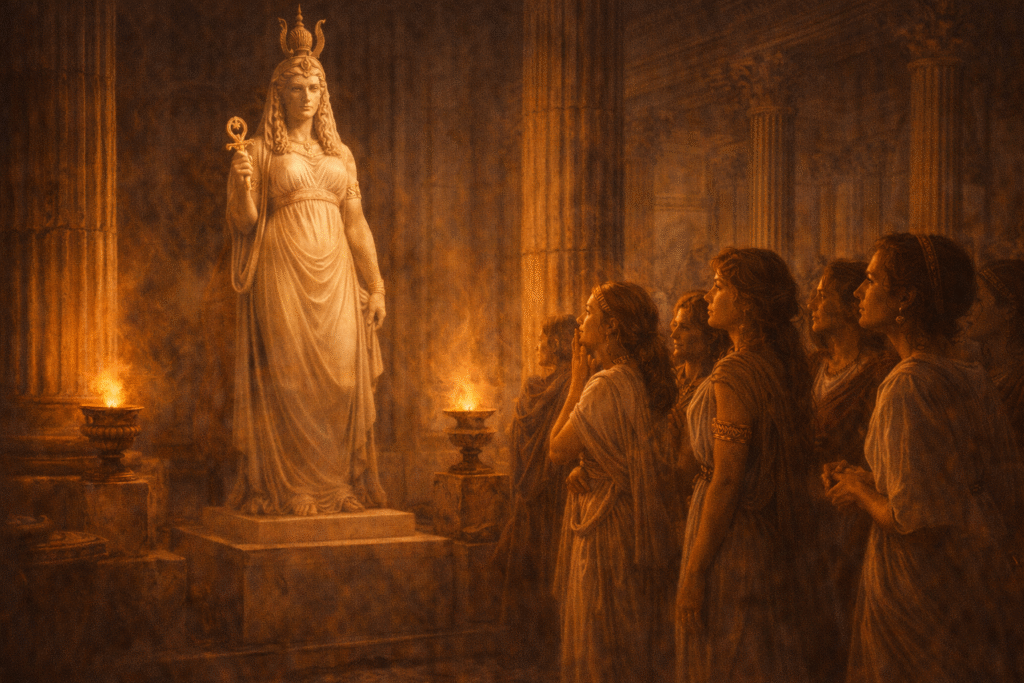
a temple to Venus Genetrix—
his claimed ancestor.
Inside it
he placed statues
of Cleopatra
as Isis.
Not in a corner.
Not hidden.
Prominent.
Open.
Seen.
Rome
had never given visibility
to a foreign queen
in its sacred spaces.
And yet here I stood,
embodied in marble,
recognized
as divine truth.
Senators seethed.
Women wept.
Merchants prayed.
Foreigners bowed.
And Rome whispered:
“She is not just his ally.
She is his equal.”
Which, of course,
was the problem.
PART VII — The Whispering Houses of Rome
Noblewomen
invited me
to their villas
under the excuse
of cultural curiosity.
In truth—
they wanted to see
what kind of woman
could move Caesar.
They asked about:
astronomy,
medicine,
philosophy,
ritual,
linguistics.
They were shocked
I understood them all.
One matron whispered:
“You are not
what they say.”
“No one is,”
I replied.
Rome’s men
feared me.
Rome’s women
understood me.
And in their eyes
I saw something
unexpected:
hope.
Hope
that a woman
could influence power
by intellect alone.
PART VIII — Caesar’s Warning
One night,
in the quiet
of the villa gardens,
Caesar spoke bluntly.
“There are men,”
he said,
“who will kill me
for what I am doing.”
I inhaled sharply.
“You know this?”
“Yes.”
“Then stop.”
He shook his head.
“I cannot.
Rome must become
more than it is.”
I touched the bark
of an olive tree.
“And what of us?”
He paused.
“Our alliance
must continue.
But our presence
together here—
in Rome—
is inflaming them.”
“Then I will leave,”
I said softly.
He looked at me.
Not as ruler.
As man.
“No,”
he murmured.
“Not yet.”
He placed a hand
over Caesarion’s sleeping form.
“Your son,”
he said,
“is a new world.”
I whispered:
“New worlds
create enemies.”
He nodded.
“Yes.”
PART IX — The Day the Sky Darkened
I was in the villa garden
when the news came:
Caesar had been killed
in the Senate.
Stabbed.
Again.
Again.
Again.
By men
he trusted.
By men
I had watched
whisper in columns.
By men
who feared
what he was becoming—
and what I represented
beside him.
The messenger knelt.
“Majesty…
Rome is erupting.”
The world
did not tilt.
It fell.
I clutched the railing
as the olive trees
swayed violently
in the wind.
My son slept
in his chamber.
I whispered:
“Your father is dead.”
The words
carved themselves
into the air.
Not a cry.
A wound.
Not for Caesar.
He was mortal.
A wound
for what his death
meant for the world.
For me.
For Egypt.
For my son.
For the future
that had just been
flipped upside down.
PART X — The Escape from Rome
Rome erupted:
riots,
fires,
marches,
factions splintering
into chaos.
I had no time
for mourning.
Only strategy.
Caesarion
was no longer tolerated
in the city.
He was a symbol
of everything
the assassins despised.
I ordered preparations
within minutes.
We fled Rome
under a moonless sky.
Not in royal procession.
In silence.
In fear.
In resolve.
As we crossed
the Tiber
once more,
I looked back
at the city—
its marble glowing
with lamplight
and anger.
Caesar
had tried
to reshape Rome.
Rome, instead,
had reshaped his legacy.
And mine.
Because his death
had severed
the bridge—
and now my son
and I stood
on one side only:
Egypt.
Where Ma’at
still needed me.
Where danger
still awaited.
Where destiny
still whispered.
PART XI — What Rome Taught Me
Rome taught me:
Power is theater.
But theater is truth.
Men fear
what they cannot control.
But fear
is the language
of empire.
A queen
in an empire
is not admired.
She is assessed.
Alliance
is temporary.
Legacy
is eternal.
And above all—
If the world
does not give you space,
you carve it
with your own hand.
Ancient Questioner’s Desk — The Rome Edition
A student asked:
“Did Cleopatra love Rome?”
The elder replied:
“She respected its power,
not its heart.”
Another asked:
“Did Rome accept her?”
The historian wrote:
“Rome accepted her presence.
It feared her influence.”
A traveler wondered:
“What did Caesar see in her?”
The scribe answered:
“Another mind
as sharp as his.”
A final question came:
“Why did she leave?”
The old master smiled.
“Because her son
was the future—
and Rome was not.”
FINAL CTA — Walk the Marble That Judged a Queen
This Scroll ends here—
on the Tiber,
the Senate steps,
the statue halls,
the villa gardens,
and the shadows
where destiny shifted.
If you want to stand
where Cleopatra confronted
the greatest empire
of the ancient world—
not with armies
but with intellect—
walk it with ENA.
Journey with ENA.
Empires watch queens—
but queens reshape empires.
Historical Context
Cleopatra traveled to Rome during her alliance with Julius Caesar, an unprecedented and politically charged act. Roman sources describe her presence as provocative and controversial.
The scenes and reactions in this scroll reflect Roman attitudes rather than a complete historical record of events.