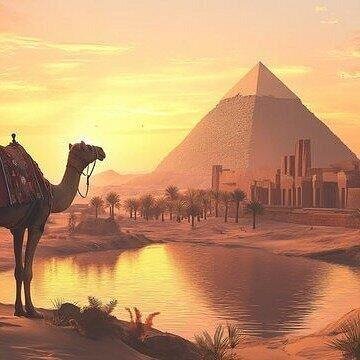
Scroll XVII – The Restoration of Ma’at
Alexandria, Memphis, The Fayum, and the Nile Valley — Early Reign, 47–46 BCE
Translated and restored for the modern traveler.
Prologue — A Kingdom Is Not Healed by Crowns, but by Balance
Egypt had a queen.
But Egypt needed something more:
Ma’at.
Order.
Truth.
Balance.
Harmony.
Fire had scorched the palace.
Civil war had split the people.
Famine had hollowed the villages.
Fear had fractured families.
Rome loomed like a shadow
waiting for its moment to expand.
A crown was not enough
to mend a wounded kingdom.
This Scroll
is the restoration —
the rebuilding of a nation
through decisions
small and grand,
through listening,
through discipline,
through justice.
This Scroll
is the beginning
of Cleopatra’s true reign.
PART I — The First Council of the Two Lands
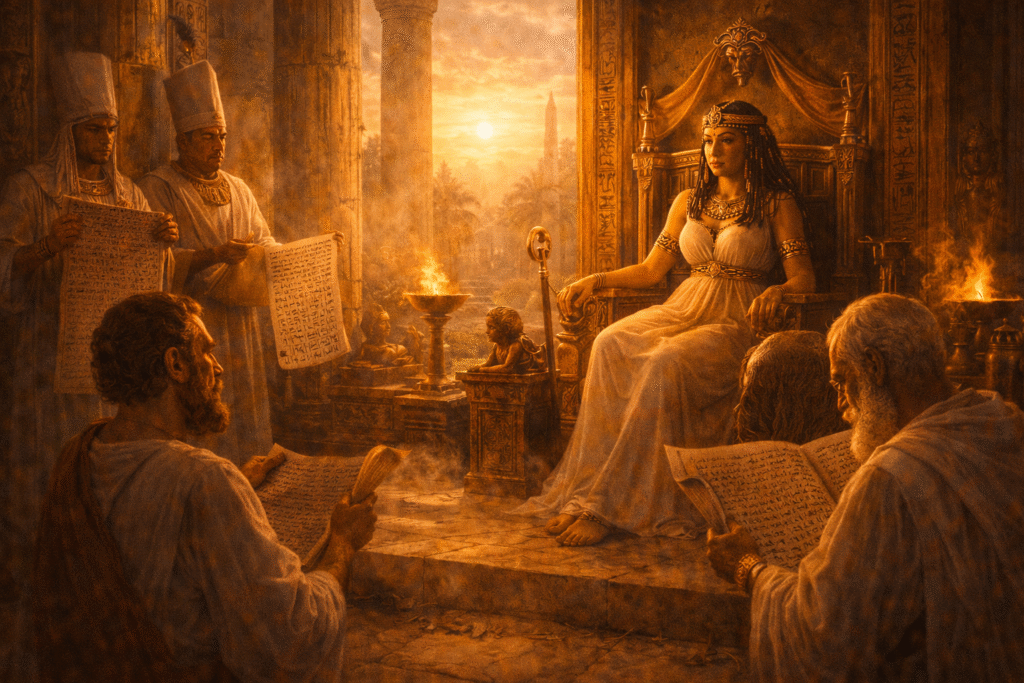
The morning after returning from Memphis,
I convened my first great council.
Not in the gilded audience hall
—still cracked from fire—
but in the long limestone chamber
overlooking the harbor.
Egyptian priests
from Heliopolis and Memphis.
Greek scholars
from the Mouseion.
Nubian diplomats.
Jewish merchants.
Arab traders.
Local governors
from the Delta and Upper Nile.
All the voices
of the Two Lands.
I began with one sentence:
“Egypt will not be ruled by fear.”
Silence
deep as the desert.
Then I spoke of Ma’at.
Not as myth.
As mandate.
“Every decision made
in this chamber
must restore balance.
For the river.
For the fields.
For the people.
For our place among nations.”
A Greek philosopher bowed.
An Egyptian high priest murmured
an invocation.
A merchant placed his hand
over his heart.
They understood:
We were not returning to the past.
We were building the future.
PART II — The Nile That Needed Healing
The Nile
is Egypt’s spine.
Its breath.
Its pulse.
Years of mismanagement,
corruption,
and political chaos
had damaged its flow.
I summoned
the Overseer of Canals,
a man older than the pyramids
and twice as stubborn.
His beard
was the color of papyrus.
His hands
calloused from years
spent repairing banks
and measuring silt.
He bowed stiffly.
“Majesty…
the river is sick.”
“Then we heal it,”
I said.
He looked up sharply.
“No ruler has said that
in a generation.”
I nodded.
“We begin with the channels.”
Over months,
crews were sent
up and down the Nile:
— dredging silted canals
— repairing collapsed levees
— clearing irrigation tunnels
— restoring the shaduf stations
— reinforcing the Fayum basin
— fixing collapsed Nilometers
(where priests measured the flood)
At Memphis,
a child ran to me
during an inspection.
“Queen,”
he said,
“the water flows again.”
Not extravagance.
Not gold.
Water.
The first sign
that Egypt
was healing.
PART III — Rebuilding the Trust of the People
A ruler
may wear gold,
but trust
is earned in linen.
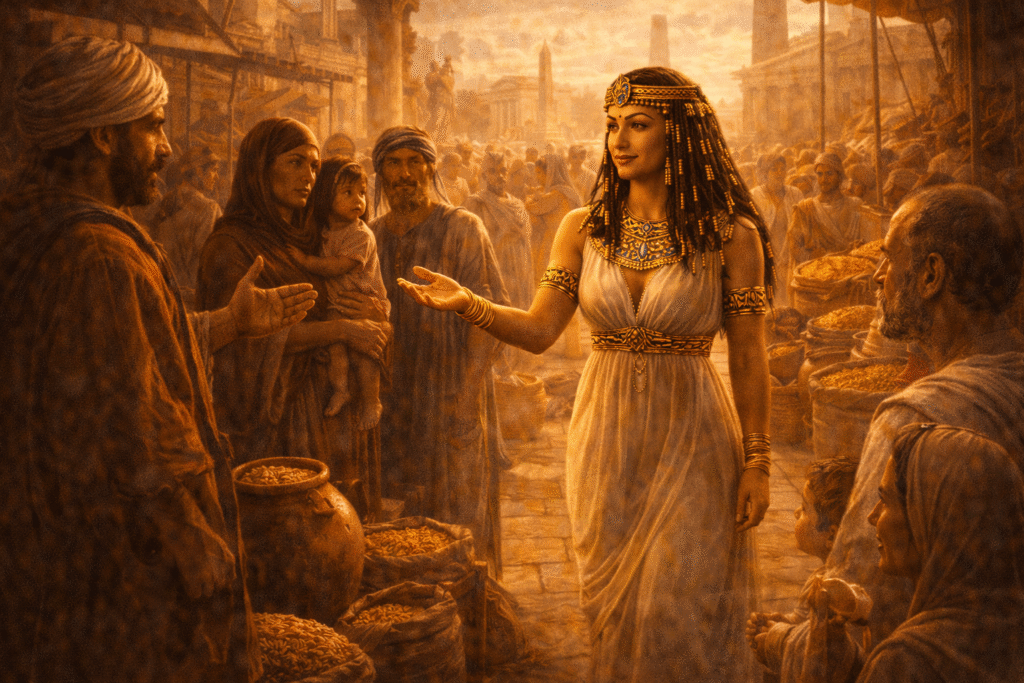
I went into the markets
of Alexandria
unprotected except for
two unarmed guards.
People stared.
Some bowed.
Some whispered.
Some approached.
A woman
who sold baskets
touched my arm lightly.
“Queen…
will the taxes stay low?”
“Yes,”
I told her.
“Until the land recovers.”
A fisherman asked:
“Will we be safe
from Rome?”
“We will be steady,”
I said.
“And steadiness
is safety.”
I visited grain houses,
workshops,
weavers,
olive presses,
date orchards.
When a young potter
brought a cracked jar
as an offering,
I asked him:
“Why this jar?”
He bowed.
“It is broken,
Majesty.
But it can be mended.
Like us.”
I kept the jar.
It sits in my chamber still.
A reminder
that queens
do not rule marble.
They rule hearts.
PART IV — Justice in the Court of Petitions
This was where
the true restoration began.
The Court of Petitions
—neglected for years—
became the anchor
of my early reign.
I sat there
every ten days.
Not as monarch.
As judge.
People came
from villages,
towns,
oases.
Complaints:
A farmer
taxed twice
for the same field.
A widow
denied her husband’s wages.
A river ferryman
beaten by an official.
A scribe
accused of altering grain records.
I listened.
Always.
Then I acted.
Not with cruelty.
With precision.
One official
had seized land
from poor laborers
and gifted it
to a noble’s cousin.
I stripped him
of his title.
His eyes widened.
“You…
you cannot remove me,”
he sputtered.
“I can,”
I said.
“And I have.”
The chamber erupted
not in cheers—
but in relief.
Justice
was no longer a rumor.
It was rule.
PART V — Reassembling the Palace Intellect
One of my most immediate goals
was reviving the knowledge
lost in the dockside fire.
I summoned scholars
from across the Mediterranean:
mathematicians from Cyrene,
astronomers from Rhodes,
philosophers from Athens,
healers from Asia Minor,
scribes from Upper Egypt.
I restored funding
to scribal schools,
ordered new papyrus shipments,
and paid stipends
to scholars
so they could work
without fear.
Most precious of all—
I gathered the surviving fragments
from the destroyed annex.
Charred.
Bent.
Unraveling.
I held one scroll
burned at the edges.
A medical text
on eye treatments
written centuries before Hippocrates.
A scribe whispered:
“We can save it.”
“Then we will,”
I replied.
Knowledge
was not just scrolls.
It was continuity.
Egypt
could not move forward
with a wounded memory.
We began rebuilding
not the library’s walls—
but its spirit.
PART VI — The Priests and the Philosophers
Egypt was not
a single voice.
She was a chorus.
Greek scholars
held one worldview.
Egyptian priests
held another.
Under my father,
the two worlds
had clashed constantly.
Under me,
they conversed.
I established
the Council of Wisdom—
a gathering
where priests
and philosophers
debated:
— medicine
— astronomy
— ethics
— governance
— ritual
— economics
I moderated
their first session.
A Greek scholar argued
that the stars
determined fate.
A priest countered
that the gods
shaped destiny.
I asked:
“Can they not both
speak truth?”
A hush.
Then murmurs.
Then agreement.
Egypt
was no longer
a divided house.
It was becoming
a unified mind.
PART VII — The Treasury Restored
War
is expensive.
Corruption
is more expensive.
My first months
as queen
were spent
unspooling knots
in the treasury:
— falsified accounts
— stolen grain
— smuggled taxes
— debts unpaid
— corrupt collectors
I traveled
to the Granary District
with only a handful
of attendants.
When the Chief Treasurer
stammered excuses,
I cut him off.
“You mistake me,”
I said.
“I do not seek blame.
I seek truth.”
Because truth
is the foundation
of Ma’at.
After a thorough audit,
I replaced
nearly half the treasury staff.
Not out of retribution.
Out of necessity.
Egypt
could not rebuild
on a cracked foundation.
PART VIII — The Reorganization of the Army
Egypt’s army
had long been
a fractured entity:
Greek commanders,
Egyptian infantry,
Nubian cavalry,
Asian Minor mercenaries.
A beautiful mixture—
but chaotic.
I brought them
under a single command:
The Great Council of Arms.
I appointed
an Egyptian general
as Supreme Commander,
with a Greek tactician
and a Nubian cavalry chief
as co-advisors.
For the first time
in generations,
the army
was not a cluster
of competing interests.
It was a singular force.
A force loyal
to Egypt.
And to me.
PART IX — Egypt Begins to Prosper Again
Harvests improved.
Canals flowed.
Taxes stabilized.
Scholars returned.
Merchants told me:
“Foreign caravans
speak of Egypt again.”
Not in fear.
In admiration.
Letters arrived
from Jewish leaders
in Judea,
from Arab tribes
near Petra,
from Greek cities
in Cyprus.
They spoke of:
— fair trade
— safe passage
— stable currency
— restored honor
This was the restoration
of Ma’at—
not as myth,
but as governance.
Egypt
was exhaling.
She was remembering
her greatness.
She was returning
to herself.
[Suggested Visual: Nile fields lush and irrigated, farmers working contentedly as Cleopatra and her retinue ride along the embankment inspecting the restoration.
AI Prompt: “Cleopatra VII inspecting irrigated Nile fields with farmers working, lush greenery, retinue behind her, optimistic cinematic realism.”]
PART X — My Private Reflection
Late one night,
I sat alone
in the garden court.
Lotus blossoms
floated in the pool.
The air smelled
of myrrh and river wind.
I removed the double crown
and held it in my hands.
It felt different now.
Not lighter.
More belonging.
I whispered:
“I will honor you, Egypt.
Not with conquest.
With stability.
Not with fear.
With order.
Not with force.
With wisdom.”
The wind
moved through the palms.
A hush.
A presence.
Not magic.
Recognition.
Ma’at
had begun to settle.
Not because a queen
demanded it.
But because a queen
embodied it.
Ancient Questioner’s Desk — The Ma’at Edition
A student asked:
“Was Cleopatra a reformer?”
The elder replied:
“She restored balance
before she sought glory.”
Another asked:
“Why did the people trust her?”
The historian wrote:
“Because she listened.”
A traveler wondered:
“Did she rebuild the Library?”
The scribe answered:
“She rebuilt knowledge.”
A final question came:
“What was Cleopatra before Caesar?”
The old master smiled.
“She was already
a ruler of order.”
FINAL CTA — Walk the Rebirth of a Kingdom
This Scroll ends here—
in the fields where water returned,
in the markets where trust returned,
in the courts where justice returned,
in the temples where balance returned.
If you want to walk
the Egypt Cleopatra rebuilt—
the canals,
the fields,
the palaces,
the granaries,
the temples,
the council halls
where the world’s most brilliant minds
met under her reign—
walk them with ENA.
Journey with ENA.
Queens do not restore empires—
they restore balance.