
Scroll XVI – The Queen of the Two Lands
Alexandria & Memphis, 47 BCE — The Restoration of Ma’at
Translated and restored for the modern traveler.
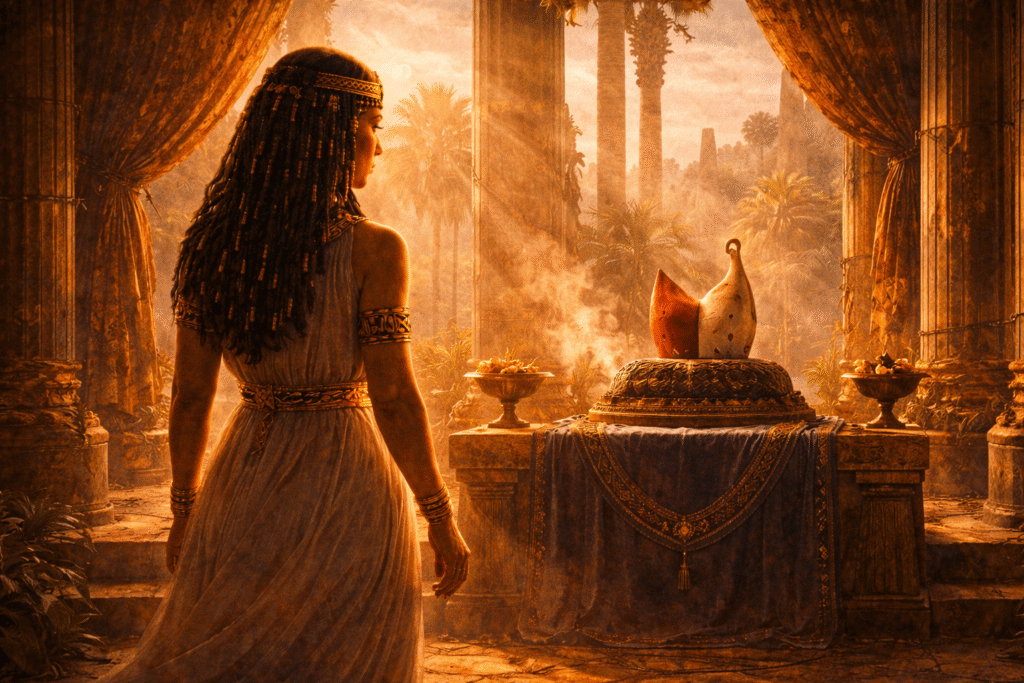
Prologue — A Crown Is Not Worn. It Is Carried.
People imagine
the moment I became queen
as triumphant.
Trumpets.
Gold.
Reverence.
In truth—
I became queen
in a palace
that still smelled of smoke,
in a city
that still trembled with fear,
in a kingdom
still fractured
by civil war.
There was no triumph.
There was responsibility.
Ma’at—
order, balance, justice—
had been broken.
My reign
would begin
by restoring it.
This Scroll
is the day
a young woman
became Pharaoh
because Egypt
needed a ruler
who could restore
the world’s balance.
PART I — The Throne That Waited for Me
The morning after
the Battle on the Nile,
the palace was quiet.
Not peaceful.
Exhausted.
Shattered tiles.
Scorch marks.
Broken spears
piled in corners.
This was the throne room
I entered.
Not gilded.
Wounded.
A handful of priests
waited silently,
their linen robes
stained with ash.
Caesar stood nearby,
arms folded—
not presiding,
but witnessing.
At the far end
of the hall,
on a low cushioned dais,
lay the Pschent—
the double crown.
White for Upper Egypt.
Red for Lower.
Together—
union.
Strength.
Burden.
I walked
across the cracked floor.
Each step
felt heavier.
Because a crown
is not placed
on a ruler’s head.
It is placed
on a ruler’s soul.
PART II — The Priest of Memphis
A senior priest
from Memphis
stepped forward.
His voice
was soft,
but unwavering.
“Cleopatra,
daughter of the Nile,
child of Isis,
bearer of two lands—
Egypt calls you
to restore balance.”
He lifted the crown.
I bowed my head.
“Do you accept
the burden
and the duty
of Pharaoh?”
I closed my eyes.
I saw my brother—
lost to fear.
I saw Alexandria—
lost to fire.
I saw the river—
lost to hunger,
and then restored.
I saw Egypt—
needing a ruler
who would not run
from responsibility.
“I accept,”
I whispered.
The priest lowered
the double crown
onto my brow.
A weight.
A presence.
A vow.
Then he said
the words
every Pharaoh hears
only once:
“Ankh wedja seneb,
Cleopatra—
Life, prosperity, and health
to the Queen of the Two Lands.”
For a moment
the world
went utterly still.
The crown
felt heavier
than any desert stone.
Because it carried
every expectation
of thirty dynasties.
Every hope
of a wounded people.
Every whisper
of the gods.
And every choice
I would make
from this day forward.
[Suggested Visual: A priest lowering the double crown onto Cleopatra’s head in a ruined but sunlit throne hall, Caesar standing in the shadows.
AI Prompt: “Priest crowning Cleopatra VII with double crown in damaged throne hall, morning sun shafts, Caesar observing respectfully, cinematic realism.”]
PART III — Caesar’s Recognition
After the ceremony,
as priests finished
their quiet prayers,
Caesar approached.
He did not bow.
Romans do not bow
to foreign rulers.
But he did
something rarer.
He inclined his head.
Respect
from a conqueror.
“Cleopatra,”
he said,
“You understand
what comes next.”
I nodded.
“Yes.
Order must be restored.”
“Order,”
he agreed,
“and legitimacy.”
Rome
had its own concerns.
Trade routes.
Stability.
Debt repayment.
A reliable Egypt.
But Caesar
also understood something:
A strong Egypt
was easier to manage
than a desperate one.
He looked at me
with an expression
that was not fondness—
but calculation
mixed with admiration.
“You will rule well,”
he said.
Not flattery.
An assessment.
“You came through fire
and remained steady.”
I met his gaze.
“And you came
through a foreign land
and did not underestimate it.”
He almost smiled.
Almost.
“Then we understand
each other,”
he said.
Yes.
We did.
PART IV — The Purge of the Court
That day,
I summoned
the nobles, scribes,
and officials
who had supported my brother.
Not all were guilty.
Not all were treacherous.
Fear
had warped loyalties.
But Egypt
needed clarity.
I spoke calmly
to the assembled court:
“You acted
in fear
during a time of war.
But Egypt
cannot be ruled
by fear.”
I offered amnesty
to those
who pledged loyalty.
Many did.
Some hesitated.
A few refused.
Those few
were removed
by the palace guard—
escorted out,
not executed.
Strength
does not need
blood.
Stability
needs competence.
“Egypt will be governed
by those
who place Egypt
above themselves,”
I declared.
A new court
was formed—
not loyal to Cleopatra
by flattery,
but loyal
to Egypt
by vow.
PART V — The First Decrees of a Queen
My first decrees
did not concern Rome
or revenge
or palace politics.
They concerned
the people.
Decree I:
Lower the grain tax
for the next three harvest cycles.
Egypt
had been bled
by conflict.
Her people
needed relief.
Decree II:
Reopen the canals
and restore the engineers
who managed them.
The Nile
was Egypt’s spine.
Its health
was my reign’s foundation.
Decree III:
Rebuild the annex
damaged by fire.
Hire copyists
to preserve what remains.
Because a kingdom
without knowledge
is a kingdom
without memory.
Decree IV:
Declare amnesty
for all common citizens
who participated
in the bread riots
during the famine.
Punishing hunger
is cruelty.
Forgiving it
is strength.
These decrees
spread through Alexandria
like clean air
after smoke.
For the first time
in years,
the city felt—
not safe,
but steady.
Not whole,
but healing.
PART VI — My Sister’s Return
Arsinoe—
my younger sister—
had been captured
during the palace battles.
When she was brought
to the hall,
she looked defiant.
A girl
who wanted a throne
because she desired power,
not responsibility.
“Sister,”
she spat,
“You think you sit there
because the gods chose you?”
“No,”
I said calmly.
“I sit here
because Egypt
cannot survive
another child’s ambition.”
She lunged
as if to strike me—
a futile gesture.
Guards stopped her gently.
“Arsinoe,”
I said softly,
“You will not be executed.”
Her eyes widened.
Fear?
Relief?
Confusion?
I continued:
“But you cannot remain
in Alexandria.”
Caesar stepped forward.
“She will be taken
to Rome,”
he said.
“For her safety.”
The truth
was darker:
Arsinoe would become
a symbol in Rome,
a reminder
of Caesar’s mercy
and Cleopatra’s legitimacy.
She glared at me.
“You think
you have won.”
“No,”
I replied.
“I think Egypt has.”
Her hatred
did not wound me.
She was a product
of the same palace
that had tried
to suffocate me.
But I had walked
through fire.
She had not.
PART VII — The Journey to Memphis
It was tradition
for a new Pharaoh
to visit Memphis—
the ancient heart
of Egyptian kingship.
I traveled
with a small retinue.
No Roman troops.
No parade.
Just me,
my attendants,
priests,
and a handful of guards.
The Nile
carried us south.
Its water
was calm.
Its banks
green again.
Egypt
was breathing.
When we reached Memphis,
I walked barefoot
into the Temple of Ptah.
The priests
welcomed me
with hymns older
than my dynasty.
Inside the sanctuary,
I placed offerings
of:
lotus,
milk,
bread,
and oil.
“Ptah,”
I whispered,
“grant me wisdom
to heal what has been broken.”
A hush
fell over the chamber.
Not magic.
Reverence.
I was home
in the oldest sense
of the word:
not palace,
not crown,
but purpose.
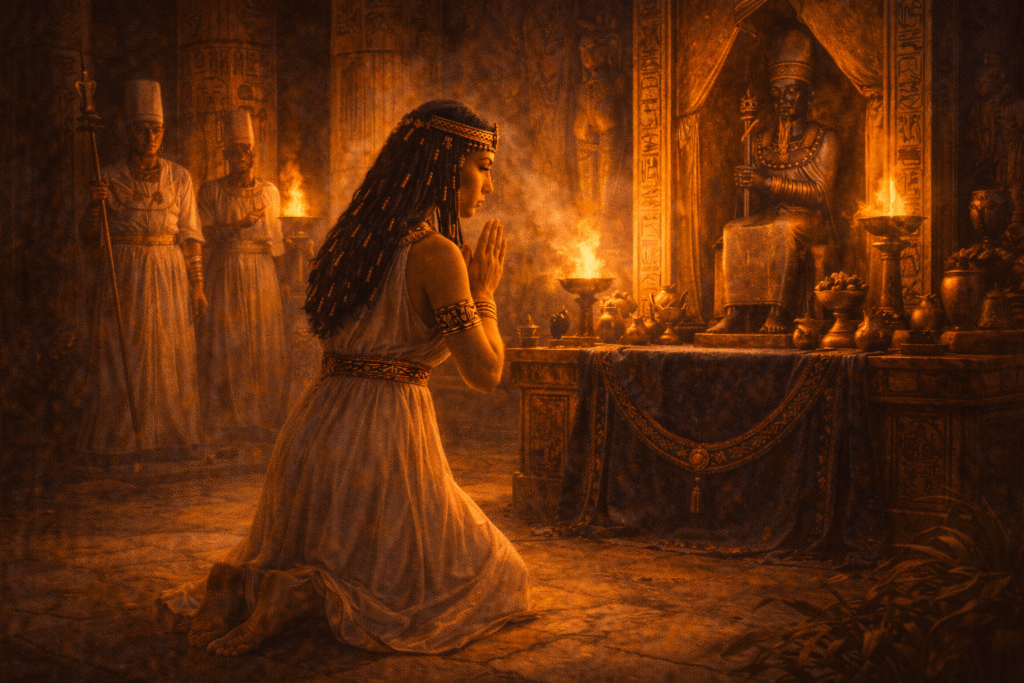
PART VIII — The Vow of the Two Lands
At Memphis,
I made a vow.
Not to Rome.
Not to Caesar.
Not to my court.
To Egypt.
Before the sacred altar,
I spoke aloud:
“I will keep the balance.
I will protect the river.
I will honor the people.
I will restore knowledge.
I will guard Egypt
from foreign greed
and from internal decay.”
The priest of Ptah
placed his hand
over mine.
“You vow this
as queen?”
he asked.
“No,”
I said.
“As Pharaoh.”
He bowed his head.
And Egypt
accepted me.
Not through ceremony.
Through recognition.
PART IX — The Return to Alexandria as Pharaoh
When I returned
to Alexandria,
the city greeted me differently.
Not as a princess.
Not as a co-ruler.
As Queen.
Children
raced through the streets
shouting my name.
Scribes
recorded my decrees
with care.
Merchants
bowed
not out of fear,
but trust.
Even the palace guards—
so recently divided—
stood straighter
as I passed.
I felt
the weight
of the double crown
not lessen,
but settle.
Fit.
Egypt
was no longer fractured.
Not completely.
But it had direction.
And direction
is the beginning
of restoration.
PART X — What It Means to Be Queen
People later claimed
I ruled by seduction.
Fools.
I ruled
by competence.
By intellect.
By diplomacy.
By languages.
By listening.
By strategy.
By empathy.
By presence.
I ruled
because Egypt
recognized me.
And more importantly—
I ruled
because I recognized
Egypt.
The Two Lands
did not need
a goddess.
They needed
a guardian.
A restorer.
A ruler
whose vision
outlasted war.
My throne
was not a prize.
It was a responsibility.
And I carried it
with the steadiness
of the river.
Ancient Questioner’s Desk — The Coronation Edition
A student asked:
“Was Cleopatra chosen by Caesar?”
The elder replied:
“No.
Caesar confirmed
what Egypt had already chosen.”
Another asked:
“Did she want power?”
The historian wrote:
“She wanted balance.”
A traveler wondered:
“Was she crowned in ceremony?”
The scribe answered:
“No.
She was crowned in necessity.”
A final question came:
“What made her a true Pharaoh?”
The old master smiled.
“She ruled the throne—
the throne did not rule her.”
FINAL CTA — Walk the Birth of a Pharaoh
This Scroll ends here—
in the quiet halls
where a damaged kingdom
found its queen,
on the river
where she pledged
to restore balance,
and in the heart of Egypt
where a ruler
reclaimed responsibility.
If you want to walk
the throne rooms
where her crown
was earned,
the temples
where she was accepted,
the riverbanks
where her reign began—
walk them with ENA.
Journey with ENA.
Queens are not crowned—
they take responsibility.