
Scroll XV – The Fall of the Boy King
Alexandria, 47–48 BCE — After the Siege, the Battle on the Nile, and the Last Days of Ptolemy XIII
Translated and restored for the modern traveler.
Prologue — Boys Do Not Become Kings by Wearing Crowns
A crown
can be placed
on any head.
But a king
is not made
by gold.
He is made
by choices.
By responsibility.
By listening.
By truth.
Ptolemy,
my brother—
my rival—
my mirror of everything
Egypt feared in a ruler—
never learned this.
He was a boy
given a kingdom
without ever
learning how to hold it.
And when the crown
grew heavy,
he grasped at shadows.
This Scroll
is not his condemnation.
It is his undoing—
the way history
traces it:
step by step,
fear by fear,
choice by choice,
until the boy king
became the threat
he feared in others.
PART I — After the Palace Burned
The flames had died,
but the war had not.
Caesar declared
the palace secured—
but the city
was not.
My brother
and his advisors
had retreated
to the eastern quarter,
fortifying streets,
controlling food routes,
holding hostages.
They wanted
to starve the palace
into surrender.
A foolish plan.
I knew the ancient cisterns
below the palace.
I knew their depth.
Their reach.
Their design.
I knew
we could survive
months
if needed.
My brother did not.
He did not know
Egypt’s architecture
any more than he knew
her soul.
And that ignorance
was already
rotting his crown.
PART II — The Boy Behind the Sword
Reports came daily
from spies, merchants,
former palace staff.
“Ptolemy is frightened.”
“Ptolemy refuses advice.”
“Ptolemy throws fits of rage.”
“Ptolemy doubts the loyalty
of even his closest men.”
Fear
turns boys
into tyrants.
He had taken to holding court
in a small eastern mansion—
far from the palace
he once called home.
He sat
not on a throne
but on a gilded stool
dragged from a shrine.
A child-king
pretending
to be a conqueror.
One spy reported
that he paced at night,
whispering:
“She will take everything.
She will take everything.”
I did not rejoice
in his suffering.
He was my brother.
But in those whispers,
I heard:
He is no longer fit to rule.
He is no longer capable
of serving Egypt.
And Egypt
deserved better
than a scared boy
making desperate men
more desperate.
PART III — Caesar’s Decision
One evening,
as we studied maps
lit by trembling lamps,
Caesar paused.
“He cannot remain king,”
he said quietly.
He did not say it
to please me.
He said it
to stabilize Egypt.
“He does not control his army.
He does not understand
the people.
He does not think
beyond his next fear.”
I nodded.
“Yes.”
Caesar’s eyes flicked to me.
“You do not ask
for his death.”
“No,”
I said.
“I ask only
for Egypt.”
He studied me
and nodded.
“Then we end this.”
It was not a moment
of triumph.
It was a moment
of necessity.
A kingdom
cannot endure
two rulers
when one
is a storm
inside a child.
PART IV — The Battle on the Nile
The final confrontation
did not happen
in the palace
or in the streets.
It happened
on the water.
The Nile—
Egypt’s oldest witness—
became the stage.
Caesar’s reinforcements
had arrived.
My allies
from Syria
had joined the lines.
My brother’s forces
retreated
to the riverbank,
boarding war barges
and fishing boats
to block the delta.
It was a desperate strategy.
Desperation
rarely wins wars.
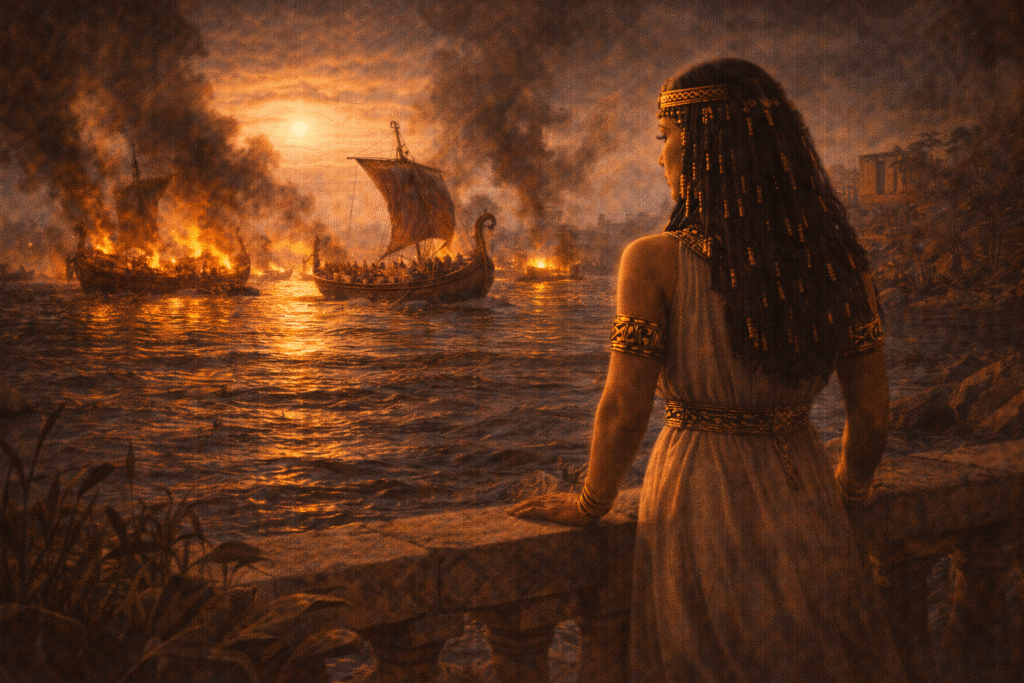
I watched
from a sheltered rise
as the battle unfolded.
Roman ships
cut through the shallows.
Egyptian barges
rammed one another.
Warriors splashed overboard,
weighed down
by armor.
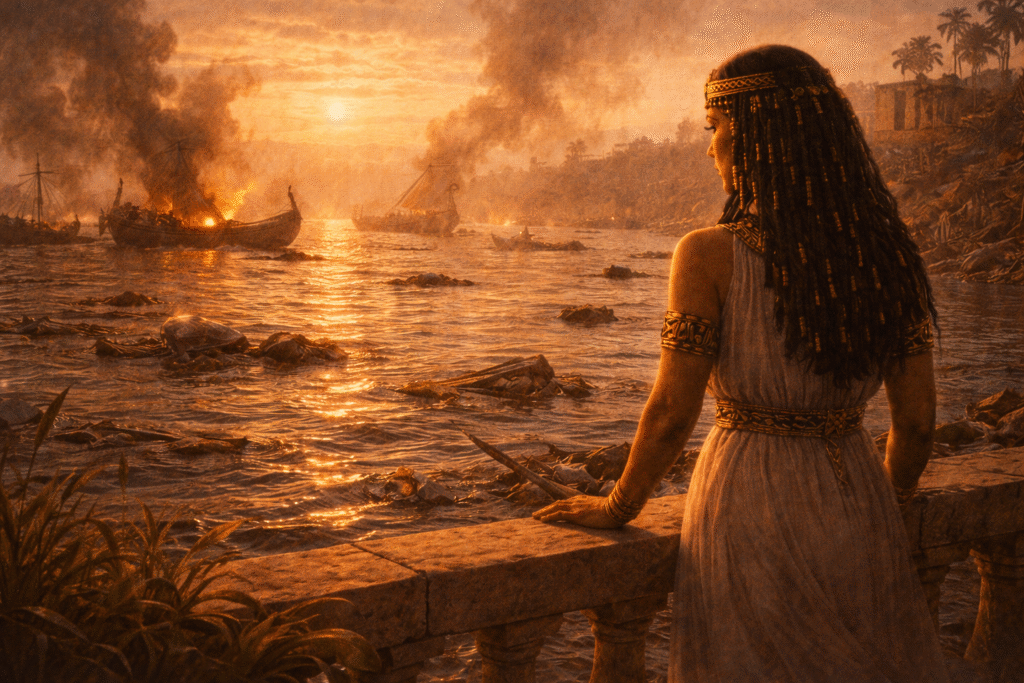
Smoke drifted
across the water,
turning the Nile
into a mirror of fire.
Ptolemy
was there—
on the largest barge,
surrounded by guards.
A boy
on a battlefield
designed for men.
Caesar’s flagship
advanced.
Trumpets blared.
Orders rang out in Latin.
Egyptian cries rose
in fear and courage.
The battle
tightened.
Then fractured.
Then collapsed.
My brother’s largest barge
tilted—
too many men
crowding one side.
A roar.
A break.
The hull
split.
The Nile—
patient, ancient,
unimpressed by kings—
began to swallow
the vessel.
Men screamed.
Armor sank.
The river churned.
And Ptolemy—
my brother—
slipped
beneath the surface.
PART V — The Moment the River Closed
People imagine
I watched without emotion.
But they do not understand
Egyptian hearts.
We do not rejoice
when the Nile
takes life.
We mourn it.
The river
is mother.
Judge.
Memory.
As the barge
shuddered
and vanished,
I felt
the world
shift.
Not victory.
Not relief.
A quiet,
terrible sorrow.
A guard beside me whispered:
“He is gone.”
I closed my eyes.
“Yes.”
He touched my arm.
“You did not wish this.”
“No,”
I said.
“I wished for Egypt
to be whole.”
Silence stretched.
“And now?”
he asked.
I opened my eyes
and looked over
the burning river.
“Now,”
I whispered,
“Egypt grieves
what it has lost—
a child king—
and prepares
for what it must gain.”
PART VI — The Recovery of the Body
Later that day,
fishermen
found a body
in the reeds.
A boy
no older than fourteen.
Gold chain
around his neck.
Royal seal
still clutched
in one hand.
Ptolemy XIII.
The child king
who drowned
in a war
he never understood.
His corpse
was brought
to Caesar and me.
Wrapped in linen.
Laid gently
on a stone bench.
I asked the soldiers
to leave.
I stood alone
beside him.
My brother.
My rival.
My mirror
of everything
Egypt feared
in a leader.
He looked peaceful.
Smaller
than I remembered.
Younger.
I reached out
and touched
his cold hand.
“I forgive you,”
I whispered.
Forgiveness
does not rewrite
the past.
But it softens
the future.
PART VII — Egypt Breathes Again
The news spread
quickly.
The boy king
was dead.
The war
was ending.
The throne
had one rightful heir.
People in the streets
lit lamps
not in celebration—
but in closure.
Alexandria
had lost
a ruler.
But it had also
lost
a fear.
Caesar
moved swiftly.
He ordered:
— the arrest of treacherous advisors
— restoration of the palace guard
— reopening of market routes
— stabilization of grain distribution
And finally—
“Cleopatra,”
he said before the court,
“daughter of the Nile,
is now sole ruler
of Egypt.”
A murmur
rose:
recognition,
relief,
resignation,
hope.
I stepped forward.
Not triumphant.
Calm.
Solid.
As the river.
“I accept the crown,”
I said,
“not as a prize—
but as a duty.”
I meant it.
Egypt
did not need
a conqueror.
Egypt
needed a guardian.
PART VIII — The Coronation Without Ceremony
There was no grand ritual.
No gold canopy.
No festival.
The palace
was half-ruined.
The city
still smoked.
The river
still carried
the weight
of my brother.
But Caesar
understood something:
True coronations
are not ceremonies.
They are decisions.
And Egypt
had decided.
My coronation
was a quiet one.
A priest
of Isis
placed a simple circlet
on my head.
A Roman officer
bowed—
not to Rome’s puppet,
but to Egypt’s queen.
My people
gathered
outside the palace gates
and chanted:
Kleopatra.
Kleopatra.
Kleopatra.
Not in triumph.
In recognition.
In expectation.
In faith.
PART IX — What the Boy King Left Behind
My brother
left behind:
a fractured court,
a wounded city,
a shaken people.
But he also left
something else—
a lesson.
A lesson
that would shape
my entire reign:
A ruler must be stronger
than the people’s fear.
Not by force—
by steadiness.
For the first time,
I understood
the weight
of the double crown.
It was not gold.
It was responsibility.
I touched the circlet
on my brow
and whispered:
“I will not fail you.”
Not to the crown.
To Egypt.
Ancient Questioner’s Desk — The Fall Edition
A student asked:
“Was Cleopatra responsible for her brother’s death?”
The elder replied:
“No.
The river judged him
more honestly
than any throne.”
Another asked:
“Did she mourn him?”
The historian wrote:
“Yes—
because queens
do not rejoice
in broken heirs.”
A traveler wondered:
“Did Caesar force her into power?”
The scribe answered:
“He recognized power
that was already there.”
A final question came:
“What did the fall change?”
The old master smiled.
“Everything but her heart.”
FINAL CTA — Walk the River of Fate
This Scroll ends here—
on the riverbank
where a kingdom’s future
shifted with the fall
of a boy king,
and a queen
stepped into her full power
not through victory,
but through resolve.
If you want to stand
where the Nile
took a king,
where Cleopatra watched
the river reshape destiny,
where the battle barges
burned and the crown
fell into her hands—
walk it with ENA.
Journey with ENA.
Queens rise
where boys fall.
Historical Context
Ptolemy XIII died during the Alexandrian War, leaving Cleopatra temporarily dominant. His death marked a turning point in Egypt’s internal power struggle.
This scroll frames the event narratively rather than reconstructing the exact circumstances of his death, which remain debated.