
Scroll XIV – Fire in the Palace
Alexandria, 48 BCE — The Alexandrian War Begins
Translated and restored for the modern traveler.
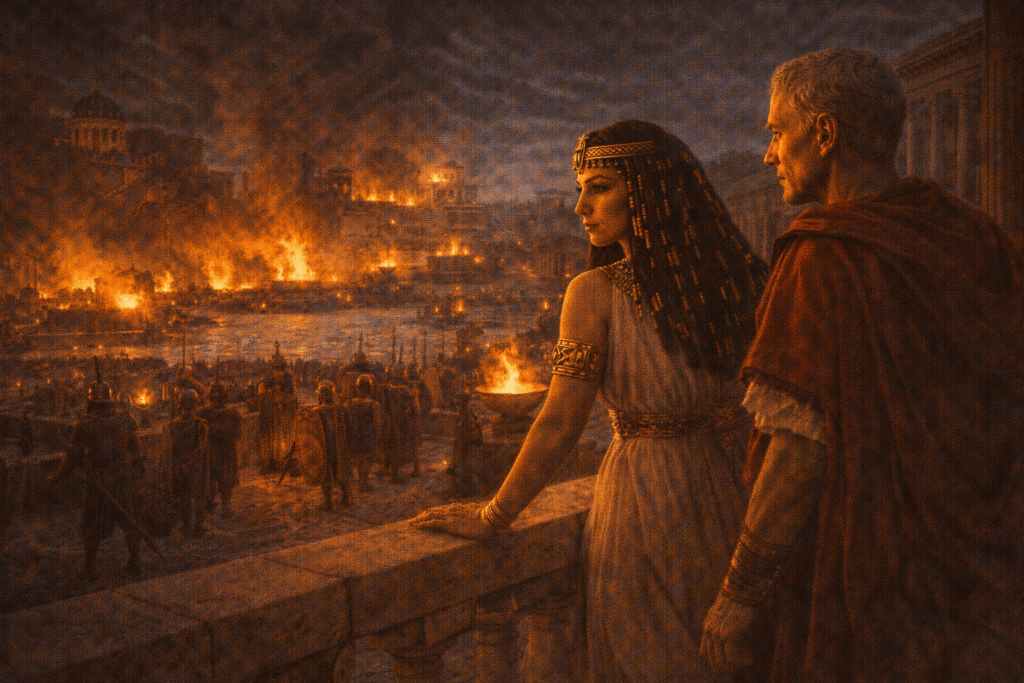
Prologue — A Kingdom Does Not Burn All at Once
People imagine
a single spark,
a single torch,
a dramatic beginning.
But kingdoms
burn slowly—
in fear,
in ambition,
in silence.
By the time
the first flame
touches wood,
the fire
has already happened
in hearts and halls.
The Alexandrian War
did not begin
with soldiers clashing.
It began
when Caesar declared
me co-ruler
and my brother’s face
twisted into something
I had never seen in him:
Fear
becoming desperation.
Desperation
becoming violence.
This Scroll
is not an account
of romance.
It is an account
of fire.
PART I — When My Brother Fled the Chamber
The moment Caesar declared
the co-rule legitimate,
my brother’s advisors
grabbed the boy-king
by the shoulders.
He tried to protest.
He tried to appear regal.
But he was shaking.
“Come,”
one whispered.
“It is no longer safe
for you here.”
He was ushered out
with alarming speed.
Caesar noticed.
“So,”
he said softly,
“They run.”
“Yes,”
I replied.
“And they will not run far.”
Because they were not fleeing
for safety.
They were fleeing
to gather troops.
I knew
what would happen
before the messengers
arrived breathless
hours later.
“Majesty—
Ptolemy’s army has seized
the eastern quarter!”
“His generals have rallied
the palace guard!”
“Roman officers have been attacked
in the streets!”
Chaos
had ignited.
But chaos
was predictable.
PART II — Caesar Takes the Palace
Caesar did not panic.
He assessed.
Calculated.
Then he spoke quickly
to his commanders in Latin:
“Secure the palace.
Block the causeways.
Control the harbor.”
His officers
darted like arrows.
Within minutes,
the palace complex
was transformed:
Curtains torn down
to use as barricades.
Furniture
piled against doors.
Archers
stationed on balconies.
Torches extinguished
to preserve darkness.
I watched
the transformation
with a strange mixture
of terror
and fascination.
Rome
was practiced in war.
My family
was practiced in politics.
But now,
politics had turned
into war.
“Stay behind me,”
Caesar said.
“No,”
I answered.
“I stay beside you.”
He glanced at me.
Not displeased.
“Then know this,”
he said,
“This siege
will not be brief.”
PART III — Alexandria Turns Against Itself
By nightfall,
the city burned
in fragments.
Not the whole city—
strategic parts.
Warehouses.
Barracks.
The canals
that fed the royal quarter.
My brother’s forces
poured in
from the eastern districts.
The palace
became an island
surrounded by flames.
As we moved
through the courtyard,
my sandals
crunched on broken pottery
and bits of fallen plaster.
Screams
echoed in the distance.
Shouts
in Greek,
Egyptian,
Latin.
The city
was becoming
a battlefield.
Caesar turned to me.
“This is not a civil dispute,”
he said.
“This is war.”
“Yes,”
I whispered.
“Welcome to Egypt.”
PART IV — The Fire Reaches the Docks
Caesar sent a detachment
to the royal harbor
to secure the fleet.
But Ptolemy’s generals
were faster.
By the time
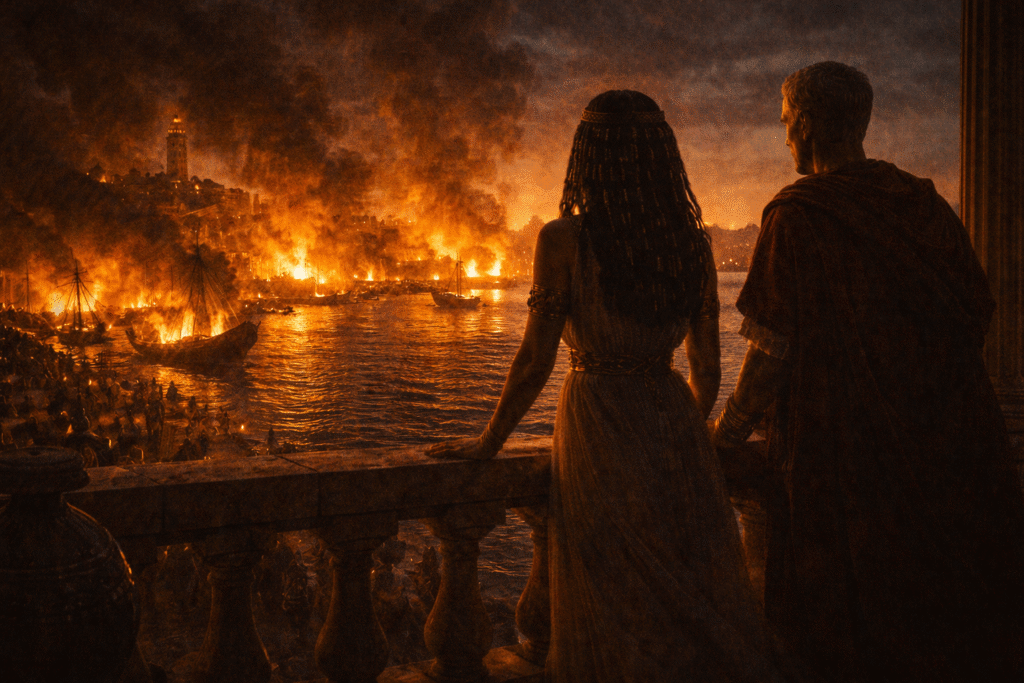
we reached the balcony
overlooking the water,
I saw it—
a line of fire
leaping across
the wooden docks
where Greek ships
were moored.
Flames
climbed ropes.
Sails ignited
like parchment.
Masts collapsed
like torches.
A soldier shouted:
“They want to trap us—
they’re burning the ships
to cut off escape!”
Caesar cursed under his breath.
“Idiots,”
he muttered.
“They risk
the entire harbor district.”
Yes.
And worse.
The docks
lay close
to a storehouse
of scrolls and papyri—
the annex
of the Great Library.
Fire spread
with terrifying speed.
I gripped the balcony rail
as heat blasted upward.
“The Library…”
I breathed.
Not the whole institution—
the main library
stood further inland.
But thousands
of scrolls
stored near the docks
were now fuel.
Not lost to negligence.
Lost to war.
Lost to ambition.
Lost to my brother’s desperation.
A piece of Egypt’s mind—
gone.
I felt
a cold, hollow ache
in my chest.
“We must contain it,”
I said.
“We cannot,”
Caesar replied.
“The fire is too wide.”
For the first time,
I saw regret
in his eyes.
Not for Rome.
For knowledge.
PART V — The Council in the Smoke
We gathered
in a marble hall
now dim with smoke.
Roman officers.
Egyptian allies.
Mercenaries
I had brought from Syria.
Maps spread out
on a low table.
Caesar placed a hand
on the map of Alexandria.
“They control
the east quarter,”
he said.
“We control
the palace and harbor.”
A commander added:
“They’re trying
to starve us out.”
I spoke:
“They forget
the palace
is built above
ancient cisterns.
We can draw water
longer than they expect.”
“And food?”
Caesar asked.
“We ration,”
I said.
A Roman officer
leaned forward.
“Majesty—
your brother’s army
is growing.
Many Egyptians
fear Rome’s presence.”
“Then,”
I said,
“we must give them
something to trust.”
The officer frowned.
“What is that?”
“A queen
who refuses
to abandon them.”
Caesar looked at me.
“You intend to stay
visible.”
“Yes.”
“That is dangerous.”
“Yes.”
He exhaled.
“And wise.”
PART VI — Walking the Palace During Siege
I walked
the palace halls
every day.
Not in jewels.
Not in royal robes.
In a simple gown
with a bronze dagger
at my hip.
Soldiers bowed
as I passed.
Servants whispered.
Priests nodded.
Every step
was a message:
Your queen is here.
Every glance
was another:
She has not fled.
In siege,
fear spreads
like smoke.
But presence
is antidote.
During one round
of checks,
a Roman soldier stopped me.
“You should be guarding yourself,”
he said gruffly.
“I am,”
I replied.
He frowned.
“I don’t understand.”
I smiled faintly.
“I am guarding myself
by guarding them.”
His expression softened.
And when he saluted me,
I realized—
I had gained
not admiration,
but respect.
Real respect.
The kind
warriors do not give
lightly.
PART VII — The Battle in the Royal Courtyard
It began
with shouting.
Roman soldiers
rushed past me,
shields raised.
An Egyptian guard
shouted:
“They’ve breached
the eastern gate!”
I ran
to the courtyard balcony—
and saw it:
Dozens
of Ptolemaic soldiers
pouring through
a broken gate,
torches in hand.
Romans
met them head-on.
Steel
against bronze.
Screams.
The crack
of spear against shield.
I gripped the balustrade
so tightly
my knuckles whitened.
A Roman officer
shouted up to me:
“Majesty—
go inside!”
“No,”
I said.
“I stay.”
He opened his mouth
to argue.
Then realized.
I wasn’t asking permission.
PART VIII — The Moment I Entered the Battle
I did not fight
with blade.
Not yet.
But battle
is more than killing.
Battle
is choosing
where your presence
shifts the tide.
When Roman morale
faltered
under the surge
of my brother’s troops,
I descended the stairs.
Soldiers
stared in disbelief.
A queen
in a courtyard
filled with blood
and fire.
I walked
steadily
to the front line.
A soldier
tried to block me.
I put a hand
on his arm.
“No fear,”
I whispered.
He nodded.
Behind me,
others straightened.
A Roman commander shouted:
“Form ranks!
Protect the queen!”
Their formation tightened.
Their courage steadied.
Their blows sharpened.
My presence
became
a weapon.
And the enemy
saw it.
I saw hesitation
flicker
in their eyes.
Then retreat.
Not a full retreat.
A shift.
A fracture.
A moment.
But moment
is enough
to win a battle.
[Suggested Visual: Cleopatra standing at the front of a palace courtyard during battle, Roman shields forming around her, firelight and smoke rising, tension high.
AI Prompt: “Cleopatra VII standing at front of palace courtyard during battle, Roman shields forming protective arc around her, firelight, smoke, cinematic realism.”]
PART IX — Caesar’s Recognition
After the courtyard
was secured
and the dead
carried away,
Caesar found me
in the ruined hall.
“You should not
have gone down there,”
he said.
“Yes, I should,”
I replied.
He studied me.
“Your presence
changed the outcome.”
“So did your tactics.”
He huffed
something like a laugh.
Then—
“You are
more dangerous
than your brother.”
“Good,”
I said.
His expression sharpened.
“Not to Rome,”
he clarified.
“To anyone
who underestimates you.”
He was right.
Underestimation
was a throne
I had set fire to.
PART X — The Night the Flames Reached the Library
During the third night
of the siege,
a storm of sparks
rose from the harbor.
One of Caesar’s officers
burst into the hall.
“Majesty—
the fire has reached
the library annex!”
We ran
to the balcony.
Flames
were leaping
from warehouse roofs
into the adjacent structures
where scrolls
were stored for copying.
A red glow
against the night.
Smoke
curling upward
like dying knowledge.
My chest tightened.
“Can we stop it?”
I asked.
Caesar shook his head.
“It is too far.”
I swallowed hard.
Part of the Great Library
was burning.
Not myth.
Not legend.
Reality.
War
eats knowledge
as easily
as timber.
For a long time,
I said nothing.
Then—
“I will rebuild it.”
Caesar looked at me.
“Rebuild?” he asked.
“Yes,” I said.
“Knowledge does not burn
when someone
is determined
to restore it.”
He nodded once.
And for the first time
since the siege began,
I saw something new
in his eyes.
Not respect.
Not admiration.
Recognition.
He recognized
my resolve—
the kind
that builds nations
after fire.
PART XI — The Tide Turns
On the sixth day
of the siege,
a distant horn
echoed across the harbor.
Then another.
Then another.
A scout raced inside.
“Caesar—
reinforcements!”
Roman ships
from Cyprus
and Rhodes
had arrived.
My brother’s generals
saw the fleet
and faltered.
They knew
what this meant:
The siege
was ending.
The city
would turn.
The throne
would shift.
Caesar
would take the palace
fully.
And I—
I would sit
beside him.
Not as his possession.
As Egypt’s ruler.
PART XII — What the Fire Left Behind
When the dust settled,
when the palace
stopped trembling,
when the gates
were secured again—
I walked
through the halls
in silence.
Charred beams.
Cracked walls.
Ash
on the marble floors.
A palace
wounded.
A city
wounded.
A queen
wounded—
but unbroken.
Fire
cannot destroy
what was forged
in fire.
And I realized:
My brother’s men
had tried to burn
my future.
Instead,
they forged it.
Through smoke.
Through ash.
Through flame.
I had become
what Egypt needed:
A queen
who survives
even her own burning.
Ancient Questioner’s Desk — The Fire Edition
A student asked:
“Did Cleopatra fight in this war?”
The elder replied:
“She fought by standing
where fear would not go.”
Another asked:
“Was the Library destroyed here?”
The historian wrote:
“Only the annex.
But the loss
was still grave.”
A traveler wondered:
“Did Caesar admire her?”
The scribe answered:
“He admired survival
more than beauty.”
A final question came:
“What did the fire change?”
The old master smiled.
“It burned away
everyone who doubted
her right to sit on the throne.”
FINAL CTA — Walk the War Inside the Palace
This Scroll ends here—
in the palace that burned,
in the harbor that blazed,
in the halls
where swords clashed
and a queen
refused to flee.
If you want to walk
the corridors
where the Alexandrian War
began,
where Caesars
and queens
fought side by side,
where knowledge burned
and destiny reshaped itself—
walk it with ENA.
Journey with ENA.
Fire does not destroy queens—
it reveals them.