Scroll XX – The Storm Gathering in the West
Alexandria & Rome’s Fractured Republic — 44–42 BCE
Translated and restored for the modern traveler.
Prologue — Storms Do Not Arrive. They Form.
The western sky
was a strange color
the day I returned to Egypt—
not grey,
not bronze,
but the deep violet of warning.
The kind of sky
sailors watch
with narrowed eyes.
The kind of sky
priests call omen.
The kind of sky
a queen
recognizes as truth.
Caesar was dead.
Rome was breaking apart.
And in the fracture
of the world’s greatest power,
I saw
what others did not:
Storms are not born in rain.
They are born in ambition.
This Scroll
is the gathering wind
that preceded
my greatest trial.
PART I — The Return to Egypt
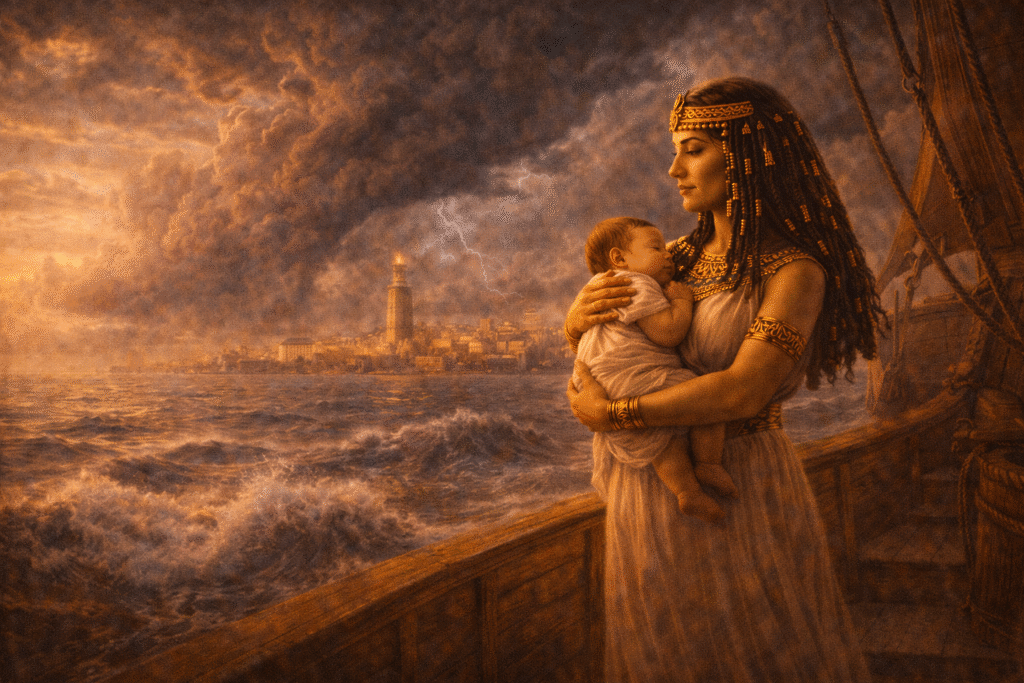
We sailed back
under silence.
No music.
No ceremony.
No trumpets.
Only the soft breathing
of my son
and the whispers
of attendants
who understood
the peril ahead.
When the lighthouse of Alexandria
rose out of the horizon,
its light
felt different.
Not welcoming.
Expectant.
The city waited
to know:
Was Egypt safe
with Caesar gone?
Was its queen
still secure?
Were the gods
still watching?
As we docked,
the crowds gathered.
Not joy.
Not fear.
Tension.
Anticipation.
Then—
someone shouted:
“Cleopatra!”
And the voices rose
like a tide:
Kleopatra.
Kleopatra.
Kleopatra.
Not celebration.
Recognition.
I held Caesarion
as I walked
through the palace gates.
I whispered:
“The world has changed,
my son.
And so must we.”
PART II — The News from Rome
Messages arrived
within days.
Rome had become
a battlefield
of speeches and knives.
Cassius and Brutus
fled the city,
declaring themselves
saviors of the Republic.
Mark Antony
claimed Caesar’s legacy
for himself.
And then—
a quieter name
surfaced:
Gaius Octavianus.
Caesar’s adopted heir.
A boy
of eighteen.
Unknown.
Unassuming.
Soft-voiced.
But dangerous.
Because ambition
is most lethal
when unexpected.
My advisors debated:
“He is a child.”
“He is insignificant.”
“He has no army.”
“He has no allies.”
“He has no experience.”
But I knew better.
Reading the world
is a queen’s duty.
And the world
had just produced
a new force.
A young man
with Caesar’s name,
Caesar’s inheritance,
and Caesar’s gaze
for opportunity.
I whispered:
“He will rise.”
The court looked at me.
“How can you know?”
“Because men
who appear harmless,”
I said,
“often intend
to be anything but.”
PART III — The Marketplace of Fear
Egypt’s merchants
brought rumors
from Roman ships.
“Antony is gathering troops.”
“Octavian is gathering support.”
“Cassius and Brutus
have taken the East.”
“Civil war is coming.”
Fear
spread through Alexandria
like a crack
through pottery.
In the marketplace,
I walked among the people
in plain linen.
A woman
selling onions
grabbed my wrist.
“Majesty,”
she whispered,
“will war reach us again?”
“No,”
I said.
“Not while I breathe.”
She bowed her head.
But I felt
the tremor
in her hand.
People trust words—
until the world
breaks beneath them.
I had to give them
something stronger
than reassurance.
I had to give them
stability.
PART IV — The Reforging of the Court
War
does not arrive suddenly.
It is prepared for
in whispers.
I summoned
my high council.
“We must secure the borders,”
I said.
“Strengthen the fleet.
Fortify the eastern fortresses.
Protect the Red Sea route.”
Admiral Apollodorus—
older,
tougher,
scarred from palace battles—
bowed.
“We will prepare the navy.”
“Quietly,”
I said.
“We do not provoke.
We anticipate.”
The treasurer
spread scrolls before me.
“Rome’s instability
will affect trade.”
“Then we build reserves.”
We stored grain
in triple the usual amounts.
We fortified granaries.
We built irrigation basins
in the Delta.
Egypt
would not starve
because Rome
was tearing itself apart.
A queen
does not wait
for storms.
She prepares.
PART V — The Message from Antony
The first letter
from Mark Antony
came on a spring morning.
The messenger
bowed deeply.
“He requests
an alliance.”
I unrolled the scroll.
Antony’s handwriting
was bold,
slanted,
unrestrained.
“Cleopatra,
The Liberators
(Cassius and Brutus)
march east.
Octavian seeks my position.
I require support.
Let us meet.”
I read it twice.
Antony was powerful.
Experienced.
Charismatic.
But he was also:
impulsive,
hot-blooded,
governed by pride
more than wisdom.
I said only:
“No.”
The court gasped.
“Majesty—
Antony commands legions!”
“Yes,”
I replied.
“So did Caesar.
And Rome killed him.”
Antony
was not yet
stable enough
to gamble Egypt on.
I would not
choose sides
in a war
that had not
yet declared
its victor.
I said:
“Send a reply.
Courteous.
Delaying.
Noncommittal.”
We would watch.
We would wait.
We would not
be pulled
into Rome’s chaos.
Not yet.
PART VI — The Shadow Called Octavian
Then came
the first letter
from the boy.
Octavian.
The heir
no one expected.
The serpent
in silk.
His letter
was not emotional
like Antony’s.
It was precise.
Measured.
Chilling in its clarity.
“Queen Cleopatra,
I recognize your reign.
Egypt’s independence
is beneficial
to stability.
Caesarion
is my kinsman.
May our futures align.”
I felt
the weight
of each sentence.
He spoke
like a man
not yet twenty
with the vision
of a man
fifty.
Dangerous.
Not because he was unstable.
Because he was steady.
Cold.
Calculating.
Patient.
The storm
was not Antony.
The storm
was Octavian.
PART VII — The Night I Read the Stars
One night,
concerned by the political winds,
I summoned
the astronomer Sosigenes
to the palace observatory.
He was the same scholar
who had advised Caesar
on the calendar reform.
“The sky,”
I asked,
“what does it say?”
He adjusted
the bronze armillary sphere.
“Majesty…
two great lights
move toward collision.”
“Caesar’s killers
and his heirs?”
He shook his head.
“No.
Octavian
and Marcus Antonius.”
“And Egypt?”
He looked at me gently.
“You are the tide
between them.”
Not crushed.
Not drowned.
Influential.
Central.
Unavoidable.
The storm
would not decide me.
I would decide
how it broke.
PART VIII — The Quiet Before the Thunder
Over the next months:
The Nile
flooded beautifully —
a good omen.
Trade routes
stabilized.
Scholars
returned to Memphis.
Farmers
brought offerings
for the healthy harvest.
But beneath the calm—
rumors swirled:
Brutus and Cassius
have taken Asia.
Antony has seized Gaul.
Octavian demands
Caesar’s legacy.
Every report
was a gust of wind.
Every gust
built pressure.
I held council weekly.
I prayed
at the temples.
I rode
the riverbanks.
I studied
the political currents
with the same care
I studied
the Nile’s flood patterns.
Because rulers
who fail
to read the tides
drown in them.
PART IX — The Death That Shifted Everything
Then word came:
Brutus and Cassius
are dead.
Defeated at Philippi.
Antony and Octavian
now ruled Rome
together—
but not equally.
Antony
had the armies.
Octavian
had the city.
Antony
had experience.
Octavian
had legitimacy.
Antony
was fire.
Octavian
was stone.
And stones
outlast fire.
I whispered:
“The storm
is no longer gathering.
It has begun.”
PART X — What I Understood Before the World Did
I understood something
long before Rome did:
The world
was no longer divided
between Caesar’s killers
and his heirs.
It was divided
between two men:
Antony
and
Octavian.
Their alliance
would fracture.
Their ambitions
would collide.
And when they did—
one of them
would turn his gaze
toward Egypt.
Toward me.
Toward my son.
Toward the legacy
that Rome
could not tolerate:
A child
who bore
Caesar’s blood.
A child
Rome feared
more than any army.
A child
whose future
depended on me.
I whispered to the night:
“I see you, storm.
And I will not break.”
Ancient Questioner’s Desk — The Storm Edition
A student asked:
“Did Cleopatra fear Rome?”
The elder replied:
“She feared instability,
not nations.”
Another asked:
“Why did she refuse Antony?”
The historian wrote:
“Because she did not trust fire
to warm without burning.”
A traveler wondered:
“Who was more dangerous—
Antony or Octavian?”
The scribe answered:
“Antony could break you.
Octavian could erase you.”
A final question came:
“When did Cleopatra realize
her greatest enemy?”
The old master smiled.
“When he was still a boy.”
FINAL CTA — Stand Where the Storm First Touched Egypt
This Scroll ends here—
on the docks of Alexandria,
in the palace halls,
in observatories lit by starlight,
in the whispers of merchants,
in the letters of generals,
and in the breath
before the greatest conflict
of Cleopatra’s life.
If you want to stand
where the storm gathered
over the Mediterranean,
where a queen prepared
for the collision of empires,
where the decisions
that shaped history
were first felt—
walk it with ENA.
Journey with ENA.
Storms do not break queens—
they reveal them.