
Scroll XIII – The Meeting in the Carpet
Alexandria, 48 BCE — The Palace Siege, Caesar’s Judgment, and the Moment the World Remembers
Translated and restored for the modern traveler.
Prologue — This Is Not the Story the Romans Told
Rome adored drama.
Rome adored spectacle.
Rome adored rewriting the truth
to make themselves
the center of every story.
So they transformed
a strategic act
into a romantic one.
A political maneuver
into a seduction.
But this is the truth:
The “carpet meeting”
was an act of war.
A royal woman
risking assassination
to reach the only man
capable of preventing
her execution.
A queen
entering the lion’s den
not to be admired—
but to survive.
This Scroll
is the real version
of the moment
that changed
not just my life,
but Egypt’s future.
PART I — The Siege Inside the Palace
When Caesar accepted
my meeting in the night,
he did not restore me.
He did not declare me queen.
He did not march into the court
with banners.
He summoned
both siblings.
Ptolemy
and me.
A hearing.
A judgment.
A Roman arbitration.
But my brother’s advisors—
men with far more ambition
than loyalty—
had no interest
in peaceful settlement.
They wanted
me dead.
The next morning,
I was informed
that the palace gates
leading to the council chamber
were sealed
from the outside.
A messenger
whispered:
“They will not allow you
to attend the hearing.”
Meaning:
they feared my presence
before Caesar.
Meaning:
they feared my truth.
Meaning:
they intended to win
by my absence
or my death.
I pressed my palm
to the cool stone wall
of the corridor.
“They will kill me
before noon,”
I said.
My attendant’s voice shook:
“What do we do?”
I closed my eyes.
“Not what they expect.”
PART II — The Man Who Carried Destiny on His Back
Apollodorus
was a Sicilian-born
art dealer,
smuggler,
philosopher,
and friend.
A man
with no titles—
but endless courage.
He bowed when he saw me.
“There is a way,”
he said.
“Tell me.”
He pointed
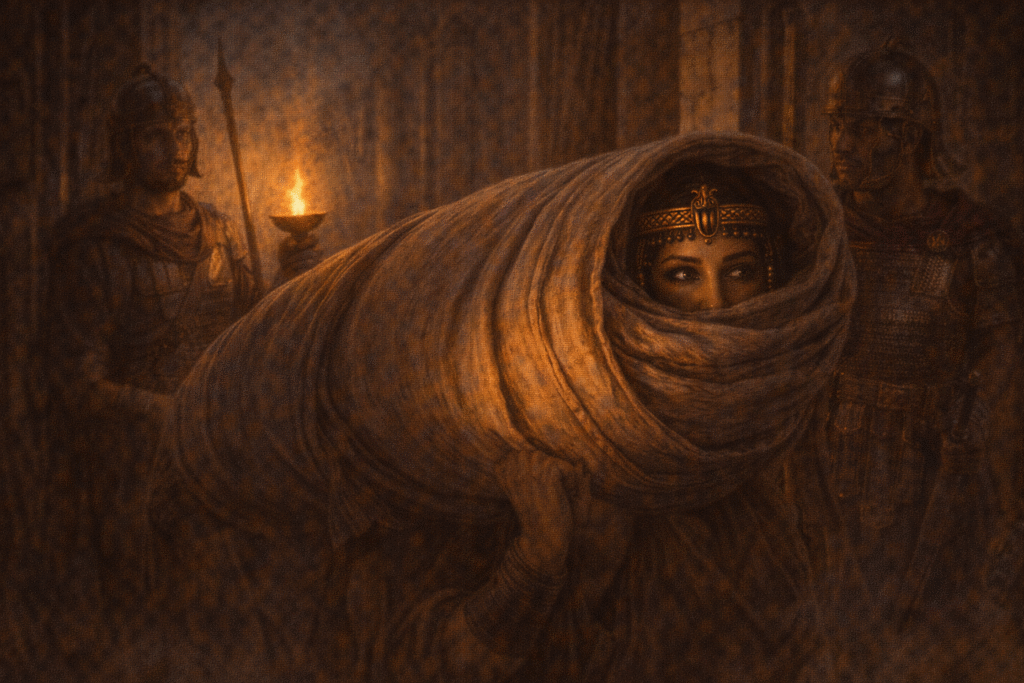
to a long bundle of cloth
on the ground.
“It contains
my finest woven carpet.
A gift for Caesar.”
I frowned.
“A carpet?”
He nodded.
“A carpet
large enough
to hide a queen.”
Understanding
rippled through me.
“Caesar expects
a presentation of gifts,”
he said.
“He will allow the carpet
to be carried in
without inspection.”
“And my brother’s men?”
“They will see
only the delivery
of an offering.”
He paused.
“But you must remain
completely still.
If the carpet drops,
if a corner is lifted—
they will kill you.”
I studied the bundle.
It was wide.
Heavy.
Suffocating.
A coffin made of tapestry.
My attendant whispered:
“This is too dangerous.”
“No,” I said softly.
“It is precisely dangerous enough.”
Because power
only respects
those who act
as if they already possess it.
I stepped forward.
“Roll it.”
PART III — Inside the Darkness
The world
collapsed
into wool.
Thick.
Dust-scented.
Tight.
Apollodorus
and another aide
lifted the bundle.
My spine curved.
My breath slowed.
My heartbeat
thundered in my skull.
We moved.
Footsteps.
Voices.
Guards.
Echoes.
The sound
of palace marble
beneath the carpet
as it dragged slightly
on corners.
Twice,
the carpet dipped
so sharply
my head nearly struck stone.
Once,
I heard my brother’s advisor
call out:
“What is that?”
“A delivery,”
Apollodorus said smoothly.
“A gift
for Caesar.”
A pause.
A heartbeat.
Then—
“Proceed.”
The wheels of fate
rolled on.
The bundle shifted again.
A torch sizzled nearby.
A guard coughed.
The air grew warmer.
Then—
A door opened.
I heard Latin voices.
Roman boots.
A command:
“Bring it in.”
PART IV — The Unrolling
I felt
the ground
beneath me
change texture—
from hard marble
to carpeted floor.
The air
suddenly cooler.
A moment passed.
Then another.
Then—
The world
exploded
into light.
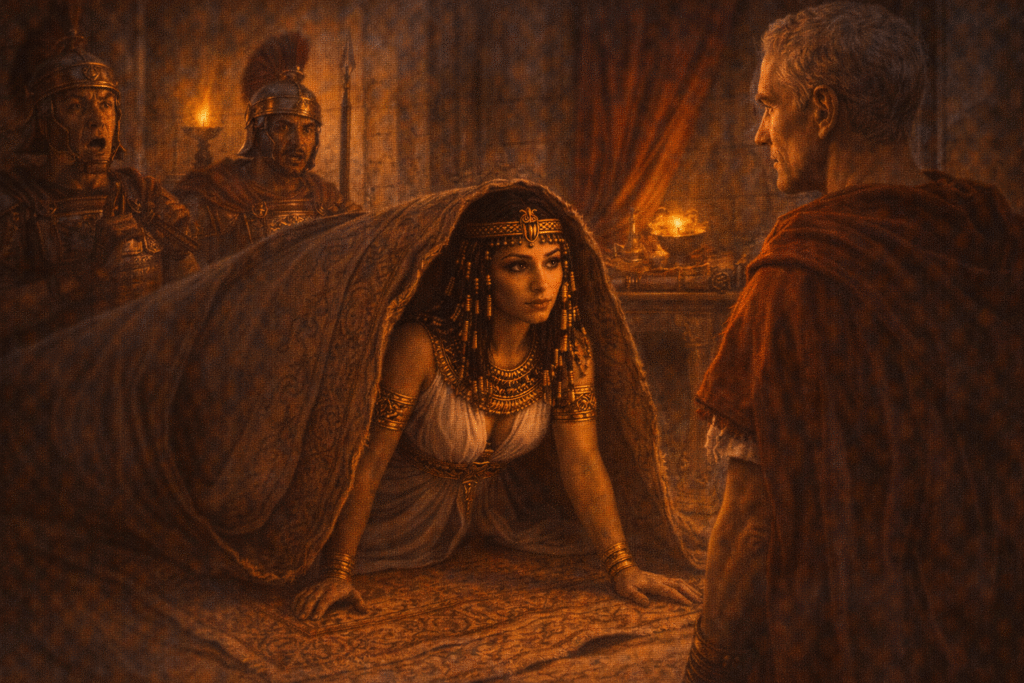
The carpet
unfurled rapidly,
the edges whipping outward,
and I spilled
onto the floor
like a reborn creature.
Gasps.
Shouts.
A clatter of armor.
I rose
slowly
to my knees,
then to my feet.
Straightened my cloak.
Lifted my chin.
And looked directly
into the eyes
of Julius Caesar.
He did not recoil.
He did not shout.
He did not smile.
He observed.
Measured.
Calculated.
Then he said:
“You risked your life
to reach me.”
“Yes,”
I replied.
“Because my life
is what we are deciding.”
PART V — The Truth Between Us
The room emptied
at Caesar’s command.
Only we remained.
He moved closer—
not with desire,
but with strategy.
“You could have been killed,”
he said.
“I knew,”
I answered.
“Why take the risk?”
“Because you asked
for both rulers.
And they tried
to keep me from you.”
He nodded.
“And if I had refused
to hear you?”
I held his gaze.
“Then I would have died
knowing I acted
instead of being acted upon.”
His eyes
softened—
with respect.
Not affection.
Respect
is a rarer power
than attraction.
“Your brother,”
he said,
“has made foolish choices.”
“Foolish advisors,”
I corrected.
“Dangerous ones.”
“And you?”
he asked.
“What choices
would you make
if restored to the throne?”
I answered
with the truth:
“The ones
that keep Egypt stable.”
Not the answer
he expected.
But exactly
the answer
Rome required.
PART VI — The Judgment Begins
Caesar called
for both siblings
to stand before him.
My brother arrived
with a parade.
Gold.
Silk.
Perfume.
Flatterers.
I arrived
with dust
still in my hair.
Caesar gestured
for silence.
“Egypt,”
he said,
“has two rulers
by the will
of your father.”
My brother
frowned.
“Only me,”
he insisted.
“Both,”
Caesar corrected.
Then he looked at me.
“You will co-rule
with your brother.”
A murmur
spread through the hall.
“And if he refuses?”
I asked.
Caesar’s gaze
did not shift.
“Then Rome
will enforce it.”
The court
froze.
My brother’s advisors
blanched.
Caesar had not chosen
me.
He had chosen
order.
But order
was my ally.
And I knew
what would happen next:
My brother
would not accept
a co-rule.
Not with me.
Not with Caesar’s backing.
He would flee.
He would gather troops.
He would start a war.
And Caesar
would fight it.
And I
would stand beside him—
not as ornament,
but as partner.
This
was not the end.
It was the ignition.
PART VII — The Moment Rome Saw Me Clearly
After the hearing,
as people filtered out,
Caesar paused beside me.
Quietly
so no one else could hear,
he said:
“You understand
your position.”
“Yes.”
“And you understand
Egypt’s.”
“Yes.”
“Then understand this:
I do not need
a queen who hides.”
I met his eyes.
“Then you have chosen
correctly.”
He studied me
for a beat.
And I realized:
In his world,
he had met senators,
generals,
kings,
and sons of kings.
But he had rarely met
a woman
who acted
with the intelligence
of a seasoned ruler.
He saw me
not as a girl
in a carpet—
but as a queen
in a trap
who had cut
her own way out.
PART VIII — The Door That Closed Behind Me
Later,
when I walked back
through the palace corridors,
I passed the spot
where I had once been locked in.
The guards
who followed my brother
watched me
with unease.
One whispered:
“She has returned
from death.”
The other replied:
“No.
She brought death
with her.”
They were wrong.
I had brought
change.
Change
that would collapse roofs,
topple factions,
burn through the palace
like a windstorm.
Because once Caesar
recognized me
as a co-ruler—
the path
to the throne
broke open.
And nothing
would close it again.
Ancient Questioner’s Desk — The Carpet Edition
A student asked:
“Did Cleopatra seduce Caesar here?”
The elder replied:
“No.
She surprised him.”
Another asked:
“Why hide in a carpet?”
The historian wrote:
“Because any other approach
meant execution.”
A traveler wondered:
“Was Caesar impressed?”
The scribe answered:
“Not by beauty.
By audacity.”
A final question came:
“What changed that night?”
The old master smiled.
“She stopped being
a displaced princess
and became
a force.”
FINAL CTA — Step Into the Room Where History Unrolled
This Scroll ends here—
in the torch-lit chamber
where a queen emerged
from darkness,
stood before a general,
and altered the fate
of two empires.
If you want to walk
the corridors
where Cleopatra defied
a murderous court,
the chamber
where she confronted Caesar,
the palace rooms
where a kingdom’s future
shifted with a single act—
walk them with ENA.
Journey with ENA.
Queens do not enter rooms—
they reshape them.
Historical Context
Ancient sources, including Plutarch, describe Cleopatra’s dramatic introduction to Julius Caesar while she was seeking to regain power. The famous “carpet” (or bedding sack) account is likely embellished but rooted in historical tradition.
This scroll follows the spirit of the ancient narrative while acknowledging its theatrical transmission.