
Scroll V – The First Exile
Alexandria → Cyprus → Rome, c. 58–55 BCE — The Journey Beyond the Nile
Translated and restored for the modern traveler.
Prologue — A Throne Is Lost Quietly First
People imagine exile
as a grand rupture—
a storm of soldiers,
doors shattered,
flames devouring the night.
The truth is smaller.
Exile begins
with whispers.
With a city
that stops looking you in the eye.
With a father
who stops sleeping.
With siblings
who stop speaking
when you enter a room.
With guards
whose loyalty
starts to hesitate.
And then,
one quiet morning,
you wake
and the air
is different.
And you know—
your home
is no longer your home.
This was the exile
that shaped me.
Not the exile
Rome invented for its poets.
The exile
that taught me
how to survive
a world
that does not care
whether a queen
is warm.
PART I — The Night We Realized Alexandria Was No Longer Ours
The signs appeared
like cracks
spreading across old plaster.
The palace guards
began changing shifts
twice as often
as before.
Foreign merchants
left the harbor
with their sails low—
a sign
that danger within the city
was greater
than danger at sea.
Scribes
began whispering
in corners
instead of at their desks.
And the people—
the people we could feel
long before we saw them—
stopped chanting blessings
when our litters passed.
They turned away.
Some spat.
“Why?” I asked my nurse
as we walked
through a dim corridor.
“Because your father
raised taxes
for Rome,”
she whispered.
“But Rome promised protection,”
I said.
She gave me a look
I was too young
yet old enough
to understand.
“Rome protects itself.”
That night,
the city erupted.
Not fire.
Not swords.
Voices.
The people rose
like a tide
against my father.
Not against the dynasty.
Against him.
The man who bowed
too deeply
to foreign power.
Shouts reached the palace:
“Down with the Roman King!”
“Egypt for Egyptians!”
“Bring back Berenice!”
And I realized
with a bitter clarity—
they did not want us dead.
They wanted us replaced.
PART II — My Father’s Fear
My father
was never a brave man.
He was clever,
charismatic,
weak,
and too fond of Rome’s approval.
But the night
the shouts reached the palace gates,
he became something else entirely:
Terrified.
He burst into my chambers,
his robe half-tied,
hair wild.
“Cleopatra,” he gasped.
“We leave now.”
“Where?” I asked.
“Anywhere Rome will not ridicule us.”
It was the wrong answer
from the wrong man.
But it was a father’s panic,
and I did not argue.
He grabbed my wrist
and pulled me toward the docks.
No formal procession.
No royal dignity.
Just a king
trying to outrun his own people.
The last thing I saw
before boarding the ship
was an Alexandrian woman
with a jar of olives
in her hands
spitting toward the palace.
Not at me.
At the idea
that her Pharaoh
had knelt
to foreigners.
Her spit
hit the marble steps.
It sounded
like judgment.
PART III — Leaving the Only World I Knew
The ship
was not a royal vessel.
No banners.
No gilding.
A merchant ship
paid with desperation.
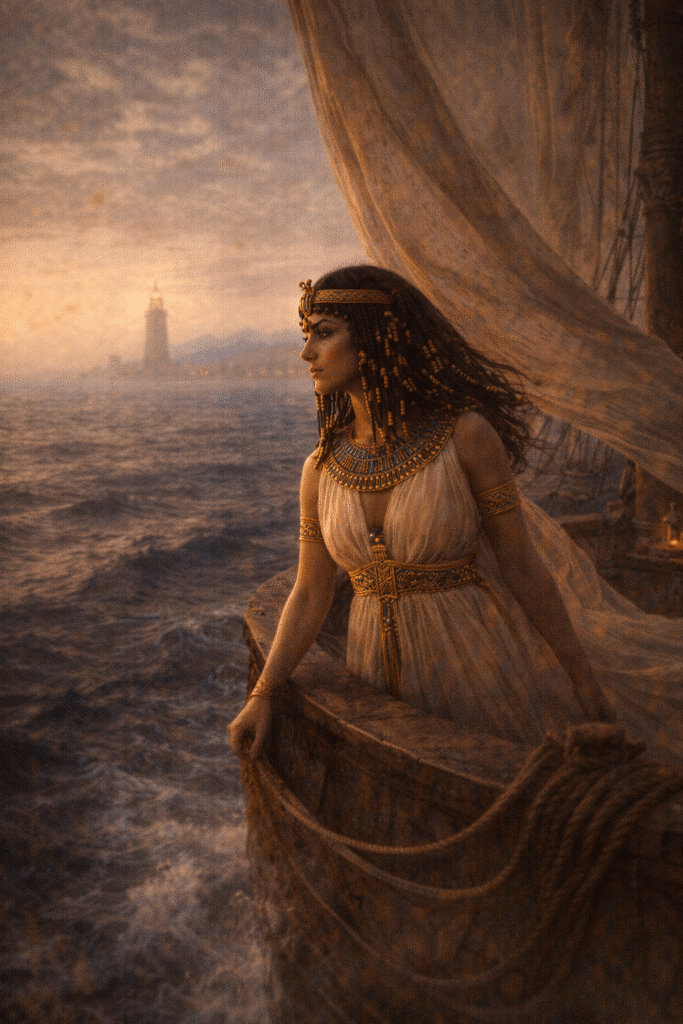
As we pulled away
from the quay,
I stood at the stern
and watched Alexandria
shrink into mist.
The Pharos lighthouse
rose bright
in the fading light—
its great fire
a promise
of homecoming.
But home
no longer felt promised.
My father
paced the deck,
muttering.
“We will go to Cyprus.”
“No—straight to Rome.”
“No—we must stop in Tyre.”
“No—no—Rome first—Rome first—”
His fear
made the crew nervous.
His fear
made me steady.
Someone had to be.
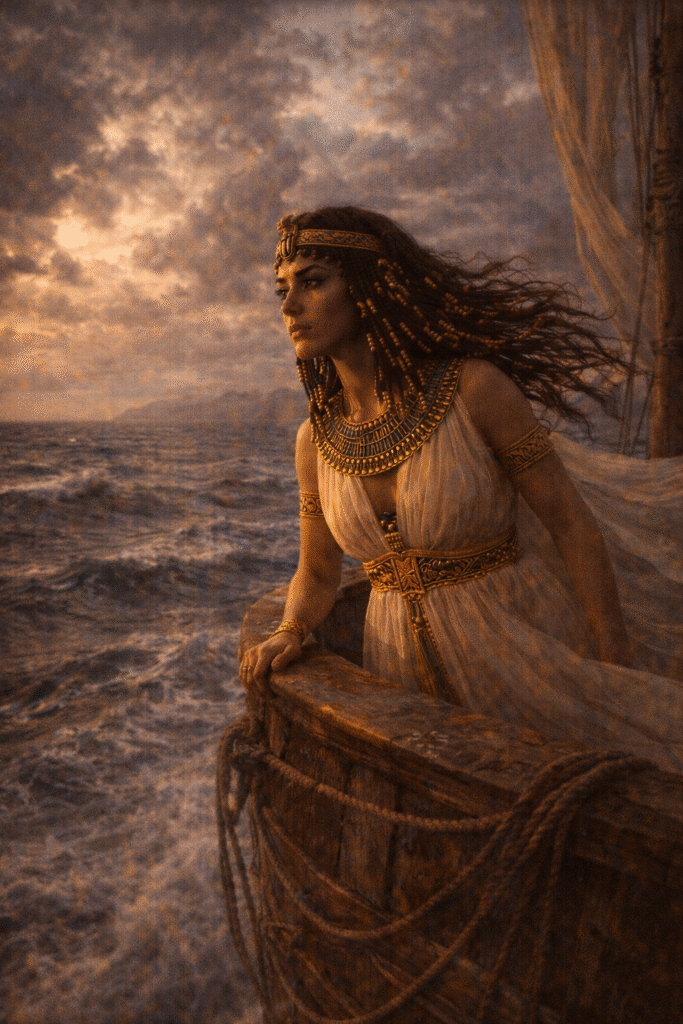
The waves lifted us
like a cradle
and dropped us
like a hammer.
Salt sprayed my face.
My linen clung
with sea-wet cold.
And for the first time,
I felt
small.
Not insignificant.
Just small
in a world
that did not care
about royal lineage.
The sea
does not bow
to any king.
It does not rise
for any queen.
It carries
and it swallows.
That realization
was the first gift
exile gave me.
PART IV — Cyprus: The Island That Held Its Breath
We reached Cyprus
after days
of harsh wind.
My father’s half-brother
ruled there
with a grip
as insecure
as my father’s.
Cyprus was a quiet island—
not peaceful,
just resigned.
A place waiting
for someone else’s decision
to determine its future.
My father begged
for soldiers.
His brother refused.
“Your people want you gone,”
he said.
“Why should I stand
in their way?”
My father erupted.
“You owe me!”
“I owe Egypt,”
his brother replied.
“And Egypt has spoken.”
I watched
from behind a pillar
as two grown men
who ruled kingdoms
argued
like children fighting
over a broken toy.
It was embarrassing.
And illuminating.
If blood
gave you nothing but rivals,
then loyalty
must come from somewhere else.
From choice.
Not lineage.
This was the second gift
exile gave me.
PART V — Rome’s First Glance at Me
Cyprus offered no help.
So we sailed
to the one place
my father hated
and depended on equally:
Rome.
The city was brutal
in a way Egypt was not.
Egypt hides its power
in stone
and ritual
and ancient memory.
Rome wears its power
on its body—
broad-shouldered senators,
armed guards,
streets that smell
of ambition
and sweat
and iron.
People pushed
with no apology.
Markets screamed
with noise.
The Tiber
was thick and brown,
not blue
not holy.
My father
was nothing here.
A king in Egypt.
A petitioner in Rome.
We entered the Senate Hall
through a side door.
A Greek advisor
tried to soothe him.
“Smile,” he whispered.
“They love weakness
disguised as humility.”
My father smiled.
It looked
like fear.
I stood beside him
with my chin high.
One senator
glanced down at me
and smirked.
“A daughter?” he said.
“An observer,” I replied.
His eyebrows rose.
He had expected
silence.
He had expected
a docile child
from a defeated kingdom.
He had not expected
Egyptian Greek
spoken with clarity,
poise,
and perfect pronunciation.
He leaned to his neighbor.
“This one,” he muttered,
“has teeth.”
That was the first time
Rome saw me.
Not yet with interest.
With caution.
PART VI — The Senate’s Decision
Rome debated
whether my father
should be restored
to the throne.
Not out of moral duty.
Out of profit.
“Egypt is wealthy,”
one senator said.
“Without a king,
it may fall to instability.”
“And instability,”
another added,
“interrupts our grain supply.”
My father bowed.
“I am loyal to Rome,”
he promised.
He said it three times.
Rome loves repetition
when extracting power.
Finally,
a senator in a crimson-trimmed toga
stood and declared:
“Ptolemy shall be restored—
by Roman arms.”
Then he looked at my father.
“And for the privilege
of this support,
Egypt shall…
contribute.”
A polite word
for extortion.
My father
nearly collapsed in gratitude.
I did not bow.
I locked eyes
with the senator.
I read
what he had not said aloud:
We will restore you
so we may control you.
He wanted
a client king.
He wanted
a weak ruler
Rome could shape
like wax.
He underestimated
one thing:
Kings could be manipulated.
Daughters
who listened
could not.
[Suggested Visual: Cleopatra and her father standing before the Roman Senate, senators in white and scarlet togas debating, Cleopatra watching them with sharp awareness.
AI Prompt: “Cleopatra VII and Ptolemy XII standing before Roman Senate, senators in white togas debating, young Cleopatra watching sharply, cinematic realism.”]
PART VII — The Roman Woman Who Saw Me
Not all Romans
looked at us
like prey.
One evening,
during a gathering
at a wealthy patron’s villa,
a noblewoman approached me.
Her name
was Fulvia.
Sharp eyes.
Sharper tongue.
A mind like a blade.
She studied me openly.
“You are not afraid,”
she said.
“I am observant,”
I replied.
She laughed.
“Observant people
are always threatening
to men who want silence.”
I blinked.
No one outside Egypt
had understood that
so quickly.
She tapped the gold serpent
around my wrist.
“You will be someone,”
she said.
“Rome will not like that.”
“Rome does not have to.”
She smiled.
“You will be trouble.”
“Only to those
who threaten my kingdom.”
Fulvia raised her cup.
“I hope you survive
long enough
to trouble all of us.”
I never forgot her.
Years later
she would be
a political opponent.
But that night,
she was the first Roman
who recognized
not my rank—
my potential.
PART VIII — Learning What Rome Thought of Us
In the weeks we stayed,
I learned something
that changed me more
than exile itself.
Egypt was not exotic
to Rome.
Egypt was useful.
Our grain.
Our exports.
Our roads.
Our scholars.
Our engineers.
They admired
our temples
while demeaning
our priests.
They coveted
our land
while mocking
our customs.
They valued us
the way a man
values a horse—
beautiful,
strong,
profitable.
Not equal.
Never equal.
Rome did not fear
Egypt’s armies.
It feared
Egypt’s identity.
Ancient.
Independent.
Older than their myths.
Standing in Rome,
I understood something
with brutal clarity:
If Egypt was to survive,
it would not be
by bowing.
It would be
by outthinking.
Outmaneuvering.
Outlasting.
Rome was iron.
Egypt was granite.
Iron rusts.
Granite remains.
PART IX — The Return Home
When we finally
returned to Alexandria,
the city did not welcome us
with open arms.
They welcomed
the Roman soldiers
who came with us.
My father
entered the palace
surrounded by armored men
whose presence
said everything:
This king
belongs to someone else.
But I saw something
the Romans did not see.
The people looked at me.
Not with anger.
Not with resentment.
With curiosity.
And something else:
Recognition.
I had returned
different.
Older.
Sharper.
Less afraid.
I spoke to the guards
in Egyptian
as we passed.
Their posture shifted.
Small things.
But small things
build legends.
Exile
had taken my home.
But exile
had given me:
knowledge of Rome,
knowledge of weakness,
knowledge of politics,
knowledge of survival—
and a sharpened loyalty
to the land
that had loved me
before any dynasty
claimed me.
I stepped
into the palace
with a vow:
I will not leave again
as a fugitive.
The next time
I leave Alexandria,
it will not be
in fear.
It will be
on my terms.
As queen.
🌿 MID-SCROLL CTA — Trace Her First Fall, Her First Rise
If you want to walk
the spaces of Cleopatra’s youth—
not the mythic queen,
but the real girl
who fled her city
and returned sharper,
smarter,
and ready to rule—
this is where ENA brings you.
Stand on the shore
where her ship left
in the dark.
See the ruins
of the palace district
that taught her fear.
Walk the streets
of modern Alexandria
where her people
first called her dangerous.
Journey with ENA.
Exile breaks the weak
and hardens the destined.
PART X — The First Exile Leaves Its Mark
That first exile
did not define me.
But it awakened me.
I learned:
- Empires never give anything.
- Kings may fear their people.
- The people fear hunger more.
- Rome listens only to profit.
- Alexandria listens to dignity.
- My family listens only to threat.
- And I am a threat.
Not to Egypt.
To anyone
who would betray her.
Exile carved this truth into me:
A queen cannot be chosen.
She must choose herself.
And the moment I returned,
I began choosing.
The palace
was a battlefield.
My siblings
were rivals.
Rome
an eclipse on the horizon.
But none of them
knew yet
that exile
had already begun
the most dangerous thing
I would ever become—
free of fear.
Ancient Questioner’s Desk — Exile Edition
A student asked:
“Did Cleopatra suffer in exile?”
The elder replied:
“She learned.”
Another asked:
“Was Rome impressed by her?”
The historian wrote:
“No—
Rome was unsettled.”
A traveler wondered:
“Did this exile break her?”
The scribe answered:
“Exile did not break her.
It broke the part of her
that hesitated.”
A final question came:
“Why did Rome fear her later?”
The old master smiled.
“Because they met her once
as a girl in exile—
and even then
she already frightened them.”
FINAL CTA — Sail the Path of Her Becoming
This Scroll ends here—
on the deck of a ship,
on foreign soil,
in crowded Roman halls,
and back again
to a city that would one day
call her Pharaoh.
If you want to follow
the journey
that turned a child
into a strategist,
and a strategist
into a queen—
walk it with ENA.
Journey with ENA.
Even queens learn exile
before they learn power.
Historical Context
Cleopatra was forced into exile early in her reign during a power struggle with her brother Ptolemy XIII. This exile is historically attested in ancient sources.
The emotional framing and specific experiences of exile are reconstructed to convey the political reality of displacement rather than a documented personal journey.