
Scroll IV – The Palace That Devoured Itself
Alexandria, c. 54–52 BCE — The Royal Quarters, The Treasury Rooms, The Women’s Wing, and the Throne Hall
Translated and restored for the modern traveler.
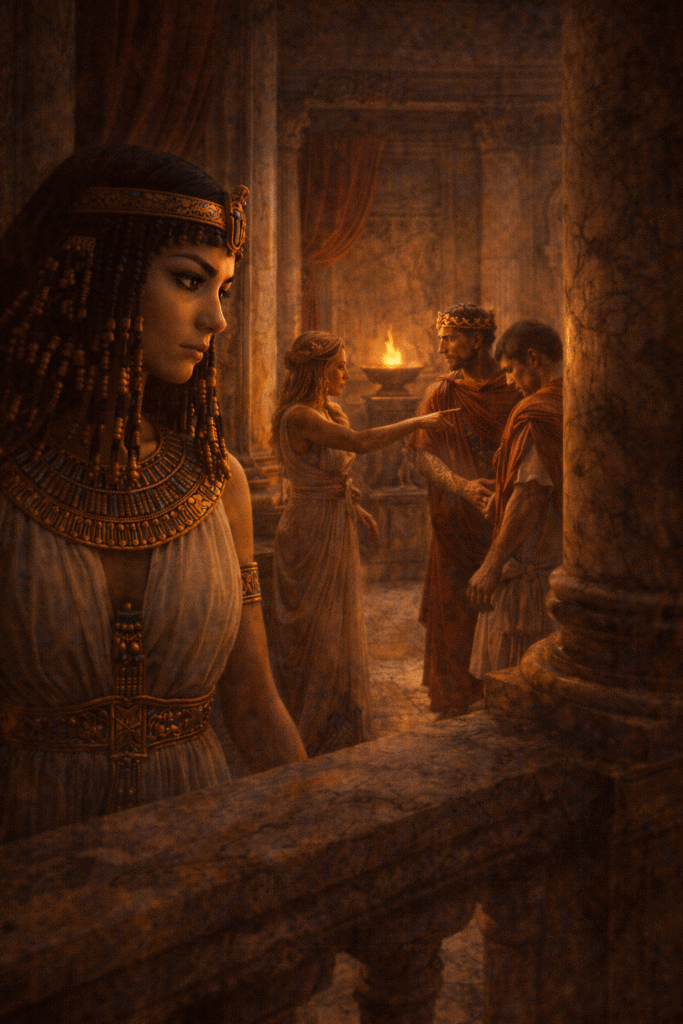
Prologue — A Palace Can Be a Tomb
People picture palaces
as places of safety—
shelter, luxury,
gilded rooms
where the world’s storms
cannot enter.
But the palace of Alexandria
was not a shelter.
It was a mouth.
A hungry one.
It swallowed alliances
as quickly as it formed them.
It digested loyalties
until nothing remained
but ambition.
And it spat out
anyone who forgot
that “family”
and “threat”
were synonyms in our halls.
I was raised
in a palace
that devoured its own.
This Scroll
is the moment
I learned that lesson
not as metaphor,
but as fact.
PART I — The Day My Mother’s Eyes Changed
My mother,
Cleopatra Tryphaena,
was a woman
of patience and composure.
She wore her silence
more elegantly
than most women
wore jewels.
But the morning
after a secret council meeting—
the first I was ever allowed
to sit near—
her eyes changed.
She summoned me
early,
before the servants had risen.
“Cleopatra,” she said,
“you must listen to me.”
I stood still.
Her voice did not tremble.
That frightened me more
than if it had.
“There is no loyalty
in these walls,”
she said.
“Not to your father.
Not to me.
Not between your siblings.”
“I know,” I whispered.
“No,” she said firmly,
“you know nothing yet.”
She took my chin
and forced me
to meet her gaze.
“You will learn
to defend yourself
not from enemies outside—
but from the ones
who share your blood.”
“What should I do?”
I asked.
She exhaled.
“You will do
what I failed to do.”
A pause.
“Listen with suspicion.”
I had thought
I was already listening.
I was wrong.
The lesson
she gave me that morning
would save my life
more times
than Rome ever did.
PART II — The Treasury That Hid More Than Money
The first sign
that the palace
was beginning to fracture
came quietly.
Like rot
under polished wood.
It began
in the Treasury.
Not in the gold room—
that was still generous enough
to impress Roman envoys.
It began
in the ledger room.
Scrolls miscounted.
Shipments “delayed.”
Grain tallies
that didn’t match
the harvest.
A surplus that vanished
between two signatures.
I was fourteen
when I first saw
the errors.
Not errors—
warnings.
My tutor
placed the accounts
before me.
“Your Highness,”
he murmured,
“I suspect
someone is draining the Treasury.”
“Rival nobles?” I asked.
“Not nobles.”
He pointed
to a name
written repeatedly
in the margins.
My brother’s.
Ptolemy.
Not the one
who would co-rule with me later.
Another one.
A boy
as clever
as he was hungry for power.
He was stealing
from our father
to buy loyalties
among guards
and scribes
and merchants.
To build
his own court
inside the court.
Berenice
had done the same
before her overthrow.
History,
it seemed,
ran in circles
inside our bloodline.
I closed the ledger.
If the palace was sick,
it would not cure itself.
PART III — The Night the Walls Had Voices
There were nights
when the palace
seemed to whisper.
Not in superstition—
in politics.
After the treasury revelations,
I began noticing
how the walls
shifted with sound:
- hurried footsteps
down servant corridors - muffled arguments
behind noble doors - the faint scrape
of papyrus being hidden
or unrolled - laughter
too tense to be joy - the rustle of silk
as people moved
too quickly
to be innocent
I learned
to stand still
long enough
for the palace itself
to speak.
One night,
in the women’s quarters,
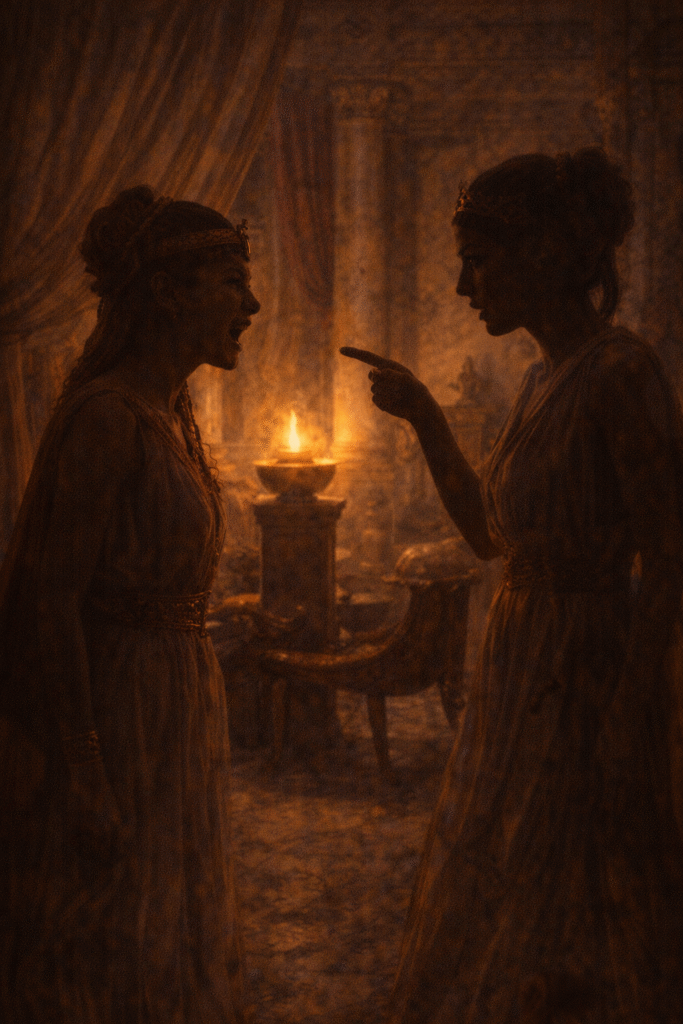
I heard my sisters arguing.
Arsinoe—
clever, impulsive,
hungry for attention—
hissed at Charisto,
the youngest:
“He will choose Cleopatra first.”
“Why her?”
the younger snapped.
“Because she’s watching.
And because she speaks
every tongue in this city.
Even the one
the people use.”
“Then she is a threat.”
Silence.
Then Arsinoe said quietly:
“She is.”
Their words
rolled through me
like cold riverwater.
Not because
they hated me.
Because they feared me.
Fear
is more dangerous
than hatred.
Fear
makes people plot.
Fear
makes people
kill.
This was the moment
I realized
my siblings
were not my companions.
They were my competitors.
And the palace
was the arena.
PART IV — The Day the Palace Doors Were Locked
Tension finally showed itself
not in words—
but in architecture.
One morning,
when I walked
to the western wing
for lessons,
a guard
blocked my path.
“Princess,” he said,
“this section is not open today.”
“Since when?” I asked.
“Since the king ordered it.”
The king—
my father—
had locked off
an entire wing.
And not the wing
with guest rooms,
or storage,
or libraries.
He had sealed off
the wing
where he kept
the messenger rooms.
The intelligence rooms.
The rooms
where foreign envoys
were received
before meeting him.
The rooms
where spies
deposited reports.
I felt something cold
move under my skin.
He was hiding information
from his own children.
Which meant
his children
were hiding things
from him.
I walked back
to my quarters
in silence.
The palace
had taken its first bite.
PART V — The Poison Incident
People ask
why Cleopatra
learned to handle poisons.
They assume seduction.
Or manipulation.
Or plotting.
The truth
is simpler:
I learned poisons
because someone
tried to kill me.
It happened
when I was fifteen.
A cup of wine
left in my room
“by accident.”
My nurse
smelled it
and froze.
Opium.
Mandrake.
Hemlock.
Not enough
to kill instantly—
enough to silence.
“Who?” I whispered.
She shook her head.
“It does not matter who.
It matters
that you learn.”
She sent a servant
to fetch
a healer from the Egyptian quarter.
The healer
taught me
what plants killed,
what plants cured,
what mixtures disguised
their scent,
what doses were meant
to terrify
versus eliminate.
She made me
taste bitterness
in diluted drops—
not enough to harm,
enough to learn.
“You must know,”
she said,
“because the palace
knows your worth.”
“Worth?” I asked.
“You are valuable
as a prize.
And valuable
as a threat.”
She looked at me
with the first respect
an adult had ever shown
that did not come
from duty.
“Know your poisons,”
she said softly.
“And you will know
your enemies.”
I did.
And I survived
because of it.
This was not villainy.
This was self-defense
in a house of knives.
PART VI — The Trial in the Marble Hall
The palace
turned on itself
fully
the day the Marble Hall
filled with accusations.
A noble family
from the Delta
was brought before my father.
They were charged
with withholding
grain shipments.
A crime.
But not the crime.
The true charge
was disloyalty.
And weakness.
And the possibility
that they had pledged
themselves
to one of my siblings.
I stood
behind a pillar
and watched.
Their patriarch
insisted on speaking:
“We have served
this dynasty
for centuries,”
he said.
“We have buried kings.
We have built temples.
We have maintained
the old ways.”
My father’s eyes
showed no movement.
“Egypt,”
the noble said,
“is not a jewel
to be traded
for Roman approval.”
Gasps.
The Greek courtiers
looked at one another
as if witnessing
a blasphemy.
My father
rose from his seat.
It was not
the rise of a king.
It was the rise
of a frightened man.
“You speak treason,”
he whispered.
“No,”
the noble replied.
“I speak truth.”
I felt
the air shift.
Guards stepped forward.
The noble knelt
without being asked.
“Egypt,” he said,
“needs someone
who listens.”
My father’s face twisted.
Someone—
one of my siblings—
whispered into his ear.
I couldn’t see which.
Next moment—
“Take him,”
my father said.
The noble was dragged away.
His family’s estates
were seized.
His sons
placed under guard.
His daughter
sent to the women’s wing
to “serve.”
The palace
had eaten another limb.
And I saw
with sudden clarity:
If the palace
could consume
a loyal family—
it could consume
a daughter
of the king.
[Suggested Visual: A noble kneeling before Ptolemy XII in a marble hall, guards moving forward, tension palpable.
AI Prompt: “Ancient Alexandria palace trial scene with noble kneeling before Ptolemy XII, guards moving forward, marble hall, young Cleopatra watching from shadows, cinematic realism.”]
PART VII — The Collapse I Couldn’t Stop
As the months passed,
everything accelerated:
- Siblings forming secret alliances
- Court factions splitting
- Merchants choosing sides
- Roman envoys sensing weakness
- Treasury shortages worsening
- Spies multiplying like insects
- The people whispering
of famine and corruption
The palace
became a crucible.
Everyone
was burning.
I watched my father
fade into wine
and fear.
I watched Arsinoe
grow sharper.
Colder.
Her eyes always calculating.
I watched my brother
disappear for days
on “training” excursions
with armed escorts.
I watched the servants
avoid eye contact—
not out of respect,
but out of terror
of being implicated.
And I watched myself.
I was no longer
simply learning
to listen.
I was learning
to be silent
so that others
might reveal
whether they intended
harm.
And I realized
something terrible:
The palace
was preparing
to choose
its next target.
It would be Berenice
all over again.
But Berenice
was gone.
The target
would be someone else.
Someone
the court feared.
Someone
the people liked.
Someone
the priests trusted.
Someone
Rome would not tolerate.
Someone
like me.
PART VIII — The Night My Father Asked Me the Wrong Question
It was late.
Servants gone.
Lamplight trembling.
My father
summoned me
to his private library.
He looked older
than he had
the week before.
“Cleopatra,” he said softly,
“tell me the truth.
Are you loyal to me?”
“Yes,” I said.
It wasn’t enough.
He reached
for my hand.
“Are you loyal
to Rome?”
“No.”
His fingers trembled.
“Then you are
dangerous.”
I went still.
“Father,” I whispered,
“I am not the one
threatening this palace.”
“You are,”
he said quietly.
“You are a daughter
the people like.
A daughter
the priests trust.
A daughter
the scholars value.
A daughter
who speaks
the tongue of Egypt itself.”
He looked at me
with sorrow.
“Such daughters
do not live long
in this palace.”
A cold
settled into my bones.
He was warning me.
Not condemning.
“What should I do?”
I whispered.
His answer
was barely audible:
“Survive it.”
PART IX — The Palace Devours One of Us
The palace
took its next victim
three months later.
Not me.
My brother.
Not the one
who would one day
war against me—
another one.
The one
who stole from the treasury.
He was found
poisoned
after a banquet.
Officially:
A tragic illness.
Truthfully:
A message.
The palace
had eaten a threat.
And the halls
fell silent after.
Not from grief.
From calculation.
Who next?
Who safest?
Who valuable?
Who expendable?
I watched
from the upper balcony
as servants carried his body.
Arsinoe
stood stone still.
My father
sank into his chair.
And I understood:
The palace
had turned predator.
It would not stop at him.
It would not stop at anyone.
Its hunger
would swallow
every fragile bond
until only predators
remained.
And if I did not adapt—
I would be next.
🌿 MID-SCROLL CTA — Walk the Palace That Chose Her Fate
If you want to stand
in the ruins
of the palace district
where Cleopatra formed
the armor she would wear
for the rest of her life—
If you want to walk
the same corridors
where whispers
became weapons
and silence
became survival—
If you want to understand
the queen
before the empire—
Walk it with ENA.
Journey with ENA.
Not all monsters
live outside the palace walls.
PART X — What the Palace Didn’t Expect
The palace devoured
many things—
but it did not devour me.
Because while
everyone else
fought
to be seen,
I mastered
the art
of going unnoticed.
While they shouted,
I listened.
While they formed factions,
I learned their secrets.
While they sought
to eliminate rivals,
I learned
how to survive rivals.
And while they thought
I was young—
I was becoming
inevitable.
I did not yet know
what Egypt would face—
exile,
war,
Rome,
love,
betrayal,
the final sunset.
But I knew this:
The palace that devoured itself
had prepared me
for every future conflict.
Because I had learned
that survival
was not strength.
It was understanding.
And Cleopatra
understood.
Ancient Questioner’s Desk — The Palace Edition
A student asked:
“How did Cleopatra learn
to survive Rome?”
The elder replied:
“She survived her family first.”
Another asked:
“What made her dangerous?”
The scribe wrote:
“She listened
while others plotted.”
A traveler wondered:
“Was her family truly so ruthless?”
The historian answered:
“In dynasties built on sibling marriage,
sibling murder is the other half
of the tradition.”
A final question came:
“How did she escape?”
The old master smiled.
“She didn’t escape.
She adapted—
until the palace
could no longer contain her.”
FINAL CTA — Leave the Marble, Enter the Sand
This Scroll ends here—
in the halls
where a girl learned
that survival
would never be given.
Only taken.
If you want to walk
through the remains
of Alexandria’s palace district
and feel the echoes
of ambition,
danger,
and rising genius—
Walk with ENA.
Stand in the places
where a dynasty
ate itself alive,
and where a young queen
refused to be consumed.
Journey with ENA.
Before she ruled Egypt,
she survived it.
Historical Context
Cleopatra’s early reign was marked by instability within the Ptolemaic court, including rivalry among family members and advisors. Ptolemaic rule was notoriously volatile, often involving internal coups and shifting alliances.
This scroll condenses broader court instability into a single narrative environment to reflect the pressures facing a young ruler.