
Scroll III – The Day I Learned to Listen
Alexandria, c. 56–54 BCE — The Palace Courts, Scholar’s Hall, Temple of Isis, and the Private Rooms of Power
Translated and restored for the modern traveler.
Prologue — The Power Behind Silence
I was shaped
not only by what I said,
but by what I heard.
Kings speak.
Queens command.
Generals shout.
But the ones
who survive
are the ones
who know when not to speak—
who listen
when others reveal themselves,
who gather words
as carefully as grain,
who build arsenals
out of secrets
instead of swords.
My father taught me caution.
My tutors taught me languages.
My nurse taught me Egypt.
But the palace court
taught me
the most essential skill
a ruler can have:
How to hear the truth
hidden beneath the words
people allow themselves to say.
This is the Scroll
of that lesson.
The day I stopped
being a child in the palace
and became
a student of power.
PART I — The Lesson That Wasn’t Given to Me
I was fourteen
when I wandered
into the Hall of Salt Columns—
a wide room used
for “informal” audiences.
Informal
meant dangerous.
Informal
meant masks slipped a little.
Informal
meant my father was not present.
I was supposed to be
in the Hall of Scrolls
studying the list of nomes
and their governors.
But the voices
pulling from the Salt Hall
were sharper
than the droning of tutors.
Men were arguing.
Their Greek accents
cut like knives
against the humid air.
“Rome will not wait forever,”
one snapped.
“And we should not bend to them,”
another countered.
“They demand tribute—”
“They demand obedience—”
“They demand the throne—”
I stepped closer.
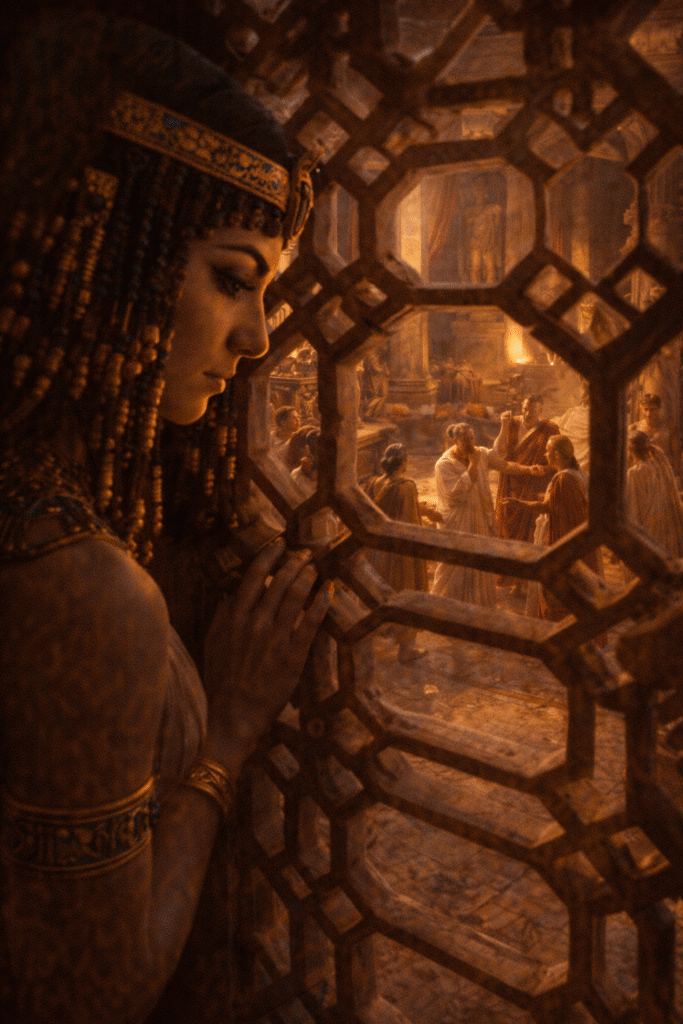
There was a lattice screen
at the edge of the balcony
above the hall.
It hid me perfectly.
They did not know
a girl stood above them.
Their mistake.
My education.
PART II — The Conversation That Bent My Future
Three men argued below:
- a Syrian merchant prince
who financed half the court’s luxuries - a Greek advisor
who believed Alexandria should imitate Athens - and an Egyptian noble
whose family had served pharaohs
long before our dynasty
They were powerful men
in a room where power
was usually hidden.
“Auletes is weak,”
the Syrian said.
“He bows to Rome,
and Rome takes more each year.”
“He must bow,”
the Greek advisor sneered.
“It’s the only way
to keep Cyprus safe.”
“And Egypt unsafe,”
the Egyptian shot back.
“You want a king,
not a Roman clerk.”
The Greek advisor laughed.
“This kingdom has no future
without Rome.”
“And no soul,”
the Egyptian replied.
Their argument
was not about my father.
It was about Egypt.
About what Egypt should be.
About whether it should survive
as itself
or as a client state
in a larger empire.
This was the first time I heard
the phrase that would haunt my life:
“Egypt cannot belong to itself anymore.”
I gripped the wooden lattice
so hard
my palms stung.
Below, they continued:
“The people,”
the Egyptian said,
“despise this Roman dependence.”
“The people,”
the Greek replied,
“despise whoever taxes them.”
The Syrian sighed.
“This land is too old
to be ruled by sentiment.
It must be ruled by strategy.”
Strategy.
The word
cracked through me
like flint.
Not strength.
Not lineage.
Not the gods.
Strategy.
A shape
formed in my mind then—
not yet a plan,
not yet ambition—
but a framework.
If kingdoms
were won by strategy,
then strategy
could be learned.
If power
was a conversation,
then power
could be overheard.
If Egypt
was being sliced
into pieces
by men who did not love her—
then I would become
someone who could stop them.
Below,
the Syrian’s voice lowered.
“And what of the young princesses?
The daughters?”
“Too young,”
said the Greek.
“Too female,”
the Syrian added.
“Too observant,”
the Egyptian murmured.
I froze.
He had noticed me
before I noticed him.
His eyes flicked upward
just once—
not enough to reveal me,
but enough to show
that he knew exactly
where I stood.
And he let me listen.
He did not call my name.
He did not expose me.
He allowed me
to hear Egypt’s crisis
through the mouths
of the men causing it.
That,
in its own way,
was an education.
When the argument ended,
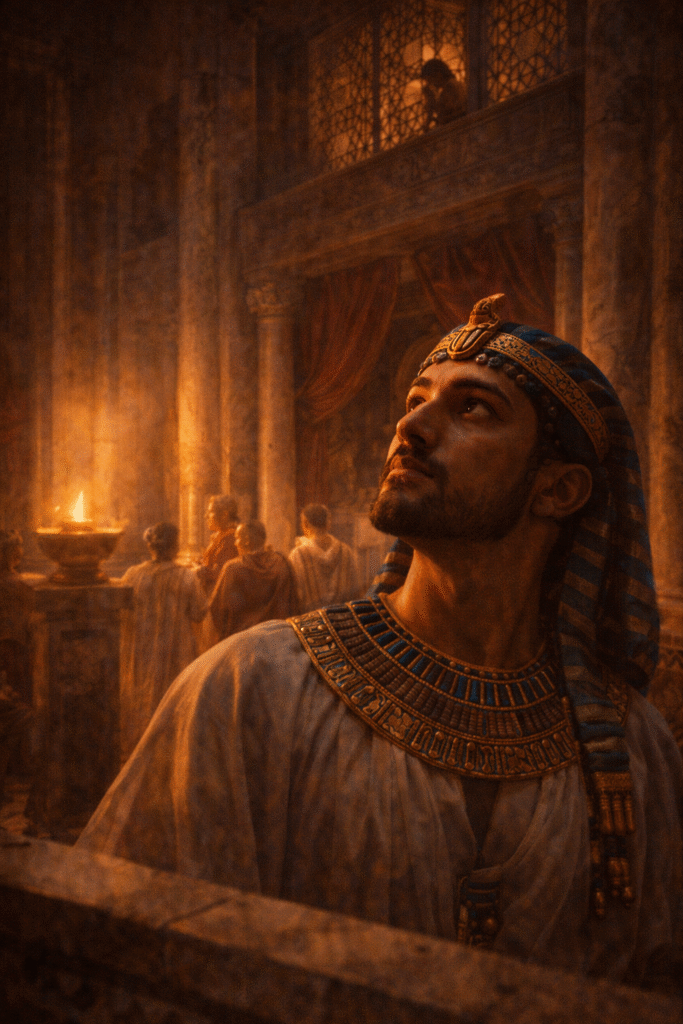
the Egyptian lingered.
He adjusted a scroll deliberately
and spoke softly
to the empty room:
“Alexandria hears more
than Rome believes.”
I knew then
he was speaking to me.
And that he expected
I would never forget it.
PART III — The Scholar Who Taught Me to Hear Motives
Later that day,
I went to the Musaion
to find the one man
who always answered
my questions plainly:
Philostratos.
A scholar
with a bent back
and a mind
sharp as obsidian.
I told him
what I had heard.
Not the names.
Just the words.
He rubbed his forehead.
“You learned more in one hour
than most princes learn in a decade.”
“I only listened,”
I said.
“That,” he nodded,
“is why they will fear you.”
He took a clean piece of papyrus
and drew a line.
“Here,” he said,
“is what people say.”
He drew another line beneath it.
“And here
is what they mean.”
I watched his hand.
“When a man says
‘Egypt must bow to Rome,’
he may mean
‘I want Roman gold.’”
Another line.
“When a man says
‘Egypt must stand alone,’
he may mean
‘I want the palace
to owe me more.’”
Another.
“When a man says
‘your father is weak,’
he may mean
‘I wish to replace him.’”
Philostratos put the reed down.
“The truth,” he said,
“is the space
between the lines.”
I leaned forward.
“How do I learn to hear that?”
He smiled.
“By practicing silence
until others fill it.”
The court
would teach me politics.
Philostratos
taught me psychology.
Egypt taught me purpose.
The combination
would one day
terrify Rome.
PART IV — The Woman Who Taught Me to Hear the Gods
Political listening
came from the palace.
Scientific listening
came from the scholars.
But spiritual listening—
that came from Philae.
After the dawn ritual
I described in Scroll II,
the high priestess of Isis
requested I return
each month.
She taught me
not doctrine,
but presence.
To stand before the altar
and hear
the difference
between sound
and meaning.
To hold silence
the way one holds breath
in deep water—
not as emptiness,
but as potential.
One night,
she placed her hands
on my ears gently.
“The world,”
she said,
“will speak to you
in noise.”
“Your task, daughter,
is to listen beneath it.”
“What will I hear there?”
I asked.
“The things
men try to hide.”
She was right.
Years later,
I would use
this training
to hear deceit
in Roman envoys,
fear
in my own court,
ambition
in Antony,
avoidance
in Caesar.
But first
I used it
to understand
my own family.
PART V — The First Time I Heard a Lie
My father
returned from Rome
with gifts
and terror
in equal measure.
At dinner
the night he arrived,
he raised a cup
and declared:
“Rome stands with Egypt!”
The courtiers cheered
like obedient actors.
I watched his face.
His smile
was not relief.
It was resignation.
He was lying.
Not out of malice.
Out of survival.
Later,
as servants cleared the table,
I approached him.
“Father,” I said.
“You are afraid.”
He froze.
In all my life
no one in the palace
had spoken to him that way.
He set the cup down.
“How did you hear that?”
he whispered.
“Because you hid it
behind joy.”
He sank into a chair.
“Cleopatra,” he whispered,
“never let Rome hear
what you just heard.”
“I won’t.”
He gripped my wrists.
“You must learn, daughter.
The ones who survive
are the ones who hear
the dagger
before they feel it.”
I did not fully understand then.
I would understand later.
[Suggested Visual: Cleopatra speaking quietly with her father by lamplight at a long table, plates half-cleared, a quiet tension between them.
AI Prompt: “Young Cleopatra VII sitting beside her father Ptolemy XII at lamplit dinner table, quiet private exchange, tension and sorrow, cinematic realism.”]
PART VI — The Spy Who Didn’t Know I Was Listening
Every palace
breathes secrets.
But spies believe
their breaths
are inaudible.
One afternoon,
walking through
the north wing,
I heard two attendants
whisper near a pillar.
“She listens,”
one muttered.
“She’s a child,”
the other scoffed.
“A child who knows too much.”
“Then why does the king
keep her near?”
“Because she reminds him
of what he lost
with Berenice.”
Silence.
Then:
“She will be dangerous
one day.”
I stepped away
before they could see me.
Dangerous.
The word
clung to me
like a prophecy.
Not because
I sought harm.
But because
Egypt needed
someone dangerous enough
to protect her—
dangerous
not in cruelty,
but in clarity.
A threat
to the ones who wished
to pillage us
quietly.
PART VII — The Night I Learned to Listen to Myself
Listening
was not only
for others.
Listening
was also
for my own mind.
One night,
unable to sleep,
I climbed the palace roof.
The sea was black glass.
The city pulsed below.
And something in me asked:
What will you become?
The growl of the harbor
did not answer.
The wind
did not answer.
But the silence
behind the wind did.
And it whispered:
What you choose.
Not prophecy.
Not destiny.
Choice.
I closed my eyes.
I listened
to the ache,
the ambition,
the love of Egypt
seeded in me
since childhood.
And for the first time,
I thought:
I will rule.
Not because I am royal.
Not because the gods choose me.
Not because Rome will approve.
Because I will know
more than any of them.
Because I will listen
more deeply
than any of them.
Because Egypt
deserves
someone who hears her.
PART VIII — How Listening Became My First Weapon
When I returned
to the court the next morning,
I saw everything differently.
When courtiers praised my father,
I heard
who hoped to gain.
When advisors criticized him,
I heard
who hoped to replace him.
When the Egyptian noble
met my gaze,
I heard
all the things he had not said aloud.
Listening
had become
pattern recognition.
Language
became map.
Silence
became compass.
And I realized
with an icy calm:
I could survive this palace.
I could survive this dynasty.
I could survive Rome.
Because I heard
what others refused to hear.
And knowledge
is its own army.
🌿 MID-SCROLL CTA — The Listener’s Path
If you’ve ever felt
the world underestimate you—
because of your age,
your gender,
your quietness—
Cleopatra’s early years
are your mirror.
Walk with ENA
through her Alexandria
where listening
became resistance,
and silence
became strategy.
Stand in the rooms
where she overheard
the first cracks
in her kingdom.
Trace the steps
of a girl
who learned to hear
the heart of Egypt
long before she ruled it.
Journey with ENA.
Sometimes the sharpest blade
is listening.
PART IX — The Day I Realized What the Court Truly Feared
It happened
two weeks later.
A gathering
in the Echo Hall—
voices bouncing
off marble
like thrown stones.
My father
had announced
he would travel again—
another Roman meeting.
The court erupted.
Arguments.
Threats.
Accusations.
I stood
in the doorway,
unseen.
A Greek lord hissed:
“She hears everything.”
A Syrian ambassador added:
“She remembers everything.”
An Egyptian noble said quietly:
“She understands.”
The hall fell
into a brief,
charged silence.
And then—
the Greek said something
that burned itself
into me:
“The girl
is more dangerous
than her father.”
They did not fear
my anger.
They did not fear
my alliances.
They did not fear
my bloodline.
They feared
my perception.
Because perception
cannot be bribed
or bought
or threatened.
Perception
is sovereignty.
That day,
they saw me.
And I saw
their fear.
It would not be
the last time.
Ancient Questioner’s Desk — The Listener’s Edition
A student asked:
“Was Cleopatra brilliant
even as a child?”
The elder replied:
“She listened.”
Another asked:
“What was her first weapon?”
The scribe wrote:
“Silence.”
A traveler wondered:
“How did she survive
so many enemies?”
The historian answered:
“She heard them
before they knew she was listening.”
A final question came:
“What made her dangerous?”
The old master smiled.
“She understood
what others merely spoke.”
FINAL CTA — Walk Into the Palace of Whispers
This Scroll ends here—
in the chambers,
courtyards,
and rooftop nights
where Cleopatra learned
to hear the truth
beneath the lies.
If you want to stand
in the places
where queens are forged
not by crowns
but by clarity—
ENA will take you there.
Walk the palace district
where whispers
shaped a destiny.
See Alexandria
not as a ruin
but as an intelligence.
Journey with ENA.
Every empire falls—
but the ones who listened
are remembered.
Historical Context
Ancient sources describe Cleopatra as highly educated and multilingual, trained in rhetoric, diplomacy, and statecraft. Her reputation for intelligence appears consistently in Roman accounts.
The specific formative moment described in this scroll is reconstructed to illustrate how such education translated into political instinct, rather than to record a single attested event.