
Scroll II – Daughter of the Two Lands
Alexandria, 55–60 BCE — The Palace, The Royal Nursery, The Temple of Isis, and the House of Scholars
Translated and restored for the modern traveler.
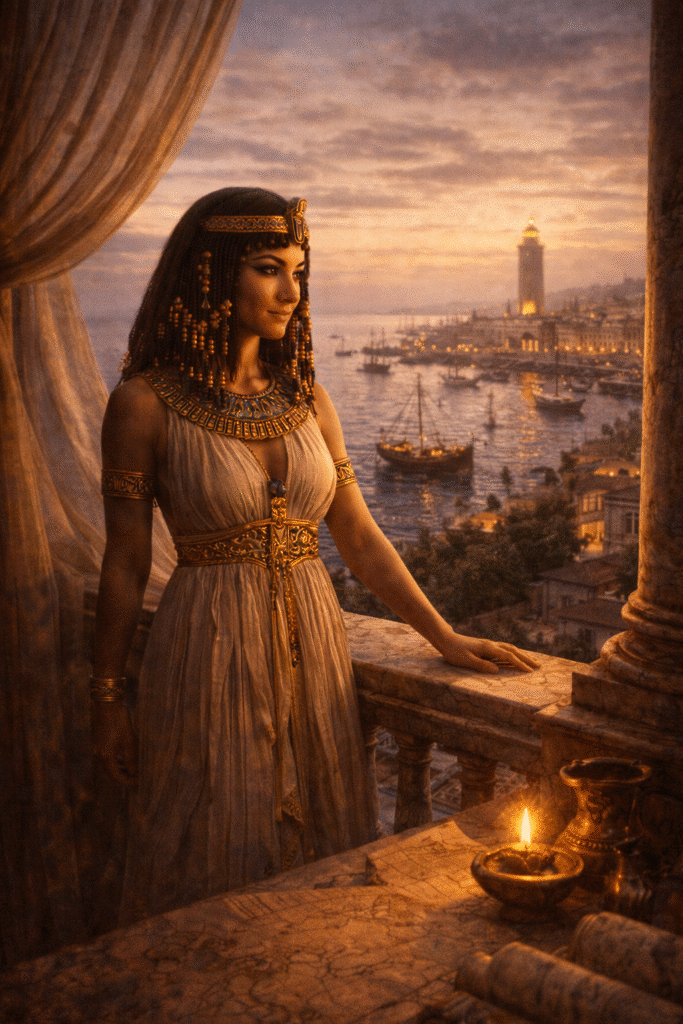
Prologue — Before They Saw Me, Egypt Saw Me First
Rome will insist
that I became someone
only when I entered their story.
That I was born the moment
Caesar looked at me,
or Antony held my hand.
They forget
I was already a daughter
of two ancient lands—
the Black Land and the Red,
the flood and the desert,
Upper and Lower Egypt,
the Two Lands
that had crowned kings
for three thousand years
before Rome even learned to write.
Before I learned Greek,
I learned the Nile.
Before I learned Latin,
I learned incense smoke
curling in the temple of Isis.
Before I ruled men,
I watched women
who knew the old gods
better than politics.
Egypt formed me
long before Rome claimed to understand me.
This Scroll
is not nostalgia.
It is foundation.
To understand why I fought so fiercely
to protect Egypt at the end,
you must see the Egypt
that raised me at the beginning.
PART I — The Palace That Was Not Egyptian
People imagine
my childhood palace
as a place of lotus ponds
and papyrus gardens
and painted columns.
They are thinking
of Thebes
or Memphis
or the temples of the old dynasties.
Alexandria was different.
Our palace
was marble.
Columns in the Greek style.
Fountains shaded by imported vines.
White walls
designed to impress Romans and Greeks—
not Egyptians.
Sometimes,
as a girl,
I found it insulting.
Egypt was not marble.
Egypt was sandstone and sun.
Egypt was the weight of monuments,
the deep scent of myrrh,
the pulse of the Nile.
But the Ptolemies
had been Macedonian imports
for nearly three centuries by then.
Half of my family
still pretended we were Greek.
The other half
forgot what we were entirely.
I stood in the middle of that lie.
A child born
in a palace that spoke Greek
on land that spoke Egyptian.
A child of two worlds
and of neither.
I learned early
that identity
could be political.
Later,
I learned to make it strategic.
PART II — My Father, the King Who Bowed Too Deeply
Ptolemy XII Auletes—
my father—
was a man
who played the flute
better than he ruled.
Rome called him “friend.”
He called them “protector.”
But the truth
was less noble.
He needed them.
He needed their gold
to keep his throne.
He needed their armies
to quiet his rivals.
He needed their attention
to survive his own court.
I loved him.
But I also watched him kneel
before Roman envoys
with a smile
that concealed trembling hands.
I watched senators
walk through our halls
as if inspecting a future purchase.
I watched my father
pay for their loyalty
with gifts
we could not afford.
I watched
and I learned:
Not all crowns are heavy.
Some are hollow.
One night,
I found him
in the Hall of Silver Lamps,
head in his hands.
“Father?” I whispered.
He wiped his eyes quickly.
“Cleopatra,” he said,
forcing a smile,
“you should be asleep.”
“I heard shouting.”
He sighed.
“The Romans want more money.”
“Do we have more money?”
He looked at me
with a sorrow that made him old.
“We never do,”
he whispered.
“Then why do we owe them?” I asked.
“Because, my daughter,”
he murmured,
“debt is the chain
they use to lead us.”
I never forgot that.
It was Rome’s first lesson to me—
and the one
I would spend my life
trying to break.
PART III — The Day I Learned Egypt Did Not Love Us Easily
One morning,
when the sun
was still pale over the harbor,
my nurse took me
beyond the palace walls.
“Should we be out here?” I asked.
“Today,” she said,
“you must see.”
We walked
through the alleys
behind the palace—
narrow streets
where fishermen mended nets
and women carried jars
from the fountain.
I had never seen
so many people so close together.
At first,
I thought they did not recognize me.
Then I realized
they recognized me too well.
Some bowed.
Some turned away.
Some glared
with a resentment
I did not yet understand.
“They do not like you,”
I whispered.
“They do not trust the palace,”
my nurse corrected.
“They do not trust the kings
who forgot the old ways.”
“But I was born here,”
I said.
“Why do they not see that?”
“Because the old kings
spoke the language of the Nile,”
she said gently.
“Your family speaks Greek.”
I fell silent.
She knelt to my height.
“But you, child—
you can change that.”
“How?”
“Learn their tongue.
Learn their gods.
Make Egypt feel
you belong to her.”
“And will she love me?” I asked.
“If you love her first.”
This was the moment
I decided
to become the kind of queen
Egypt would claim as her own.
Not out of rebellion
against my heritage.
Out of longing
for a home
that matched my blood.
I was nine years old.
But the decision
was clear.
I would be
Egyptian.
Not in name.
In truth.
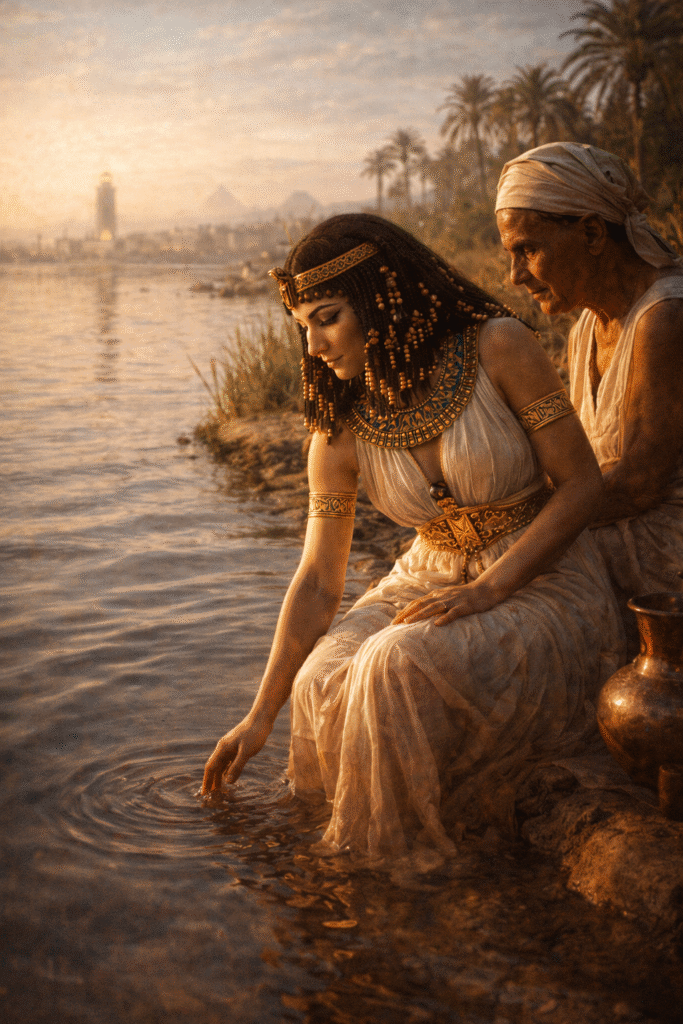
PART IV — The First Time I Heard My Name in Egyptian
Most of the palace
called me Kleopátra.
Sharp consonants.
Greek pride.
But one evening,
in the kitchens of the palace,
a cook dropped a bowl
and cursed softly:
“May the gods protect Neferu!”
I froze.
“What did you call me?”
I asked.
He turned pale.
“Forgive me, Majesty—
I meant no disrespect.”
“Say it again.”
“Neferu,” he whispered.
“Beautiful one.”
“But that is not my name.”
He shook his head.
“It is the name
the workers use.
When they speak kindly.
In Egyptian.”
Neferu.
Soft.
Warm.
Like honey and stone.
A name of the Nile.
A name
Egyptians gave
to women they admired.
It felt
more real
than my Greek one.
In that moment,
something in me rooted.
Not a rejection
of my heritage.
An expansion.
A choice
to be a queen
who belonged
to all her people.
Later scholars will say
I “used Egyptian identity
to gain political support.”
Maybe.
But the truth is simpler:
Egypt loved me
before I loved myself.
I answered.
PART V — The House of Scholars
If my father
feared Rome,
I feared ignorance.
The Musaion—
the great house of scholars—
was the closest thing
to temple and battlefield
combined.
I begged
to study there.
Women
were not forbidden
from learning—
but they were not encouraged,
either.
My tutor,
a stooped man
with ink on every finger,
brought me in secretly
at dawn.
He showed me:
Papyrus rolls
lined in cedar stands.
Astronomical charts
inked in blue and red.
Philosophers
arguing beneath colonnades.
Physicians grinding herbs.
Mathematicians
copying tables
written before Rome
was even a rumor.
“Everything here,”
he said,
“is older
than our dynasty.
Older than your father’s crown.
Older than the men
who think they can judge us.”
I devoured it all.
Within months,
I could speak:
Egyptian
Greek
Syriac
Aramaic
Latin
Medjay
Hebrew
and the traders’ dialect
spoken in Cyrene.
They will tell you
Cleopatra seduced men.
No.
Cleopatra seduced languages.
Words were kingdoms.
Speaking to a man
in his own tongue
was not seduction.
It was power.
And Rome never forgave me
for knowing theirs too well.
PART VI — The Sister Who Would Be Queen
You cannot understand me
without understanding her.
Berenice.
My elder sister.
Beautiful.
Proud.
Furious.
Brilliant.
And doomed.
She believed
our father
was weak.
She was right.
She believed
the people
hated his Roman debts.
She was right.
She believed
she could rule better.
She might have.
When my father fled Alexandria,
leaving chaos behind,
the city raised Berenice
as queen.
The priests accepted her.
The people cheered her.
For a brief moment,
Alexandria
belonged to an Egyptian woman.
But Rome
wanted our father back.
And so Berenice
was sentenced
not for being cruel,
or incompetent,
or corrupt—
but for being successful
in a way Rome did not approve.
When my father returned,
the Romans
took her head.
I remember
the night I learned
she was dead.
A servant whispered it.
My mother’s face
went white.
My father drank.
I could not breathe.
Berenice was not
a villain to me.
She was the warning
painted in blood:
Rome does not negotiate
with strong Egyptian women.
It removes them.
This truth
became the metal
in my spine.
🌿 MID-SCROLL CTA — For Travelers Who Want the Real Cleopatra
If you want Cleopatra
not as a myth or lover,
but as a girl who grew
between empires—
If you want to stand
in the places where she first
heard Egyptian names,
felt Egyptian sand,
studied Egyptian science—
If you want to see
the emotional foundations
of the last Pharaoh—
Walk this with ENA.
Alexandria was not
a backdrop for Romans.
It was a mind.
A world.
A girl learning
how to survive men
who wanted her throne
before she even grew into it.
Journey with ENA.
History is a house
built on childhood.
PART VII — The Day Egypt Chose Me First
I was twelve
when the priests of Isis
summoned my father.
A rare event.
They asked
for one of his daughters
to participate
in a dawn ritual
at Philae.
My father
offered Arsinoe.
The priests refused.
He offered another.
They refused again.
Finally,
hesitant,
he said my name.
The high priest
bowed.
“Her.”
It was not flattery.
Not politics.
Priests do not choose
to please kings.
They choose
when the gods
speak through patterns
they will never reveal.
That dawn,
wrapped in white linen,
I stood before the altar
while the sun
rose in red-gold bands
over the river.
The high priest
poured water
from a silver ewer.
“Daughter of the Two Lands,”
he said softly,
“your presence
aligns the balance.”
I shivered.
Not from cold.
From recognition.
I did not yet know
what would happen in my life—
exile,
return,
Roman war,
love,
loss,
triumph,
end—
but I knew this:
Egypt had seen me.
Before Rome ever would.
PART VIII — The Lesson on the Terrace
One evening,
I climbed to the palace roof
where the city
looked like a mosaic
of lanterns and voices.
My father stood there
alone.
“Cleopatra,” he said
without turning.
“Yes, Father?”
“You will rule one day.”
The words
hit me harder
than any prophecy.
“Not alone,” he added.
“You will share the throne
with a brother,
as tradition demands.”
I nodded.
“But know this,” he said,
his voice strangely steady:
“Men will think
they are saving you
when they push you aside.
Women will think
they envy you.
And Rome—”
He stopped.
Looked at the dark horizon.
“Rome,” he whispered,
“will think
you are theirs to shape.”
He turned to me.
“Do not let them.”
I swallowed.
“How?”
He placed his hand
over my heart.
“Begin here,” he said.
“Belong to your people.
Learn them.
Serve them.
Then—
when everyone tries
to take you—
you will not be lost.”
That night,
I stood alone
under the Alexandrian stars
and promised myself:
I will not be
my father.
I will not be
my sister.
I will be
mine.
And Egypt’s.
PART IX — The Moment Childhood Ended
My childhood ended
not with war
or prophecy
or a coronation.
It ended
on a quiet afternoon
in the women’s quarters.
A servant
knelt before my mother
with a scroll in hand.
She read it.
Her face turned stone.
My father
was leaving again.
For Rome.
Again.
The city
was already restless.
The treasury
nearly empty.
The grain shortage
spreading.
When she left the room,
I took the scroll
and read it myself.
I was thirteen.
In that single page,
I understood:
If Egypt was to survive,
it would not be
because my father returned
stronger.
It would be
because I grew
faster.
I folded the scroll
and placed it under my pillow.
That night,
I slept
with duty beside me.
When I woke,
I was still a child.
But one
who knew the cost
of not becoming more.
Ancient Questioner’s Desk — The Origin Edition
A student asked:
“Was Cleopatra Egyptian
or Greek?”
The elder replied:
“She was both—
and more.”
Another asked:
“Did Egypt choose her
or did she choose Egypt?”
The historian wrote:
“Yes.”
A traveler wondered:
“Why did the people
love her?”
The scribe answered:
“Because she spoke
their language
before she wore
their crown.”
A final question came:
“Was she destined
to be queen?”
The old master smiled.
“She was destined
to choose it.”
FINAL CTA — Walk the First Steps of Her Becoming
This Scroll ends here—
in the palace,
the alleyways,
the temple halls,
the scholarly rooms
where a girl became
a ruler.
If you want to feel
the Alexandria
that birthed the last Pharaoh—
not the ruins,
but the living city—
come walk it with ENA.
Stand where she stood
between worlds.
Hear the languages
she learned.
See the childhood
that shaped
a queen who would fight
an empire.
Journey with ENA.
Every last dawn
begins with an early light.
Historical Context
Cleopatra deliberately presented herself as both a Hellenistic monarch and a traditional Egyptian ruler. She adopted Egyptian royal titles and associated herself with the goddess Isis, while also ruling within Greek political frameworks.
The symbolic language in this scroll reflects known royal ideology rather than a documented personal declaration.