Luxor Temple Guide (2026): What to See, Best Time to Visit & Planning Tips
Luxor Temple deserves its own visit even if you have already spent hours at Karnak. The two were connected in antiquity, but they were built for different purposes and feel completely different on the ground. Karnak is enormous, layered, and sprawling. Luxor Temple is more compact, easier to read architecturally, embedded directly in the modern city, and unusually atmospheric after sunset.
Its importance also lies in movement. The temple was closely connected with the Opet Festival, when the sacred images of Amun, Mut, and Khonsu traveled from Karnak to Luxor. The building’s unusual orientation toward Karnak reflects that relationship, and the restored Avenue of Sphinxes still traces the processional connection between them. Egypt’s Ministry of Tourism and Antiquities identifies Luxor Temple—known to the ancient Egyptians as Ipet-resyt, the “Southern Sanctuary”—as the destination of this major religious procession.
For most visitors, 90 minutes is enough for a strong first visit, while two hours gives you time to slow down through the colonnade, examine the Roman and later religious layers, and photograph the temple as daylight fades. If your itinerary allows it, arrive in the late afternoon and stay into the evening. Unlike the exposed West Bank sites, Luxor Temple is one of the few major archaeological sites in Luxor where visiting later can actually improve the experience.
Expert Insight: If Karnak shows the monumental power of Amun’s great sanctuary, Luxor Temple shows how ritual, kingship, procession, and the living city connected. Do not visit it expecting a smaller version of Karnak.
Quick Planning
| Planning point | Best default |
|---|---|
| Time needed | 1.5–2 hours |
| Best time | Late afternoon into evening |
| Setting | Central Luxor, East Bank |
| Walking | Moderate |
| Shade | Limited in the open courts; more cover among columns |
| Guide value | Moderate to high |
| Best pairing | Karnak Temple |
| Avenue of Sphinxes | Worth seeing; full walk is optional |
| Photography | Particularly strong around dusk and after dark |
The Ministry of Tourism and Antiquities current Luxor Temple page does not display usable opening-hour information, while recent 2026 visitor-planning sources commonly report evening opening, often until around 9:00 or 10:00 PM depending on season. Confirm closing time locally on the day if you are specifically planning a night visit.
Why Visit Luxor Temple If You’ve Already Seen Karnak?
Because the comparison is useful only up to a point.
Karnak grew into an enormous religious complex through centuries of royal additions. Its scale can be difficult to absorb in a single visit, and much of the experience is about understanding how one king built around, through, or beyond another.
Luxor Temple is more concentrated.
Its surviving core was built largely under Amenhotep III, with major additions by Ramesses II. The architectural sequence is therefore easier to follow. You move from Ramesses II’s monumental entrance and court into the great colonnade and the older Amenhotep III sections beyond.
There is also a fundamental difference in ritual role. The temple was not simply another sanctuary duplicating Karnak. Its orientation toward Karnak and its place in the Opet Festival tied it to the renewal of divine and royal power.
UNESCO treats both monuments as central elements of Ancient Thebes, but even its description distinguishes Amenhotep III’s Luxor Temple as one of the refined masterpieces of New Kingdom architecture rather than simply an extension of Karnak.
If you have only enough time for one East Bank temple, Karnak takes priority for scale and historical range. If you have enough time for both—and most Luxor itineraries should—Luxor Temple adds something Karnak cannot.
Ramesses II Controls the First Impression
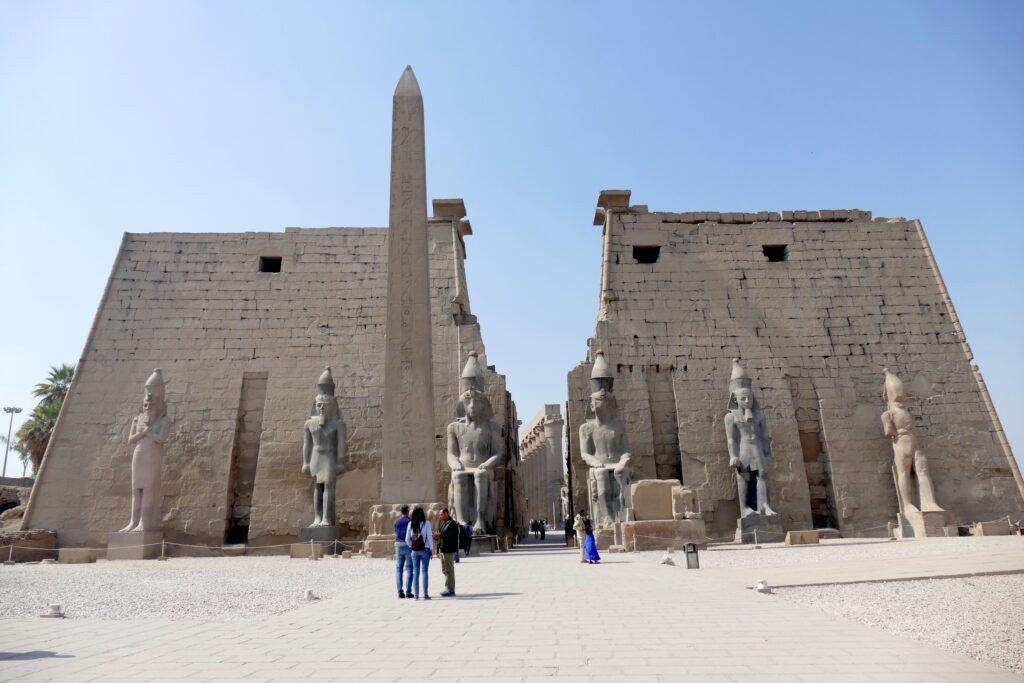
The entrance you see today is largely the work of Ramesses II.
His huge pylon creates the northern entrance, and monumental statues of the king reinforce the political message immediately. In antiquity, two obelisks also stood in front of this façade. Only one remains in Luxor today.
The other has stood in Place de la Concorde in Paris since the nineteenth century. Egypt’s Ministry notes that the pair originally stood approximately 25 meters high and that the second obelisk has been in Paris since 1836.
Do not rush through this entrance because you have already seen colossal statues elsewhere in Egypt.
Stand back far enough to read the ensemble: pylon, seated royal figures, standing statues, obelisk, and the processional approach from the Avenue of Sphinxes. This is not a collection of independent monuments. It is a carefully staged royal entrance.
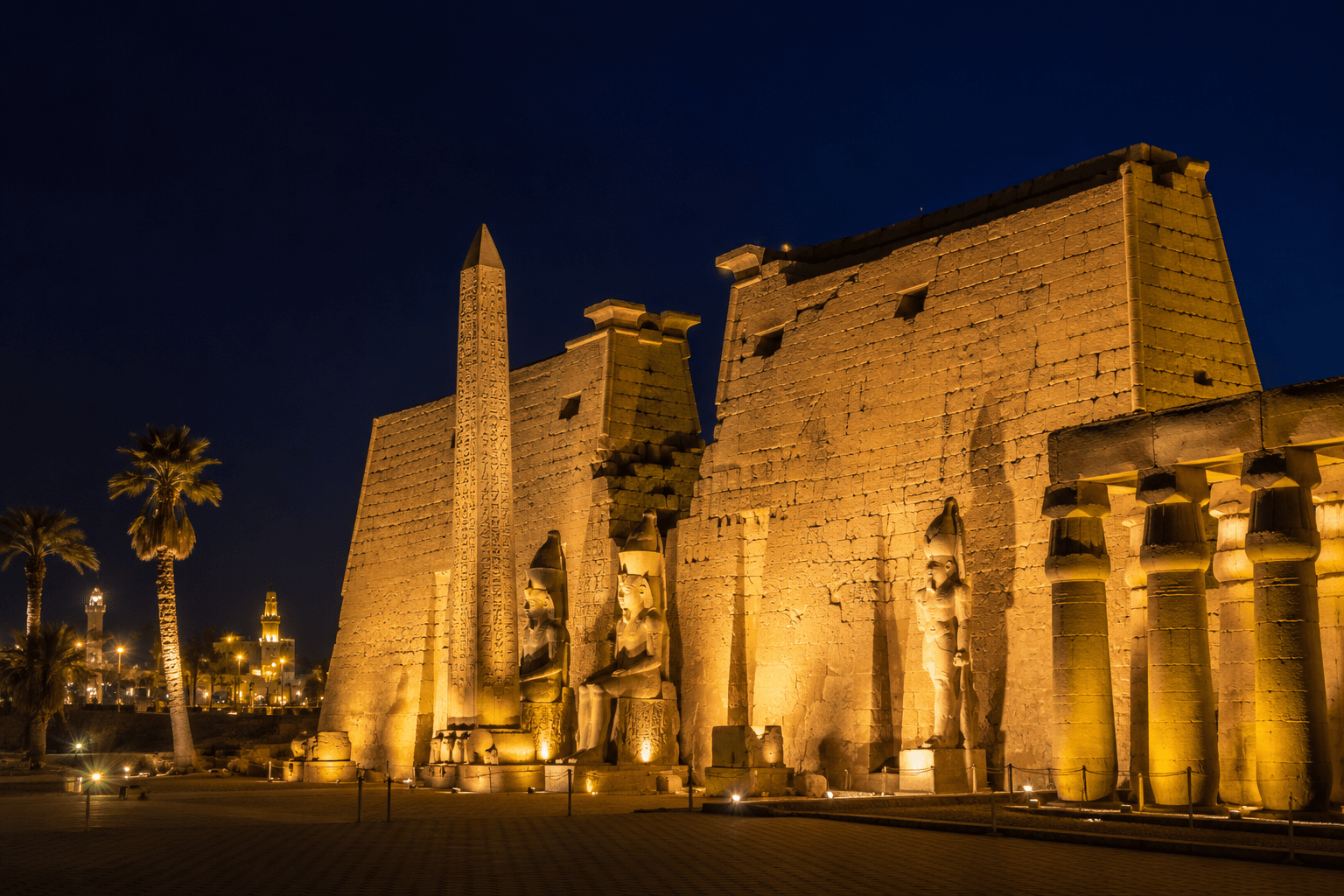
The lighting becomes particularly effective around dusk, when the obelisk and statues begin to separate visually from the massive pylon behind them.
The Great Court Is More Layered Than It First Appears
Beyond the pylon lies Ramesses II’s Great Court, surrounded by columns and monumental royal statues. But the courtyard also reveals something unusual about Luxor Temple: the ancient complex remained embedded within the living city long after the pharaonic period ended.
The Mosque of Abu al-Haggag, built centuries later, still stands above part of the ancient temple. Its elevated position reflects how deeply the ancient ruins had become buried beneath centuries of accumulated settlement before archaeological clearance exposed the original temple level.
The mosque is one visible reminder that Luxor Temple continued to be reused long after the pharaohs—but it is only one chapter in that much longer story.
Then later, when the visitor reaches the relevant area, give Christianity the full treatment:
Look for Luxor Temple’s Christian Past
One of the easiest layers of Luxor Temple to overlook has nothing to do with the pharaohs.
During Egypt’s Christian period, parts of the ancient temple complex were reused for Christian worship, and several churches were established within or around the ancient monument. Rather than abandoning the enormous structures left by earlier civilizations, later communities adapted portions of them for new purposes.
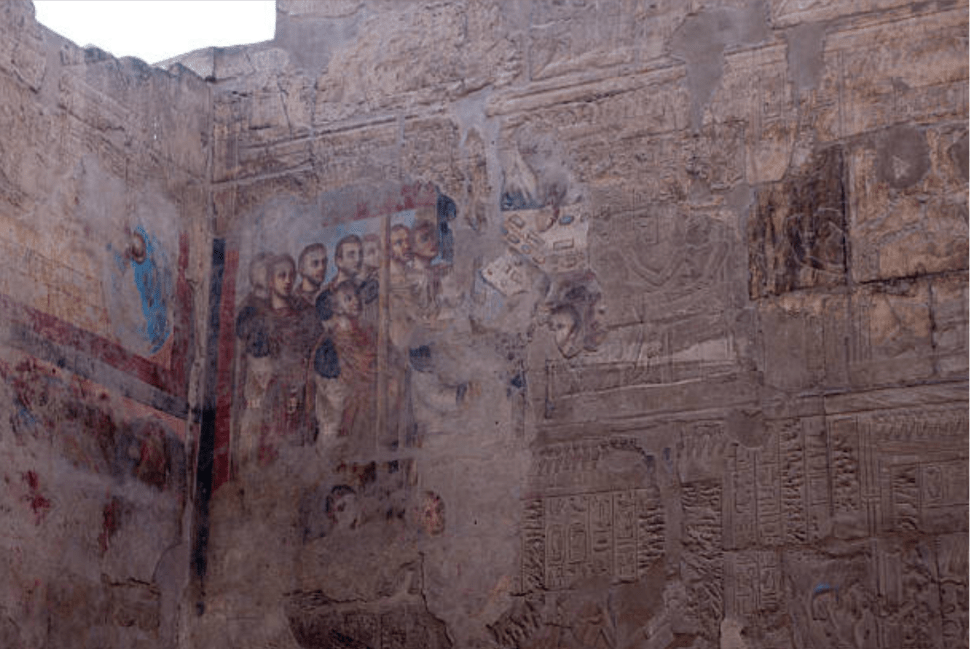
Some of the most interesting evidence survives deeper inside Luxor Temple, in an area that had already undergone another transformation under Roman rule. The Romans altered part of the temple for imperial use, including what is often called the Roman Imperial Cult Chamber. Later Christian use left another layer behind, including surviving traces of Christian-period painted and plastered decoration.
This creates an extraordinary sequence within the same monument. Ancient Egyptian religious spaces were altered during the Roman period and subsequently reused in Christian Egypt. Centuries later, the Mosque of Abu al-Haggag became another part of the site’s continuing history.
Expert Insight: Don’t focus only on the hieroglyphs as you move through Luxor Temple. Look for places where later plaster, paintings, architectural changes, or reused spaces interrupt the pharaonic decoration. They reveal a side of Luxor Temple that visitors concentrating exclusively on ancient Egypt can easily miss.
Amenhotep III Built the Core of the Temple
Once you move beyond Ramesses II’s additions, the building becomes increasingly associated with Amenhotep III, one of the most important rulers of Egypt’s Eighteenth Dynasty.
The Ministry identifies him as the builder of the temple’s principal surviving core, including the court and major architectural spaces toward the southern end of the complex.
This is important because visitors often leave Luxor remembering only Ramesses II.
His statues dominate the entrance, but architecturally the temple owes a great deal to Amenhotep III.
The difference becomes clearer as you move through the monument. Ramesses II’s court has a forceful monumental character; the Amenhotep III sections beyond feel more ordered and internally coherent.
One of the temple’s significant themes is also Amenhotep III’s divine legitimacy. Rooms in the inner temple preserve scenes associated with his Divine Birth, presenting the king as the son of Amun-Ra. The Ministry explicitly identifies these scenes as part of the theological program of the temple.
That political use of divine parentage is worth remembering if you have also visited Hatshepsut’s mortuary temple. Her famous divine-birth scenes at Deir el-Bahari use related royal theology for a different ruler in a different setting.
The Great Colonnade Is Luxor Temple’s Architectural High Point
The Great Colonnade forms one of the most impressive transitions within Luxor Temple.
Amenhotep III constructed it as two rows of seven colossal columns. The decoration was completed later, particularly under Tutankhamun and Horemheb.
This is where slowing down pays off.
The walls preserve scenes connected with the Opet Festival, the ritual that explains much of Luxor Temple’s relationship with Karnak. Instead of treating those scenes as decorative background, think about what they show: divine images, priests, royal participation, boats, music, and movement through the city.
The temple was not waiting passively for worshippers to arrive. During the festival, sacred images came here from Karnak.
That changes the meaning of the Avenue of Sphinxes as well. It was not built simply as a grand boulevard between two impressive monuments. It was a ceremonial route activated by ritual.
Guide’s Note: If your guide has limited time to explain only one set of reliefs here, ask about the Opet scenes. They explain why Luxor Temple exists where it does and why its relationship with Karnak matters.
Amenhotep III’s Court Rewards a Slower Look
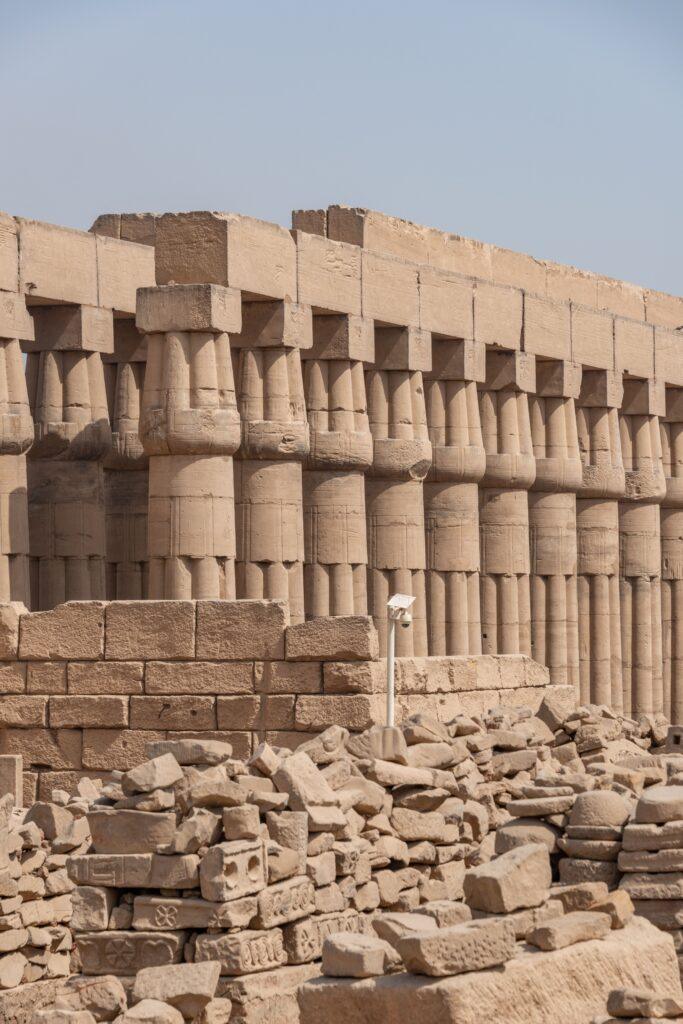
Past the colonnade, Amenhotep III’s court feels more enclosed and rhythmic than the broad entrance created by Ramesses II.
Repeated columns surround the space, creating strong symmetry and one of the temple’s best photography areas.
Daylight is useful here because it reveals carved detail more evenly. Near sunset, however, angled light catches the column shafts and creates much stronger contrast.
This is one reason a late-afternoon visit works so well. You can see the temple both as archaeology and as architecture under changing light.
At night, artificial illumination emphasizes the depth between the columns and makes the court feel considerably different again.
You do not need to choose between “day” and “night” if you time the visit properly. Arrive before sunset and experience both.
Luxor Temple’s Later History Is Not a Footnote
Many Egyptian temples contain later additions.
Luxor Temple contains later reuse on a scale that changes how the visitor should interpret the entire place.
During the Roman period, a fort developed around the temple. A chamber within the Amenhotep III section was converted into a space associated with the Roman imperial cult, and pharaonic reliefs were covered with plaster and Roman-style paintings depicting Emperor Diocletian and his fellow tetrarchs. The Ministry describes these Roman-period alterations directly in its official site history.
Experience Egypt also notes that the temple became a Roman military camp under Diocletian and that surviving paintings from this phase have undergone restoration.
Later, parts of the site were used by Christians.
Still later, the Mosque of Abu al-Haggag became part of the complex and remains an active religious building.
These layers are one of the strongest reasons Luxor Temple deserves its own article and its own visit. Karnak communicates scale and long-term temple construction. Luxor Temple communicates continuity of urban and religious occupation with unusual clarity.
The Avenue of Sphinxes Makes the Karnak Connection Physical
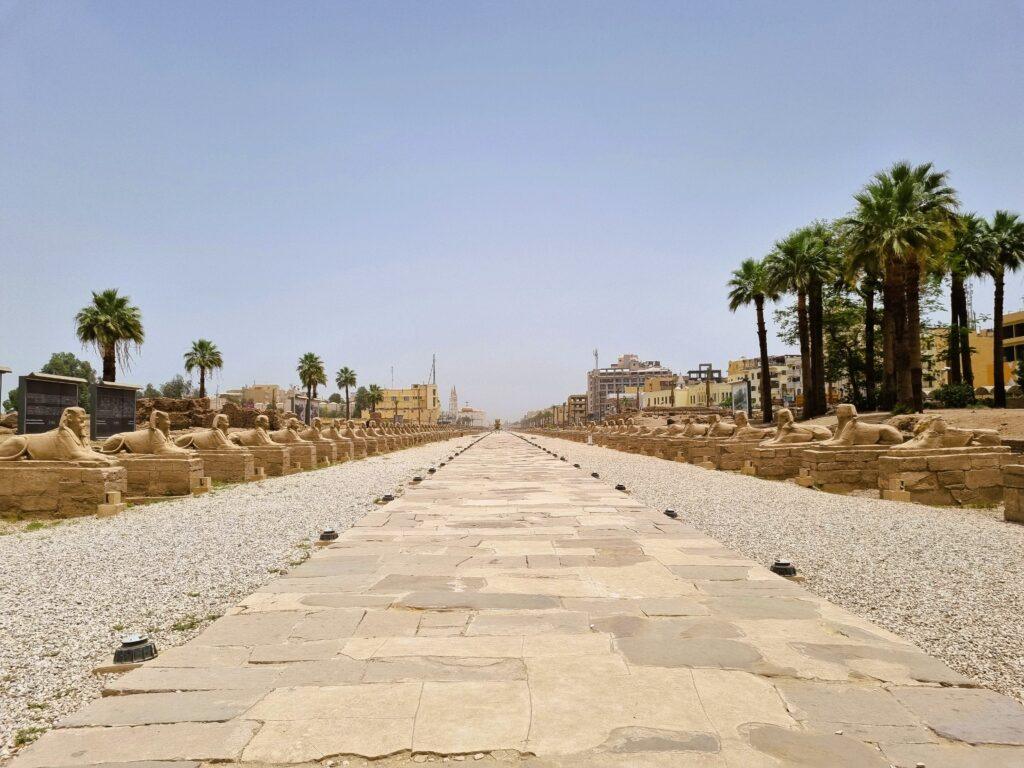
The restored Avenue of Sphinxes extends for roughly 2.7 kilometers between Luxor Temple and Karnak.
Egypt’s Ministry describes it as an ancient processional route constructed and modified by rulers between the Eighteenth and Thirtieth Dynasties. Archaeological work on the avenue continued for decades before its modern restoration and reopening.
The avenue is particularly useful because maps can make the relationship between the temples seem abstract.
Stand at Luxor Temple and look north along the processional route. Karnak is no longer simply another archaeological attraction somewhere else in the city. You can understand how sacred movement tied the two places together.
The modern avenue includes different styles of sphinx sculpture along its length, reflecting various phases of construction rather than a single unified building campaign.
This is another reminder that ancient Thebes was not static.
Should You Walk the Entire Avenue of Sphinxes?
Only if the walk itself interests you.
The approximately 2.7-kilometer route is manageable for a reasonably fit traveler in comfortable weather, but it should not automatically become part of every Luxor itinerary.
Walking it after spending two or three hours at Karnak in July is a poor use of energy.
If temperatures are comfortable, the route offers something unusual: you can physically retrace part of the ceremonial connection between the two temples instead of moving between them by vehicle.
If history rather than exercise is the priority, walking a shorter section near Luxor Temple is enough to understand the avenue.
This is especially true if you still have West Bank archaeology planned the following morning. Luxor days accumulate walking quickly, and conserving energy matters more than proving you walked the full ancient road.
Luxor Temple Is One of the Rare Egyptian Sites I Prefer Near Sunset
Early morning is the strongest default at most exposed archaeological sites in Upper Egypt.
Luxor Temple is different.
Its central location, comparatively manageable size, and evening illumination make late afternoon into night the better choice for most travelers.
Arrive roughly an hour before sunset. You will have enough daylight to see carved details and understand the architecture before the light begins changing.
Then stay.
As darkness develops, the pylons, columns, obelisk, and statues are illuminated against the night sky. UNESCO’s own World Heritage gallery prominently features Luxor Temple photographed at night, reflecting how strongly the monument’s nighttime appearance has become associated with the visitor experience.
Recent visitor-planning sources continue to recommend arriving before dusk and remaining until the artificial lighting comes on.
That recommendation is not simply about prettier photographs.
During the hotter months, evening also removes the physical pressure of standing in Luxor’s intense midday sun.
Daytime or Evening: Which Is Better?
If you must choose, choose late afternoon and stay after dark.
Pure daylight gives you the clearest view of relief detail. It is particularly useful for travelers with a serious interest in inscriptions, architectural phases, or photography that requires accurate surface detail.
Night gives the temple atmosphere.
The city remains active immediately outside the ancient walls, while warm illumination isolates statues and columns against the dark. Luxor Temple does not feel detached from modern Luxor at night; it feels embedded within it.
The ideal visit therefore crosses both conditions.
Karnak deserves the cool early morning.
Luxor Temple deserves the transition into evening.
That distinction also prevents the two temples from becoming repetitive during a single East Bank day.
How Long Do You Need?
Allow 90 minutes for a first visit.
That is enough to see the Ramesses II entrance, Great Court, colonnade, Amenhotep III court, inner sections, Roman layers, and part of the Avenue of Sphinxes without rushing.
Two hours is better if you have an Egyptologist explaining the reliefs, want to photograph sunset and night conditions, or are interested in the later Roman and religious phases.
A one-hour visit is possible but turns the temple into a sequence of headline features.
Three hours is unnecessary for most travelers unless you are combining detailed archaeological study with a long photography session or walking a substantial portion of the Avenue of Sphinxes.
Heat, Shade and Walking Are Easier Than Karnak—But Still Matter
Luxor Temple is considerably more compact than Karnak.
UNESCO’s mapped World Heritage component for Luxor Temple covers about 4.75 hectares, compared with nearly 70 hectares for the Karnak component. That does not correspond directly to the exact area a tourist walks, but it gives a useful sense of the difference in scale.
You should still expect uneven archaeological surfaces and prolonged standing.
The Great Court and other open areas have limited shade, while columns and internal sections provide intermittent relief.
In winter, daytime walking is generally comfortable.
In summer, the central issue is not whether the temple can technically be visited at midday. It can. The question is why you would choose that slot when the site remains accessible later and becomes more atmospheric as temperatures fall.
Save the hardest early-morning logistics for sites that actually need them.
Is a Guide Worth Having Here?
A guide is useful, but Luxor Temple is easier to understand independently than Karnak.
The overall path is relatively clear. Visitors can move naturally from Ramesses II’s entrance toward Amenhotep III’s inner temple without becoming lost in an enormous complex.
The value of an Egyptologist lies instead in interpretation.
A good guide can explain why the temple faces Karnak, identify the Opet Festival scenes, separate Amenhotep III’s work from Ramesses II’s additions, explain the Roman imperial paintings, and make sense of the mosque sitting far above the ancient floor.
Without that context, many visitors notice the layers but do not understand why they are there.
If you are paying for guided time on only one East Bank site, I would give Karnak slightly higher priority because it is harder to read independently. But a guide who accompanies you through both sites creates a much stronger combined story.
The Best Way to Combine Karnak and Luxor Temple
Do not visit them back-to-back at midday simply because they are both on the East Bank.
A stronger day is:
Visit Karnak early, while temperatures are lower and the Hypostyle Hall has fewer tour groups.
Then leave the archaeology for several hours.
Have lunch, rest, return to your hotel or cruise, or visit a museum if you still want something indoors.
Visit Luxor Temple in the late afternoon, ideally remaining after sunset.
This gives each monument the conditions in which it works best.
Our Karnak Temple Guide explains why that complex deserves two to three hours and what to prioritize beyond the famous Hypostyle Hall.
The eventual Luxor Travel Guide should be used for the larger itinerary decision: how to divide East Bank and West Bank archaeology without turning every day into an endurance test.
Expert Tip: Seeing Karnak and Luxor Temple on the same calendar day does not mean they need to be visited consecutively. A midday break is one of the simplest ways to improve a Luxor itinerary.
How Luxor Temple Fits With the West Bank
Luxor Temple should not be combined with every major West Bank site simply because the distances around Luxor look manageable.
The Valley of the Kings works best early because tomb entrances, exposed pathways, and West Bank heat become harder later in the morning.
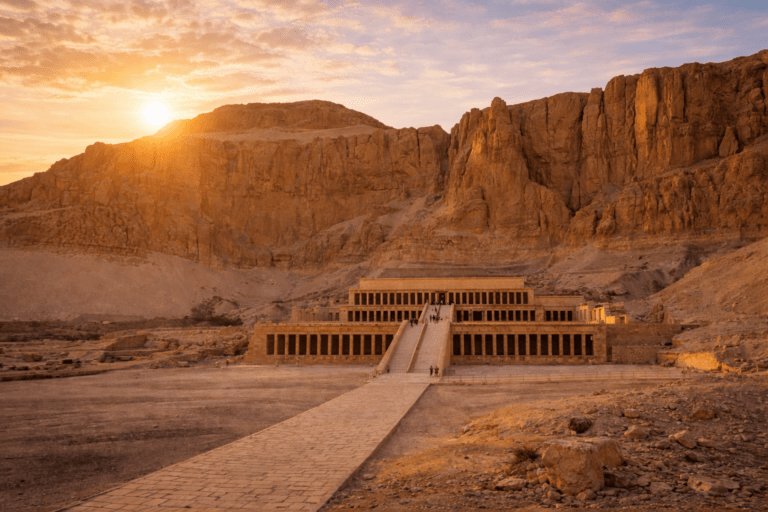
Hatshepsut Temple has a similar problem because the limestone cliffs behind Deir el-Bahari reflect heat across its terraces.
Those sites therefore compete for the cool hours.
Luxor Temple does not.
This makes it an excellent evening counterpart to a West Bank morning. A traveler could visit the Valley of the Kings and Hatshepsut Temple early, rest through the middle of the afternoon, then visit Luxor Temple near sunset without the day feeling geographically illogical.
Our Valley of the Kings Guide and Hatshepsut Temple Guide cover those sites independently because their planning problems are very different from Luxor Temple’s.
What First-Time Visitors Commonly Get Wrong
The most common mistake is assuming Luxor Temple is optional because Karnak is larger.
Size is not the reason to visit it.
Another mistake is visiting both temples during the same hot late-morning block, when fatigue makes Luxor Temple feel like “more columns” rather than a distinct monument.
Travelers also frequently photograph the Abu al-Haggag Mosque without understanding why it appears to float above the ancient court. Once you recognize that the surrounding medieval city accumulated above the buried pharaonic temple, its strange elevation becomes one of the site’s most useful historical clues.
Finally, do not stop at the Ramesses II façade. The entrance is spectacular, but the Amenhotep III core, Opet reliefs, Roman reuse, and later religious layers are what distinguish Luxor Temple from a dozen other monumental Egyptian façades.
Frequently Asked Questions
Is Luxor Temple worth visiting after Karnak?
Yes, because it offers a different experience rather than a smaller version of Karnak. Karnak is a vast temple complex accumulated over many reigns; Luxor Temple is more compact, strongly associated with Amenhotep III and Ramesses II, tied directly to the Opet Festival, and preserves unusually visible Roman, Christian, and Islamic layers.
How long should I spend at Luxor Temple?
Allow 90 minutes to two hours. Ninety minutes covers the main monument comfortably, while two hours gives you time for historical explanation, photography, and the transition from daylight into evening. Travelers walking a substantial section of the Avenue of Sphinxes should allow additional time.
What are Luxor Temple’s opening hours?
The Ministry’s current Luxor Temple page provides ticket prices but does not presently display usable opening-hour data. Recent 2026 visitor sources commonly report opening from around 6:00 AM with evening closing around 9:00 or 10:00 PM depending on season. Because evening access is central to planning this particular site, confirm the current closing time locally before structuring your visit around sunset.
Is Luxor Temple better during the day or at night?
Late afternoon into night gives the strongest overall experience. Daylight is better for reading reliefs and seeing architectural details, while the illuminated temple after dark has a noticeably stronger atmosphere. Arriving before sunset lets you experience both without buying a second visit.
What happened to the second Luxor Temple obelisk?
Ramesses II originally erected two obelisks in front of the temple. One remains in Luxor; the other has stood in Place de la Concorde in Paris since 1836.
Can you walk from Luxor Temple to Karnak?
The restored Avenue of Sphinxes runs roughly 2.7 kilometers between the two temple areas. Walking it can be worthwhile in comfortable weather, but the full route is optional. During the hottest months, taking transport between Karnak and Luxor Temple and walking only a shorter section of the avenue is usually the better decision.
Why is there a mosque inside Luxor Temple?
The Mosque of Abu al-Haggag was built when much of the ancient temple had been buried beneath centuries of accumulated urban material. Later archaeological clearance exposed the much lower pharaonic floor, leaving the mosque visibly elevated within the ancient complex. Its presence reflects the site’s continued religious and urban use long after the pharaonic period.
Was Luxor Temple used by the Romans?
Yes. The Romans established a military presence around the temple, and a chamber inside the monument was adapted for the imperial cult. Ancient Egyptian reliefs were plastered over and Roman-style paintings associated with Diocletian and the Tetrarchy were added.
Should I visit Karnak and Luxor Temple on the same day?
They make an excellent same-day pairing, but do not assume they should be visited consecutively. Karnak is strongest early in the morning; Luxor Temple is particularly effective in late afternoon and after dark. Separating them with a midday break gives each site better conditions and reduces temple fatigue.
The mistake is treating Luxor Temple as the smaller attraction you squeeze in after Karnak. It works best when you give it a different role: Karnak in the cool morning, a break during the hottest hours, then Luxor Temple as the city moves toward evening and its obelisk, statues, courts, and colonnade begin to glow under artificial light. Explore ENA’s Luxor tours and Egypt itineraries to sequence the East Bank around how these sites actually feel on the ground, rather than simply placing two temple names beside each other on an itinerary.