
Scroll XII – When Rome’s War Reached Egypt
Pelusium → Alexandria, 48 BCE — Pompey’s Arrival, Caesar’s Pursuit, and the Destinies That Collide
Translated and restored for the modern traveler.
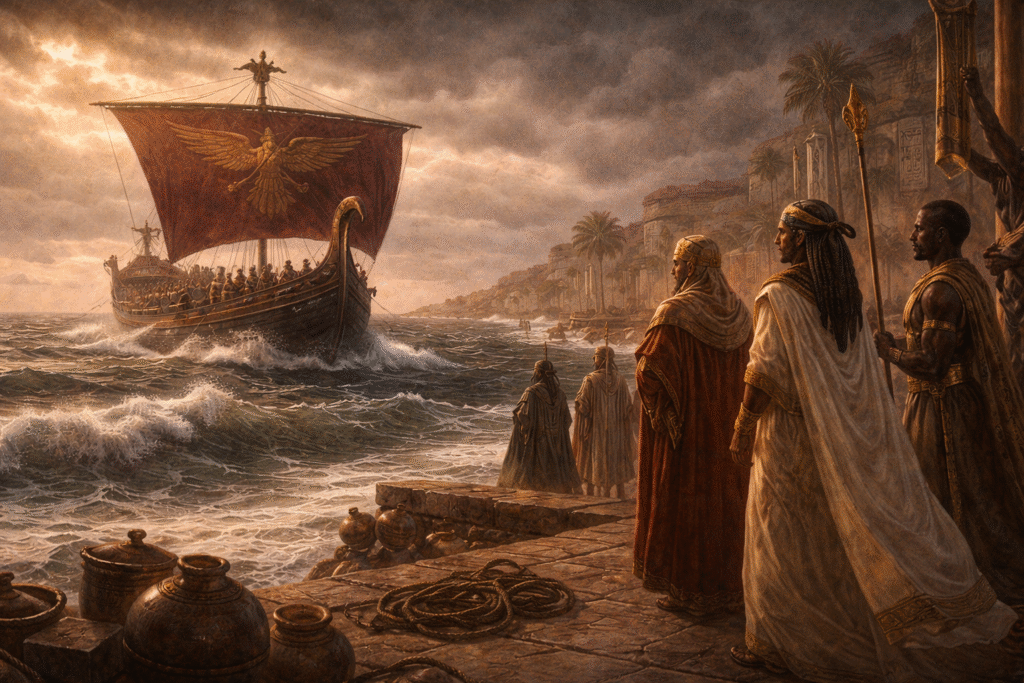
Prologue — Empires Do Not Knock. They Arrive.
We had prepared
for conflict with my brother.
We had prepared
for a return to Alexandria.
We had prepared
for a restoration.
We had not prepared
for Rome
to bring its civil war
to Egypt’s doorstep.
Yet one morning
the desert winds shifted,
and whispers arrived
from the north:
“Pompey is coming.”
Pompey the Great.
Conqueror of kings.
Master of legions.
Once the most powerful man
in Rome.
Now a fugitive
with a shattered fleet
and Caesar
at his heels.
Egypt
became the meeting place
of giants—
and I
was caught
between their shadows.
But shadows
do not terrify
those who know
how to walk toward light.
This Scroll
is how fate
stepped toward me.
PART I — The Messenger Who Rode Through the Night
I received the first warning
in Syria.
A messenger
arrived before dawn,
covered in dust,
breathless.
He bowed, trembling.
“Majesty—
Pompey has fled to Egypt.”
My blood
stilled.
Pompey,
seeking refuge
from his rival
Julius Caesar.
And where did he choose?
Alexandria.
My city.
My throne.
My brother’s trap.
“What of Caesar?” I asked.
“He follows.
He is days behind.”
The tent
felt suddenly
too small.
Rome’s two greatest men
were converging
on my kingdom.
My attendant whispered:
“This is… opportunity.”
I nodded.
“And danger,”
I said.
“Equal in measure.”
PART II — The Debate in the Syrian Council
My commanders gathered
hours later.
Maps unfurled.
Torches burned.
“We must move now!”
one mercenary argued.
“Arrive before Caesar.
Offer him your allegiance—
Egypt will be yours.”
Another countered:
“No.
Pompey is the senior Roman.
Aid him,
and he will restore you
after he regains Rome.”
A Nabatean scout leaned forward.
“Choose Pompey or Caesar—
and Egypt becomes
a Roman prize.”
They were all wrong.
I listened
to the arguments
as if they were echoes
from a future
I did not want.
Finally,
I raised my hand.
Silence.
“We are not choosing
between Romans,”
I said.
“We are choosing
how Egypt
remains Egypt.”
They stared.
I continued:
“Pompey seeks safety.
Caesar seeks victory.
But both seek
to use Egypt.”
The scarred mercenary frowned.
“Then what is your plan?”
“The plan,”
I said softly,
“is not to choose.”
Confusion spread.
I explained:
“We return to Egypt
not as Roman allies—
but as rightful rulers.
Whichever Roman survives
their civil war
will need Egypt.
And they will find
me
already on the throne.”
Eyes widened.
“You want to use
their war?”
a commander whispered.
“No,”
I said.
“I want to survive
their war
without becoming
their servant.”
This
was strategy.
Not allegiance.
Survival.
PART III — Pompey’s Final Journey
As we prepared to move,
another courier arrived.
This one
ashen-faced.
I broke the seal.
The words
cut like cold metal:
“Pompey is dead.”
“What?”
my attendant gasped.
I read the note:
He was killed at Pelusium
upon landing.
Your brother’s advisors
claimed it was
‘a gift to Caesar.’”
A hush settled
over the room.
Pompey the Great—
slaughtered
by Egyptian hands.
A king murdered
on foreign shore.
A general
put to death
not in battle—
but in diplomacy.
The note continued:
“His head has been taken
to the palace
as an offering.”
I closed my eyes.
Not out of grief.
I did not know Pompey.
He was a stranger
to me.
I closed them
out of calculation.
Because Pompey’s death
was not just
a Roman tragedy.
It was an Egyptian mistake—
and a dangerous one.
“Caesar will not forgive this,”
I whispered.
“And now,”
I added,
“my brother
has tied Egypt
to his rage.”
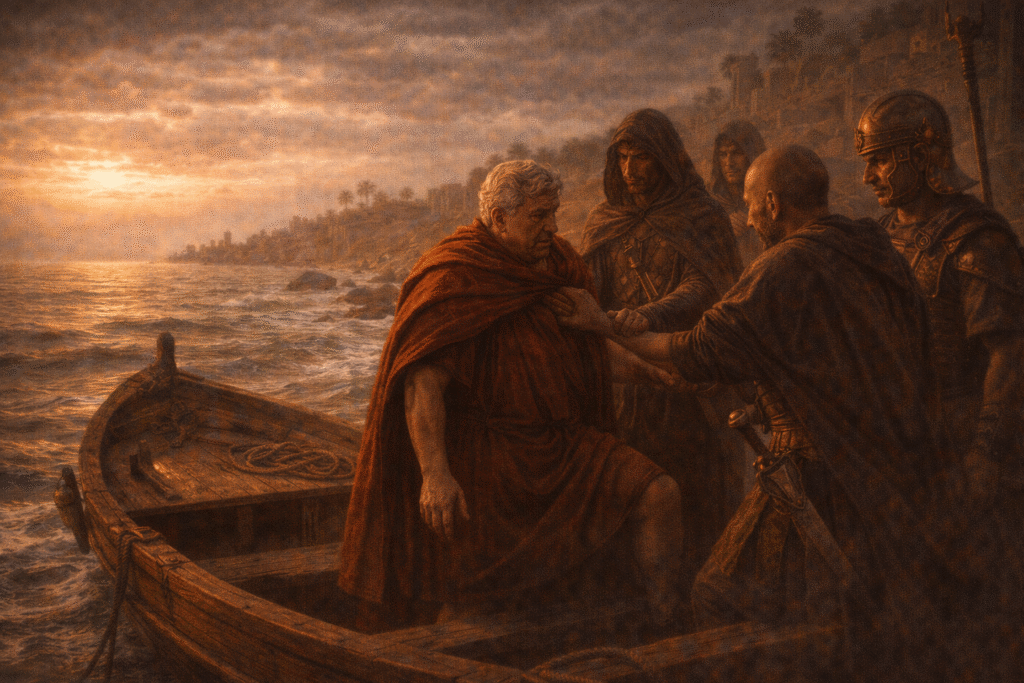
PART IV — Caesar Arrives
Reports came quickly.
A Roman fleet
approaching Alexandria.
Red-painted hulls.
Hundreds of soldiers.
Caesar himself
aboard.
A conqueror
arriving not for battle—
but for judgment.
My guards exchanged glances.
“Now we move, Majesty,”
one said.
“Before Caesar reaches the palace
and the city locks tight.”
But we could not rush back blindly.
I needed intelligence.
I dispatched
two scouts
to slip into Alexandria
and observe.
Their report
returned three days later.
“Caesar is furious,”
one said.
“He demanded
to see Pompey’s killers.”
“And my brother?” I asked.
“He tries
to welcome Caesar
as an ally.”
I closed my eyes.
Ptolemy XIII
was a child
playing with a lion
he believed tame.
“He insists,”
the scout continued,
“that you are a traitor.”
The other added:
“And Caesar wants
to hear both sides.”
I inhaled deeply.
This
was the opening.
This
was the hinge
of fate.
Caesar
was no fool.
He would not trust
a single child-king
in a divided land.
He would want balance.
Stability.
Intelligence.
I had all three.
But I needed
one more thing—
to reach him
before my brother stopped me.
PART V — The Plan No One Expected
My council
begged me
not to go.
“Your brother
will have spies
on every road.”
“He will kill you
before you reach the city.”
“Let us send an envoy.”
“No,”
I said.
“Caesar will not be persuaded
by envoys.”
“Then wait,”
one argued.
“Wait for a safer moment.”
“There will be no safer moment,”
I said.
“Caesar is a storm.
You do not wait
for a storm
to pass.”
“What then?”
the scarred mercenary asked.
“I will go to Caesar
myself.”
Shock.
Fear.
A murmur
like wind over stone.
“Alone?”
someone asked.
“No,”
I said.
“With destiny.”
One of my commanders
rubbed his forehead.
“This is madness.”
“This,”
I said softly,
“is necessity.”
Then I added
the truth that framed everything:
“Whoever reaches Caesar first
controls the story.”
And stories
are the most powerful
weapons
in political war.
PART VI — The Hidden Road to Alexandria
We chose a path
no royal
had taken in generations—
the marsh route
through the eastern Nile delta.
A place of reeds,
mud,
mosquito-clouds,
and crocodiles.
But also a place
where palace scouts
would not look.
I traveled
in a simple cloak.
No jewelry.
No banners.
No insignia.
Just a woman
moving through mud.
One night,
as we crossed
a shallow waterway,
a crocodile surfaced
so close
I felt the ripple it made.
My guard moved
to shield me.
I touched his arm.
“No,”
I whispered.
“We are the intruders here.”
The crocodile
watched us
with ancient judgment.
Then slipped below.
Egypt
had acknowledged me.
Nature
had acknowledged me.
The delta
showed me the path.
But it also showed me
what leadership meant:
to step
into danger
with clarity
instead of fear.
PART VII — The Alexandria That Did Not Recognize Me
After days
of hard travel,
we reached
the outskirts
of Alexandria.
It was dusk.
The great lighthouse
glowed
over the harbor.
The city
looked
exactly as I remembered—
and nothing
like I remembered.
Roman banners
hung beside
Ptolemaic ones.
Soldiers
patrolled the streets.
Nobles
hurried indoors.
The palace
was alive
with unfamiliar shadows.
I entered
through a servant gate
in the western wall—
the same one
I had used
to escape.
Alexandria
did not see me.
Alexandria
was busy being afraid.
PART VIII — The Meeting That Would Change History
In the dead of night,
accompanied by only
two loyal guards
and my attendant,
I slipped
into the palace complex.
Not through doors.
Through the laundry shaft
leading to the old library.
The air smelled
of dust
and papyrus
and imminent fate.
I made my way
through the corridors
until I reached
the chambers
where Caesar
was staying.
Torches flickered
at the ends
of the hall.
The guards
outside the door
were Romans.
Hardened.
Alert.
Unimpressed
by royal ornament.
Good.
I had none.
I stepped forward.
They raised spears.
“I am Cleopatra,”
I said.
Their eyes widened—
but they did not move.
One went inside.
Caesar’s voice
rumbled through the door.
“Let her in.”
The guard returned
and pushed the door open.
I stepped inside.
[Suggested Visual: Cleopatra in a simple cloak entering Caesar’s tented chamber, torchlight throwing shadows, Caesar turning toward her with stern curiosity.
AI Prompt: “Cleopatra VII entering Julius Caesar’s chamber in Alexandria, simple cloak, torch-lit, Caesar looking up in stern curiosity, cinematic realism.”]
PART IX — Caesar
He stood
at a writing table,
scrolls spread
before him
like open wounds.
When he lifted his head,
our eyes met.
He did not smile.
He did not frown.
He assessed.
A soldier
measuring
the worth
of a stranger.
“You came alone,”
he said.
“Yes.”
“You crossed
the delta marshes.”
“Yes.”
“You risked death
to reach me.”
“No,”
I said.
“I risked irrelevance.”
His eyes sharpened.
“And why
should I support you
against your brother?”
I stepped forward.
“Because my brother
killed your rival.
Because he lies
to Rome.
Because he controls
a city
that no longer trusts him.
Because Egypt
is more stable
with me
than without me.
And because
you, Caesar,
value intelligence
more than flattery.”
A long silence.
Then—
He exhaled.
“You are bold,”
he said.
“Boldness,”
I replied,
“is what kept me alive.”
He nodded slowly.
“Then we negotiate.”
And with that,
the fate of Egypt
shifted.
PART X — What This Moment Meant
The world
would later twist
this encounter
into a seduction.
Nonsense.
There was no seduction.
There was strategy.
Urgency.
Calculation.
Respect.
Caesar
did not help me
because he desired me.
He helped me
because he recognized
what Rome needed:
A capable ruler
in Egypt.
A stable ally.
A partner
who understood
politics,
intellect,
and survival.
He saw all three
in me.
Not because I was royal.
Because I had earned them.
I had come
through exile,
desert,
propaganda,
and danger—
not broken.
Sharpened.
And Caesar
recognized
a sharpened mind.
This night
was not the end
of my exile.
It was the beginning
of my return.
Ancient Questioner’s Desk — The Turning Point Edition
A student asked:
“Did Cleopatra seduce Caesar here?”
The elder replied:
“No.
She convinced him.”
Another asked:
“Why did Caesar choose her?”
The historian wrote:
“Because she made
the most sense
for Egypt
and for Rome.”
A traveler wondered:
“Was Pompey’s death decisive?”
The scribe answered:
“Yes—
but only because it revealed
the recklessness of her brother.”
A final question came:
“How did Cleopatra reach Caesar?”
The old master smiled.
“By walking through
the only doors
that were not locked.”
FINAL CTA — Stand in the Night Where History Pivoted
This Scroll ends here—
in the dimly lit chamber
where two of the most
influential minds
of the ancient world
met for the first time,
not as lovers,
but as strategic equals.
If you want to walk
the palace corridors
where Cleopatra
slipped past guards,
where Caesar
stepped into Egypt’s chaos,
where a kingdom
was rewritten—
walk it with ENA.
Journey with ENA.
History turns quietly—
until someone brave
pushes it.