
Scroll XI – Gathering the Winds of War
Syria, 49–48 BCE — The Desert Courts, the Mercenary Halls, and the Quiet Rooms Where Alliances Are Forged
Translated and restored for the modern traveler.
Prologue — Before Battles Come the Rooms Where No One Speaks Honestly
People imagine
war begins with:
clashing swords
booming trumpets
armies shouting under banners.
No.
War begins
in smaller rooms.
Whispered.
Measured.
Calculated.
War begins
when one powerful man
raises a goblet
and says,
casually:
“What do you offer?”
War begins
when the fate of nations
is traded in conversations
where no one
ever speaks truth directly.
This Scroll
is the making
of an army—
but not on battlefields.
In chambers,
courtyards,
dimly lit halls
where Cleopatra began
to gather forces
for her return.
This is not the war.
This is the wind
that precedes it.
PART I — The Governor’s Court: Where I Learned the Price of Betrayed Kings
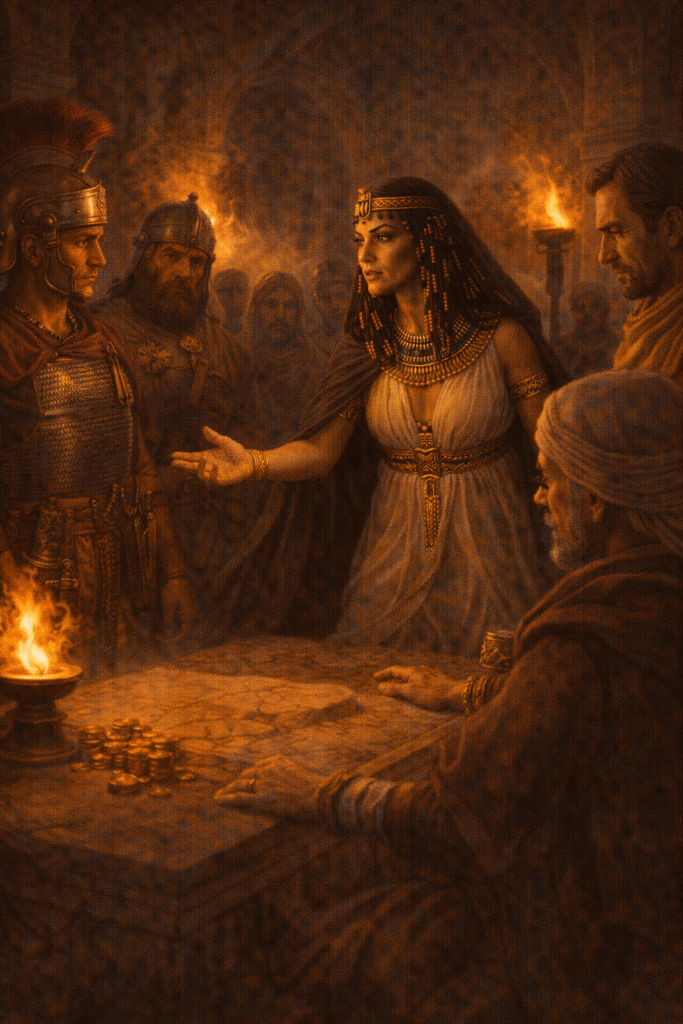
I entered the governor’s hall
with sand still in my hair
and fire in my lungs.
The governor—
a man of silver robes
and mathematic eyes—
studied me
as if I were
a difficult equation.
“So,”
he said,
“Egypt has lost her daughter.”
“No,”
I replied,
“Egypt misplaced her.”
He smirked.
“You want soldiers.”
“No,” I said.
“I want Egypt.”
“And to have Egypt,”
he said,
“you need soldiers.”
There it was.
Not a request.
An equation.
He motioned
for a servant to pour wine.
“As you know,”
he said,
“we cannot move openly
against your brother.
Rome would object.”
“So do not move openly,”
I said.
That made him smile.
“You are young,”
he observed.
“You are cautious,”
I answered.
He laughed once.
“Very well. Tell me, Cleopatra—
if I lend you troops,
what do I gain?”
I met his eyes.
“A queen
who remembers
who stood with her
when she had nothing.”
He inhaled.
Recognition.
Not flattery.
Reality.
This is what I offered
better than gold:
Loyalty.
True loyalty
from Egypt
was worth more
than any treasure.
“Perhaps,”
he murmured,
“you and I
have business.”
PART II — The Mercenary Halls: Where Soldiers Choose Their Own Kings
From the governor’s court,
I was escorted
to a stone complex
outside the city—
a place used
by mercenaries
between campaigns.
The air smelled of:
metal oil,
sweat,
smoke,
and ambition.
Men
from half the world
sat around low tables:
Thracians
with braided hair.
Cilician pirates
turned hired blades.
Nabatean scouts
famous for desert travel.
Greek veterans
who had served
under my grandfather.
Warriors
who did not kneel
because of birth.
Only because of respect.
The hall fell silent
as I entered.
Not out of awe.
Out of calculation.
A young woman.
A displaced queen.
A potential employer.
They studied me
the way wolves
study weather.
One stepped forward—
a tall man
with a scar
running from ear to jaw.
“Are you the Egyptian
the desert merchants whisper about?”
“Yes,” I said.
“And you plan
to take back your throne?”
“Yes.”
He nodded slowly.
“Then speak.
What kind of ruler
would you be?”
Not “what do you offer?”
Not “how much gold?”
What kind of ruler.
They were not selling swords.
They were choosing a cause.
“I will be,”
I said,
“a ruler who stands
in front of her army,
not behind it.”
A murmur
went through the hall.
“But,”
I added,
“I will also be a ruler
who returns you home alive.
Victory without waste.”
The scarred man
leaned in.
“And how do you plan
to fight your brother?”
I held his gaze.
“I do not plan to fight him.”
The hall froze.
“I plan,”
I continued,
“to make him irrelevant.”
Warriors understand
strategy
better than kings.
Half the hall
nodded.
The scarred man
extended his forearm.
A mercenary’s pledge.
I clasped it.
“In that case,”
he said,
“you will have warriors.”
PART III — The Letter from Alexandria
A courier
arrived at dawn.
Dust in his hair.
Breath unsteady.
“From the city,”
he gasped.
From Alexandria.
I tore open the papyrus.
It was from a scribe
I had once defended
against a corrupt noble.
He wrote:
The king has seized the throne alone.
Your statues are being removed.
Your supporters are being dismissed.
Your name is forbidden in petitions.
I write this at risk.
Then—
The people are uncertain.
Not against you—
but afraid to speak your name aloud.
Then—
Return before Rome names your brother
sole ruler.
My hands tightened
around the scroll.
Rome
was moving quickly.
I had to move faster.
“What is it?”
my attendant asked.
I handed her the scroll.
She read it slowly.
“Then we must ride soon,”
she whispered.
“No,”
I said.
“We must plan.”
Because returning home
without a plan
would be suicide.
Returning home
with a plan—
that would be history.
PART IV — The Allies Who Found Me
Not all allies
were bought.
Some came
because they believed.
A priest from Bubastis
arrived with a caravan.
“I bring messages
from the temples,”
he said.
“Which temples?” I asked.
He knelt.
“All who remember
your visit
to the river shrine.”
A chill
ran through me.
“The gods
do not choose lightly,”
he said softly.
“And the temples
remember
who listens.”
He placed a sealed pouch
in my hand.
“Funds
from those
who believe Egypt
should be led
by the one
who serves Egypt.”
Priests
do not give money.
Not unless
they fear
the wrong ruler.
Or trust
the right one.
That night,
I cried alone
for the first time
in months—
not from sorrow.
From gratitude.
The desert
had taken much from me.
But it had given me
something priceless:
Belief.
From strangers.
From warriors.
From priests.
From Egypt itself.
PART V — Training in the Dust
An army
is not built
in gold halls.
It is built
in dust.
I trained
alongside the soldiers.
Not because
I needed to be
a fighter.
Because I needed
to be seen
training.
A queen
who sweats
earns loyalty
that jewels never can.
I ran
until my lungs burned.
I practiced
sword drills
until my arms shook.
I rode
until dust
turned my hair grey.
Some nights,
I collapsed
onto my bedroll
with bruises
across my ribs.
But in the morning,
I rose.
A Thracian veteran
with grey in his beard
watched me train one day.
He nodded slowly.
“We will follow her,”
he said to the others.
“She bleeds like we bleed.”
It was not poetry.
It was contract.
And it mattered
far more
than crowns.
PART VI — The First Strategy Council
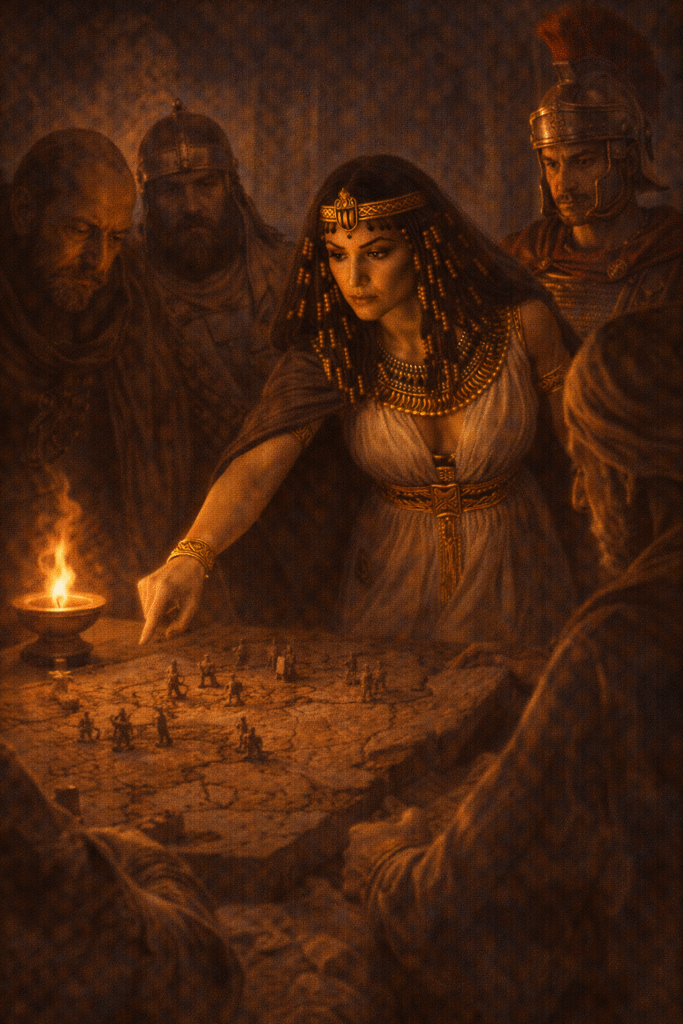
In a stone room
overlooking the desert,
I held my first council.
It was not grand.
A map carved into clay.
Soldiers standing.
No throne.
No scribes.
No diplomats.
Only people
willing to return with me
to reclaim Egypt.
The scarred mercenary spoke:
“We should march
straight to Pelusium.”
“No,”
I said.
“They are expecting that.”
Another said:
“We will storm the palace.”
“No,”
I said.
“The palace
does not decide Egypt.
The people do.”
Silence.
I pointed to Alexandria.
“The city is fractured.
The court is divided.
The priests
are watching.
Rome
will interfere—
but only if we move
without legitimacy.”
Another mercenary frowned.
“So what is your plan?”
I placed my hand
on the map.
“We will return
not as invaders.
We will return
as the rightful rulers.”
They stared.
“How?”
the scarred man asked.
I answered:
“By forcing Rome
to acknowledge me.”
“What would drive Rome to do that?”
I took a breath.
“War,”
I said.
“Not ours—
theirs.”
A ripple
of understanding.
Caesar
and Pompey
were at the brink
of civil war.
A Roman civil war
could open the door
to my Egyptian restoration.
If I played
the moment right.
If I timed
my return
exactly.
If I arrived
not with force—
but with inevitability.
PART VII — The Messenger from Rome
One night,
as we discussed timing,
a messenger
arrived from the west.
Travel-worn.
Dust-choked.
Wide-eyed.
He bowed.
“There is news,”
he said.
“Which Roman won?”
I asked.
His voice shook.
“No one, Majesty.”
I froze.
He continued:
“Pompey the Great
has fled
across the sea.
He sails for Alexandria.”
The room
fell silent.
Pompey.
The hero of Rome.
The general
who had conquered empires.
Now a fugitive.
And heading
toward Egypt.
I whispered:
“Then Caesar
cannot be far behind.”
The messenger nodded.
“He is chasing him.”
A chill passed through me.
Two titans of Rome
were moving
toward my kingdom.
Their civil war
was becoming
Egypt’s opportunity.
I looked around the room.
“This,”
I said softly,
“is our moment.”
One of the soldiers frowned.
“What does Pompey
have to do with us?”
I answered:
“Because when Rome burns,
Egypt chooses
its ruler.”
PART VIII — The Vow in the Desert Wind
That night,
beneath a sky
thick with stars,
I stood alone
at the edge of the camp.
The desert wind
cut across my skin.
Not cruelly.
Firmly.
Directly.
As if
it demanded
a promise.
So I gave one.
I spoke
to the wind.
To the gods.
To the ancestors.
To the river
that had blessed
and punished
and shaped me.
“I will return,”
I whispered.
“I will reclaim
what is mine.
Not for power.
Not for pride.
For Egypt.”
The wind shifted.
As if accepting
the vow.
I inhaled—
dust,
cold,
resolve.
And I said:
“And when I return…
I will not return alone.”
PART IX — What I Was Becoming
I had left Alexandria
as a girl cast out.
I now stood
as:
a strategist,
a diplomat,
a commander,
a negotiator,
a reader of maps,
a collector of loyalty,
a woman who understood
the pulse of empires.
I was preparing
for war—
but not the kind
people sing of.
I was preparing
for the war of minds.
The war of timing.
The war of legitimacy.
The war where armies
are not just soldiers
but alliances.
Rome’s civil war
was the spark.
Egypt’s fate
was the fuel.
And I—
I was the one
who would shape
the flame.
Ancient Questioner’s Desk — The Winds of War Edition
A student asked:
“Did Cleopatra seek war?”
The elder replied:
“She sought Egypt.”
Another asked:
“Did she hire mercenaries?”
The historian wrote:
“Yes—
and they followed her
because she earned them.”
A traveler wondered:
“What made her dangerous here?”
The scribe answered:
“She saw a war
between giants
and recognized
a doorway.”
A final question came:
“Was she ready
to reclaim Egypt at this point?”
The old master smiled.
“She was ready
to make Egypt choose her.”
FINAL CTA — Stand in the Rooms Where Her Return Began
This Scroll ends here—
in Syria’s halls,
in mercenary firelight,
in whispered alliances,
in vows made to stars
and sand
and destiny itself.
If you want to walk
the places
where Cleopatra gathered
the winds of war—
not for conquest,
but for homecoming—
walk with ENA.
Journey with ENA.
Queens rise long before
their armies march.