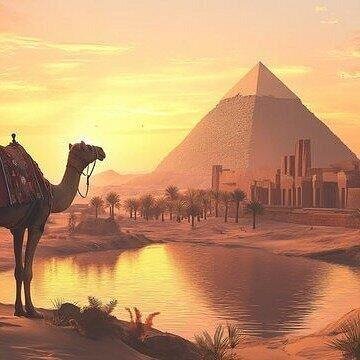
Scroll X – Crossing the Desert of Ash
Northern Sinai → Gaza → Pelusium → The Road to Syria, 49 BCE
Translated and restored for the modern traveler.
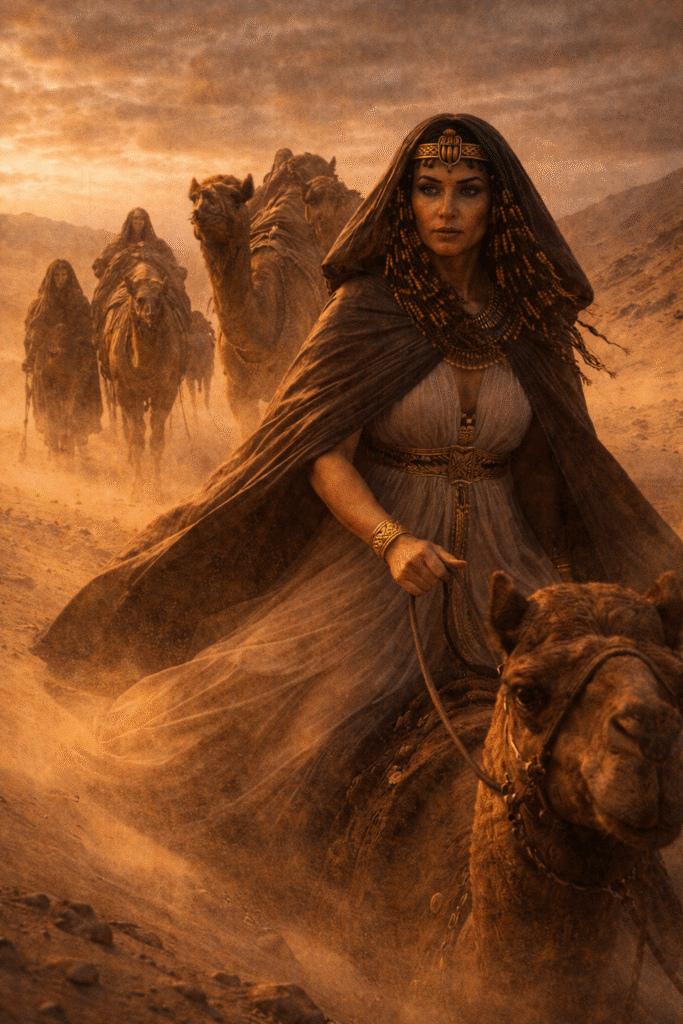
Prologue — Exile Hardens or It Breaks. It Chose to Harden Me.
There are deserts
made of sand.
Deserts made of hunger.
Deserts made of silence.
But the worst desert
is the one made of loss.
I walked into that one.
Alexandria
behind me.
Syria
ahead of me.
A throne
slipping from my hands.
A future
refusing to die.
This Scroll
is the transformation—
from girl exiled
to woman forged.
From princess displaced
to queen becoming.
In this desert,
I lost everything
that had cushioned me.
And I gained
everything
I would need
to take Egypt back.
PART I — The First Steps Into Nothingness
When we first stepped
off the ridge
and into the northern desert,
the wind felt
like a warning.
Cold at night.
Hot by day.
A blade
in every direction.
My sandals
filled with grit
within moments.
My cloak
clung to my skin
or whipped violently
depending on the wind’s mood.
Beside me—
my attendant,
two loyal guards,
and the hired guides
who knew the desert paths.
We were not an army.
We were a rumor.
The city behind us
did not know
I was gone yet.
But it would.
And the desert
did not care.
I looked back
only once.
Alexandria
was already
a memory
behind heat-blurred air.
I whispered:
“I will return.”
The desert
did not answer.
Deserts rarely do.
They simply
test.
PART II — The Sand That Remembers No One
There is a silence
in the Sinai
that swallows thought.
Waves of sand
stretch so far
you lose perspective.
Lose scale.
Lose arrogance.
A palace girl
quickly becomes
a creature
dragging her feet
through powder.
A princess
becomes
a woman
learning to keep her veil
tight across her face
so the sand
doesn’t fill her lungs.
By midday,
my lips cracked.
By afternoon,
my steps grew heavy.
By sunset,
I realized—
I had underestimated
not the desert,
but myself.
I had always viewed hardship
as something suffered by others.
Now
hardship walked beside me.
And I discovered
I was not soft.
I burned.
I endured.
I adapted.
Pain
is a tutor
that wastes no time.
PART III — The Night Storm
On the third night,
a desert storm rose
like a beast waking.
Wind
screamed against the cliffs.
Sand
cut like fine glass.
The sky
turned grey and violent.
We huddled
behind a rock outcrop.
A guard
wrapped his cloak
around me,
shouting:
“Princess—stay low!”
Princess.
In the storm,
the word felt absurd.
I was not royalty.
Not here.
I was
a body
fighting wind.
Lightning
flashed behind the dunes,
turning the world
into momentary ghosts.
My attendant
reached for my hand.
“We will survive,”
she said,
her voice steady.
I held it tightly.
And I knew—
I was no longer
protected by marble halls.
I was protected
by people.
By loyalty.
By love.
By the kind of devotion
no throne room
could demand.
The storm passed
hours later.
We emerged
covered in grit,
half-blind,
exhausted.
But alive.
And something in me
shifted.
If I could survive this—
I could survive
my brother.
Rome.
War.
A kingdom’s collapse.
Loss
had not broken me.
It had clarified me.
PART IV — The Oasis of Tents
At dawn,
a caravan appeared
like phantoms
on the horizon—
Nabatean traders.
Masters of desert routes.
Smugglers.
Diplomats of sand.
They approached slowly.
Our guide raised his hand
in greeting.
Their leader—
a woman older than my mother,
face shaded by carefully draped cloth—
studied us.
“You are far from home,”
she said in Aramaic.
“So are you,”
I replied.
She grinned.
“Home travels with me.”
She offered
food.
Water.
Shelter in their circle.
We accepted.
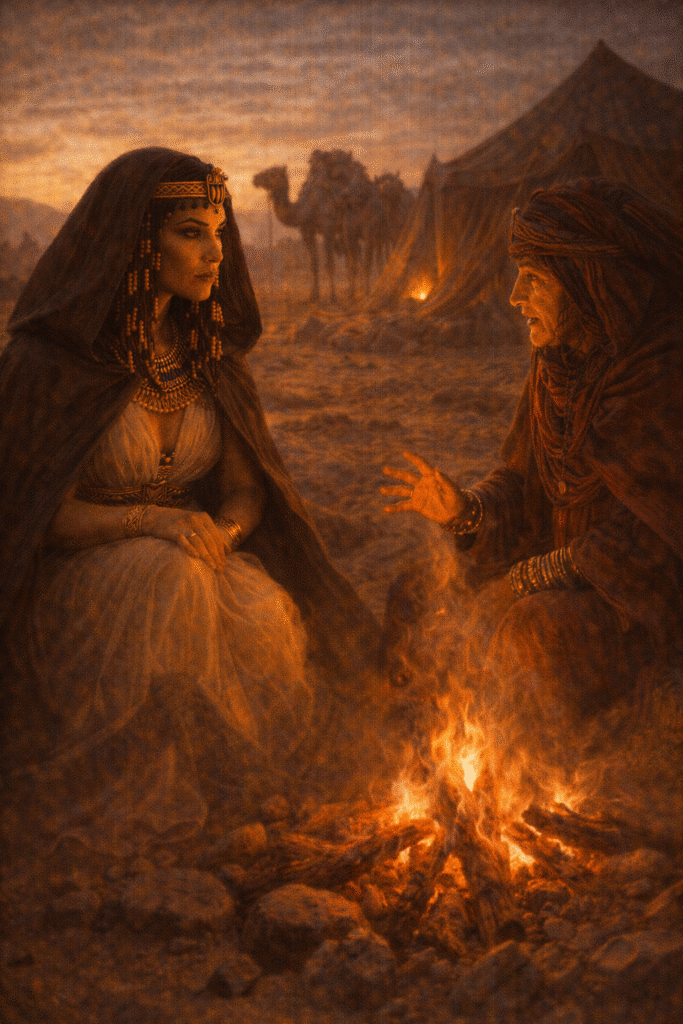
As we shared dates
and bread
around a small fire,
she asked:
“Who hunts you?”
I hesitated.
She nodded.
“Only those hunted
by kings
hesitate that way.”
She was not wrong.
When I finally answered,
I did not say
my brother’s name.
I said:
“Jealous men.”
She smirked.
“Ah.
The most predictable predators.”
Then—
“You will need more
than survival, child.
You will need leverage.”
Her eyes gleamed.
“And leverage
comes from alliances.”
It was the first time
someone outside Egypt
spoke to me
as if I were already a leader.
The desert,
it seemed,
recognized authority
before courts did.
PART V — The Dead City of Pelusium
We passed Pelusium
days later.
Once a mighty port—
border fortress of Egypt.
Now
a husk.
The Roman garrison
had withdrawn
months earlier.
The marshlands
around it
had swallowed
half the outer structures.
Pelusium’s silence
cut deeper
than the desert’s.
Cities should breathe.
Pelusium did not.
My guard whispered:
“This is what happens,
Princess…
when the Nile’s daughters
do not rule.”
But I knew
the truth was broader:
This is what happens
when Egypt
is managed
by opportunists
instead of guardians.
We passed
broken walls,
empty cisterns,
dead gardens.
I felt
no fear.
I felt
resolve.
A country
can survive famine.
It can survive drought.
It can survive war.
But it cannot survive
leaders
who forget
their country’s soul.
I whispered to myself:
If I return,
Egypt will not look like this again.
The vow
burned like the desert wind.
PART VI — The Road of Scorpions
Beyond Pelusium,
the desert changed.
No longer smooth
golden dunes—
jagged grey flats
littered with black rock.
The locals
called it
“The Road of Scorpions.”
Not metaphor.
Reality.
Our guides
killed nine
in one night.
I learned
to shake out my boots
each morning.
To listen
for the faint clicking
beneath sand.
To sleep
with my dagger
near my pillow.
Fear
was constant.
But fear
became discipline.
Every dangerous moment
showed me
who I could become.
When one of the guards
was stung
and collapsed,
I took his arm.
My hands
did not tremble.
“Breathe,”
I commanded.
We cut the wound.
Applied the poultice.
Held him upright.
He survived.
When he opened his eyes,
he whispered:
“Cleopatra…
you should have been king.”
I answered:
“Not king.”
He blinked.
“Pharaoh.”
The desert
had begun
to crown me
long before the crown reached my head.
PART VII — The Messengers in the Night
We reached Gaza—
a city of stone
and watchtowers—
just as dusk bled
across the horizon.
Within hours,
messengers arrived.
One from an Alexandrian merchant
loyal to me.
One from a priest
in Memphis.
One from a Roman scholar
who had once debated with me
at the palace library.
Each message
said the same thing:
Ptolemy has declared you
“dangerous.”
A traitor.
A destabilizer.
A threat
to unity.
He had frozen my assets.
Dismissed my scribes.
Seized my estates.
Placed my name
on a list
of “foreign sympathizers.”
He was rewriting history
before I was even gone.
I sat
in a borrowed chamber
in Gaza,
the scrolls in my lap.
My attendant’s voice
trembled:
“Princess…
what will you do?”
What would I do?
I would not beg.
I would not hide.
I would not return
to be executed quietly.
I lifted my chin.
“I will build an army.”
“And then?”
I looked toward the desert
where the road
to Syria waited.
“I will return home
with power.”
PART VIII — Syria: The First Negotiation
When we crossed
the Syrian border,
something shifted.
Not in the landscape.
In me.
Exile
had stripped me.
Syria
would shape me.
Within days,
I sent word
to the governor’s court.
A woman
seeking audience
was nothing remarkable.
A princess
seeking an army
was something else.
But I had learned
how to speak
in languages
that opened doors.
Greek
for scholars.
Egyptian
for priests.
Aramaic
for merchants.
Flattery
for gatekeepers.
Reason
for generals.
Gold
for those who needed gold.
Memory
for those who needed
to be reminded
of my father’s debts.
Piece by piece,
I gathered influence.
Not fealty.
Influence.
Influence
builds armies
before soldiers arrive.
The governor
studied me closely.
“You come barefoot
from the desert,”
he said.
“And you demand allies.”
“I come with a kingdom
behind me,”
I replied.
“And I demand
its future.”
He smiled.
“You are bolder
than your father.”
“I am bolder
than any king
who bows.”
He leaned back.
“And what will you give
in return
for our support?”
I said the only word
that mattered:
“Egypt.”
He laughed softly.
“Ah,”
he murmured.
“Now we speak truth.”
Negotiations began.
Not over armies—
over possibility.
The possibility
that the rightful ruler
of Egypt
was not the boy
who seized a throne—
but the woman
who survived her country’s edges
to reclaim it.
[Suggested Visual: Cleopatra standing before a Syrian governor in a stone hall, still travel-worn but standing firmly, a soldier at her side.
AI Prompt: “Cleopatra VII negotiating with Syrian governor in stone hall, travel-worn desert attire, soldiers watching, cinematic realism.”]
PART IX — The Moment I Stopped Being Exiled
Exile
is not a place.
It is a condition.
A condition
of disbelief.
Of being unwanted.
Unclaimed.
Unprotected.
But one night,
in a simple room
lit by oil lamps,
after sending messengers
to potential allies,
I sat alone
on a woven mat
and felt something new.
Not grief.
Not fear.
Not outrage.
Command.
Quiet.
Steady.
Undeniable.
I realized:
I was no longer
a girl who lost Alexandria.
I was a woman
planning how to take it back.
I was no longer
running from my brother.
I was preparing
to confront him.
I was no longer
the hunted.
I was becoming
the hunter.
The moment
I understood that—
the desert
was behind me.
Exile
was behind me.
Only Egypt
remained ahead.
PART X — What the Desert Gave Me
It gave me:
Endurance —
the ability to lead
when exhaustion
would undo others.
Perspective —
the knowledge
that thrones
are fragile,
but resolve
is not.
Allies —
loyalty forged
not by birth
but by shared struggle.
Clarity —
the understanding
of who I must become
to rule.
Fire —
the fire needed
to confront kings,
senators,
armies,
and destiny.
But most of all—
the desert gave me
myself.
Not the girl
from the palace.
Not the daughter
of the king.
Not the co-ruler
pushed aside.
It gave me the woman
Egypt would one day follow
through war,
through alliance,
through rebirth.
The woman
Rome would fear.
The woman
history would rename.
The woman
I had to become
to reclaim my throne.
Ancient Questioner’s Desk — Exile to Queen Edition
A student asked:
“Did Cleopatra become a queen in exile?”
The elder replied:
“She became a queen
the moment exile stopped frightening her.”
Another asked:
“What did the desert teach her?”
The historian wrote:
“That power is not inherited—
it is forged.”
A traveler wondered:
“Why didn’t she break?”
The scribe answered:
“Because Egypt
had not broken yet.”
A final question came:
“What was Cleopatra
before Caesar?”
The old master smiled.
“Already unstoppable.”
FINAL CTA — Walk the Path Where Queens Are Forged
This Scroll ends here—
in the endless sand,
in the broken port of Pelusium,
in the shadows of Gaza,
and in the rising halls of Syria—
where a displaced girl
transformed into a ruler
with a singular mission:
Return.
If you want to walk
the real road
Cleopatra crossed,
to feel the grit
that carved resolve
into her bones,
to stand where exile
turned into ambition—
walk it with ENA.
Journey with ENA.
Thrones are won
long before they are taken.