
Scroll IX – The Day I Lost Alexandria
Alexandria, c. 49 BCE — The Palace Coup, The Propaganda War, and the Quiet Exile
Translated and restored for the modern traveler.
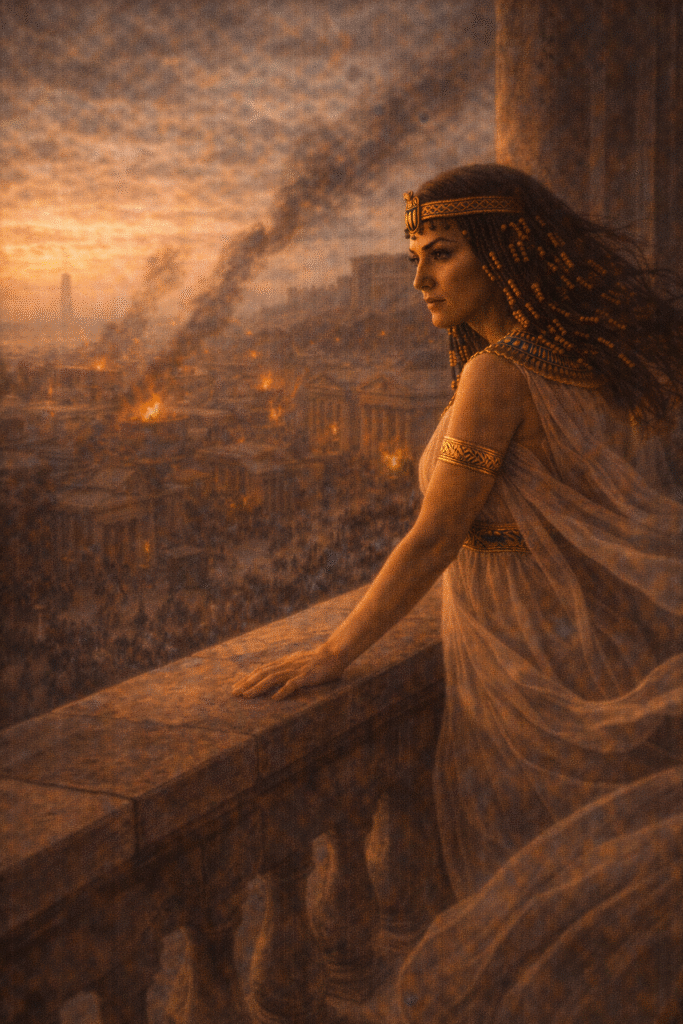
Prologue — Cities Don’t Break in Revolutions. They Break in Whispers.
People imagine
I lost Alexandria
in an explosion—
a riot,
a battle,
a torch thrown
into the night.
But cities
do not fall
in fire.
Cities fall
in murmurs.
In shifts
barely felt at first.
A guard assigned elsewhere.
A scribe suddenly distant.
A priestess avoiding your gaze.
A Roman envoy
visiting your brother
more often than you.
Power loosens
before it breaks.
And when it breaks,
it is silent.
This Scroll
is the day
Alexandria stopped being mine—
not because I surrendered it,
but because the city
was taken out
from under my feet.
PART I — The First Sign: The Papers That Lied
It began
in the petition court.
A modest complaint—
a merchant claiming
his taxes had doubled
overnight.
I requested the ledger.
It came
too quickly.
And it was wrong.
King’s seals
in the wrong place.
The grain figures
misaligned.
A signature
I recognized
as belonging
to a scribe
who had left Alexandria
three months earlier.
Forged.
Not crudely.
Professionally.
I looked at the magistrate.
“Who altered this?”
He swallowed.
“We received it
only this morning.”
A lie.
A quiet one.
A dangerous one.
When officials
start lying easily,
they’re not acting alone.
They’re acting
for someone.
Someone higher.
Someone protected.
And I knew
who had begun
to rewrite my kingdom:
My brother.
Or rather—
his handlers.
The men
who feared me.
The men
who wanted
a king they could shape.
And a queen
they could silence.
PART II — The Second Sign: The Guards That Disappeared
The next shift
came days later.
Two of my personal guards
did not report for duty.
At first,
I assumed illness.
At second thought,
politics.
I asked
the captain of the palace guard.
His expression tensed.
“They have…
been reassigned, Princess.”
“By whom?” I asked.
“By the king.”
Not our father.
My brother.
I dismissed him
with ceremony
and walked
straight to Ptolemy.
He sat
in a small audience room,
surrounded by
men he had recently elevated.
Cliens.
Clients.
Dependents.
Men who had
something to gain
from a malleable boy-king.
“Brother,” I said,
“you removed my guards.”
He smiled.
“For your own safety.”
“My safety,”
I said,
“requires loyalty.”
He nodded.
“Exactly.”
And I understood.
He did not remove my guards
because they were disloyal.
He removed them
because they were loyal—
to me.
His smile widened.
“You have nothing
to fear here.”
But fear
was not the concern.
Isolation was.
Isolation
is how coups begin.
PART III — The Third Sign: The People Stop Speaking Freely
Alexandrians
are not a quiet people.
They gossip loudly.
Praise loudly.
Complain loudly.
Argue loudly.
Silence
is unusual.
And suddenly—
they grew silent.
Not everywhere.
Not always.
But in certain districts:
The dockside.
The artisan quarter.
The market street
beneath the palace.
At first,
I thought it was fear
of famine returning.
But it was not fear.
It was uncertainty.
A quiet so heavy
that the air
felt thick with it.
Every time
I passed,
people bowed quickly—
too quickly—
as though being seen
acknowledging me
might invite punishment.
Someone
had told them something.
Someone
had whispered
a new truth.
Someone
had begun
poisoning my name.
And the palace
was the only place
capable of whispering
loud enough.
PART IV — The Propaganda War Begins
It happened
in the marketplace
three days later.
A crowd parted
as I walked—
not with respect.
With discomfort.
At the edge
of a pottery stall,
I spotted it:
A small piece of papyrus
tacked to a beam.
A crude image
painted with charcoal.
A woman—
a queen—
holding a bag of coins
with Roman markings.
At first glance,
harmless.
Then I saw the inscription:
“Roman Queen.”
No name.
Not needed.
Everyone understood
who it meant.
Me.
I tore it down.
Merchants froze.
Whispered.
Then,
from behind a pillar,
another papyrus fluttered in the wind.
Then another.
Then another.
I ripped them down
one by one.
They kept appearing.
Not many.
Just enough.
Enough
to infect.
Propaganda
is not a shout.
Propaganda
is a seed.
And someone
was planting them
in my own city.
PART V — The Roman Envoy
Rome
never acts openly
at first.
They prefer
subtle gestures.
A visit.
A warning.
An insinuation.
The envoy
requested an audience.
A man
with a thin mouth
and calculating eyes.
He bowed.
“Princess Cleopatra,”
he said,
“Rome is concerned.”
“About what?” I asked.
“Your…
independence.”
“I am co-ruler.”
“Precisely.”
He walked slowly
around the colonnade.
“You have been seen
speaking to the people.
Listening.
Intervening.”
“I serve Egypt.”
“Or divide it?”
I stared at him.
“You fear a queen,”
I said.
He smiled.
“We fear
instability.”
“Then you fear
my brother more.”
He paused.
“You misunderstand.
Rome wants unity.
You—
are a disruption.”
Not a rival.
A disruption.
Rome prefers
leaders
without initiative.
My brother
was manageable.
I
was not.
The envoy’s eyes hardened.
“For the stability of Egypt,”
he said,
“we suggest
you reduce
your public presence.”
“I will not.”
“Then,”
he said quietly,
“Egypt may decide
for you.”
It was a warning.
But not his.
Someone
inside the palace
had invited Rome
to intervene.
Someone
who wanted me gone.
PART VI — The Night the Palace Locked Its Doors
That night,
I returned
to my chambers
and found
the corridor guards—
men loyal to Ptolemy—
standing closer
than usual.
I nodded.
They did not nod back.
Inside,
my lady’s attendant
whispered:
“Princess…
the doors…
they have been bolted
from the outside.”
I checked.
She was right.
The bolts
were new.
Heavy.
Deliberate.
Not for protection.
For confinement.
I knocked
on the guards’ shields.
“Open this.”
“No one enters or leaves,”
one said.
“By order of the king.”
The king.
My brother.
It was not violence.
It was not threat.
It was not accusation.
It was something
far more dangerous:
Containment.
Contain someone long enough,
and rumors
do the work for you.
“Why?” I asked.
The guard
said nothing.
Silence.
The language
of palace coups.
PART VII — The Message from the Priests
At dawn,
a scrap of papyrus
slipped under my door.
I recognized
the handwriting.
Priests
from Philae.
Only three words:
“Leave.
Now.
North.”
No symbols.
No signatures.
Just urgency.
Priests
never act lightly.
And they never
advise escape
unless the gods
—or the politics—
demand it.
I pressed the papyrus
to my chest.
I had been co-ruler
for months.
But I had been heir
in the hearts
of the people
for years.
Heirs
are the first targeted
in consolidations of power.
My brother
was not acting alone.
Nobles.
Roman envoys.
Treasury officials.
Men hungry
for a king
they could control.
I was not that king.
So they would remove
the queen.
Quietly.
Cleanly.
Without bloodshed—
for now.
I looked at my attendant.
“We leave tonight.”
She nodded once.
Just once.
No questions.
She knew.
PART VIII — The Escape
It was not dramatic.
It was not heroic.
Escape rarely is.
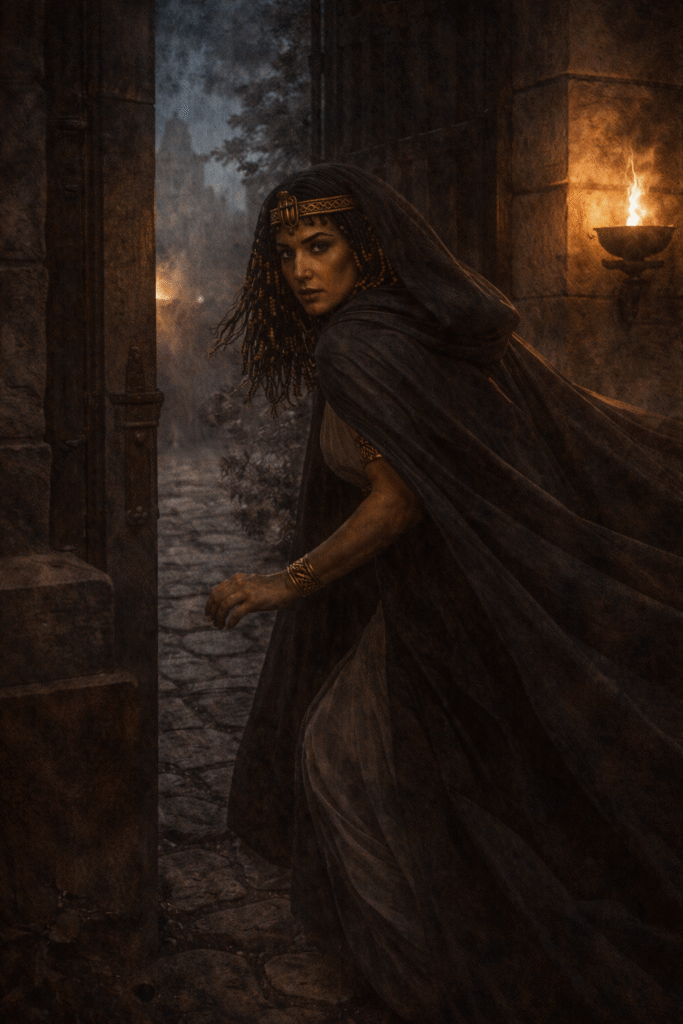
We left
through the laundry corridor—
the only place
where guards
did not assume
royalty would pass.
A servant
who had once thanked me
for remitting her father’s debt
guided us
through the storage halls.
She left us
at a narrow back gate
used for waste carts.
“Go,” she whispered.
“Rome thinks
you will flee east.
The king’s men think
you will flee south.”
“Where should we go?” I asked.
“Where neither expects,”
she said.
“North.”
To Syria.
To the desert.
To the place
where exile
sharpens
or destroys.
When we stepped
into the night air,
Alexandria
felt different.
Not hostile.
Not welcoming.
Just…
wounded.
As if the city itself
could not believe
its daughter
was leaving again.
PART IX — The Last Look Back
At the top
of the ridge
above the harbor,
I turned.
The Pharos
glowed
like an enormous
single eye.
The palace roofs
sparkled
as if nothing
were wrong.
But everything
was wrong.
Because leadership
is not in marble.
It is in trust.
And trust
had shifted.
Not away from me.
Toward fear.
Fear
of famine.
Fear
of Rome.
Fear
of conflict.
Fear
of choosing the wrong ruler.
Egypt
was bracing
for civil war.
And I—
I who had loved her
more than anyone
in that palace—
was being pushed
into the desert.
My attendant
touched my arm.
“Princess…
we must go.”
I whispered:
“I will return.”
The wind
carried the words
like a vow.
Not bravado.
A promise.
Alexandria
had lost me.
But I had not lost
Alexandria.
PART X — The Beginning of the Real Cleopatra
People think
my story begins
with Caesar,
with rugs,
with seduction.
But that is Rome’s fiction.
My story begins here—
walking into exile
with sand in my sandals,
fear in my ribs,
and clarity
in my mind.
I was not running.
I was positioning myself.
Rome had chosen
my brother.
The court
had chosen fear.
But the river,
the priests,
the people—
they had chosen me.
And they would
again.
Because when a throne
is broken,
the city will eventually
seek the one
who can repair it.
I walked north
with no army,
no allies,
no crown.
But I walked
with something
far more powerful:
A nation
waiting
for a reason
to call me back.
Ancient Questioner’s Desk — The Fall Edition
A student asked:
“Was Cleopatra overthrown?”
The elder replied:
“No.
She was outmaneuvered.”
Another asked:
“Why did Ptolemy fear her?”
The historian wrote:
“Because Egypt listened
when she spoke.”
A traveler wondered:
“Did Rome orchestrate her exile?”
The scribe answered:
“Rome opened the door.
Her brother pushed her through.”
A final question came:
“How did she return?”
The old master smiled.
“Queens return
when the city
remembers
why it loved them.”
FINAL CTA — Walk the Night She Lost Her City
This Scroll ends here—
on a ridge
above a sleeping Alexandria,
with a princess
stripped of her title,
her guards,
her standing—
but not her destiny.
If you want to walk
the alleys
where she slipped past guards,
the halls
where whispers overtook justice,
the harbor edge
where she promised to return—
walk it with ENA.
Journey with ENA.
Cities fall quietly—
but queens rise loudly.
Historical Context
Alexandria experienced periods of violence and political upheaval during Cleopatra’s reign, particularly amid Roman civil wars.
This scroll interprets “loss” symbolically, reflecting the erosion of sovereignty rather than a literal destruction of the city in a single day.