
Scroll VII – The Night the Priests Whispered My Name
Alexandria → Philae, c. 52 BCE — The Sanctuary of Isis & the Temple’s Inner Court
Translated and restored for the modern traveler.
Prologue — The Gods Choose Quietly
Kings rise
in ceremonies.
Queens rise
in marriages.
But the gods—
the old Egyptian gods—
choose
in silence.
They choose
in shadows,
in omens,
in breath between words.
Not with trumpets.
With whispers.
This Scroll
is the night
I was whispered into.
The priests thought
they were discussing
fate.
Later,
I realized
they were discussing
strategy.
Faith and politics
are siblings in Egypt.
This night
taught me both.
PART I — The Summons That Was Not Truly a Summons
It arrived
as all dangerous things do—
quietly.
A slip of papyrus
under my door.
Only two words
written in a scribe’s
careful hand:
Philae.
Midnight.
No royal seal.
No title.
No explanation.
A summons
meant to be obeyed
and never spoken of.
I knew
who had sent it.
Not the palace.
The priesthood.
The only institution
older than the crown.
Older than my dynasty.
Older than Alexander.
Older than memory.
The priests of Isis
did not summon royalty
unless something
was shifting.
And things
were shifting.
The Nile had punished us.
The people were restless.
My father was slipping.
My siblings were stirring.
Rome was watching
too closely.
When the priests call
at midnight,
they are not calling for ceremony.
They are calling for intervention.
PART II — The Journey to the Temple of Isis
Philae
is not near Alexandria.
It lies far south—
a sacred island
on the Nile
near the First Cataract.
A place
where Egypt begins
and Nubia ends—
where borders blur
and gods feel close.
But the priests
had prepared a solution.
A fast boat
waited at the eastern quay.
No banners.
No escorts.
Only a hooded priest
who whispered:
“Your presence is required.”
We sailed
by moonlight.
The wind
was cold
and impatient.
I sat alone
on the deck
as Alexandria shrank
behind us.
The river
was dark
as obsidian.
When dawn broke,
the priest said:
“Close your eyes.”
I obeyed.
The air changed.
When I opened them,
the cliffs of Philae
rose
like painted stone
from the river.
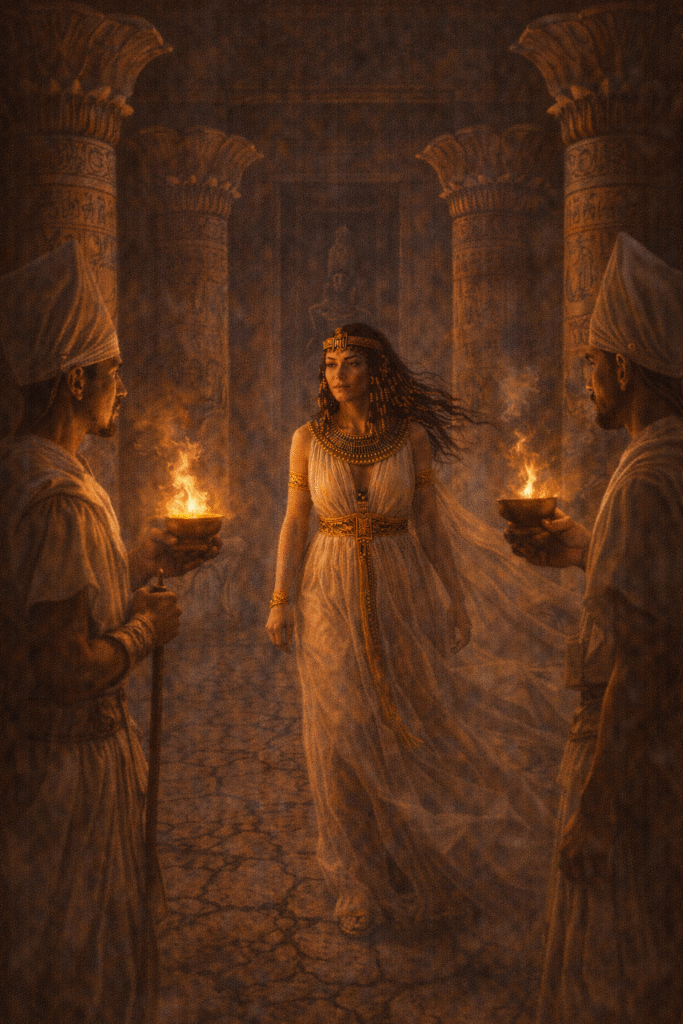
Columns.
Lotus capitals.
Torches
still burning
from the night ritual.
I knew,
before setting foot
on the island,
that something
in my life
would change here.
PART III — Entering the Inner Court
Inside the temple,
the air smelled of:
incense,
sandstone dust,
lotus oil,
and the faint metallic scent
of offerings.
Isis’s shrine
flickered in the half-light.
Five priests
stood in a semicircle.
In front of them—
an empty space.
A space
for someone
they had chosen.
Someone
not yet crowned.
Someone
not yet protected.
Someone
like me.
The High Priest
stepped forward.
“Cleopatra,”
he said,
speaking my name
not as a courtesy—
but as a declaration.
“You have come.”
“Yes,” I said.
“You know why?”
“No.”
“Good,” he said.
“You speak truth.”
The honesty
unnerved me.
Priests rarely valued
plainness.
Unless the moment
required it.
Unless the truth
was necessary
for what came next.
PART IV — The Chamber of the Star Basin
They led me
into a smaller chamber.
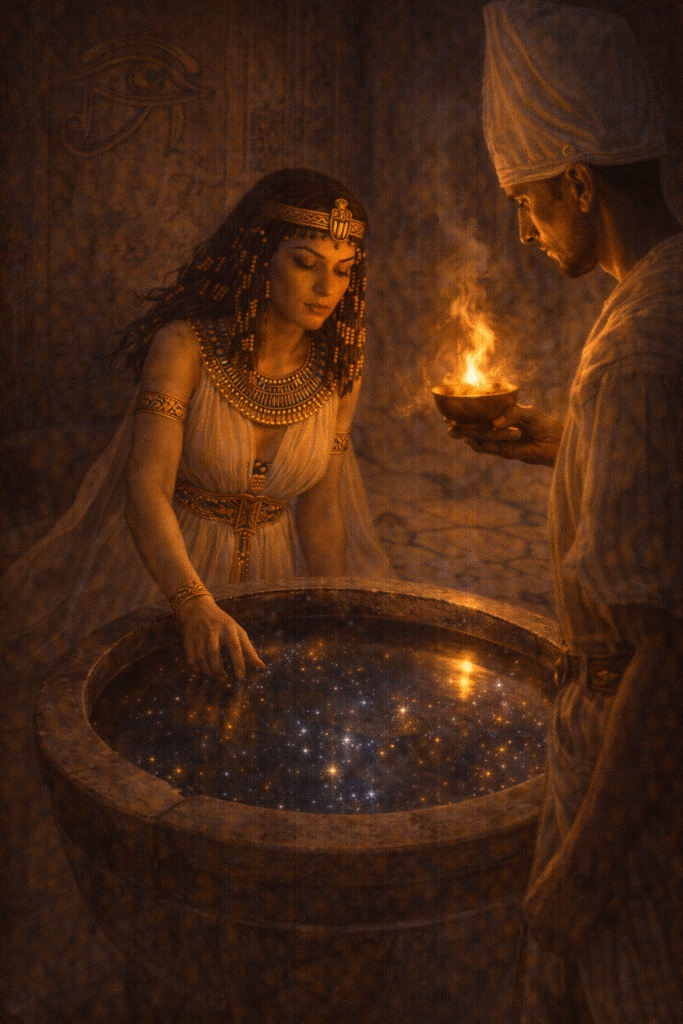
An oval basin
filled with still water
sat in the center.
Not for bathing.
For seeing.
The Star Basin.
A tool
for priests
to observe reflections
of celestial patterns
at night.
A mirror
of the heavens.
“Look,”
the High Priest commanded.
I knelt
and peered
into the water.
At first,
I saw only
my own face.
Then the water shimmered.
Not magic—
science.
Star patterns
reflected
from an opening
in the ceiling.
The priests
had angled the basin
exactly
to receive
the mapped sky.
One priest
inhaled sharply.
“There,”
he whispered.
A faint alignment
appeared—
three stars
forming a narrow V
above my reflection.
Another priest
murmured:
“The sign
of the Two Ladies.”
Wadjet and Nekhbet—
the goddesses
of Upper
and Lower Egypt.
“Protector of Pharaohs,”
the High Priest said quietly.
My heartbeat
softened
into a slow, steady pulse.
“What does it mean?”
I asked.
The High Priest
did not answer immediately.
He dismissed
the other priests
with a gesture.
Only when the chamber emptied
did he speak plainly.
PART V — The Words Meant for Me Alone
“You know,”
he began,
“that your father
is losing Egypt.”
I said nothing.
“You know
that Rome
is tightening its grip.”
I said nothing.
“And you know,”
he continued,
“that your siblings
would rather spill blood
than share power.”
Still —
I said nothing.
“Good,”
he murmured.
“You understand silence.”
He knelt beside me
at the basin.
“Look again.”
This time
my reflection
was darker,
deeper,
as if the water
had thickened.
The star alignment
had shifted
as the night ended.
The V had widened.
Creating
the shape
of a double crown.
The High Priest
spoke softly:
“There will be a ruler
of the Two Lands
from your line.”
“Which one of us?”
I asked.
He held my gaze.
“You already know.”
My breath
caught.
He continued:
“You have walked the streets
when your father hid.”
True.
“You have spoken
to the hungry.”
True.
“You have listened
where others shouted.”
True.
“You have become
the mirror
Egypt turns to.”
I swallowed.
“Am I to become Pharaoh?”
I whispered.
The High Priest
did not blink.
“Not yet.”
So it was coming.
But not now.
“Then why call me?”
His voice
turned grave.
“Because Egypt
will need you
before the crown does.”
The air
tightened.
“How?”
“Your family
is devouring itself.”
True.
“And Rome
will devour
whatever remains.”
Also true.
“Between these forces,
only one person
stands
who sees Egypt clearly.”
I felt
a trembling
behind my ribs.
He touched two fingers
to the water surface.
Ripples
spread outward.
“The Nile returns
to those
who understand balance.”
A beat.
“You restore balance.”
I whispered:
“But I am only sixteen.”
He answered:
“And Egypt is only
a heartbeat away
from choosing you.”
PART VI — The Priest Who Tested Me
As the High Priest
prepared to dismiss me,
another priest—
older, thinner,
with eyes like obsidian—
stepped forward.
He did not bow.
He did not smile.
He simply asked:
“Why do you want power?”
The question
struck like lightning.
“I did not say
I want it,”
I replied.
“Good,”
he said.
“Desire clouds judgment.”
He stepped closer.
“What is Egypt?”
he asked.
“A kingdom,”
I said.
“No.”
“A people.”
“Closer.”
“A civilization.”
“No.”
I hesitated.
He placed a hand
over the basin.
“Egypt,”
he said,
“is continuity.”
He tapped the water.
“And continuity
requires guardians.”
Then he looked
directly at me.
“You guard Egypt
because Egypt
has guarded you.”
His eyes narrowed.
“But you must decide—
will you guard Egypt
from foreign hands?”
“Yes.”
“From corrupt hands?”
“Yes.”
“From your own blood?”
Silence.
Long.
Heavy.
A test
not of ambition—
of conviction.
Finally,
I answered:
“If they endanger Egypt…
yes.”
The High Priest
exhaled.
“Then you are ready.”
Ready for what?
They did not say.
Their silence
told me more
than their words.
PART VII — When the Priests Whispered My Name
As I left
the sanctuary,
I heard it.
Not loudly.
Not ceremonially.
Soft.
Private.
Heavy with intention.
Priests
whispering.
“Cleopatra.”
“Daughter of the Two Lands.”
“She sees.”
“She listens.”
“She hears Egypt.”
Not a prophecy.
Recognition.
Not flattery.
Assessment.
I did not feel proud.
I felt
seen.
Seen
in the way
power sees
before it chooses.
Seen
in the way
fate sees
before it arrives.
And I knew
with a quiet certainty:
This night
would be remembered
long after
these priests were dust.
Not because
they named me.
Because Egypt did.
PART VIII — The Vision That Followed Me Home
On the return journey,
I did not sleep.
I watched the river
slide past
like a living mirror.
The words
echoed in the water:
Balance.
Continuity.
Rightful one.
Listen.
Guard.
As Alexandria’s lights
appeared on the horizon,
I whispered to the river:
“If Egypt needs me…
I will answer.”
And something strange happened.
The wind shifted.
The water swelled.
The boat rocked gently—
like a nod.
Not magic.
Not omen.
Nature
recognizing sincerity.
Or perhaps
it was simply
my own heart
aligning with destiny.
When I stepped off the boat,
the priest who had ferried me
said quietly:
“You will return here
one day.”
“For guidance?”
I asked.
“For farewell,”
he said.
I did not understand then.
But I would.
Much later.
🌿 MID-SCROLL CTA — Walk the Night Egypt Chose Her
If you want to stand
in the temple
where the priests
first saw Cleopatra
not as a girl,
but as a guardian—
If you want to walk
the same colonnades
where a future queen
heard her name
spoken by the oldest voices
in Egypt—
If you want to feel
the spiritual weight
that shaped
her political destiny—
Walk with ENA.
Feel the whispers
still clinging
to the stones of Philae.
Journey with ENA.
The gods do not choose loudly—
they choose deeply.
PART IX — The Return to a Palace That Did Not Know What Had Changed
When I returned,
Alexandria
looked the same.
The palace
looked the same.
My father
looked the same.
But I
was not the same.
My siblings
argued.
The court
plotted.
Rome
waited.
Nothing
had changed.
And yet—
everything
had changed.
Because now
I carried something
none of them did:
Purpose.
Not ambition.
Not hunger.
Purpose.
Leadership
is not given
by crowns.
It is given
by clarity.
And the priests
had shown me
mine.
I would not seek the throne.
I would not crave it.
I would not chase it.
But if the moment came—
if Egypt called—
I would not turn away.
Because Egypt
had whispered my name.
And I had answered.
Ancient Questioner’s Desk — The Whisper Edition
A student asked:
“Did Cleopatra believe
the gods chose her?”
The elder replied:
“She believed
Egypt chose her.”
Another asked:
“Was this destiny?”
The historian wrote:
“Destiny
is simply timing
meeting preparation.”
A traveler wondered:
“Why did the priests
trust her?”
The scribe answered:
“Because she listened
with more than ears.”
A final question came:
“Did this night make her a queen?”
The old master smiled.
“No—
this night made her ready.”
FINAL CTA — Enter the Sanctuary of Becoming
This Scroll ends here—
in the shadowed halls
of Philae,
in the whispered naming,
in the birth
of a calling.
If you want to walk
the temples
where Egypt
chose its last Pharaoh—
not through coronation,
but through recognition—
walk with ENA.
Journey with ENA.
Queens are not crowned first—
they are called first.
Historical Context
Egyptian priesthoods held significant influence, and rulers often negotiated legitimacy through religious institutions. Cleopatra actively cultivated religious imagery and associations, particularly with Isis.
The private tone of this scroll is literary, representing institutional dynamics rather than documenting a secret ritual or meeting.