
Scroll VIII – The Return to a Broken Throne
Alexandria, c. 52–51 BCE — The Palace, The Harbor, The Courts of Petition, and the Shadow of Rome
Translated and restored for the modern traveler.
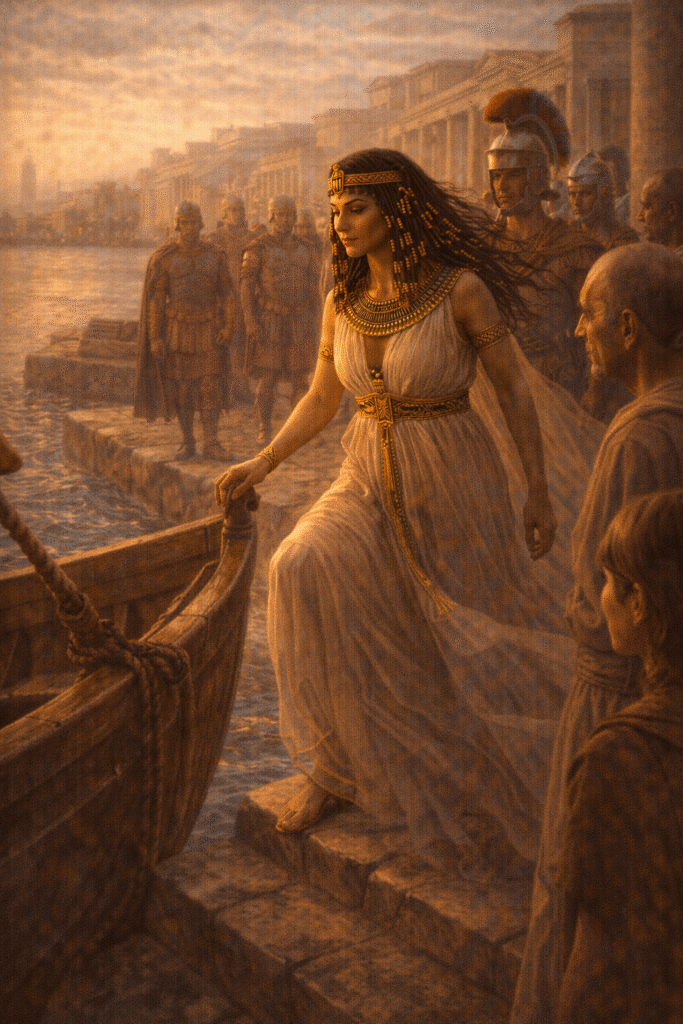
Prologue — Coming Home to a Kingdom That Had Changed Without Me
When you leave a city
in crisis
and return older,
sharper,
chosen by priests
and tested by exile,
you expect
to find everything different.
The strange cruelty is this:
I returned to Alexandria
and everything looked the same.
The Pharos still burned.
The harbor still crowded.
The palace still glittered.
The streets still roared.
But beneath the familiar skin,
something essential had broken.
Trust.
My father
sat again on the throne—
restored by Rome.
The people worked,
traded,
prayed.
But Egypt
was no longer ruled.
It was managed.
Drained.
Balanced on debts
and fragile agreements.
This Scroll
is my homecoming—
not to comfort,
but to collapse.
And the first time
I understood
that if Egypt was to live,
I would have to become
more than a dutiful daughter.
I would have to become
what the throne
refused to be:
a spine.
PART I — The City That Pretended Nothing Happened
From the deck
as we entered the Great Harbor,
Alexandria looked
almost peaceful.
Ships moved in and out,
sails blooming and folding.
Dockworkers shouted,
arguing over cargo.
Fishmongers stank of salt and scale.
Market-sellers rattled coins.
Life.
But as we drew closer,
I saw the details.
Walls bearing
old protest marks—
hastily whitewashed,
but still visible
under new paint.
A statue of my father
near the quay
with a faint crack
across its base—
a reminder
of a riot
someone had tried to erase.
Roman soldiers
standing too straight,
too relaxed,
the posture of men
who believe
no one will challenge them.
And the eyes.
Alexandrians
had always watched
royals with curiosity,
irritation,
sometimes admiration.
Now they watched
with calculation.
How far can this king survive?
How far will Rome reach?
Who will we turn to
when it all falls?
I stepped off the gangplank.
A murmur ran through the crowd.
“Cleopatra.”
Not shouted.
Spoken.
Tasted.
The city
was remembering me.
And evaluating.
PART II — A Throne Held Up by Foreign Hands
In the audience hall,
my father sat
on the gilded chair
that had once belonged
to Ptolemy I.
The throne of Alexander’s heir.
The throne of Egypt.
Now it looked
smaller.
Not physically.
Symbolically.
Beside it
stood two Roman officers—
not officially,
not in any grand role—
just close enough
to remind everyone:
This king
does not stand alone.
The senators
who had voted
for his restoration
had not followed him here.
They had sent
representatives.
Men
whose armor
gleamed brighter
than their respect.
As I entered,
my father forced a smile.
“Cleopatra,”
he said.
“Our prodigal daughter returns.”
“Egypt’s daughter returns,”
I replied, bowing.
His eyes flickered.
He heard the difference.
To the court,
he announced:
“She has walked
among the priests
and the people.
Let her bring us
wisdom.”
The Romans
looked at me
with cool interest.
A princess
with education.
A dangerous combination.
I bowed again.
“I have one piece
of wisdom,”
I said softly.
“Thrones supported
by foreign swords
are as fragile
as pottery.”
The hall
held its breath.
My father
laughed too loudly.
“Ah!
The innocence of youth.
We shall speak in private,
my child.”
His voice said “child.”
His eyes said “problem.”
PART III — The Conversation Behind Closed Doors
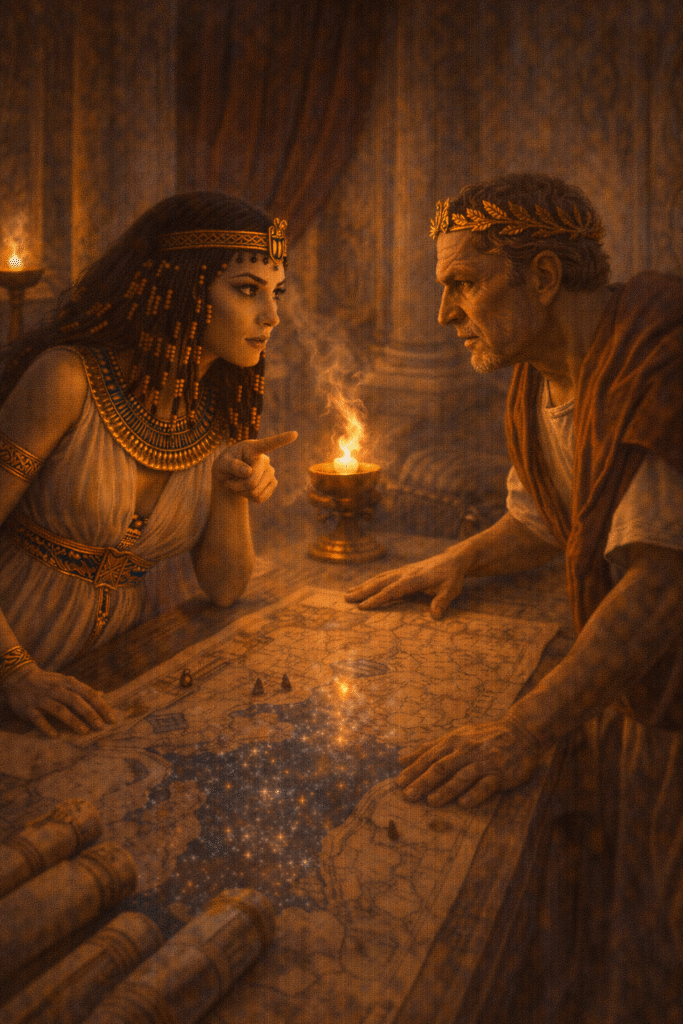
In his private chamber,
the mask dropped.
“You will not speak
against Rome
in front of Rome,”
he hissed.
“I spoke for Egypt,”
I said.
He paced.
“You think I like
their presence here?
You think I enjoy
being weighed
like grain in their markets?”
“I think you tolerate it,”
I replied.
“And so does the city.”
He stopped pacing.
“You went to Philae,”
he said quietly.
So he knew.
“The priests
whisper your name.”
“So do the people,”
I answered.
His lips thinned.
“You think
that makes you strong.”
“It makes me responsible.”
He stared at me
for a long time.
Finally, he said:
“They will turn to you
when I fail.”
It was not self-pity.
It was certainty.
I asked the only question
that mattered.
“And will you hate me then?”
He laughed once.
“No,” he said.
“I will be dead.”
It was a grim truth.
He poured wine.
“We have little time,”
he murmured.
“Time for what?”
“For you to learn
how to survive
what comes next.”
PART IV — The Court of Petitions: Where Egypt Spoke Plainly
If you want to know
the health of a kingdom,
you do not read decrees.
You go
to the petition court.
The place
where farmers, merchants,
widows, soldiers,
and scribes
come with complaints
and requests.
My father
rarely attended.
Too tedious.
Too many demands.
Too much reality.
So one day,
I sat there in his place.
Officially,
“to learn.”
Unofficially,
“to interfere.”
A scribe announced the cases.
A farmer from the Delta—
fields ruined by the bad flood,
tax collectors still demanding
full payment.
A widow whose husband
died defending a granary—
promised compensation
that never came.
A merchant
whose shipment was seized
“for the king,”
then sold privately
by a noble.
As each case
was read aloud,
the magistrates
shifted uncomfortably.
Their rulings
were formulas:
“The matter will be reviewed.”
“The king is merciful.”
“Further inquiry is needed.”
Meaning:
Nothing will be done.
I interrupted.
“Bring me the tax records
for this farmer’s district.”
A hush.
“Princess,”
one magistrate frowned,
“That is not—”
“Within my authority?”
I finished.
“Then consider this
practice.”
The records came.
I scanned them
while the petitioner watched,
eyes hollow
with resignation.
There it was.
The tax tally
was higher on papyrus
than in reality.
Someone had padded the numbers.
Someone in the chain
had stolen.
“This man,”
I said,
pointing to the scribe’s mark,
“has cheated the crown
and the farmer alike.”
The magistrate swallowed.
“What would you rule,
Princess?” he asked.
I looked at the farmer.
“His tax is remitted,”
I said.
“And the scribe
will be brought for questioning.”
The room shifted.
A guard hid a smile.
A scribe panicked.
A noble looked irritated.
The farmer—
this man
who had come
expecting only
dust and delay—
fell to his knees.
“May the gods
protect you,
daughter,”
he whispered.
It was a small act.
It was everything.
Word spread quickly:
There is someone in the palace
who listens,
who reads,
who acts.
Not a king.
A princess.
PART V — Rome Notices
Change
never goes unnoticed
by those
who benefit
from stagnation.
One of the Roman officers
requested an audience.
Ostensibly
to “discuss trade.”
In truth,
to inspect me.
We sat
in a shaded colonnade
overlooking the sea.
He spoke Latin.
I answered in Latin.
His eyebrows rose.
“Your Greek is excellent,”
he said.
“So is my Egyptian,”
I replied.
He smiled thinly.
“Why meddle
in petitions?” he asked.
“Such courts
are beneath a royal.”
“Is grain,”
I asked,
“beneath a royal?”
He tilted his head.
“You mean to help
your people.”
“Yes.”
“That is admirable.”
I waited.
Men who praise
often prepare to restrict.
He continued:
“But Rome prefers stability
over… experiments.”
“Justice,”
I said,
“is not an experiment.”
“For us,”
he said.
“For you—
perhaps it is.”
He leaned closer.
“Princess,”
he murmured,
“we restored your father.
We can restore—or remove—
anyone.”
I met his gaze.
“Then you should hope,”
I said softly,
“that when Rome is hungry,
Egypt is still willing
to feed her.”
His expression flickered.
We both understood
what I had not said:
A queen
who loves her people
can influence what they give.
A king
no one trusts
cannot.
Rome did not yet fear me.
But it had begun
to calculate me.
[Suggested Visual: Cleopatra and a Roman officer seated in a colonnade with sea in the background, both composed, both cautious.
AI Prompt: “Cleopatra VII in conversation with Roman officer in colonnaded terrace overlooking sea, tension hidden under politeness, cinematic realism.”]
PART VI — The Siblings’ Circle Narrows
While I repaired small fractures,
my siblings
worked on larger ones.
Arsinoe
cultivated friends
in the women’s wing—
daughters of nobles,
wives of officials.
Ptolemy XIII—
the younger brother
who would one day
share my throne—
studied not law or history,
but flattery and force.
He learned
which guards could be bought.
Which scribes
could alter records.
Which Roman officers
enjoyed bribes.
He was clever.
Quick with a smile.
Able to make anyone
feel like an ally.
And like all
deeply insecure men,
he collected power
the way others
collect charms—
one more piece,
one more pledge,
never enough.
We met often
in formal settings.
“Beloved sister,”
he would say,
voice as smooth as oil.
“Beloved brother,”
I would answer,
equally smooth.
Beneath our courtesy,
a simple arithmetic
was forming:
There could not be
two centers
of gravity.
He would accept
no equals.
Neither would I.
Egypt
would eventually choose.
But the palace
was already aligning.
Not around competence.
Around fear.
And fear
is a currency
my brother wielded
well.
PART VII — The Day My Father Named His Heirs
The throne hall
was packed.
Nobles.
Priests.
Merchants.
Roman envoys.
My father announced
his will:
At his death,
Egypt would be ruled
by two:
Ptolemy
and Cleopatra.
Brother and sister.
King and queen.
Dual rule.
It sounded harmonious.
It was not.
I felt
every gaze
swing between us.
Some already imagining
which one would fall first.
Which one would rule alone.
The Romans
whispered to each other.
They had seen
our dynamic.
They understood
what this meant:
There would be conflict.
And in conflict,
Rome
thrives.
My father
looked relieved.
“I have secured
succession,”
he said.
He had secured nothing.
He had simply
shifted the battlefield
to the next generation.
Later,
in a garden court,
Ptolemy approached me.
“So, sister,”
he said with a smile,
“we will rule together.”
“If we are wise,”
I answered.
“And if we are not?”
I held his gaze.
“Then only one of us will.”
His eyes sharpened—
for just a moment,
then softened again
into that charming mask.
“Let us hope,”
he said,
“that the gods
favor harmony.”
The gods
favor those
who serve Egypt.
We both knew
only one of us
intended to.
PART VIII — The Broken Throne Speaks to Me Alone
One evening,
after court had emptied,
I stayed alone
in the throne room.
The gilded chair
stood before me.
For the first time,
I saw
how worn
its footrest was.
Hundreds of years
of kings existing.
Some ruling.
Some failing.
Some merely sitting.
I walked up the dais
and stood beside it.
Not on it.
I ran my hand
along the carved lions
at its arms.
The gold
was cool.
Cold.
Pharaoh
was more than this chair.
But the chair
had trapped many
into thinking
they were Pharaoh
as soon as they sat.
I whispered:
“If I take you…
I will not be like them.”
The throne
did not answer.
But in the quiet,
I heard
my own resolve:
I would not be king
to satisfy my vanity.
I would be King
if Egypt needed one.
Not a consort.
Not a decorative sister.
Not a pawn.
If the throne was broken,
I would repair it
by becoming something
no one in Rome
believed possible:
A woman
who ruled Egypt
as Egypt.
Not as ornament.
Not as puppet.
Not as prize.
As Pharaoh.
🌿 MID-SCROLL CTA — Stand in the Room Where Succession Shifted
If you want to stand
where a dying king
publicly tied his fate
to two children
already preparing
for a civil war—
If you want to walk
through the throne spaces
where Cleopatra
began to see
not just power,
but its structural failures—
If you want to feel
what it means
to inherit
a broken kingdom—
walk with ENA.
Stand in the places
where the future
was announced
and fracture
was sealed.
Journey with ENA.
Sometimes a throne
is not a gift,
but a wound.
PART IX — The Quiet Allies
In a broken court,
allies are rare.
But I found some.
Not among nobles.
Not among Roman guests.
Among:
Scribes
who valued order.
Priests
who valued balance.
Guards
who valued stability.
Merchants
who valued honest routes.
They began to come to me
with information.
A shipment
delayed suspiciously.
A decree
altered in copying.
A Roman officer
receiving more “gifts”
than necessary.
I never promised them
riches.
I promised them
this:
“I will remember
that you served
Egypt
when others served
only themselves.”
Loyalty
is not bought.
It is recognized.
A young guard
once said to me:
“If you become queen,
will you still walk
through the city?”
“Yes,” I said.
“Then I will follow you.”
Not “obey.”
Follow.
Different word.
Different relationship.
That night,
I slept lighter.
Not because I was safe.
But because I finally knew
I was not alone.
PART X — My Father’s Final Conversation with Me
Shortly before his death,
my father called me.
He was thinner.
Eyes dimmer.
Hands shaking.
“Cleopatra,”
he said,
“they will tell you
I chose you for Rome.”
“They already do,”
I answered.
He shook his head.
“I chose you
for Egypt.”
I could have argued.
I could have listed
his failures.
But this was
a dying man
trying to leave
one honest mark
on a life
too full of compromises.
So I listened.
“Your brother,”
he rasped,
“has many friends
at court…
and in Rome.”
“I know.”
“You have many friends
in the streets…
and in the temples.”
“I know.”
He smiled weakly.
“Rome believes
that means he will win.”
“And you?”
He looked at me
with the clarity
of someone
finally done with fear.
“I have seen
how this city
looks at you.”
He paused.
“Do not betray that.”
I bowed my head.
“I will not.”
He struggled
for breath.
“When they…
when they put you
on the throne,”
he whispered,
“remember this:
The throne is broken.
Do not sit on it
as it is.
Change it.”
His hand
found mine.
“For Egypt,”
he murmured.
We do not always
get the fathers we want.
But in that moment,
he was the king
Egypt needed him to be—
not in policy,
but in recognition.
And recognition
is where change begins.
PART XI — The Broken Throne Awaits
When he died,
the city did not erupt.
It exhaled.
The Romans
tightened their presence.
My brother
tightened his circle.
The court
tightened its smiles.
I tightened my resolve.
I was no longer
a princess
returning to a broken throne.
I was an heir
standing before it.
Beside me,
Ptolemy XIII
smiled to the court.
“Let us rule together,”
he said.
He meant:
Let me rule
and let her
stand beside me.
I smiled back.
“Yes,”
I said.
I meant:
Let Egypt
decide.
Because in the end,
it would not be
Rome,
or the court,
or even my brother
who decided my fate.
It would be
the people.
The priests.
The river.
The Three
who had always
truly ruled Egypt.
And they had already
begun to choose.
Ancient Questioner’s Desk — The Broken Throne Edition
A student asked:
“Why did Egypt accept Cleopatra?”
The elder replied:
“Because Egypt
recognized itself in her.”
Another asked:
“Was her brother
truly dangerous?”
The historian wrote:
“He was dangerous
to everyone but Rome.”
A traveler wondered:
“Did her father
trust her?”
The scribe answered:
“He trusted her
more than he trusted
his own legacy.”
A final question came:
“Could the throne
have remained shared?”
The old master smiled sadly.
“A broken throne
cannot carry two.”
FINAL CTA — Stand at the Edge of Her Crown
This Scroll ends here—
on the threshold
between princess
and queen,
between broken father
and broken throne,
between Rome’s shadow
and Egypt’s hope.
If you want to feel
the tension
of a kingdom
about to choose
between two children,
and the quiet certainty
of the one
who loves it more—
walk this arc with ENA.
Stand where Cleopatra stood
when the world believed
her story was about to begin—
not knowing
how much of it
had already been written.
Journey with ENA.
Before she wore the crown,
she learned why it was broken.
Historical Context
Cleopatra regained power with Roman support following her exile, marking the beginning of Egypt’s deeper dependence on Roman political structures.
This scroll narratively compresses the political aftermath of her return to emphasize instability rather than chronological detail.