
7 Day Egypt Itinerary With Kids (Private Family Tour + Optional Nile Cruise) – 2026 Complete Guide
There are two types of families who consider Egypt.
The first group dreams about it but hesitates. They imagine heat, crowds, long museum days, and exhausted children dragging their feet past monuments they don’t understand.
The second group goes — and returns saying it was the most eye-opening trip their children have ever taken.
The difference between those two outcomes is not luck. It is structure.
Egypt is not difficult for families. It is demanding if approached without intention. Ancient sites are vast. Distances between cities require planning. Museum collections can overwhelm without guidance. And desert climates punish poor scheduling.
But when paced privately, with built-in recovery time, realistic daily windows, and experiences designed for engagement rather than endurance, Egypt becomes immersive rather than exhausting.
This 7 day Egypt itinerary with kids is built around our private 7-Day Cairo & Nile Cruise Family Tour — refined through real family travel experience rather than theory. It combines private guiding, strategic pacing, the Grand Egyptian Museum, complimentary camel rides at the pyramids, and a fully integrated Nile cruise that simplifies logistics and builds natural downtime into the journey.
It is not a checklist itinerary. It is a psychologically structured family travel plan.
Why Egypt Works for Families — When Designed Correctly
Children respond to scale, story, and physical presence.
They do not need imagination to be captivated in Egypt. The pyramids rise in front of them. Tomb walls glow with color carved three thousand years ago. Massive statues tower above them. Boats glide along the Nile exactly as they did in antiquity.
Unlike destinations that require contextual explanation before interest develops, Egypt is immediately visual.
Where families go wrong is assuming more exposure equals more value.
It does not.
The real skill of family travel in Egypt is restraint.
Limiting site duration.
Starting early in warm months.
Returning to the hotel before fatigue sets in.
Protecting downtime as fiercely as sightseeing time.
When those principles are respected, Egypt becomes not only manageable — but transformative.
7 Day Egypt Itinerary With Kids – Structured for Energy, Not Exhaustion
Day 1 – Arrive in Cairo: Stabilize Before You Explore
Arrival in Egypt should never be treated as a sightseeing window.
After international travel, children are cognitively overloaded — even if they seem energetic. The first evening in Cairo is about recalibration.
Private airport assistance minimizes friction. A direct transfer removes navigation stress. The goal is simple: hydrate, rest, reset sleep cycles.
If energy allows, a short evening stroll or relaxed dinner works beautifully. But the pyramids should wait.
Anticipation is powerful when paired with rest.
Day 2 – Giza Plateau & The Grand Egyptian Museum
This is Egypt’s impact day.
An early morning start at the Giza Plateau preserves cool air and attention span. The pyramids dominate physically — children do not need historical lectures to feel scale.
Your guide shapes the experience around story and observation:
How were blocks moved?
Why is the Sphinx aligned this way?
What do we still not know?
The Valley Temple introduces ancient ritual architecture without overwhelming walking distance.
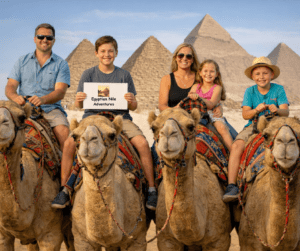
A camel ride near the pyramids adds physical memory — desert wind, shifting perspective, laughter. For many children, this becomes the emotional anchor of the trip.
After rest and lunch, the Grand Egyptian Museum provides context.
Rather than touring every gallery, the focus remains selective:
• The Tutankhamun collection
• Monumental statues
• Architectural scale
Two to three hours is ideal. The goal is engagement — not completion.
Evening flight south transitions the family to Upper Egypt.
Day 3 – Aswan: Modern Engineering & Ancient Granite
Aswan feels calmer immediately.
The High Dam introduces modern Egypt and the story of controlling the Nile. Children grasp scale quickly when they see Lake Nasser stretching into the desert.
At the Unfinished Obelisk, the learning becomes tactile. Tool marks are visible. The crack that halted its completion becomes a story of ambition and imperfection.
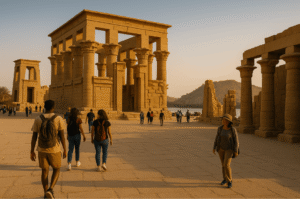
Philae Temple offers contrast — reached by boat, surrounded by water, framed by open sky. It is visually digestible and emotionally accessible.
The afternoon allows decompression.
If traveling by Nile cruise, this is where the rhythm shifts: unpack once, settle into river pace.
Day 4 – Kom Ombo & Edfu: Symbolism and Structure
This day introduces temple design through contrast.
Kom Ombo’s rare dual layout sparks curiosity — two mirrored sanctuaries, crocodile symbolism, carved medical instruments.
Edfu feels cinematic. Towering pylons and enclosed courtyards create fortress-like drama.
Visits remain intentional and time-limited.
The Nile cruise option provides built-in rest between stops — meals included, pool access, no repacking.
Energy remains protected.
Day 5 – Luxor’s West Bank: Tombs & Monumental Architecture
Luxor compresses intensity.
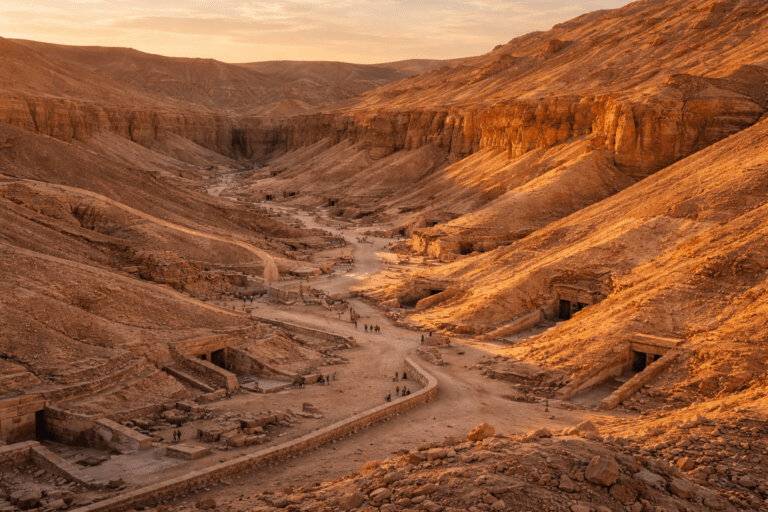
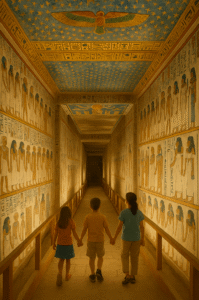
The Valley of the Kings is approached selectively — two or three vividly painted tombs are enough. Overexposure dulls impact.
Children respond strongly to:
• Star-covered ceilings
• Narrow painted corridors
• The sensation of stepping inside ancient burial chambers
Hatshepsut’s Temple introduces architectural geometry against desert cliffs — open, dramatic, walkable.
The Colossi of Memnon provide scale without long exertion.
If included, Karnak’s vast hypostyle hall offers vertical grandeur — but again, in measured time blocks.
The rule remains consistent: leave before exhaustion.
Day 6 – Luxor Temple & Return to Cairo
Luxor Temple offers a final layer of perspective.
Unlike isolated archaeological zones, this temple sits integrated into a living city. Its layers — pharaonic, Roman, Islamic — illustrate continuity.
A relaxed lunch precedes the flight back to Cairo.
The final evening is intentionally flexible.
Families who want a cultural browsing experience may explore Khan el Khalili at this stage — when major sightseeing is complete and there is no pressure to rush.
Others may prefer pool time or quiet reflection.
Completion should feel calm.
Day 7 – Departure
Transfer to Cairo Airport concludes the structured journey.
Seven days in Egypt does not aim to see everything.
It aims to see what matters — at the right scale.y.
The Nile Cruise Option: Structured Ease
For many families, the Nile cruise is not about luxury — it is about logistics.
Unpacking once.
Meals included.
Transportation embedded.
Pool access during sail time.
Sailing between temples offers decompression space. Children can read, swim, journal, or simply watch riverbanks pass.
The cruise transforms travel days into rest days.
Temple visits from cruise stops are short and intentional. Kom Ombo’s crocodile symbolism fascinates children. Edfu’s towering columns feel fortress-like and cinematic.
Evenings are calm. No repacking. No late transfers.
For families who prefer simplicity, the cruise removes friction.
The No-Cruise Option: Flexible Control
Some families prefer full customization.
Staying in boutique riverside hotels allows for:
Later starts if needed.
Longer pool sessions.
More selective temple visits.
This option works especially well for families with very young children or those who prioritize pacing over structure.
Neither option is superior. Each reflects a travel personality.
Luxor – High Impact, Carefully Managed
Luxor concentrates visual intensity. Valley tombs, towering temples, desert cliffs — all within short distances.
The temptation is to see everything.
Resist it.
The Valley of the Kings is best approached as a curated experience. Two or three tombs with vibrant wall color are sufficient. Overexposure dulls impact.
Children respond to the enclosed atmosphere, the preserved paintings, the feeling of stepping into ancient burial chambers. They do not benefit from five consecutive tombs.
The Temple of Queen Hatshepsut introduces architectural contrast — geometric terraces set against desert rock.
For families with older children or teenagers, the optional sunrise hot air balloon ride has become one of Luxor’s most requested experiences. Floating quietly above farmland and temple complexes reframes geography in a way no ground visit can.
It is not adrenaline-driven. It is contemplative.
The key again is pacing.
Luxor should feel monumental — not marathon-like.
Safety, Reality, and Reassurance
Safety questions are normal, especially for parents.
Major tourist corridors in Egypt operate under visible and structured security frameworks. Hotels screen entrances. Archaeological sites are monitored. Airports are modern and organized.
Private touring further reduces unpredictability.
Children’s practical safety is addressed through:
Hydration management.
Sun protection.
Midday rest planning.
Reputable food sourcing.
Medical facilities are available in major cities. Travel insurance is strongly recommended, as with any international trip.
Egypt is not chaotic when navigated professionally.
It is structured, layered, and surprisingly organized within tourism zones.
Climate and Seasonal Strategy
Egypt’s best family travel window is October through April.
Temperatures are manageable. Evenings are comfortable. Walking feels sustainable.
Summer travel is possible but demands discipline: early site entry, afternoon retreat, evening activity.
Children tolerate heat better when adults plan around it instead of through it.
For updated seasonal information, families can consult Egypt’s official tourism resource.
The Most Common Family Mistake
The most common mistake families make in Egypt is overestimating daily capacity.
Parents often feel pressure to “maximize” a rare international trip.
But memory does not correlate with volume.
Children remember:
The camel ride.
The balloon ascent.
The moment inside a painted tomb.
The first sight of the pyramids.
They do not remember a fourth temple added at 4:30 PM.
Restraint creates retention.
What Makes This 7-Day Structure Effective
This itinerary works because it balances:
Monumental sites with recovery time.
Visual intensity with narrative explanation.
Movement with stillness.
Structure with flexibility.
It acknowledges that Egypt is both ancient and modern, intense and beautiful, educational and adventurous.
It protects children’s energy rather than consuming it.
Is This 7 Day Egypt Itinerary With Kids Right for Your Family?
Frequently Asked Questions About Visiting Egypt With Kids
1. Is Egypt safe for families traveling with children?
Major tourist areas such as Cairo, Luxor, and Aswan are well-secured and heavily monitored. Traveling with licensed private guides and arranged transportation adds structure and comfort for families.
2. What age is best for visiting Egypt?
Egypt works especially well for children aged 6 and older, as well as teenagers. Younger children can travel comfortably with slower pacing and private touring.
3. Is a Nile cruise suitable for kids?
Yes. A Nile cruise simplifies travel logistics, reduces daily packing, includes meals, and offers downtime such as pool access between temple visits.
4. Is Egypt too hot for children?
The best months for visiting Egypt with kids are October through April. Summer travel is possible with early starts and scheduled rest time.
5. Do kids get bored at temples?
Not when visits are curated and guided properly. Private guides adapt explanations based on age and keep visits focused rather than overwhelming.
6. Does this itinerary include a camel ride?
Yes. A complimentary camel ride experience is included when visiting the Pyramids of Giza.
7. Can we customize this 7-day itinerary?
Yes. As a private Egypt tour, pacing and optional experiences can be adjusted based on your family’s interests and energy levels.
8. Is the Grand Egyptian Museum better for kids than the old museum?
The Grand Egyptian Museum is modern, spacious, and easier to navigate, making it more comfortable for families.
9. Is the Luxor hot air balloon ride safe for families?
When operated by licensed companies with strong safety records, the sunrise balloon ride is considered safe and has become popular with families traveling with older children.
10. How many days are enough for Egypt with kids?
Seven days allows families to experience Cairo, the Nile, and Luxor comfortably without rushing. Ten days allows for additional rest time or a Red Sea extension.
11. Are there family-friendly hotels in Egypt?
Yes. Cairo, Aswan, and Luxor offer hotels and cruise ships with pools and family room options.
12. Is a private tour better than a group tour for families?
Private tours allow flexible pacing, custom explanations, and real-time adjustments — which are especially valuable when traveling with children.
Final Perspective
Egypt with children is not about endurance.
It is about exposure at the right scale.
When managed privately, paced intelligently, and built around emotional highs rather than historical saturation, Egypt becomes more than a vacation.
It becomes a reference point in a child’s understanding of the world.
Seven days is enough.
Not to see everything.
But to see what matters — clearly, comfortably, and memorably.
Explore more detailed planning advice inside our Egypt travel guides.
Families who prefer a slower pace with added Red Sea downtime can explore our 10 day Egypt itinerary with kids for a more expanded structure.
Ready to Plan Your 7-Day Egypt Family Tour?
If this itinerary feels like the right balance of culture, comfort, and adventure for your family, you can view the full journey details here: