Scroll XXVI – The Day We Chose the Sea
Alexandria → Patrae → Actium — 32–31 BCE
Translated and restored for the modern traveler.
Prologue — Decisions Are Not Made in Confidence. They Are Made in Consequence.
When history speaks
of our final war,
it claims we chose the sea
out of pride.
That is a lie.
We chose the sea
because every road
was already on fire.
Octavian’s armies
marched relentlessly.
His propaganda
poisoned the world.
His political machinery
dominated Rome.
His allies
swelled like a tide.
Land
was no longer strategy.
Sea
was our only path
to survive the storm
that had already begun.
This Scroll
is the night
we made the choice
that fate had been whispering
for years.
PART I — The Fall of Our Allies
Before the decision,
our world shrank
with terrifying speed.
Herod of Judea
betrayed his oath
and sided with Octavian.
Kings of Asia Minor
bowed to Rome
out of fear.
Numidian cavalry
vanished,
lured with Roman gold.
Greek cities
declared neutrality—
which meant
Octavian owned them.
Our diplomats
returned from missions
with hollow eyes.
“Majesty,” they said,
“Rome offers peace—
but only if Antony
abandons Egypt.”
“And if he refuses?”
I asked.
“War.”
There was no neutrality left.
The world
had chosen sides.
Even before we did.
PART II — The First Council of War
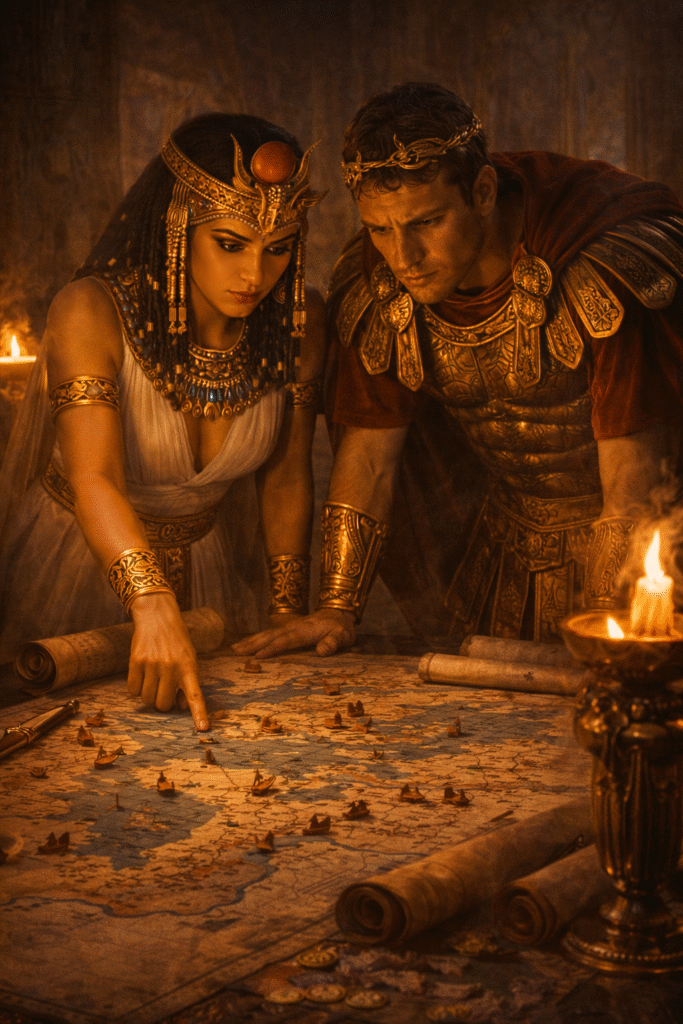
We met in Alexandria’s war hall.
Bronze ship icons
glittered on the map.
Ink rivers
cut the Mediterranean
into routes and choke points.
Antony stood
at the head of the table.
His strongest generals
lined the sides:
Canidius.
Eros.
Dellius.
Agrippa’s spies
reported from afar.
I sat beside Antony.
Not behind.
Beside.
A queen
in a war of nations.
Antony began:
“Octavian cannot match
our eastern legions.”
“True,”
Canidius said.
“We outnumber him on land.”
Antony nodded.
“But he dominates the sea.”
Silence.
The generals shifted.
Antony turned to me.
“Cleopatra,”
he said,
“Egypt’s fleet is the strongest
in the Mediterranean.”
“Yes,”
I replied.
“But numbers are not enough.”
Then I spoke
the truth
no one wanted to say:
“If we remain on land,
Octavian will cut our supply lines.
Starve our armies.
Trap us in Greece.
Bleed us without battle.”
Antony placed a hand
flat on the map.
“We must choose.”
PART III — Why We Did Not Choose the Land
In later centuries,
historians insisted
we were fools
for not choosing
a land battle.
But those historians
did not stand
where we stood.
They did not see:
**1. Octavian’s general Agrippa
had seized the Aegean,
cutting off our supply routes.**
**2. Roman legions
in Europe and Asia
were ready to converge
from two directions.**
**3. Land routes
could be closed by winter storms.**
**4. Our armies
were exhausted from marching
and undersupplied.**
**5. Greece
was sympathetic to Rome,
not to us.**
**6. On land,
the terrain favored Octavian —
open, flat, perfect for his formations.**
Choosing land
was choosing strangulation.
Choosing sea
was choosing risk.
Between suffocation
and storm—
we chose storm.
PART IV — My Voice in the Decision
Antony dismissed his generals
for a moment.
“Cleopatra,”
he said quietly,
“speak.”
So I did.
“Octavian cannot defeat us
in open water.
He knows only speed.
We know endurance.
Your ships are strong—
mine are stronger.”
I touched the map.
“Our hulls
are triple-layered.
Our rams
are iron-forged.
Our sails
are reinforced for storms.”
I looked him in the eye.
“At sea,
we control the narrative
and the horizon.”
Antony studied me.
“You believe
the sea is our salvation.”
“No,” I said softly.
“I believe the sea
is our only battlefield
where Rome does not
already hold the ground.”
He breathed out slowly.
“Then the sea it is.”
PART V — The Night Before We Chose
Antony could not sleep.
He walked the palace
like a restless lion.
I found him
in the moonlit garden,
staring at the reflecting pool.
“Cleopatra,”
he said,
“Am I choosing this
for strategy—
or because I fear
facing Rome on land?”
I stepped closer.
“You do not fear Rome,”
I said.
“You fear losing
what remains of yourself.”
He closed his eyes.
“Octavian has already
turned the Senate
against me.”
“Yes,”
I said.
“But he has not turned
the sea.”
He opened his eyes.
“When did you see
that we would end
on the water?”
“The day
he stole Caesar’s will.”
Antony looked away.
“He fights with words.”
“And we will answer
with waves.”
PART VI — The Fleet of Alexandria
We prepared
not a fleet—
a floating city
of war.
230 Egyptian ships
reinforced with oak and cedar.
Heavy hulls.
Iron rams.
Archers stationed on towers.
Fire pots ready.
Ballistae mounted.
Greek engineers
tuning catapults.
Nubian archers
training on deck.
Egyptian sailors
burnishing oars.
The greatest fleet
since Xerxes.
Every hull
painted with eyes—
to “see” the enemy.
Every mast
wrapped with linen charms
prayed over by priests.
Every deck
scrubbed
before dawn
with Nile water.
The sea
was not our enemy.
It was our ally.
If we honored it.
PART VII — The March to Actium
Antony led
20,000 infantry
and 12,000 cavalry
northward.
I followed
with the fleet—
slower,
heavier,
but steady.
Greece
was beautiful
in early summer.
Olive groves
silver under sun.
Blue waters
like polished stone.
Villages
caught between fear
and hospitality.
But beneath the beauty—
danger.
Octavian’s scouts
watched our every move.
Agrippa seized harbors
before we could reach them.
Supplies dwindled.
Sickness crept.
By the time
we anchored in Actium—
a tiny curve of land
shaped like a scythe—
I understood.
This place
would either
save us
or bury us.
PART VIII — The Final War Council
The war council
met in a stone villa
overlooking the bay.
Waves pounded
the rocks
like war drums.
Antony’s generals
begged:
“Fight on land!”
“Withdraw to Egypt!”
“Break through the blockade!”
Antony slammed his fist
on the table.
“No.
We fight at sea.”
Some glared at me,
blaming the choice
on a queen.
I met their glares
without blinking.
“Do not confuse
a woman’s presence
with a woman’s influence,”
I said.
“This war
was inevitable
long before I walked
into it.”
Silence.
Then Antony said:
“Enough.
Cleopatra is right.
Land will destroy us.
The sea
offers escape
and victory.”
He looked at me.
“We sail
at dawn.”
PART IX — The Dawn We Chose the Sea
The morning
rose cold
and windless.
The worst kind
of omen.
I walked
the deck of my flagship
before sunrise.
Sailors bowed their heads.
Priests murmured blessings.
Archers tightened bowstrings.
Rowers dipped fingers
into the sea
and kissed them.
Antony boarded
his flagship
with a face
that looked carved
from bronze.
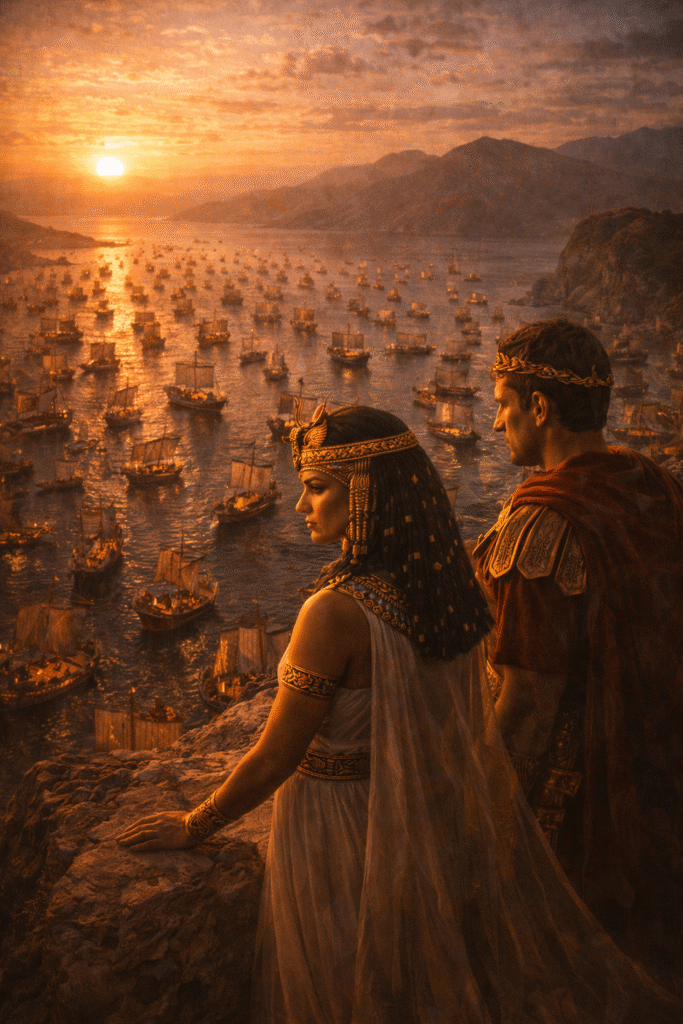
When our ships
aligned
in perfect formation—
230 Egyptian ships
shoulder to shoulder
with Antony’s Roman vessels—
the horizon shimmered.
We had done something
no one thought possible:
We created
a united navy
strong enough
to shake the world.
I touched the railing
and whispered:
“Sea,
carry us.”
PART X — What We Did Not See Coming
We believed
the sea was ours.
We believed
our hulls
would crush Rome’s speed.
We believed
Agrippa’s blockade
could be breached.
We believed
Antony’s legions
would hold Octavian’s from land.
We believed
our alliance
balanced fire
with stone.
We believed
the world
still shifted
under our feet—
not entirely
under Rome’s.
But the sea
does not love anyone.
It respects those
who respect it.
And punishes
those
who mistake its surface
for safety.
The choice
was right.
The conditions
were not.
Because Octavian
was not waiting
to defeat us at sea.
He was waiting
to let the sea
defeat us for him.
War
is never one decision.
It is a thousand
small inevitabilities
masquerading as choice.
Ancient Questioner’s Desk — The Sea Edition
A student asked:
“Why did Cleopatra and Antony choose a naval battle?”
The elder replied:
“Because the land
was already lost.”
Another asked:
“Was the decision foolish?”
The historian wrote:
“It was strategically sound—
and cruelly timed.”
A traveler wondered:
“Did Cleopatra convince Antony?”
The scribe answered:
“She showed him
the only path left.
He chose it.”
A final question came:
“Would any choice
have saved them?”
The old master sighed.
“No.
Rome wanted a world
that did not include
their future.”
FINAL CTA — Stand on the Shore Where Fate Chose Its Battlefield
This Scroll ends here—
on the cliffs of Actium,
in the war rooms of Alexandria,
in the quiet nights
before storm winds rose,
in the moment
a queen and a general
chose the only battlefield
Rome had not yet conquered.
If you want to walk
the waters
where empires collided,
the harbors
where fate whispered,
the shores
where the last hope
of the East
prepared to rise—
walk them with ENA.
Journey with ENA.
Some choices shape battles.
Some choices shape destinies.
This choice shaped the world.