
Scroll XXV – The War of Words and Shadows
Rome & Alexandria — 33–32 BCE
Translated and restored for the modern traveler.
Prologue — Wars Begin Long Before Swords Are Drawn
Weapons kill bodies.
Words kill nations.
Rome had always understood this.
Octavian mastered it.
And so the war
did not begin
with ships
or armies
or generals.
It began
with ink.
With scrolls.
With whispers.
With rumors
faster than legions.
The war that would end my life,
that would drag Antony into ruin,
that would shatter the world we built—
began with shadows.
This Scroll
is the story
of how Rome
tried to erase me
before ever lifting a blade.
**PART I — Octavian’s First Strike:
Not Against Antony, but Against Me**
Most historians misunderstand this:
Octavian did not declare war
on Mark Antony.
He declared war
on Cleopatra.
Because Antony
—brilliant, impulsive, military titan—
could be defeated.
But Cleopatra
—strategist, sovereign, mother of heirs—
was a threat to the world order.
A ruler
whose dynasty
made Rome unnecessary
in the East.
A queen
who could unite
Egypt, Syria, Judea, Anatolia, Armenia, and more
into a rival empire.
A woman
with a legitimate heir
to Julius Caesar himself.
Octavian understood:
If he wanted Rome,
he must destroy Cleopatra.
Antony was merely
in the way.
PART II — The Scrolls Arrive in Alexandria
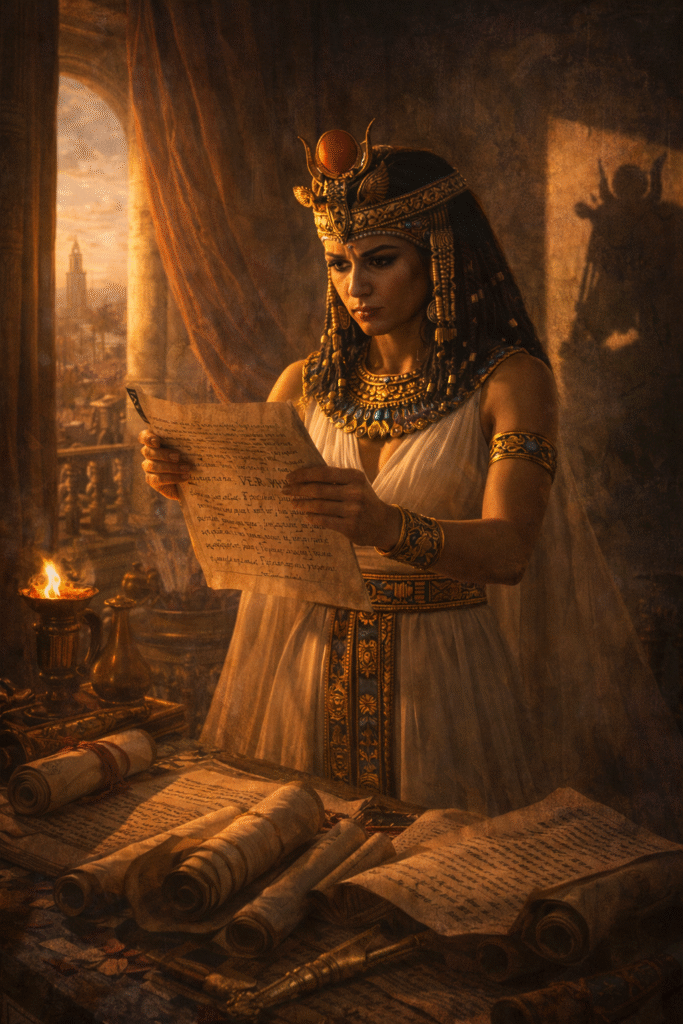
I read the first Roman pamphlets
in my solar at dawn.
They had arrived
secretly,
smuggled by merchants
and spies.
Ink still fresh.
Words sharp as knives.
“Antony has become Egypt’s slave.”
“Cleopatra controls Rome’s eastern army.”
“This foreign queen corrupts our general.”
“She plots to move the capital to Alexandria.”
“She dreams of ruling the world.”
My steward trembled
as he handed me the pile.
“Majesty…
these writings spread
through Rome
like wildfire.”
I read each line carefully.
Not insulted.
Not surprised.
Forewarned.
Because Octavian
was revealing his strategy:
1. Turn Antony into a traitor
—not because he was,
but because Rome feared losing him.
2. Turn Cleopatra into a monster
—not because I was,
but because Rome feared
a powerful foreign queen.
3. Turn the Roman people
against both of us
before a single battle was fought.
Words
are the battlefield
where wars are won
long before the armies march.
**PART III — Octavian’s Second Strike:
Stealing Caesar’s Will**
In Rome,
lies grew teeth.
Octavian seized
Caesar’s sealed will
from the Vestal Virgins—
a sacrilege so shocking
that even his allies
hesitated.
But he knew
that power
requires blasphemy.
He opened the will
before the Senate.
I was not named in it.
Caesar had died
before Caesarion’s birth
was publicly acknowledged.
But that didn’t matter.
Octavian lied.
He told the Senate:
“Caesar intended to give Rome
to Cleopatra and her son!”
Gasps.
Shouts.
Chaos.
A lie
in a sacred chamber
becomes a truth
in the public square.
Rome erupted.
“Egypt must be destroyed!”
“Cleopatra seeks to make Romans slaves!”
“She seduces our generals!”
“She defiles our traditions!”
“She poisons the Republic!”
It was a storm
of words
designed to force
a storm of swords.
**PART IV — Antony’s Letters Arrive
and the Shadows Grow Longer**
Antony sent letters
to the Senate
defending our alliance.
They never reached
the people.
Octavian intercepted them.
He read them aloud—
altered,
edited,
twisted.
He mocked Antony
for loving a foreign queen.
He mocked Antony
for naming our children.
He mocked Antony
for planning Eastern futures.
He turned Rome
into an audience
and Antony
into a joke.
Ridicule
is deadlier than wounds.
Rome laughed.
And in that laughter
was the sound
of armies forming.
**PART V — Alexandria’s Response:
Not Fear. Preparation.**
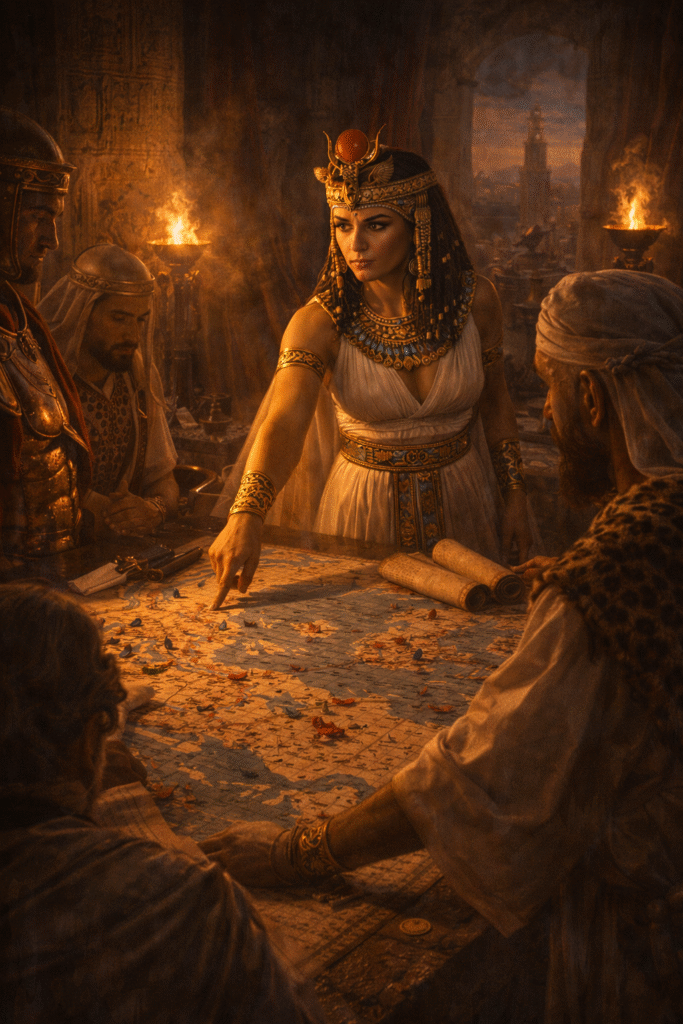
I gathered my generals,
treasurers,
scholars,
admirals.
I said:
“Octavian prepares
for war.”
Some trembled.
Some argued.
Some denied.
But I knew.
The Mediterranean
had changed color.
Trade winds
smelled of iron.
Diplomatic letters
grew colder.
Spies grew bolder.
Allies grew cautious.
Egypt
would be the battlefield.
Not because Egypt
was weak—
but because Egypt
was essential.
We prepared:
— rebuilt the navy
— fortified the Delta
— stored grain
— trained new soldiers
— strengthened walls
— diversified alliances
A queen
does not wait
for war to arrive.
She prepares her people
for the weight of it.
PART VI — The Roman Marriage Weapon
Then Octavian made
his most brilliant move.
He forced Antony’s wife—
Octavia, his own sister—
into the center
of the propaganda war.
He paraded her
through the streets.
He showed the people
a wronged Roman woman.
He told crowds:
“My sister is abandoned
for a foreign temptress!”
He turned her grief
(real or performed —
historians still debate)
into a political weapon.
Rome does not hate betrayal.
Rome hates humiliation.
By using Octavia,
Octavian made Antony’s alliance
with me
an insult
to Roman pride.
War
was not only justified.
It was demanded.
**PART VII — The Senate Vote:
Not on Antony—
On Me**
The Senate convened.
Octavian stood before them
in immaculate white.
He raised his voice:
“Rome does not wage war
on Mark Antony.
He is our misguided brother.
Rome wages war
on Cleopatra—
queen of Egypt,
enemy of the Republic.”
My name
echoed through the chamber
like a curse.
And with that one vote—
Rome committed itself
to war
against a woman.
Against a queen.
Against an idea:
**That the East
could be powerful
without Rome.**
History remembers
what came after.
But this
was the real moment
the empire was born.
Not in conquest.
In fear.
Fear of me.
Fear of Egypt.
Fear of a world
they could not conquer
through negotiation.
PART VIII — The Night the Priests Warned Me
One night,
the high priest of Isis
came to me trembling.
“Majesty,”
he whispered,
“The omens turn dark.”
“What do they say?”
“That a great serpent
moves westward.”
“Octavian,”
I said.
He nodded.
“And the gods warn
that this serpent
speaks with many mouths.”
Propaganda.
Rumor.
Fear.
Lie.
Shadow.
Octavian’s greatest weapons.
“The gods ask,”
the priest whispered,
“Will Egypt endure?”
I looked out
toward the Mediterranean—
dark, silent,
waiting like a battlefield
that had not yet remembered
its own blood.
And I whispered:
“Yes.”
Not because the future
was certain.
But because surrender
is not in Egypt’s blood.
PART IX — What Antony Did Not See
I could read Octavian
the way sailors
read storms.
Antony could not.
Antony believed
honor
could win battles.
Octavian believed
information
could win wars.
Antony was fire.
Octavian was ice.
Antony was beloved.
Octavian was feared.
Antony moved armies.
Octavian moved nations.
And the worst part?
Antony still thought
the war would be fought
with swords.
But Octavian
was already winning
with scrolls.
And scrolls
spread faster
than legions march.
I saw it.
Antony did not.
And that—
more than any naval mistake,
more than any battle—
would be
the undoing of everything.
PART X — What I Understood Before the End
I stood one evening
on the palace balcony
while the sea wind
tangled my hair.
The horizon
was a bruise.
Purple.
Grey.
Swollen with future storms.
I whispered:
“Octavian does not want Egypt.
He wants the world.”
Antony stepped beside me.
“He will not take it.”
I looked at him.
Passionate.
Brave.
Loyal.
Brilliant.
Flawed.
A man of war—
in an era
that had become
a war of words.
“He already has,”
I murmured.
Antony frowned.
“What do you mean?”
“He has taken Rome.
He has taken the Senate.
He has taken the people.
He has taken the truth.”
I turned toward him.
“All that remains
is the battlefield.”
And the battlefield
was coming.
Not tomorrow.
Not next year.
Now.
Unstoppable.
Relentless.
Cold.
Ancient Questioner’s Desk — The Shadow War Edition
A student asked:
“Why did Octavian hate Cleopatra?”
The elder replied:
“Because her existence
proved Rome did not control the world.”
Another asked:
“Did Cleopatra provoke Rome?”
The historian wrote:
“No.
She built the East.
Rome could not tolerate competition.”
A traveler wondered:
“Why not declare war on Antony directly?”
The scribe answered:
“Because Rome feared its own generals—
but never feared
destroying a foreign queen.”
A final question came:
“When did Cleopatra know
the end was coming?”
The old master smiled sadly.
“When Rome learned
to kill with words
before swords.”
FINAL CTA — Walk the Edges of the Storm Before It Broke
This Scroll ends here—
in Alexandria’s shadowed halls,
in Rome’s venomous Senate,
in the whispers of propaganda,
in the storm of lies
that made war inevitable.
If you want to walk
the spaces where history
was twisted into weapons—
the halls where my name
became a threat,
the chambers where Rome
voted to destroy a queen,
the courtyards where Egypt
braced for war—
walk them with ENA.
Journey with ENA.
Wars of swords end nations—
but wars of shadows define them.