Luxor Egypt Tours: The Complete Guide to Ancient Thebes
Luxor is where ancient Egypt stops being a topic you read about and becomes a place you walk through. Long before it was called Luxor, this city was Thebes, the spiritual heart of Egypt during the New Kingdom—an era that shaped the country’s most famous pharaohs, its grandest temples, and its most stunning tomb art.
If Cairo represents Egypt’s power and Alexandria reflects Egypt’s Mediterranean intellect, Luxor represents Egypt’s sacred ambition. The city is split by the Nile into two symbolic halves that still define the best Luxor Egypt tours today: the East Bank, associated with the living and the great state temples, and the West Bank, associated with the dead and the royal necropolises where pharaohs prepared for eternity.
This guide covers what to see, how to plan, where travelers waste time, and how to build an itinerary that feels premium—not rushed.
Why Luxor Is the Most Important City for Ancient Egypt Lovers
During the New Kingdom (c. 1550–1070 BC), Thebes became the religious capital of Egypt. Pharaohs poured resources into temples dedicated primarily to Amun-Ra, building monumental complexes designed to prove divine legitimacy and eternal rule. When you visit Luxor today, you’re not seeing one “ancient site.” You’re seeing an entire sacred landscape built over centuries.
Luxor also offers something rare: concentration. In a relatively small area, you can visit world-class temples, decorated tombs, and royal memorial sites in a single trip. That’s why Luxor is often the most memorable destination in Egypt—because the history is not behind glass; it’s under your feet.
Top Things to Do in Luxor Egypt
Karnak Temple Complex
Historical context: construction expanded over many reigns, with major phases in the New Kingdom.
Karnak is not one temple. It is a sprawling sacred city built and rebuilt for nearly 2,000 years. Walking into Karnak feels like entering a place that was designed to make humans feel small—in the best possible way. The scale is deliberate. The alignment is deliberate. The details are deliberate.
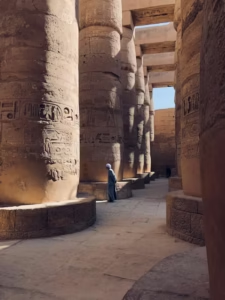
The highlight for most visitors is the Great Hypostyle Hall, where towering columns create a stone forest that once supported a massive roof. Many travelers do not realize that the color traces you still see were once part of a fully painted world—hieroglyphs and carved scenes meant to communicate power, ritual, and cosmic order.
Karnak is also where a guide matters. Without context, it can feel like “big columns.” With context, it becomes a story of political theology—how pharaohs used architecture to claim divine authority.
Luxor Temple
Historical context: major work by Amenhotep III and Ramses II; tied to royal ritual.
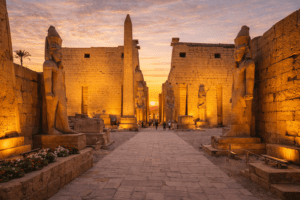
Luxor Temple sits closer to modern life—cars, shops, and daily movement right outside its walls. That contrast is part of the magic: ancient power placed directly into a living city. This temple was deeply connected to royal ceremony, particularly festivals that reinforced the pharaoh’s divine role.
Luxor Temple is also one of the best sites in Egypt to visit at sunset or in the evening. Lighting changes everything. The carvings become sharper, shadows deepen, and the temple feels theatrical—exactly as it was meant to feel.
A restored sphinx-lined avenue now symbolically reconnects Luxor Temple to Karnak, reflecting the ancient processional route used during major festivals.
West Bank Luxor: The City of the Dead
Valley of the Kings
Historical context: primary royal burial ground of New Kingdom pharaohs.
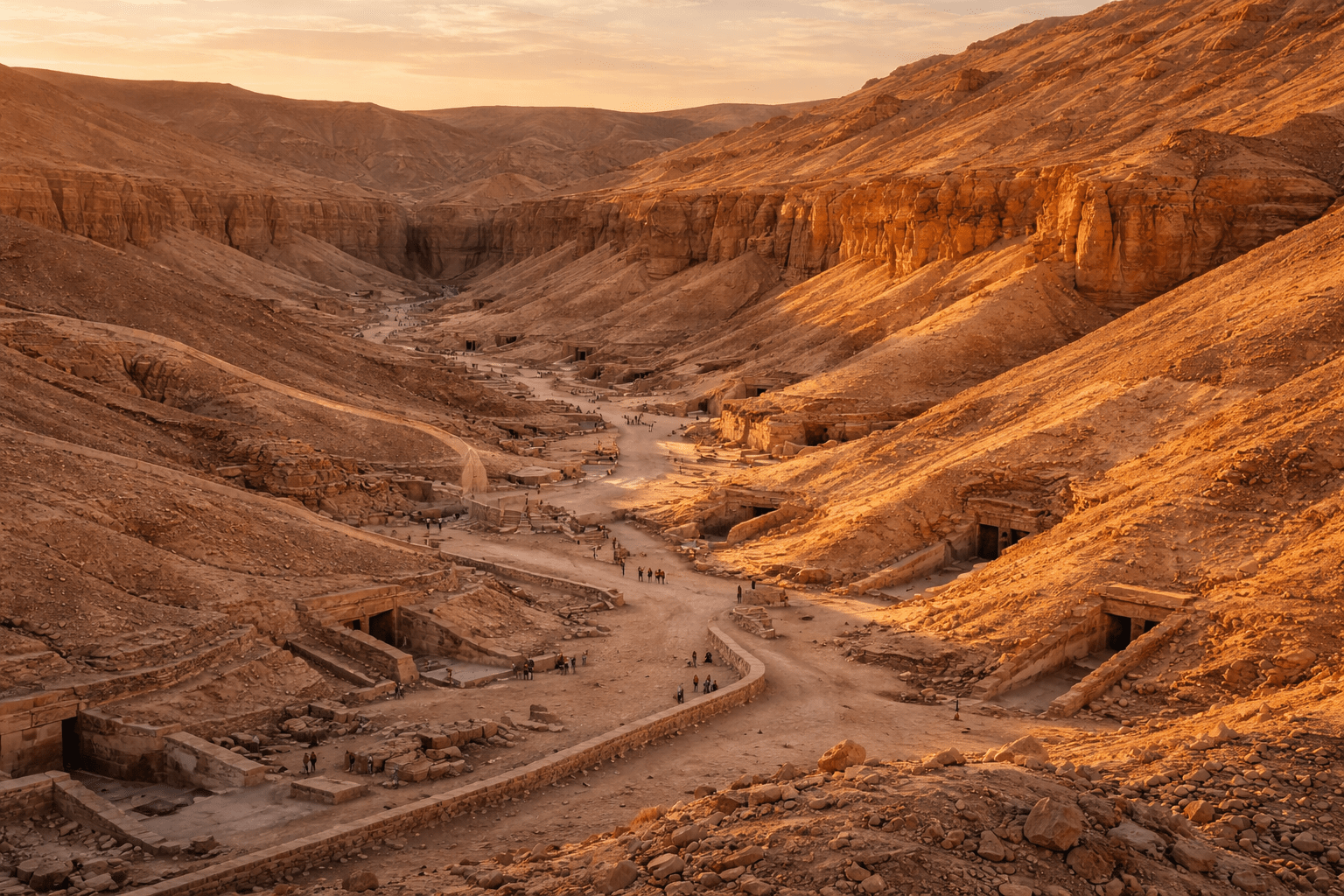
The Valley of the Kings is where the New Kingdom pharaohs hid their tombs—underground, sealed, and guarded by geography. The shift away from pyramids was strategic: pyramids attracted looters. Hidden tombs were meant to protect the king’s body and the sacred objects needed for the afterlife.
The real value of the Valley is not just “a tomb.” It’s the art—highly symbolic walls that describe the pharaoh’s journey through the underworld. The paintings are not decoration; they are a map for eternity.
Most tickets include entry to a set number of tombs, and some special tombs require an extra ticket. A great Luxor tour chooses tombs intentionally: variety of layout, quality of art, and pacing so you don’t burn out early.
Practical tip that saves tours: Start early. Heat + crowds ruin the experience later in the day.
Temple of Hatshepsut at Deir el-Bahari
Historical context: built for Queen Hatshepsut, one of Egypt’s most remarkable rulers.
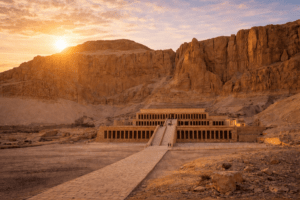
Hatshepsut’s temple is one of the most visually striking monuments in Egypt because it’s built into the cliff face in a series of terraces. It feels modern in its symmetry, yet it is ancient in meaning. The location is not random: the cliffs create a dramatic natural amphitheater—stone framing stone.
Hatshepsut ruled during a period of stability and wealth. Her temple tells a story of legitimacy, divine birth, and successful expeditions. It’s also one of the best places in Luxor to understand how political messaging worked in ancient Egypt.
Colossi of Memnon
Historical context: guardians of Amenhotep III’s mortuary temple.
These two massive statues are what remain of a once-enormous mortuary complex. Many travelers treat them as a photo stop. That’s fine—but the deeper story is scale: Luxor’s west bank wasn’t just tombs; it was a landscape of royal monuments designed to keep the pharaoh’s name alive forever.
Optional West Bank Upgrades (Worth It if you have time)
If you can add one extra stop beyond the “standard trio,” choose based on what you love:
- If you want epic wall scenes: Medinet Habu (often a favorite for serious history lovers)
- If you want a quieter tomb experience: Valley of the Queens
- If you want a more complete Thebes story: a guided “west bank circuit” with better pacing
How Many Days in Luxor?
Minimum: 2 Days
A true Luxor experience needs at least two days because East Bank + West Bank are heavy.
- Day 1: Karnak + Luxor Temple (East Bank)
- Day 2: Valley of the Kings + Hatshepsut + Memnon (West Bank)
Ideal: 3 Days
A third day gives breathing room—less rushing, more time for an optional site, and the ability to experience Luxor at night. Travelers remember Luxor more when they aren’t exhausted.
Luxor as Part of a Nile Cruise
Luxor is the northern anchor of most Nile cruise routes. If your itinerary includes a cruise between Luxor and Aswan, Luxor becomes the “grand opening” of the temple journey: monumental scale first, then river scenery and smaller temples as you travel south.
Best Time to Visit Luxor Egypt
Luxor can be intense in summer. Heat changes everything: energy, comfort, and how long you can stay inside open-air sites.
The best months for Luxor Egypt tours are usually:
- October to April (cooler, more comfortable touring)
If visiting in warmer months:
- Tour early morning
- Avoid long midday sun exposure
- Build breaks into your schedule
Luxor is better when your pace is sustainable.
How to Plan Luxor Without Wasting Time
Here are the common mistakes that make Luxor feel chaotic:
Mistake 1: Trying to do everything in one day
Luxor is not a “quick stop.” The best experiences come from pacing, not sprinting.
Mistake 2: No East/West bank strategy
Mixing banks randomly creates unnecessary driving and time loss.
Mistake 3: Not choosing tombs intentionally
A random tomb selection can leave you feeling unimpressed. A curated selection makes the Valley unforgettable.
Mistake 4: Skipping guidance entirely
Luxor is meaning-heavy. Understanding the story is the difference between “beautiful ruins” and “holy wow.”
Luxor vs Cairo: Which Matters More?
They serve different roles.
Cairo gives you the pyramids and the national museum story. Luxor gives you immersion—temples you walk inside, tombs you descend into, walls that still speak in color.
Most travelers who care about ancient Egypt say Luxor is the highlight.
Frequently Asked Questions About Luxor Egypt Tours
Is one day enough for Luxor?
Not really. One day is a rushed highlights run. Two days is the minimum for a satisfying trip.
Is Luxor safe for tourists?
Yes. Luxor is one of Egypt’s main tourism centers and is built around visitors.
Do I need a guide in Luxor?
If you want depth, yes. Luxor is where explanations change the experience.
What is the must-see in Luxor?
Karnak + Valley of the Kings are the core. Add Hatshepsut if you can.
Final Thoughts: Why Luxor Belongs in Every Egypt Itinerary
Luxor is the heart of ancient Egypt’s grandest period. It’s where architecture was religion, where art was a map to eternity, and where pharaohs built in stone to outlast time.
If your Egypt trip is about more than checking landmarks—if it’s about stepping into the civilization itself—Luxor Egypt tours are not optional. They’re the experience.
Ready to experience ancient Thebes in the most unforgettable way? Explore our curated Luxor Egypt tours designed to cover Karnak, the West Bank, and the Valley of the Kings with expert pacing and deep historical context. Visit our Luxor destination page to choose the itinerary that fits your trip style. Planning a full trip? See our complete 7 day Egypt itinerary with kids.