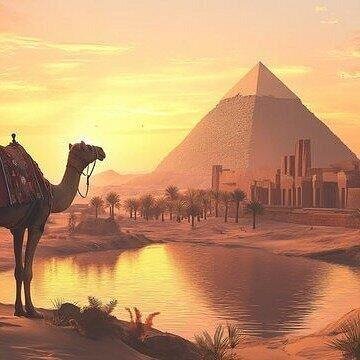
Cairo Egypt Tours: The Complete Guide to Pyramids, Pharaohs & Living History
Cairo is the beginning of Egypt’s story—and, for most travelers, the moment Egypt becomes real.
This is not a city you “see.” It’s a city you survive, absorb, and remember. Cairo is loud, layered, and relentlessly alive. Yet just beyond the traffic and rooftops, the desert holds the most famous stone geometry on earth: the Pyramids of Giza. In the city’s heart, museums preserve royal treasures and mummies that still carry names spoken for over 3,000 years. And woven through it all are medieval mosques, Coptic churches, markets, and streets that never stop moving.
That’s why Egypt tours aren’t just a checklist. Done right, Cairo is your gateway to five thousand years of history—ancient, medieval, and modern—stacked in the same day.
This guide covers what to see, how to plan, what most people get wrong, and how to make Cairo feel premium instead of exhausting.
Why Cairo Matters (It’s Much More Than the Pyramids)
For many first-time visitors, Cairo is simply the city where you see the pyramids.
But Cairo is far more than a gateway to Giza. It is one of the few cities in the world where thousands of years of history exist side by side in a living, modern metropolis.
Within a relatively small geographic area, Cairo connects nearly every major era of Egyptian civilization.
Just outside the city stand the monumental remains of the Old Kingdom, including the pyramids of Giza, the Step Pyramid of Saqqara, and the ruins of Memphis — once the capital of ancient Egypt more than 4,000 years ago.
Travel a short distance in another direction and you encounter the legacy of early Christianity in Egypt. In the district known as Coptic Cairo, some of the oldest churches in the Middle East still stand, reflecting the period when Egypt became one of the early centers of Christian culture.
Cairo’s historic heart also preserves one of the greatest collections of Islamic architecture in the world. For centuries, powerful dynasties ruled Egypt from this city, constructing mosques, schools, palaces, and markets that still define the skyline today. Walking through Islamic Cairo reveals centuries of medieval urban life that have continued almost uninterrupted to the present day.
And surrounding all of this history is modern Cairo, a city of more than twenty million people. Bustling streets, crowded cafés, and energetic markets create an atmosphere that feels intense but deeply alive.
This layering of civilizations is what makes Cairo unique.
In very few places on earth can a traveler stand beside a 4,500-year-old pyramid, walk through a 1,000-year-old mosque, and then step into a living marketplace that has operated for centuries — all within the same afternoon.
Understanding Cairo requires accepting that it is not just an archaeological destination. It is a city where ancient monuments, medieval neighborhoods, and modern life exist simultaneously.
For travelers, the key to enjoying Cairo is not trying to see everything at once.
Instead, it is about finding the right rhythm — balancing iconic sites like the pyramids with moments spent exploring historic districts, museums, and everyday life in one of the most fascinating cities in the world.
The Pyramids of Giza: How to Experience Them the Right Way
For many travelers, the pyramids are the reason Cairo appears on the itinerary in the first place.
But visiting the Giza Plateau can either feel magical—or strangely rushed and confusing—depending on how you approach it.
Many first-time visitors arrive expecting a quiet desert landscape and instead find crowds, tour buses, and a chaotic entrance area. That contrast can make the experience feel less monumental than expected.
The key is understanding two things before you arrive:
First, what the pyramids actually represent historically.
Second, how to move through the plateau so you experience its scale rather than just taking the standard photos.
When approached with the right perspective, Giza becomes one of the most extraordinary archaeological landscapes on earth.
The History in 60 Seconds (So You Understand What You’re Seeing)
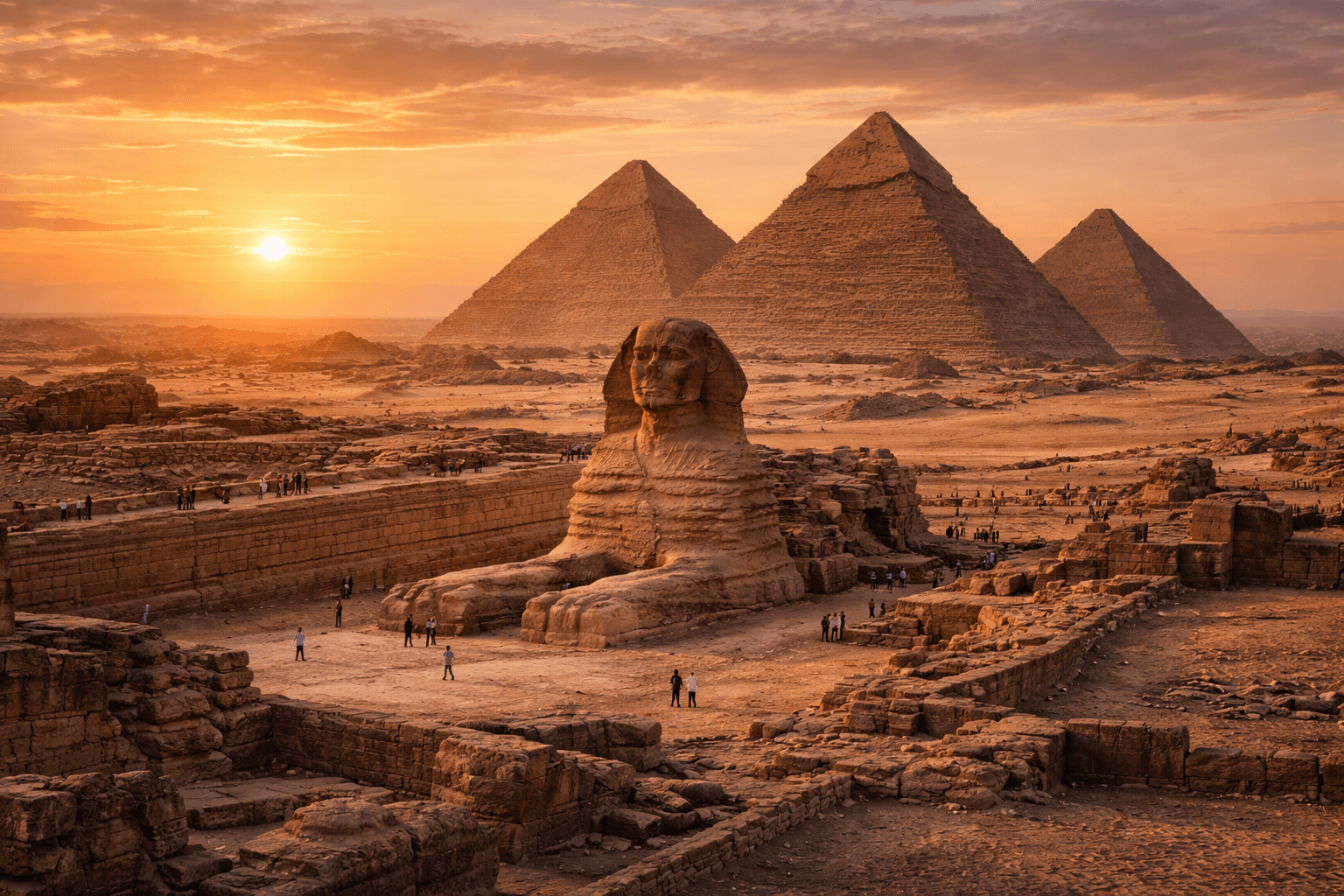
The pyramids of Giza were built during Egypt’s Fourth Dynasty, around 2600–2500 BC, during what historians call the Old Kingdom.
This was the period when pyramid construction reached its peak.
The three main pyramids belong to three pharaohs of the same royal line:
Khufu (Cheops) — builder of the Great Pyramid
Khafre (Chephren) — builder of the second pyramid
Menkaure — builder of the smallest of the three main pyramids
The Great Pyramid of Khufu was the largest structure humans built for nearly 4,000 years. Originally standing about 146 meters tall, it contained more than two million limestone blocks carefully fitted together.
But the pyramids were never meant to stand alone.
Each one formed the center of a massive funerary complex that included:
- temples where rituals were performed
- causeways connecting the pyramid to the Nile floodplain
- smaller pyramids for queens
- boat pits containing ceremonial solar boats
- tombs of nobles and officials
The entire plateau was designed as a sacred landscape reflecting the pharaoh’s divine role in maintaining cosmic order.
In other words, the pyramids were not simply tombs. They were national-scale projects meant to demonstrate royal power, religious belief, and the stability of the Egyptian state.
What Most Tours Get Wrong
One of the most common mistakes during a Giza visit is moving through the site too quickly.
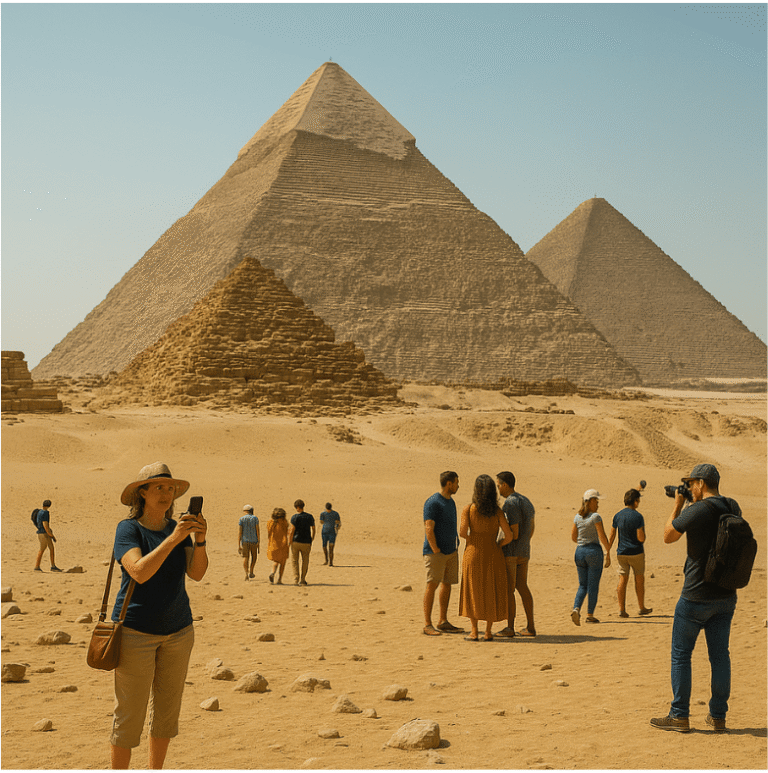
Many standard tours stop briefly at the entrance viewpoint, take photos, and then move directly to the Sphinx before leaving.
While this approach allows visitors to check the pyramids off their list, it often prevents them from appreciating the scale and layout of the plateau.
A more meaningful visit focuses on three things:
First, understanding how the plateau functioned as a ceremonial and sacred landscape rather than just a cluster of pyramids.
Second, allowing time to walk or drive between viewpoints so the pyramids can be seen from different perspectives.
Third, planning the visit around heat and crowds, which can change the atmosphere of the site dramatically.
With even a little extra time and context, the Giza Plateau transforms from a quick photo stop into one of the most impressive historical landscapes in the world.
The Best Viewpoints on the Plateau
If you want the cinematic experience of the pyramids—the one that feels like stepping into ancient Egypt—you need to move beyond the crowded entrance area.
Higher viewpoints on the plateau offer the best perspectives.
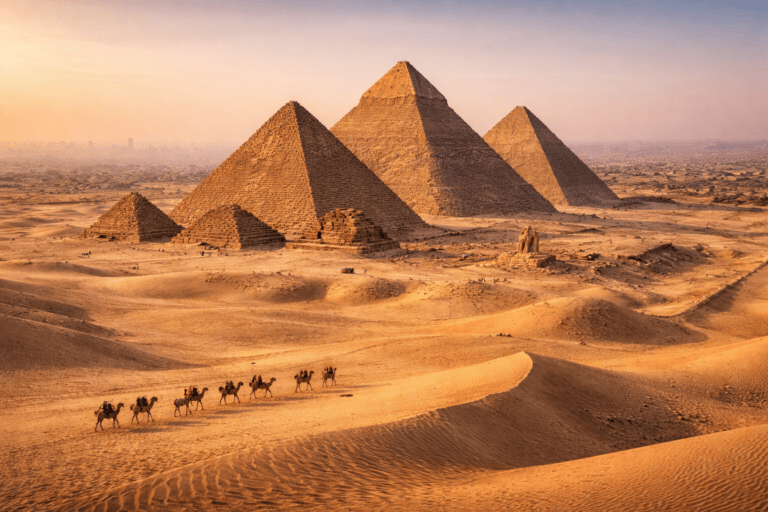
From these vantage points, the three pyramids separate visually across the desert horizon, revealing their true scale and geometric alignment.
Standing in these quieter areas allows visitors to appreciate the setting that ancient Egyptians chose deliberately: a high plateau overlooking the Nile Valley, where the pyramids could dominate the landscape.
This is where many travelers finally feel the emotional impact of the site.
The desert stretches outward, the pyramids rise above the sand, and the noise of the entrance fades into the background.
Should You Go Inside a Pyramid?
Visitors can enter several pyramids on the plateau, including the Great Pyramid of Khufu, though tickets are limited each day.
Entering a pyramid can be an exciting experience, but it’s important to have realistic expectations.
The interior is very different from the richly decorated tombs found in Luxor.
Inside the Great Pyramid, visitors walk through narrow stone corridors that climb upward toward the King’s Chamber. The passages are steep, warm, and physically demanding.
There are no wall paintings or elaborate decorations.
Instead, the experience is about understanding the engineering and construction techniques that allowed ancient builders to create one of the most remarkable structures in human history.
For travelers who enjoy archaeology and ancient engineering, entering the pyramid can be fascinating.
Others may prefer spending more time exploring the plateau and viewing the pyramids from outside.
The Great Sphinx: Smaller Than Expected, Bigger Than Its Legend
Many visitors are surprised by the scale of the Great Sphinx of Giza.
Photographs often make it appear much larger than it feels in person.
But what the Sphinx lacks in sheer size, it makes up for in symbolism.
Carved directly from limestone bedrock, the Sphinx combines the body of a lion with the head of a king, representing the union of strength and royal authority.
It is believed to have been created during the reign of Khafre, the builder of the second pyramid.
Positioned at the entrance to the plateau’s temple complex, the Sphinx likely served as a guardian figure protecting the sacred landscape.
Over thousands of years, the Sphinx has been buried by desert sand, restored repeatedly, and surrounded by countless historical debates about its construction and purpose.
A knowledgeable guide can transform the Sphinx from a quick photo stop into one of the most intriguing monuments on the plateau.
Saqqara: The Upgrade That Transforms a Cairo Trip
If you want to deepen your understanding of Egypt’s pyramid history, consider adding a visit to Saqqara.
Located about 30 kilometers south of Giza, Saqqara is where the story of pyramid construction truly begins.
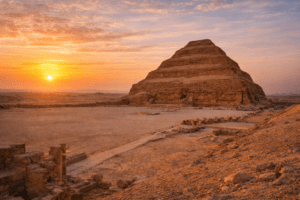
Here stands the Step Pyramid of Djoser, built around 2700 BC by the architect Imhotep.
Unlike the smooth-sided pyramids at Giza, the Step Pyramid consists of stacked mastaba structures that represent the earliest attempt to create monumental stone pyramids.
Saqqara offers something else that Giza does not: richly decorated tombs filled with detailed carvings showing scenes from everyday life.
Visitors can see depictions of farming, fishing, food preparation, and family life from more than four thousand years ago.
These scenes reveal the human side of ancient Egypt in ways that massive pyramids cannot.
While many visitors focus only on the pyramids of Giza, those who add Saqqara gain a deeper understanding of how Egyptian architecture evolved.
For travelers who want their Cairo experience to feel more complete—and far less rushed—Saqqara is often the highlight they didn’t expect.
Cairo’s Museums: Where the Story of Ancient Egypt Becomes Clear
Seeing Egypt’s monuments in person is powerful. Standing in front of the pyramids or walking through a temple corridor makes the scale of ancient Egyptian civilization feel real.
But monuments alone don’t tell the full story.
To truly understand ancient Egypt, you also need to see the objects people left behind — statues, jewelry, tools, burial artifacts, and the preserved remains of the people themselves.
That’s where Cairo’s museums become essential.
The museums connect the architecture you see across Egypt to the human lives behind the stone monuments.
When you look at a royal statue, a decorated sarcophagus, or a piece of ancient jewelry, the world that created the pyramids begins to feel much more personal.
For most travelers, Cairo’s museum experience will involve one of two major institutions.
The Egyptian Museum in Tahrir Square
For more than a century, the Egyptian Museum in Tahrir Square has been one of the most famous museums in the world.
Opened in 1902, the museum contains an enormous collection of ancient Egyptian artifacts — far more than most visitors can realistically see in a single visit.
Walking through the building feels almost like exploring an archive of ancient history. Glass cases are packed with statues, reliefs, jewelry, papyrus scrolls, and everyday objects that span thousands of years.
One of the museum’s most famous exhibits has long been the treasures of Tutankhamun, including the iconic golden funerary mask that became one of the most recognizable symbols of ancient Egypt.
Although the museum can feel crowded and somewhat chaotic, it still offers an incredible sense of discovery. Many visitors appreciate the feeling that they are exploring a historic institution that has shaped our understanding of ancient Egypt for generations.
The Grand Egyptian Museum (GEM)
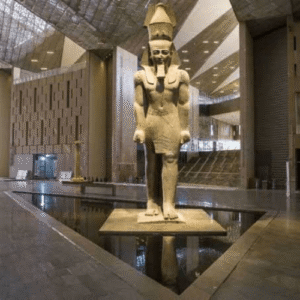
Just outside Cairo near the pyramids of Giza stands the Grand Egyptian Museum, often called GEM.
Designed as one of the largest archaeological museums in the world, GEM represents the future of how ancient Egyptian history will be presented to visitors.
The museum’s design is modern and expansive, with enormous galleries built specifically to display artifacts with proper lighting, space, and interpretation.
One of the most anticipated features of the Grand Egyptian Museum is the complete collection of Tutankhamun artifacts, displayed together for the first time.
GEM also offers dramatic views toward the pyramids themselves, visually connecting the artifacts inside the museum with the monuments outside.
For travelers visiting Cairo today, museum planning may involve choosing between these two experiences — the historic charm of the Egyptian Museum or the modern presentation of GEM.
Either way, visiting at least one major museum adds essential context to Egypt’s archaeological sites.
Why Museums Matter for Understanding Egypt
It’s easy to view pyramids and temples as abstract monuments.
Museums change that perspective.
When you see the personal belongings placed inside tombs — jewelry, tools, furniture, toys, writing tablets — the ancient world suddenly becomes more human.
You begin to understand that the pyramids were not just architectural achievements. They were part of a complex belief system about death, the afterlife, and the power of kings.
Statues reveal how rulers wanted to be remembered. Painted coffins show how Egyptians imagined the journey after death.
Even small objects, like cosmetics containers or carved figurines, offer glimpses into everyday life thousands of years ago.
In this way, Cairo’s museums transform ancient monuments from impressive structures into pieces of a much larger story.
What to Prioritize (So You Don’t Burn Out)
One of the biggest challenges visitors face in Cairo’s museums is simply the sheer number of artifacts.
Trying to see everything is impossible — and attempting to do so usually leads to exhaustion.
A better strategy is to approach the museum with a few clear priorities.
First, focus on major royal artifacts, especially those connected to famous figures like Tutankhamun, Ramses II, or Hatshepsut. These objects often represent the most important discoveries in Egyptian archaeology.
Second, take time to understand the timeline of ancient Egyptian history. Moving from Old Kingdom artifacts to the Middle Kingdom and then the New Kingdom helps visitors understand how Egyptian civilization evolved over time.
Finally, choose at least one exhibit or gallery that you allow yourself to explore slowly and carefully. Whether it’s a collection of statues, burial artifacts, or royal treasures, spending time with one memorable section often creates the strongest impression.
When visitors try to see everything, the experience can blur together.
But when they focus on a few meaningful highlights, the museum becomes one of the most fascinating parts of the Cairo experience.
Islamic Cairo: The Most Underrated Part of the City
Many travelers come to Cairo for the pyramids and leave without ever exploring one of the city’s greatest treasures: Islamic Cairo.
That’s a mistake.
While the pyramids reveal Egypt’s ancient past, Islamic Cairo tells the story of the city during the medieval era, when Cairo became one of the most powerful and sophisticated capitals in the Islamic world.
For centuries, dynasties such as the Fatimids, Ayyubids, and Mamluks ruled Egypt from Cairo. Each left behind mosques, schools, gates, palaces, and markets that still shape the historic landscape today.
The result is one of the richest concentrations of medieval architecture anywhere in the world.
Walking through Islamic Cairo is not simply sightseeing — it’s stepping into a district where centuries of religious, political, and commercial life unfolded within a dense network of streets that still pulse with activity today.
The Citadel of Saladin and the Muhammad Ali Mosque
One of the most important landmarks in Islamic Cairo is the Citadel of Saladin.
Built in the 12th century as a fortress to defend the city from Crusader attacks, the Citadel later became the seat of government for Egypt’s rulers for nearly 700 years.
From its elevated position above the city, the Citadel offers one of the best vantage points in Cairo. Standing on its terraces, visitors can see the modern skyline stretching across the horizon while the historic mosques of Islamic Cairo spread out below.
Within the Citadel complex stands the Muhammad Ali Mosque, often called the Alabaster Mosque because of the stone that lines its interior.
Its towering domes and slender minarets dominate Cairo’s skyline. Inside, the vast prayer hall glows with soft light reflecting from the alabaster walls and ornate chandeliers.
For many visitors, the Citadel provides the first moment when Cairo’s immense scale becomes clear.
Al-Muizz Street: Cairo’s Open-Air Museum
Few streets in the world contain as many historic monuments as Al-Muizz Street.
Running through the heart of Islamic Cairo, this street has served as a central axis of the city for centuries.
Along its length stand some of the finest examples of Islamic architecture in Egypt: mosques, madrasas, mausoleums, and historic gates built by powerful dynasties over hundreds of years.
Walking along Al-Muizz Street can feel like moving through a timeline of medieval Cairo.
Intricate stone carvings decorate doorways, massive wooden doors guard ancient courtyards, and minarets rise above the rooftops. Each building reflects a different period in the city’s architectural history.
Exploring this area with a knowledgeable guide can transform the experience. What initially appears as a dense collection of buildings becomes a story about how Cairo grew into one of the great cities of the medieval world.
Khan el-Khalili: Cairo’s Historic Bazaar
At the end of Al-Muizz Street lies Khan el-Khalili, Cairo’s most famous market.
The bazaar has existed for more than six centuries and remains one of the liveliest places in the city. Narrow alleys are filled with shops selling lanterns, spices, textiles, jewelry, perfumes, and handmade crafts.
For first-time visitors, Khan el-Khalili can feel overwhelming.
The key is approaching it with the right mindset.
Rather than treating the bazaar as a strict shopping destination, it’s better to see it as a cultural experience. Wander through the lanes, watch craftsmen at work, photograph the glowing lantern displays, and pause at one of the traditional cafés.
One of the most famous is El Fishawy Café, which has been serving tea and coffee to travelers and locals alike for generations.
When approached this way, Khan el-Khalili becomes less about bargaining for souvenirs and more about experiencing the atmosphere of one of the oldest marketplaces in the Middle East.
Why Islamic Cairo Matters
What makes Islamic Cairo so special is not just the individual monuments, but the way they exist within a living city.
Mosques still host daily prayers, shopkeepers continue centuries-old trading traditions, and residents navigate streets that have connected neighborhoods for generations.
For travelers who take the time to explore beyond the pyramids, Islamic Cairo reveals a different side of Egypt — one that blends architecture, religion, commerce, and daily life into a vibrant historic landscape.
In many ways, this district represents the bridge between Egypt’s ancient past and its modern identity.
Coptic Cairo: The Quiet Power Layer of the City
While many travelers come to Cairo for the pyramids or Islamic architecture, Coptic Cairo reveals another essential layer of Egypt’s identity.
This historic district preserves the legacy of Egypt’s early Christian communities, whose presence dates back nearly two thousand years. Long before Cairo became the center of Islamic dynasties, Christianity had already taken deep root in the region.
According to tradition, the Holy Family — Mary, Joseph, and the infant Jesus — passed through Egypt during their flight from King Herod. Several churches in Coptic Cairo are believed to stand on or near places connected to that journey, making the area an important pilgrimage site for Christians.
Today, Coptic Cairo contains some of the oldest churches in the Middle East, along with monasteries, museums, and religious landmarks that reflect centuries of Egyptian Christian history.
One of the most famous sites is the Hanging Church (Saint Virgin Mary’s Coptic Orthodox Church). Built above the ruins of a Roman fortress gate, the church appears suspended in the air — giving it the name “Hanging Church.” Its wooden ceiling shaped like Noah’s Ark and intricate icons offer a glimpse into ancient Coptic artistic traditions.
Nearby stands the Church of St. Sergius and Bacchus, believed to be built over a crypt where the Holy Family may have sheltered during their time in Egypt.
Visitors can also explore the Coptic Museum, which houses one of the world’s most important collections of Coptic art, manuscripts, and religious artifacts.
What surprises many travelers is the atmosphere of the district itself.
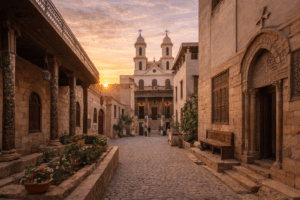
Compared with Cairo’s busy streets and crowded markets, Coptic Cairo feels quiet and contemplative. Narrow stone paths connect ancient churches, shaded courtyards offer places to sit, and the pace of life slows noticeably.
For travelers who feel overwhelmed by Cairo’s intensity, Coptic Cairo often provides a welcome change of rhythm.
It is a place where Egypt’s history is experienced not through massive monuments or grand temples, but through centuries of spiritual tradition and community life that continue into the present day.
In many ways, Coptic Cairo reminds visitors that Egypt’s story is not defined by a single era or religion. Instead, it is a civilization shaped by multiple cultures layered across thousands of years — each leaving its own imprint on the city.
How How Many Days Do You Need in Cairo?
One of the most common planning questions travelers ask is simple: how many days should you spend in Cairo?
Because the city contains several major historical districts — each representing a different era of Egyptian history — the answer depends on how deeply you want to explore.
Some visitors treat Cairo as a quick stop to see the pyramids before flying south to Luxor. Others spend several days discovering the city’s museums, medieval architecture, and historic neighborhoods.
Understanding the right pace can make the difference between a rushed visit and a rewarding one.
Minimum: Two Days in Cairo
Two days is the absolute minimum most travelers should consider.
This allows enough time to experience Cairo’s two most important highlights: the pyramids of Giza and the city’s museum and historic districts.
A typical two-day structure might look like this:
Day 1: The Pyramids of Giza and the Sphinx
Spend the morning exploring the Giza Plateau. Seeing the pyramids in person requires more time than many travelers expect, especially if you want to walk between viewpoints or visit the Sphinx.
If your schedule allows, continue to Saqqara in the afternoon to see the Step Pyramid of Djoser and some of Egypt’s most beautifully decorated tombs.
Day 2: Museums and Historic Cairo
Dedicate your second day to Cairo’s museums and historic districts. Begin with either the Egyptian Museum in Tahrir Square or the Grand Egyptian Museum near Giza.
In the afternoon, explore Islamic Cairo, including Al-Muizz Street, historic mosques, and the famous Khan el-Khalili bazaar.
Two days allows visitors to experience Cairo’s most important sites, though it still moves at a fairly quick pace.
Ideal: Three to Four Days in Cairo
If your schedule allows, spending three or four days in Cairo creates a much more balanced experience.
Additional time allows you to explore the city beyond the most famous landmarks and experience its historical layers more comfortably.
A longer stay might include:
• A deeper visit to Cairo’s museums
• Time exploring Coptic Cairo and its historic churches
• A slower walk through Islamic Cairo’s monuments and markets
• Evening experiences such as rooftop cafés, Nile river views, or traditional markets
Evenings in Cairo can be surprisingly enjoyable once the daytime heat fades and the city’s energy shifts toward cafés and street life.
Why Cairo Rewards Time
Cairo is not a city that reveals itself quickly.
The first impression can feel overwhelming: traffic, crowds, and the constant movement of a megacity with more than twenty million people.
But once travelers settle into the rhythm of the city, Cairo begins to feel more understandable.
Ancient monuments, medieval architecture, and modern neighborhoods gradually connect into a larger story.
Rushing through Cairo can make the experience feel exhausting.
Giving the city a little more time often turns it into one of the most memorable parts of an Egypt journey.
Best Time to Visit Cairo
Cairo can be visited year-round, but the overall experience changes dramatically depending on the season. Because many of the city’s major attractions — especially the pyramids and historic districts — require extensive walking outdoors, weather plays an important role in planning your visit.
For most travelers, the best time to visit Cairo is between October and April.
During these months, daytime temperatures are generally mild and comfortable, making it easier to explore archaeological sites and historic neighborhoods without exhaustion. Winter temperatures typically range between 18–25°C (64–77°F), which is ideal for spending long hours outdoors at places like the Giza Plateau or Islamic Cairo.
This period also coincides with Egypt’s peak tourism season, meaning popular attractions can be busier, particularly around major holidays such as Christmas and New Year. Even so, the comfortable climate makes these months the most enjoyable time for sightseeing.
Visiting Cairo in Summer
Summer in Cairo — especially from June through August — can be intensely hot. Temperatures often climb above 35–40°C (95–104°F) during the day, particularly in open areas such as the Giza Plateau.
Travel during this season is still possible, but it requires thoughtful planning.
Visitors who travel in summer typically structure their days differently:
• Start sightseeing early in the morning when temperatures are cooler
• Plan indoor museum visits during the hottest hours of the afternoon
• Schedule outdoor locations like the pyramids for sunrise or late afternoon
• Take regular breaks in shaded cafés or air-conditioned spaces
In many ways, managing the heat becomes part of the Cairo travel strategy.
Travelers who adapt their schedule often find that summer offers one major advantage: smaller crowds at major attractions.
Spring and Autumn: Cairo’s Sweet Spot
Many experienced travelers consider March, April, October, and November to be the ideal months for visiting Cairo.
These months offer a balance of comfortable temperatures, manageable tourism levels, and clear skies that are excellent for photography.
During these seasons, visitors can comfortably spend long days exploring outdoor sites while still enjoying evenings walking through historic neighborhoods or relaxing in rooftop cafés overlooking the city.
For travelers who want the best combination of weather and atmosphere, these shoulder seasons often provide the most rewarding experience.
The Key to Enjoying Cairo in Any Season
No matter when you visit, one principle remains true: Cairo rewards travelers who plan their days around the rhythm of the climate.
Early mornings are the best time for exploring outdoor sites like the pyramids or historic mosques.
Midday works well for museums, lunch breaks, or relaxing at a café.
Evenings are often the most pleasant time of day, when temperatures cool and Cairo’s vibrant street life comes alive.
Understanding this rhythm allows visitors to enjoy the city fully — whether visiting during the mild winter season or the heat of summer.
“High-Interest” Cairo: The Experiences People Actually Remember
Many first-time itineraries treat Cairo as a checklist.
Pyramids. Museum. Bazaar. Done.
But the Cairo trips people remember most are not built only around monuments. They are built around moments — the experiences that transform the city from overwhelming megacity into something cinematic and unforgettable.
The pyramids and historic districts provide the historical backbone of the trip. But adding a few carefully chosen experiences changes how Cairo feels.
These are the moments that often become the strongest memories of the city.
Early Morning at the Pyramids of Giza
The Giza Plateau is one of the most famous archaeological sites in the world, which means it rarely feels empty.
However, visiting early in the morning dramatically changes the atmosphere.
The desert air is cooler, the light is softer, and the crowds have not yet fully arrived. The pyramids feel larger and more isolated when the plateau is still quiet.
Photographs taken during the early morning hours also tend to be far better, with warm light illuminating the limestone blocks and long shadows stretching across the sand.
More importantly, visiting early allows travelers to experience something closer to the emotional impact that ancient monuments deserve.
Instead of navigating crowds and heat, visitors can focus on the scale and mystery of structures that have stood for more than four thousand years.
A Rooftop Meal With a View
Cairo’s street level can feel chaotic.
Traffic moves constantly, sidewalks fill with people, and the energy of the city never seems to slow down.
But above the streets, Cairo reveals a completely different personality.
Several restaurants and cafés offer rooftop terraces with views across the city, some even looking directly toward the pyramids.
From these elevated spaces, the city feels calmer and more atmospheric. Minarets rise across the skyline, the evening call to prayer echoes through the air, and the lights of Cairo stretch toward the horizon.
A rooftop dinner or evening tea can become one of the most memorable moments of a Cairo visit — not because of the food alone, but because of the perspective it provides on the city itself.
A Short Nile Experience
The Nile River is the reason Cairo exists.
For thousands of years, the river has shaped Egypt’s economy, agriculture, and transportation routes. Yet many travelers visiting Cairo never actually spend time on the water.
Even a short Nile experience can transform the way the city feels.
Traditional felucca sailboats glide quietly along the river, offering a peaceful contrast to the intensity of the streets.
At sunset, the river reflects the changing colors of the sky while Cairo’s skyline gradually begins to glow with evening lights.
Whether it is a short sail, a sunset cruise, or simply sitting at a riverside café, time on the Nile allows visitors to see Cairo from a completely different perspective.
Instead of chaos, the city suddenly feels timeless.
Why These Moments Matter
Monuments tell the story of Cairo’s past.
But experiences shape how travelers remember the city.
Adding just a few high-interest moments — sunrise at the pyramids, a rooftop view, or time on the Nile — helps balance Cairo’s intensity with moments of calm and wonder.
Those moments often become the memories people talk about long after their trip ends.
Cairo vs Luxor: Which Is Better?
Travelers planning their first trip to Egypt often ask the same question: Should I spend more time in Cairo or Luxor?
The short answer is that the two destinations serve completely different roles in understanding Egypt’s history.
Cairo and Luxor are not competitors. They are two chapters of the same story.
Cairo: The Origin Story
Cairo provides the historical foundation of an Egypt journey.
Here you encounter the earliest monumental achievements of ancient Egyptian civilization, including the pyramids of Giza and the Step Pyramid at Saqqara. These structures represent the beginning of large-scale royal architecture during the Old Kingdom.
Cairo also houses Egypt’s most important museums, where statues, burial objects, royal treasures, and mummies help explain the world behind the monuments.
But Cairo’s importance goes beyond ancient Egypt.
The city also reveals Egypt’s medieval and religious history through districts such as Islamic Cairo and Coptic Cairo, where centuries of architecture and culture still shape the modern city.
In this sense, Cairo provides the context for everything travelers will see later in Egypt.
It explains where the civilization began and how its legacy continued through different historical periods.
Luxor: The Immersive Monument Landscape
Luxor delivers a completely different experience.
While Cairo provides context and artifacts, Luxor surrounds visitors with the monumental architecture of the New Kingdom — the period when Egypt reached the height of its imperial power.
Here, temples and tombs dominate the landscape.
Massive complexes such as Karnak Temple and Luxor Temple demonstrate the scale of ancient religious architecture, while the Valley of the Kings reveals the burial places of powerful pharaohs including Tutankhamun.
Unlike Cairo, where monuments are scattered around a modern megacity, Luxor feels like an open-air archaeological landscape.
The Nile divides the city into the East Bank and West Bank, each containing temples, tombs, and ancient structures that can fill several days of exploration.
This immersive environment allows visitors to step deeper into the world of ancient Egypt.
Why Most Travelers Need Both
Experiencing Cairo without Luxor can feel incomplete.
Cairo shows the origins of pyramid construction and introduces the artifacts that defined ancient Egyptian life. But Luxor reveals the later period when Egypt built some of its most dramatic temples and burial complexes.
Likewise, visiting Luxor without Cairo would mean missing the pyramids and the museums that help explain the civilization behind those temples.
Together, the two destinations create a balanced understanding of ancient Egypt.
Cairo introduces the civilization.
Luxor immerses you inside it.
For this reason, most well-designed Egypt itineraries include both cities — usually beginning in Cairo before continuing south toward Luxor and the Nile Valley.ents and the museum context. Luxor gives the deep ancient world experience.
Cairo Safety and Reality: What Visitors Actually Need to Know
For many first-time visitors, Cairo’s reputation can feel intimidating.
In reality, the biggest challenge most travelers face in Cairo is not safety — it’s logistics.
Cairo is one of the largest cities in the world, with more than twenty million people moving through its streets every day. Traffic is heavy, distances between sites can be longer than they appear on a map, and travel times often vary depending on the time of day.
What this means for visitors is simple: planning and pacing matter.
A well-structured day in Cairo can feel exciting and rewarding. A poorly planned one can quickly become exhausting.
The Real Challenge: Moving Through the City
The most common difficulty travelers encounter in Cairo is transportation.
Major sites such as the Giza Plateau, the Egyptian Museum, Islamic Cairo, and Saqqara are spread across different parts of the metropolitan area. Moving between them often requires navigating busy roads and unpredictable traffic patterns.
This is one reason many travelers choose to use guided tours or private drivers while exploring Cairo.
Guides are valuable not only for historical explanations but also for helping visitors move efficiently between sites, avoid unnecessary delays, and structure a realistic schedule for the day.
Even experienced independent travelers often find that having organized transportation for at least part of their Cairo visit makes the experience far more enjoyable.
Practical Tips for Visiting Cairo
A few simple habits can make your time in Cairo much smoother.
Keep your daily plans realistic.
Trying to visit too many locations in a single day is the most common mistake travelers make. Cairo rewards slower pacing.
Use reliable transportation.
Reputable drivers, organized tours, or hotel-arranged transportation often make navigating the city much easier.
Avoid overscheduling.
Traffic, weather, and the scale of historical sites can all affect how long visits take.
Stay hydrated.
Many major attractions — especially the pyramids at Giza — require time outdoors in the sun. Carrying water is essential.
Why Planning Changes Everything
Cairo is an intense city, but that intensity is also part of what makes it fascinating.
The city blends ancient monuments, medieval architecture, and modern urban life into a constantly moving environment.
When travelers approach Cairo with realistic expectations and a thoughtful plan, the experience can feel exhilarating — a chance to explore one of the most historically layered cities in the world.
When visitors try to rush through too many sites in too little time, however, the city can quickly feel overwhelming.
In Cairo, good planning is not just helpful — it is the key to enjoying the city fully.
FAQs: Cairo Egypt Tours
Are the pyramids actually in Cairo?
Technically, the Pyramids of Giza are located in Giza, which sits just outside central Cairo on the western edge of the Nile. In practice, however, they are considered part of the greater Cairo metropolitan area and are one of the city’s most famous attractions.
The Giza Plateau is about 30–40 minutes from downtown Cairo, depending on traffic, which is why most Cairo itineraries include the pyramids as a primary highlight. A typical visit combines the Great Pyramid of Khufu, the Pyramid of Khafre, the Pyramid of Menkaure, and the Great Sphinx, often alongside nearby sites like Saqqara or Memphis.
Is one day enough for Cairo?
One day in Cairo is possible, but it usually results in a very rushed experience focused mainly on the pyramids. Most travelers find that Cairo deserves at least two full days to properly explore its main highlights.
A balanced itinerary usually includes the Pyramids of Giza and the Sphinx, the Egyptian Museum or Grand Egyptian Museum, and one of the historic districts such as Islamic Cairo or Coptic Cairo.
If you have three days, Cairo becomes far more enjoyable because you can slow down, explore Old Cairo, and add memorable experiences like a Nile sunset or rooftop dinner overlooking the city.
What is the best Cairo itinerary for first-timers?
A well-planned Cairo itinerary balances ancient monuments with the city’s historic neighborhoods.
Day 1: Visit the Pyramids of Giza, the Great Sphinx, and if time allows, extend the trip to Saqqara to see Egypt’s earliest pyramid complex.
Day 2: Explore Cairo’s museums, such as the Egyptian Museum in Tahrir Square or the Grand Egyptian Museum near Giza, followed by a walk through Islamic Cairo and the Khan el-Khalili bazaar.
Optional Day 3: Discover Coptic Cairo, including historic churches and religious landmarks, and finish the day with a Nile sunset cruise or rooftop dinner overlooking the city.
This pacing allows travelers to experience Cairo without feeling rushed.
Do I need a guide in Cairo?
While it’s possible to visit Cairo independently, many travelers find that a knowledgeable guide significantly improves the experience. Cairo’s major sites—especially the pyramids, Saqqara, and historic districts—contain layers of history that are easy to miss without explanation.
A guide also helps with logistics and pacing, which matters in a city where traffic and distances can be unpredictable. Organized tours usually combine transportation, site entry planning, and historical interpretation into a smoother day.
For first-time visitors who want to understand Cairo’s story rather than simply see the landmarks, guided Cairo tours often provide the most efficient and rewarding experience.
How many days should you spend in Cairo?
Most travelers should plan two to three days in Cairo. Two days is enough to see the essential highlights such as the Pyramids of Giza, the Sphinx, and one of Cairo’s major museums, along with a short exploration of Old Cairo.
Three days allows a more relaxed experience and gives you time to explore Islamic Cairo, Coptic Cairo, local markets, and a Nile experience without rushing between sites.
Because Cairo is both a historic capital and a modern megacity, giving it enough time helps the destination feel exciting rather than overwhelming.
Final Thoughts: Why Cairo Belongs at the Start of Your Egypt Journey
Cairo is where the story of Egypt begins to feel real.
It’s the place where ancient history stops being something you read about and becomes something you stand beside.
Here, the pyramids still rise from the desert exactly where they were built more than four thousand years ago. Museums hold the statues, artifacts, and royal treasures that once filled those monuments. Medieval streets and mosques reveal centuries of Islamic civilization layered across the city.
And surrounding all of it is modern Cairo — a living metropolis where everyday life continues in the shadow of extraordinary history.
What makes Cairo unique is this layering of eras.
Few cities in the world combine ancient monuments, medieval architecture, and modern urban energy in such a concentrated space.
For travelers exploring Egypt, Cairo provides the essential starting point. It introduces the origins of the civilization, the artifacts that defined it, and the historical layers that shaped the country long after the age of the pharaohs.
When experienced at the right pace, Cairo becomes more than a stop on the way to other destinations. It becomes the place where the entire journey begins to make sense.
The key is approaching the city thoughtfully: begin with the pyramids, deepen the story through the museums, explore the historic districts, and end your days with a moment of perspective — perhaps a rooftop view or a quiet stretch of the Nile at sunset.
Seen this way, Cairo transforms from an overwhelming megacity into something far more powerful: a gateway into one of the greatest civilizations in human history.
Plan Your Cairo Experience
Ready to experience Egypt’s most iconic city the right way?
Explore our curated Cairo Egypt tours, designed to combine the Pyramids of Giza, Cairo’s world-class museums, and the historic districts of Old Cairo with thoughtful pacing and expert local guidance.
You can also visit our Cairo destination guide to explore itineraries, travel tips, and ideas for building the perfect Cairo experience.