
Scroll XXVII – The Battle on the Waters of Fate
Actium — 2 September, 31 BCE
Translated and restored for the modern traveler.
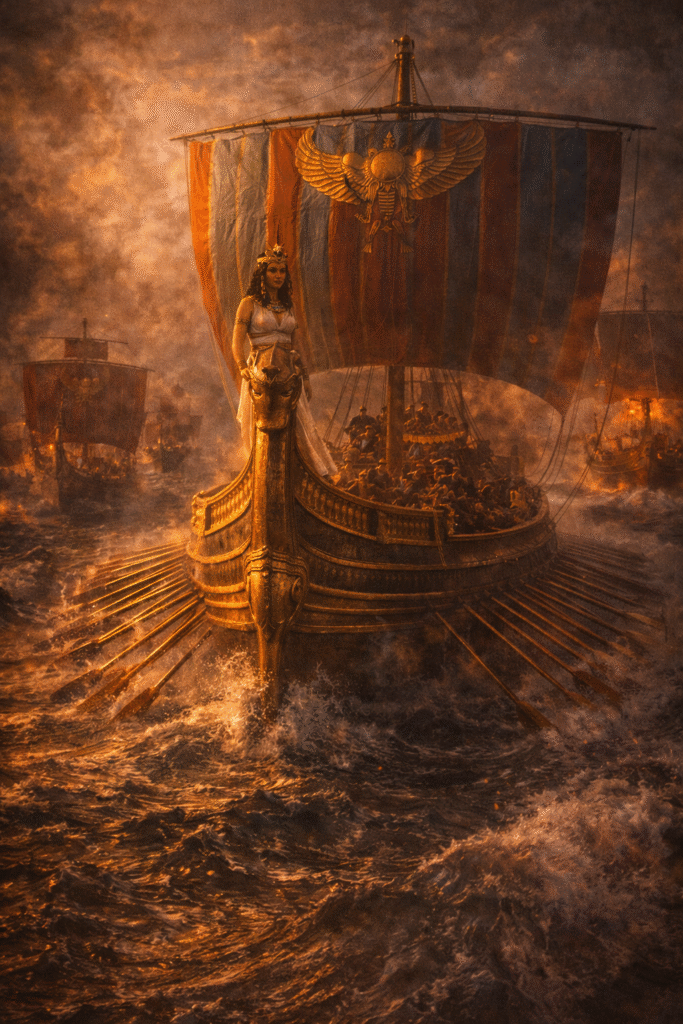
Prologue — No Sea Is Ever Still at the Edge of History
All battles are storms.
But some storms
are born of nature.
Others
are born of men.
This one—
the Battle on the Waters of Fate—
was both.
Actium
was not a simple defeat.
Not a flight.
Not a panic.
It was the moment
the ancient world
cracked along its spine.
And everything
that followed—
Antony’s ruin,
Egypt’s fall,
Rome’s empire—
was written here,
in smoke over water.
This Scroll
is not a defense.
It is a witness.
PART I — Dawn Over the Straits
The sky was pale
when I woke.
Not soft blue.
Not gold.
Grey.
Reluctant.
As if the sun itself
hesitated to rise
on what it would see.
My servants dressed me
in battle linen—
white, unembellished,
reinforced at the seams.
A queen’s garments
turned to armor.
I stepped onto the deck.
The sea stretched out
cold
and unnervingly still.
A glass surface
waiting to be shattered.
Antony’s flagship
rested a short distance away—
a bronze giant
with red sails
marking his command.
He stood on the deck,
broad-shouldered and grim.
We did not speak.
We didn’t need to.
The sea between us
was thick enough
with all the words
we already knew.
PART II — Formation of the Fleets
Antony commanded
230 ships.
Heavy.
Fortified.
Beautiful.
Egypt’s contribution—
my fleet—
held the center.
Ships carved of cedar
and oak,
hulls reinforced with iron.
Barges with towers.
Five-banked galleys
with deadly rams.
But heavy ships
require wind.
And the wind
refused us.
Octavian’s commander,
Agrippa,
knew this.
His ships—
lighter,
faster,
nimble—
were built
for a day like this.
Our oarsmen
strained in silence,
waiting for the signal.
Antony raised his arm.
A horn sounded across the bay.
The battle began
not with a charge—
but with waiting.
PART III — The First Clash
Agrippa struck first.
Roman ships
rushed forward
like wolves—
fast, coordinated,
circling our heavier vessels.
They avoided our rams.
They targeted our oars.
They fired flaming projectiles
onto our decks.
The wind
pushed smoke
straight into our eyes.
I shouted orders:
“Archers—
aim for their mast ropes!”
“Rowers—
half speed on port!”
“Ballistae—
fire when the deck clears!”
My flagship moved
with disciplined grace,
but the sea churned
with bodies,
splintered wood,
shouts in Greek,
Latin,
Egyptian.
It was not war.
It was drowning
in every direction.
PART IV — Antony’s Line Breaks
Antony’s ships
formed a defensive crescent.
Strong.
Elegant.
Mathematically sound.
But wars
are not equations.
Agrippa saw the weakness
before any of us:
The crescent
was too rigid.
The Roman ships
pierced the left flank,
breaking the curve
like snapping a bowstring.
Suddenly—
our formation shattered.
Antony roared orders.
Trumpeters cried out.
Flags whipped wildly.
But chaos
moves faster
than discipline.
Broken lines
never heal
in the middle of a battle.
I watched
as Antony’s best vessels
collided,
burned,
or spun helplessly
in the Roman surge.
The sea
had turned
against us.
PART V — The Moment the Winds Betrayed Us
Around midday,
the wind shifted.
A small change—
a whisper.
But it changed everything.
Until now,
the air had been still.
Our heavy ships
depended on wind
to push momentum
into their mass.
Roman ships
needed none.
When the wind
finally arrived—
it blew against us.
Straight into our sails.
Turning them
into useless flags.
Our oars
fought the water
with diminishing strength.
Rowers screamed
under the weight
of resistance.
I felt the deck
tremble.
Not from impact.
From inevitability.
PART VI — The Smoke That Hid the Sun
A Roman tower ship
fired a flaming pot
onto an Egyptian vessel
near my own.
It hit the deck.
Exploded.
The sky went dark.
Oil
—Greek fire,
sticky and fast—
splashed across the water
and ignited.
Sailors leaped
into the sea
only to be swallowed
by flame.
The smoke
rolled across the fleet,
blotting out
everything.
We could not see
our allies.
Our enemies.
The horizon.
We fought
in blindness.
Archers loosed arrows
into silhouettes.
Rowers struggled
without direction.
Captains shouted orders
lost in wind and fire.
I gripped the railing.
“This,”
I whispered,
“is not strategy.”
“This is catastrophe.”
PART VII — Antony’s Signal
Through the smoke,
through the heat,
through the screams—
Antony’s red sail
appeared
like a wound
torn open in the sky.
A horn sounded.
Once.
Twice.
Three times.
His signal.
It was not retreat.
It was escape.
A prearranged maneuver—
known only
to a handful of us.
Not cowardice.
Not flight.
A lifeline.
The plan had always been:
If the sea turned
beyond salvation,
we would break out
together
toward the open water—
regroup,
preserve the fleet,
fight another day
for Egypt.
I shouted:
“Full speed!
All rowers—
break the line!”
My admiral hesitated.
“Majesty—
Antony’s ship moves alone!”
But I already knew.
The smoke swallowed
Antony’s fleet.
Only his flagship
emerged on the far side—
racing for open sea.
He expected me
to follow.
He trusted
I would understand.
He trusted
we would meet again.
He trusted
survival
over glory.
He was right.
But the cost—
the cost
would echo
through eternity.
PART VIII — The Breakout
My ship
turned sharply.
Oars slashed water.
Sails groaned under strain.
Archers fired cover shots
at pursuing ships.
A storm of arrows
rained onto our deck.
A spear
struck the mast
beside my head.
I did not blink.
“Hold formation!”
I commanded.
“Stay with me!”
The fifteen ships
closest to mine
followed.
Others
could not.
Shattered hulls
blocked the escape route.
Roman ships
rammed through gaps.
Sailors screamed.
Flames roared.
The sea
became a grave.
My fleet—
the greatest Egypt had built
in a century—
was collapsing behind me.
We broke through
a narrow channel
between two Roman ships,
shearing oars,
splintering decks.
The open water
finally surged beneath us.
Behind me—
Actium burned.
Ahead of me—
Antony’s red sail
vanished
into the horizon.
I whispered:
“We are not defeated yet.
Not yet.”
PART IX — The Silence After the Roar
By dusk,
we were far from Actium.
The sea
was eerily calm—
as if the waters themselves
wished to erase
what they had seen.
My sailors
collapsed from exhaustion.
My generals
stood pale,
shaking.
I stood
at the prow.
Not victorious.
Not broken.
Something else:
Awake.
The world
had changed shape.
And now
we would have to change
with it.
When Antony’s ship
finally appeared
in the distance,
I felt my breath return.
We had survived.
But survival
is not triumph.
And Rome
would not forgive us
for escaping.
PART X — What Actium Truly Was
A student once asked
what Actium was.
A battle?
A loss?
A turning point?
The answer is
all of these—
and none.
Actium
was the day
Rome realized
it could not share
the world.
Actium
was the day
Octavian secured
his future empire.
Actium
was the day
Antony lost
not honor—
but momentum.
Actium
was the day
Cleopatra understood
the truth she had feared
for years:
Rome would never
let Egypt live
as an equal.
And so Actium
was also this:
The day hope
narrowed
but did not die.
The day fate
closed one door
and forced us
to seek another.
The day
the waters
of the world
turned
and carried us
toward the final chapter.
Ancient Questioner’s Desk — The Waters Edition
A student asked:
“Was Cleopatra a coward at Actium?”
The elder replied:
“No.
She was a strategist
in a battle already lost.”
Another asked:
“Did Antony flee?”
The historian wrote:
“He executed a planned maneuver
to preserve the alliance.
It failed only in perception.”
A traveler wondered:
“Could Actium have been won?”
The scribe answered:
“Perhaps—
but not against fate
and propaganda combined.”
A final question came:
“What did Cleopatra save that day?”
The old master smiled.
“Herself.
Her fleet.
And the last chance
to fight for Egypt.”
FINAL CTA — Stand Where the Sea Held Its Breath
This Scroll ends here—
on the burning waters of Actium,
in the smoke that hid armies,
in the wind that betrayed ships,
in the moment when destiny
chose its course.
If you want to walk
the shores where empires collided,
the cliffs where Antony watched the horizon,
the waters where Cleopatra fought
against the impossible—
walk them with ENA.
Journey with ENA.
Some battles are lost in a day.
Others reshape the world forever.
Historical Context
The Battle of Actium (31 BCE) was the decisive naval engagement between Octavian and the forces of Antony and Cleopatra. Ancient accounts differ on Cleopatra’s role and intentions during the battle.
This scroll reflects the uncertainty and chaos of the event rather than asserting a definitive motive.