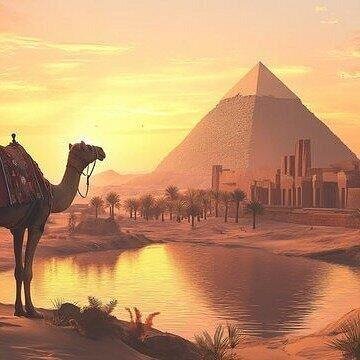
Scroll XXIV – The Day the World Bowed in Alexandria
Alexandria — 34 BCE
Translated and restored for the modern traveler.
Prologue — Glory Is Never Born From Pride. It Is Born From Vision.
People claim
that this day
—this spectacular day—
was excess.
Arrogance.
Hubris.
They are wrong.
The Day the World Bowed
was not a performance
for delight.
It was a statement:
The East
would not kneel
to Rome’s coming empire.
Not quietly.
Not trembling.
We would rise
with brilliance,
with unity,
with civilization older
than Roman marble.
This Scroll
is the moment
the Mediterranean realized:
Cleopatra and Antony
were building a world order
that could rival
—even surpass—
Rome.
No wonder Octavian
trembled.
PART I — Preparing the Day the World Would Remember
The preparations began
before dawn.
The entire city
moved in harmony:
— priests purifying the streets
— children weaving lotus garlands
— merchants hanging blue and gold banners
— scribes arranging scrolls for the proclamations
— soldiers forming perfect ranks along the Gymnasium
Alexandria did not do this
because it was commanded.
Alexandria did this
because it believed.
Believed in Egypt.
Believed in stability.
Believed in the dynasty
we were building
together.
I dressed
in the regalia of Isis:
white linen,
golden collar,
lapis bracelets,
the vulture crown
that spoke of
divine protection.
Not to imitate a goddess.
To honor the tradition
that a Pharaoh
embodied responsibility
not for self
but for order.
Antony
wore crimson and bronze—
lion’s skin,
military cloak,
symbols of Herakles.
Fire and stone,
side by side.
Ready to remake the world.
PART II — The Procession Through Alexandria
We traveled
not on litter or chariot—
but on foot,
through our people.
Through the palace gates,
down the marble steps,
into the streets
glittering with sunlight.
Crowds
pressed forward
with joy,
children reaching out
to touch my gown.
Trumpets sounded.
Horns cried out.
Drums rolled like thunder.
Incense floated in spirals.
Petals fell like soft rain.
Every balcony,
every roof,
every stairway
overflowed with citizens.
Not with fear.
With pride.
They saw not a queen
with a Roman general—
but Egypt
standing tall
after centuries
of foreign manipulation.
I saw tears
on the faces
of older women
who had lived
through famine,
war,
and palace coups.
I saw hope
in the faces
of young men
armed for new service
to a rising East.
I saw unity—
a people
ready to reclaim
their place
in the world.
**PART III — The Gymnasium of Alexandria:
The Stage of a New World**
The Gymnasium
was vast—
an open-air complex
large enough to hold
tens of thousands.
Columns towered
like forests of stone.
Silk banners
in royal blue
and deep Egyptian gold
draped from every height.
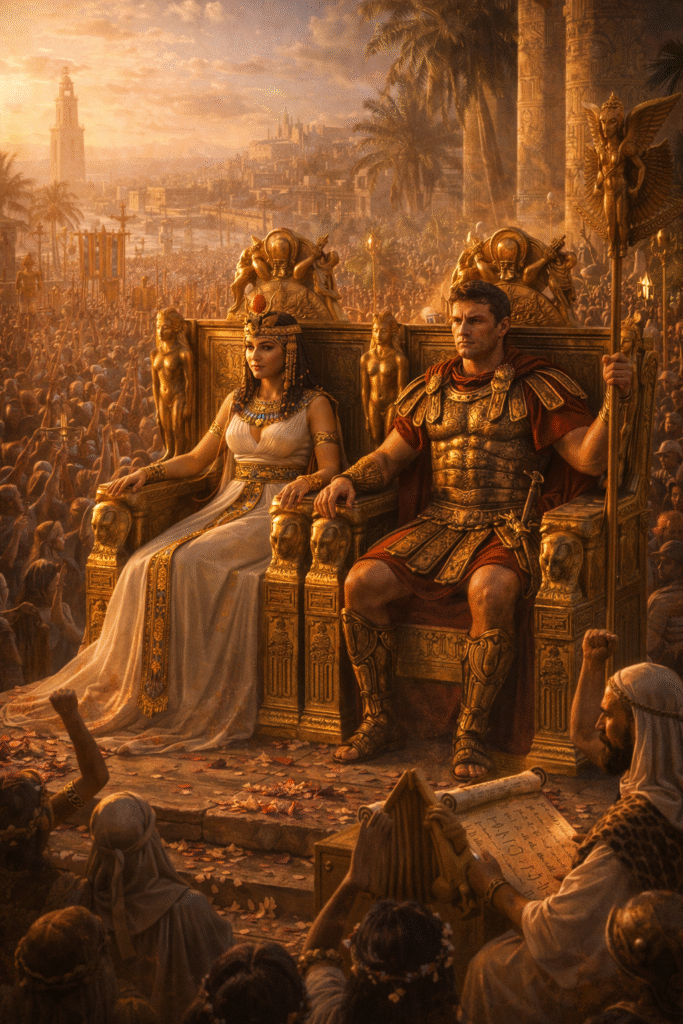
A massive dais
had been constructed:
two thrones at its summit,
four smaller seats below.
When Antony and I ascended,
the roar from the crowd
rose like the sea.
This was not theater.
This was declaration:
Egypt
was no longer
Rome’s quiet ally.
Egypt
was a center of power.
And the East
was awakening.
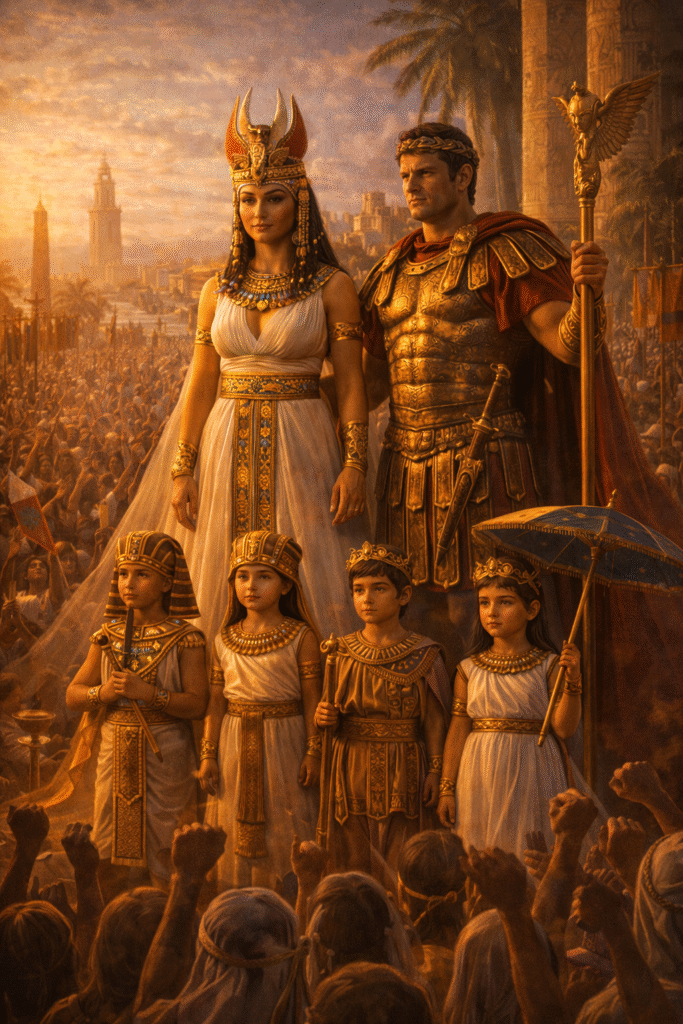
PART IV — The Four Children Take Their Place
From the palace gateway
emerged my children:
Caesarion —
my eldest,
clad in white and gold,
bearing the symbols
of Pharaoh.
Alexander Helios —
in shimmering gold cloth,
his hair crowned
with rays.
Cleopatra Selene —
in silver and blue,
moonlight woven into form.
Ptolemy Philadelphos —
smallest,
in soft purple,
walking proudly
between attendants.
The crowd
went silent
in awe.
Not for beauty.
For meaning.
Children
represent futures.
These four
represented
the future of an empire
that did not yet exist—
but could.
Antony looked at me
and murmured:
“They shine.”
“Yes,”
I said softly.
“And the world
is already afraid.”
**PART V — The Proclamations:
The Day the Mediterranean Shifted**
Antony raised his hand.
The people hushed.
Scribes stepped forward
with the proclamations.
Their voices carried
across the Gymnasium,
across Alexandria,
across time:
**1. Caesarion declared
“King of Kings”
and rightful heir
of Julius Caesar.**
A shockwave moved
through the crowd.
This was the moment
Octavian would never forgive.
My son
—Caesar’s true blood—
was publicly acknowledged
as heir to the greatest leader
Rome had ever produced.
This was not rebellion.
This was truth.
And truth
is the sharpest weapon.
**2. Alexander Helios
crowned “Great King
of Armenia, Media, and Parthia.”**
A symbolic claim—
not a conquest.
A vision
of what could be built
beyond the Euphrates.
**3. Cleopatra Selene
crowned “Queen
of Cyrene and Crete.”**
A recognition
of her diplomatic brilliance
even as a child.
**4. Ptolemy Philadelphos
granted “King
of Syria and Cilicia.”**
Future-building.
Territory rebalancing.
Strength divided
to ensure unity.
The East
was no longer
a collection of provinces.
It was becoming
a constellation.
A network.
A vision.
A dynasty.
One Rome
could not control.
PART VI — Cleopatra Crowned “Queen of Kings”
When the proclamations ended,
the high priest
of Memphis
stepped forward.
He held the double crown.
The White Crown
of Upper Egypt.
The Red Crown
of Lower Egypt.
The union.
The eternal.
He raised it high.
“Cleopatra,”
he proclaimed,
“Chosen of Isis,
Daughter of the Nile,
Guardian of Ma’at,
Mother of Kings—
Today we name you:
Queen of Kings.”
The crowd erupted.
Not like a mob—
like a nation.
Like a heartbeat.
Antony bowed his head.
Not as consort.
As equal.
As ally.
As co-architect
of the world
we were shaping.
PART VII — Why Rome Broke After This Day
What happened in Alexandria
did not stay in Alexandria.
Messengers
carried the news
by sea
and desert
and mountain pass.
And when the proclamations
reached Rome—
Octavian exploded.
Not in public.
In private.
Violently.
Because he understood
what his Senate
did not:
This was not indulgence.
This was succession.
This was not spectacle.
This was structure.
This was not arrogance.
This was architecture.
A dynasty
that united:
Egypt,
Syria,
Cyrene,
Crete,
Armenia,
Media,
Parthia
(in symbolic claim),
and large parts
of the Eastern Mediterranean—
under one lineage
that Rome
did not control.
My children
represented
a future
where Rome
was no longer inevitable.
And that
was the true threat.
Not me.
Not Antony.
The future we offered.
A future
Rome could not dominate.
A future
Rome could not tolerate.
PART VIII — The Night After the World Bowed
After the ceremony,
I stood alone
on the palace balcony.
The city
still hummed
with celebration.
Torches flickered.
Voices sang.
The harbor glittered
with tiny lights.
Below me,
my four children slept
in the royal nursery.
Antony moved quietly
to stand beside me.
“You have built
what no Pharaoh
has built in centuries,”
he said.
“No,”
I replied.
“We are building
what the world needs.”
He exhaled.
“They will come for us
because of today.”
“Yes,”
I whispered.
“But today
was worth coming for.”
The wind blew warm
from the desert.
The Nile
glimmered like obsidian.
And I knew:
We had reached
the highest point
of our reign.
Which meant the world
would now begin
its descent
toward chaos.
But tonight—
tonight was victory.
Not over Rome.
Over fear.
Because fear
never built anything.
And we
were builders.
Ancient Questioner’s Desk — The World-Bowing Edition
A student asked:
“Was this celebration arrogance?”
The elder replied:
“No.
It was architecture.”
Another asked:
“Did Cleopatra want an empire?”
The historian wrote:
“She wanted balance
in a world tilting toward Rome.”
A traveler wondered:
“How did Rome see this day?”
The scribe answered:
“As treason.”
A final question came:
“What did this day mean?”
The old master smiled.
“It meant the East
had remembered its power.”
FINAL CTA — Walk the Day the World Held Its Breath
This Scroll ends here—
in the blazing light
of Alexandria’s greatest spectacle,
the moment when Egypt
rose above fear,
when the Mediterranean
saw its future,
when a queen and a general
proclaimed a dynasty
the world would never forget.
If you want to stand
in the Gymnasium
where banners flew,
where proclamations echoed,
where a new world
nearly took its first breath—
walk it with ENA.
Journey with ENA.
Some days reshape history.
Some days challenge empires.
This day did both.
Historical Context
Cleopatra and Antony publicly displayed power through ceremonial acts, including the Donations of Alexandria, which deeply alarmed Rome.
This scroll narratively focuses on perception and symbolism rather than reproducing a full ceremonial record.