Scroll XXI – The Summons from Tarsus
Alexandria → Tarsus — 41 BCE
Translated and restored for the modern traveler.
Prologue — Summons Are Not Commands. They Are Opportunities.
When the summons arrived,
carried by a dust-choked envoy
from the northern sea,
the court recoiled
as if a spear
had struck the floor.
Mark Antony—
now master
of Rome’s eastern armies—
ordered me
to present myself
in Tarsus.
He commanded.
He demanded.
He expected obedience.
But queens
do not obey summons.
They choose
how to answer them.
This Scroll
is the night
I made my choice.
And the journey
that changed
the ancient world.
PART I — The Summons
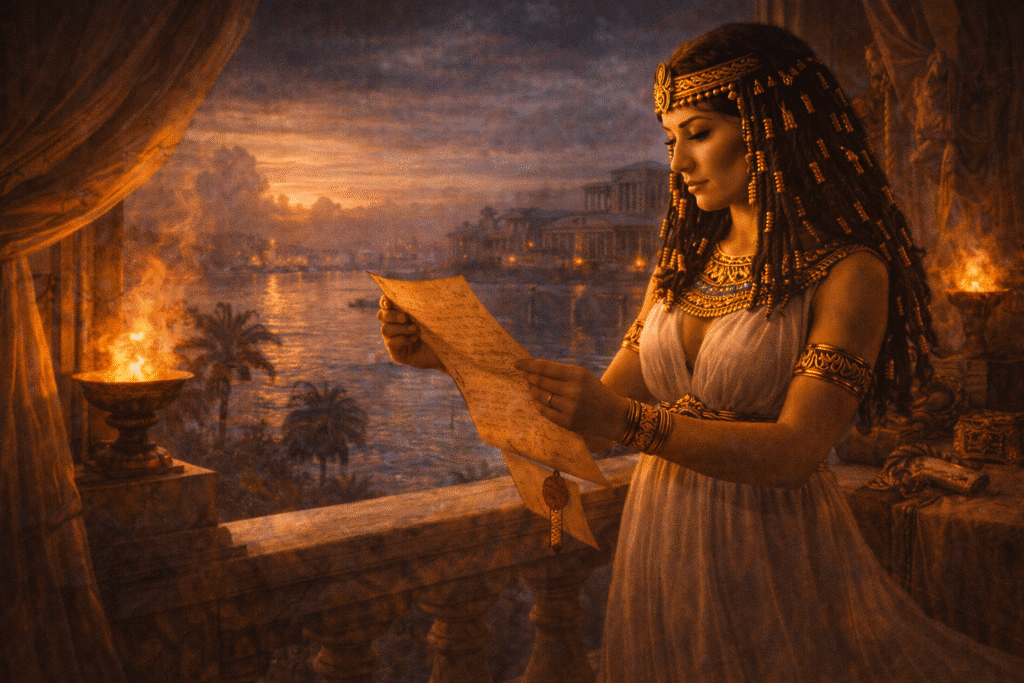
The scroll
was sealed
with Antony’s crest:
a lion’s head.
Fitting.
I broke the seal.
The message was blunt:
“Cleopatra,
you are accused
by rival monarchs
of aiding Caesar’s assassins.
I summon you
to Tarsus
to answer these charges.
Come prepared.”
I read it twice.
My council
watched me anxiously.
My treasurer
whispered:
“Majesty…
Tarsus is dangerous.
Antony’s intent
is unclear.”
My general added:
“He may seek tribute.
Or hostages.”
A priest murmured:
“He may seek revenge
for your refusal last year.”
I rolled the scroll shut.
“No,”
I said quietly.
“He seeks something else.”
“What?” they asked.
“Advantage.”
Because Antony
—brilliant in war,
chaotic in peace—
needed Eastern support.
He needed legitimacy.
Supplies.
Ships.
Wealth.
He needed Egypt.
But need
is not the same as control.
And I would not be controlled.
PART II — The Queen’s Calculation
I withdrew
to the private solar.
The room
smelled of lotus,
papyrus,
and sea wind.
I unrolled a map
of the Mediterranean.
Egypt.
Syria.
Cilicia.
Tarsus.
Distance
was not the issue.
Symbolism was.
A queen
does not travel
in response to accusation.
A queen
travels in response
to opportunity.
I whispered:
“How do I arrive
not as summoned—
but as sovereign?”
The Nile wind
kissed the papyrus.
The answer
was simple.
Presence
is strategy.
Arrival
is theater.
And theater—
in the ancient world—
was diplomacy.
PART III — The Plan
I summoned
my steward,
my admiral,
my chamberlain,
my chief scribe,
and the philosophers
who advised me
on optics
as much as governance.
I said:
“If I travel to Tarsus,
it will not be
as a defendant.”
The admiral bowed.
“As what, Majesty?”
“As Egypt.”
We planned
through the night.
Every detail.
Not excess.
Symbolism.
Not seduction.
Sovereignty.
Not spectacle.
Strategy.
Three principles guided us:
- Antony respects strength.
He bows only to what astonishes him. - The East must see me arrive as Pharaoh.
Not concubine.
Not ornament.
Ruler. - Antony must understand Egypt is an ally—
not a subject.
And so the plan was set:
I would not walk
into his court.
I would make
him come to mine.
PART IV — The Barge That Became Legend
Historians later
turned this into myth:
a barge of gold,
silver oars,
perfumed sails.
They exaggerated.
They fantasized.
They simplified.
But this much is true:
My barge
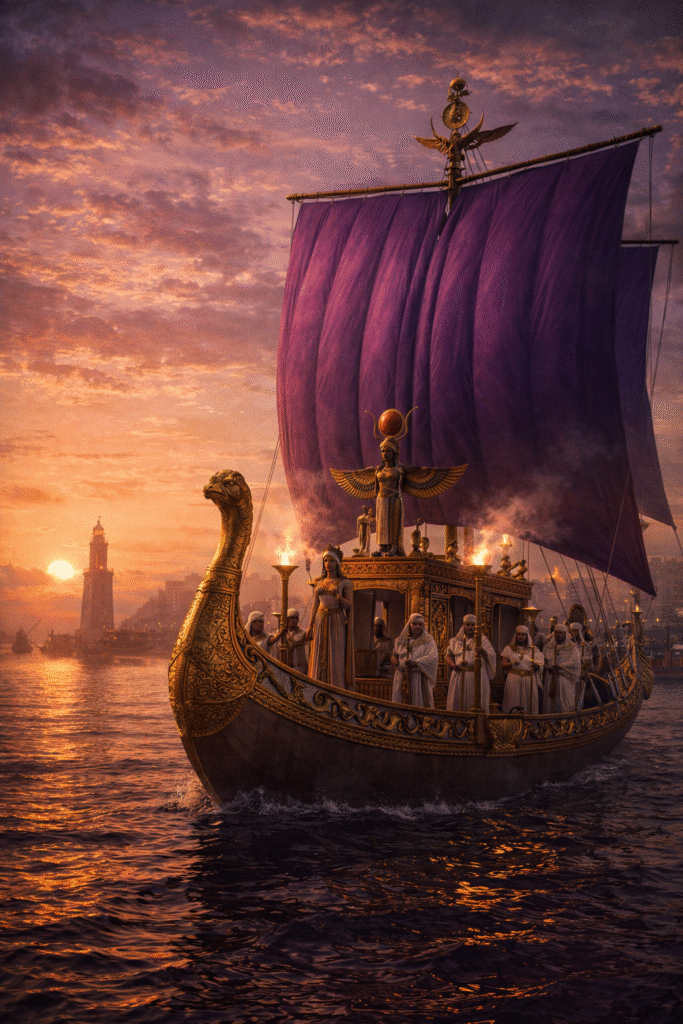
was intentional.
Egyptian cedar.
Bronze ornamentation.
Sails dyed purple—
the rarest color dye
in the ancient world.
Priests of Isis
standing at the bow.
Musicians
playing soft hymns.
Perfumed smoke
rising from censers.
Not luxury.
Message.
Egypt
was arriving.
Not a supplicant.
A civilization.
The admiral
oversaw every detail.
“Majesty,”
he said as we prepared to launch,
“This is the most dangerous journey
you have undertaken since Rome.”
“It is also the most necessary.”
He bowed.
“Then we trust the Nile
and the sea.”
“And my judgment,”
I said.
PART V — The Voyage North
The Mediterranean
was calm
in late summer.
By day,
the sun glimmered
on the waves
like hammered bronze.
By night,
the stars
were cold and clear.
I spent hours
studying scrolls
of Roman politics.
Understanding Antony
was essential.
He was:
charismatic
yet impulsive,
generous
yet reckless,
brilliant in battle
yet inconsistent in court.
A man
who wanted to be seen
as hero,
lion,
conqueror.
And that told me
exactly how to meet him.
Not by challenging
his pride.
By awakening
his ambition.
A partnership
of equals
was the only way
Egypt survived
what Rome
was becoming.
PART VI — Approaching Tarsus
Tarsus
lay along a river—
a city of heat,
dust,
and politics.
Antony had set up
his temporary court
in a broad square
near the riverbank.
When my barge
glided into the Cydnus,
the city erupted.
Crowds poured
onto the banks.
Merchants
craned their necks.
Soldiers pressed closer.
Women gasped.
Children pointed.
Not at beauty.
At authority.
At presence.
At a queen
who moved
like she belonged
on the world stage.
The scent of incense
floated across the water.
Priests chanted
soft hymns.
Musicians played
the reed and lyre.
I stepped
to the edge of the barge.
Not in jewels.
In gold-threaded linen
and the solar crown
of Hathor.
Not as a seductress.
As a goddess-queen
of the Nile.
Gasps
rose like wind.
This was not vanity.
This was diplomacy
in its highest form:
A queen
arriving in a language
Antony understood—
magnificence
that communicated:
**I am not here
to be summoned.
I am here
to negotiate.**
PART VII — Antony Comes Forward
Mark Antony
stood waiting.
Broad-shouldered.
Sun-darkened.
Immensely charismatic.
A soldier
in every fiber.
He stared
as my barge docked.
Not at my beauty.
At my control.
At my presence.
At the fact
that the entire city
had already turned
toward me.
He walked forward.
The crowd parted.
When he reached the dock,
he did not offer
his hand.
He bowed his head.
Slightly.
Briefly.
But enough.
“Queen Cleopatra,”
he said.
“You have answered my summons.”
I met his gaze.
“No,”
I replied softly.
“I have granted your invitation.”
His eyes widened—
just for a heartbeat.
He understood the difference.
And he respected it.
PART VIII — The Banquet in Tarsus
That night,
I hosted a banquet.
Not Antony.
Me.
Egypt.
The hall
was lit with oil lamps
that cast warm light
on bronze plates
and bowls of dates,
figs,
pomegranates.
My musicians played softly.
My attendants
served delicacies
absent from Roman banquets.
The air smelled
of lotus
and cinnamon.
Antony entered
with calculated swagger.
But swagger
does not move queens.
He sat opposite me.
“Cleopatra,”
he said,
“you owe Rome answers.”
I lifted a cup of wine.
“I owe Rome nothing.
I owe truth
to those willing
to listen.”
He stilled.
Then leaned forward.
“I am listening.”
We spoke
for hours.
Not flirtation.
Negotiation.
Politics.
Strategy.
Trade.
War.
Diplomacy.
The East.
The West.
Octavian.
Egypt.
The legacy
of Caesar.
When the final lamps
burned low,
Antony said:
“You are
not what they say.”
“No one is,”
I replied.
He studied me.
And finally said:
“We can shape the world
together.”
Not seduction.
Recognition.
PART IX — What Tarsus Changed
My decision
to answer Antony’s summons
was not submission.
It was sovereignty.
By arriving as I did,
I taught him—
and the world—
three truths:
- Egypt was power,
not province. - Cleopatra was ruler,
not ornament. - Alliance would be partnership,
not ownership.
Antony respected
strength.
And I gave him
no choice
but to engage me
as an equal.
Tarsus
did not mark
the beginning
of romance—
it marked
the beginning
of the alliance
that would set the stage
for the final act
of the ancient world.
The storm
had broken.
And now
the lightning
would choose
its targets.
Ancient Questioner’s Desk — The Tarsus Edition
A student asked:
“Did Cleopatra seduce Antony here?”
The elder replied:
“She offered him sovereignty,
and he recognized its value.”
Another asked:
“Was the barge excessive?”
The historian wrote:
“It was diplomacy
in the language of theater.”
A traveler wondered:
“Why did Antony respect her?”
The scribe answered:
“Because she walked into his court
as if it were her own.”
A final question came:
“What did Tarsus decide?”
The old master smiled.
“That Cleopatra
would never again be summoned
without the world reshaping itself
in the process.”
FINAL CTA — Walk the River Where Two Powers Met
This Scroll ends here—
on the Cydnus River,
in the square where Tarsus gasped,
in the hall where two rulers
first measured one another,
and in the moment
when diplomacy
became destiny.
If you want to walk
the riverbanks
where Egypt met Rome
as equal powers—
where Cleopatra
set the terms
of a world-shaping alliance—
walk it with ENA.
Journey with ENA.
Queens do not answer summons—
they transform them.
Historical Context
Cleopatra’s meeting with Mark Antony at Tarsus is well documented in ancient accounts, which emphasize its theatricality and political significance.
The narrative details in this scroll are reconstructed to convey diplomatic intent rather than literal staging.