
Scroll I – My Name, Stolen by Rome
Alexandria, 30 BCE — The Palace on the Harbour, After Actium, Before the End
Translated and restored for the modern traveler.
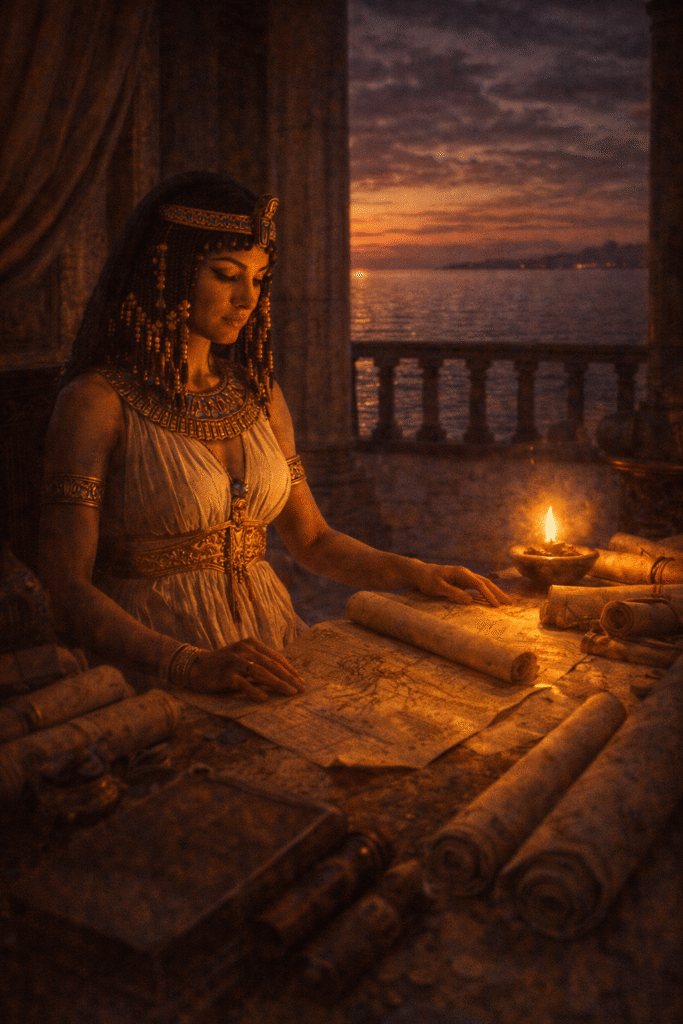
Prologue — They Will Lie About Me
By the time you read this,
I will already belong to other people’s stories.
Men I never met
will put words in my mouth.
Generals who never saw my city
will describe my character.
Foreign poets
will decide what my eyes meant
when I looked at the world.
They will call me:
- seductress
- sorceress
- destroyer
- whore
- witch of the Nile
- the woman who brought down a great man
- the woman who brought down a great empire
They will say
I wrapped myself in carpets
like a trick.
They will say
I ruled with my body
instead of my mind.
They will say
Rome fell for my perfume.
They will forget my languages.
My treaties.
My reforms.
My ships.
My scholars.
My city.
They will reduce an entire kingdom
to the curve of my arm.
That is theft.
So before they seal my body
in a mausoleum I have not chosen,
before they parade my memory
through their marble streets,
before the ink is dry
on their versions of me—
I will write myself.
You will not know me perfectly.
No one ever can.
But you will not know
only what my enemies chose to keep.
That is why this Journal exists.
Not to beg for mercy
from the future.
To demand accuracy.
PART I — The Room Where Alexandria Ends Quietly
I am writing this
from a high room
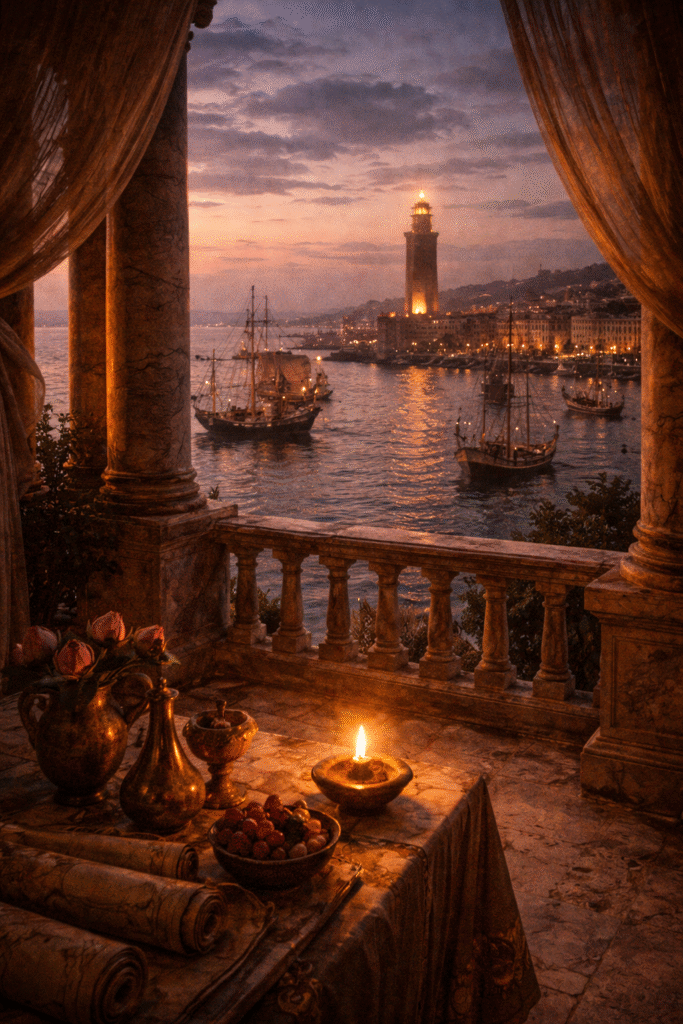
overlooking the great harbour.
Once,
these windows framed
the pride of the world:
- the Pharos lighthouse,
its fire a second sun
for sailors at night - ships from Cyprus, Syria,
Nubia, Rome, far beyond - the white line of the Heptastadion,
dividing the waters like a measuring rod - the Musaion and its scholars,
breathing argument and ink
Now,
the same windows
frame something smaller.
Roman sails.
Docked.
Waiting.
The city is not burning.
Conquerors like flames,
but Octavian likes
something colder.
He prefers
a quiet surrender.
In the streets below,
Alexandrians speak softly,
as if sound itself
could draw unwanted attention.
Those who still dare to look up
glance toward the palace
with mixed expressions:
fear,
pity,
anger,
love.
I know those looks.
I have worn them myself
for cities under siege
far from here.
Now I am
the one under siege.
When you picture a fallen queen,
you may imagine
screams,
cries,
chaos.
But the end of a world
sounds more like this:
servants still lighting lamps
out of habit.
The soft clatter
of amphorae moved
from one storeroom
to another.
The sea
continuing to breathe,
indifferent as always.
The world does not end
for everyone at once.
It ends
for one city,
one family,
one woman—
and the rest of the earth
continues as usual.
This room
is where my Egypt ends.
Not in fire.
In lamplight.
In ink.
PART II — What Rome Has Already Decided
Rome has already
begun writing me.
I hear it
in the way their envoys speak.
To my face,
they still say:
“Queen.”
Behind closed doors,
they say:
“Dangerous woman.”
“Foreign influence.”
“Oriental corruption.”
“The disease in Antony’s will.”
They will not call me Pharaoh.
To them,
Pharaohs are hieroglyphs and mummies,
things to plunder
and display.
I am more dangerous than that.
I am contemporary.
Alive.
Untranslated.
Inconvenient.
It is easier
to make me a symbol
of everything Rome fears
in itself.
Greed.
Desire.
Ambition.
Softness.
Love of luxury.
The temptation to be ruled
by something other
than discipline and iron.
So they take my name—
Cleopatra Thea Philopator,
Glorious Goddess,
Father-Loving—
and shorten it.
Just Cleopatra.
As if there had never been
six queens before me
with the same name.
As if I am not
in a line of women
and men
and gods.
They remove my number
and keep the part
they can turn into a curse.
They will write
as though I emerged
from nowhere.
A storm
rather than a season.
It is a common trick
of conquerors:
erase what came before,
so the person you destroy
looks like an accident
instead of a culmination.
I know their tricks.
I watched them practice
on my father.
I watched them practice
on entire kingdoms.
They will not have
the last word.
PART III — Why I Am Writing to You (And Not to Them)
You may wonder:
“If she knows she is dying,
why does she write?”
I have no illusions
that Octavian will preserve
these scrolls out of respect.
He will not.
He wants an Egypt
without a voice.
But I am not writing for him.
I am writing
for whoever comes after Rome
and after those who come after Rome—
for the ones
who walk through these streets
centuries from now
and feel
an ache they cannot name.
For the woman
who stands among fallen columns
and feels
more kinship with the ruins
than with the guides.
For the man
who has been told
he is “too much”
for the world around him
and has had
his ambition called sin.
For the child
who learns
that powerful women
are always called dangerous
by the men
who want their power.
I am writing
for the ones
who know
the world is rarely as simple
as the winners say it is.
You.
I write for you.
You may not know my language.
You may not know my gods.
But you know
what it is
to be described
by people
who do not love you.
So when you walk
through Alexandria’s dust,
or stand
in a museum far away
looking at my coins,
or read my name
flattened into myth—
you will also have this:
my own account.
Not of every battle.
Not of every night.
Of the moments that mattered.
The choices.
The humiliations.
The victories.
The quiet hours
of calculation
and fear
and stubborn hope.
PART IV — I Was Not Born a Myth
They will speak of me
as if I stepped onto the stage
fully formed.
As if I began
with Caesar
or Antony.
As if my life
were an accessory
to theirs.
It is indecent,
how small
they will make me.
Let me say this clearly:
When Julius Caesar
first set foot
in my city—
I already existed.
I already spoke more languages
than most men in his Senate.
I already ruled a broken court
with both hands steady.
I already knew
the grain routes,
the temple factions,
the moods of the Nile,
the cost of a failed flood.
I did not become
significant
because Rome looked at me.
Rome looked at me
because I was already significant.
You must understand this now,
at the beginning,
or everything they tell you later
will sound plausible.
They will tell you
I bewitched him.
As if politics
were a spell.
As if empire
falls for perfume.
I will show you instead
how I used intelligence
where others used armies.
How I used my city
as leverage.
How I used my body
as part of my arsenal—
but never as my only one.
You will see me girl,
sister,
daughter,
exile,
queen,
mother,
friend,
enemy,
last Pharaoh.
You will not see
a myth.
You will see
a person.
PART V — The Mirror I Refused to Trust
In the next room,
they have placed
a tall bronze mirror.
Servants polished it today
until it could swallow light.
They think
it will comfort me
to see that I am still beautiful.
Beauty,
in their eyes,
is my greatest currency.
They are wrong.
I look into the mirror
and see:
- lines at the edge of my eyes
from years of sun and worry - a mouth that has learned
to say what men want to hear
and what they fear to hear
often on the same breath - a body that has carried children,
and the weight of a kingdom,
and the stares
of a thousand envoys
Rome will say
I ruled with that reflection.
They will call it sorcery.
Depravity.
Luxury.
But I know
the mirror’s limits.
It shows me
skin.
Shape.
Posture.
It does not show
the nights I spent
learning the laws
of three legal systems.
It does not show
the arguments I memorized
in Greek and Egyptian
to move priests and scholars alike.
It does not show
the grain accounts
I corrected myself
when the scribes
“miscounted”
in someone’s favor.
The mirror
is Rome’s favorite object.
It proves nothing.
So instead of
trusting the mirror,
I trust this:
papyrus.
Ink.
Memory.
The mirror
will not outlive me.
This might.
🌿 MID-SCROLL CTA — For the Traveler Who’s Tired of the Hollywood Version
If you are already weary
of the Cleopatra
you’ve been given—
the cartoon,
the seductress,
the scandal,
the eyeliner—
and you are hungry
for the woman
who actually lived,
this Journal is your entrance.
Walk with ENA
through Alexandria
not as a set
for other people’s empires,
but as the living mind
of its last queen.
Stand where she stood
above the harbour.
Look out at the sea
where foreign sails gathered.
Feel what it means
to hold a civilization
in your hands
while the rest of the world
writes you into a joke.
Journey with ENA.
Some women refuse
to be footnotes.
PART VI — The Sound of a City Waiting for a Verdict
Alexandria is quiet,
but not calm.
There is a difference.
Calm is chosen.
Quiet is imposed.
In the courtyards,
the fountains still run.
In the streets,
vendors still call—
but softly,
as if afraid
to attract notice.
In the Brucheion district,
near the great library’s shell,
I know
they are already sorting:
Which scrolls
might please Rome.
Which might be burned.
Which names
are safest to speak.
Which names
should be buried in whispers.
My own name
moves through the city
with caution.
Some say it
only indoors now.
Some trace it
on tabletops
with their fingers
as if to reassure themselves
it still exists.
My children’s names
are even more dangerous.
Caesarion.
Alexander Helios.
Cleopatra Selene.
Ptolemy Philadelphos.
They are futures
Rome did not plan.
Rome does not like
unplanned futures.
The city knows this.
So it waits.
It waits for Octavian
to decide whether
to parade me
or kill me quietly.
To spare my sons
or cut the line of Pharaohs
at the root.
I cannot stop the city
from waiting.
But I can decide
how I spend
these waiting hours.
I choose
to spend them
telling you
how we got here.
PART VII — The First Truth I Owe You
Before we step backward
into my childhood,
into the palace,
into my father’s frightened reign,
into the years of famine
and exile
and return—
I must give you
one truth
at the front.
You are wondering
about my death.
Everyone does.
You will hear stories.
They will say
I died by snake.
They will say
I staged it
for drama.
They will say
I reached for symbols
in my final hour
like a bad actor
who cannot stop performing.
Listen to me:
I will tell you
how I die
when we arrive there.
Not now.
Not in the first Scroll.
I will not let my ending
eat my entire life.
But know this:
My death
will not be
an accident.
It will not be
a surrender.
It will be
my last decision.
A decision
to leave this world
as queen of myself
if I cannot remain
queen of anything else.
You came here
for tragedy.
You may stay
for something truer:
a woman
who refused
to let her enemies
script her final act.
Ancient Questioner’s Desk — Rome’s Version vs Mine
A student asked:
“Why not let the future
decide what it thinks of her?”
An elder replied:
“The future can only choose
from the stories it is given.”
Another asked:
“Was she really so dangerous?”
A historian wrote:
“To empires built on control,
any woman who writes herself
is dangerous.”
A traveler wondered:
“Is this history
or defiance?”
A scribe answered:
“Both.”
A final question came:
“Can we trust her?”
The old master smiled.
“Trust her,” he said,
“to tell you
what she wanted—
and to show you
how much more
that was
than they said.”
FINAL CTA — Enter the Last Dawn
This first Scroll
ends not with my birth,
but with my choice.
The choice
to speak
before silence.
The next Scroll
will take you backward—
into the house
that raised me,
the father
who feared Rome,
the court
that forgot
how to be Egyptian,
the girl
who began to study languages
like weapons.
If you walk with me
through all of them,
you will not leave
with a simpler picture.
You will leave
with a truer one.
And perhaps,
when you stand one day
on a hill above the sea
wondering what became
of my city—
you will say my name
the way it deserves
to be said:
Not as a punchline.
As a person.
Journey with ENA.
This is not Rome’s Cleopatra.
This is hers.
Historical Context
Cleopatra VII Philopator was the final ruler of the Ptolemaic dynasty of Egypt. Unlike later legend, she was a Macedonian Greek by ancestry and ruled Egypt as part of a complex Hellenistic kingdom deeply entangled with Roman power.
This opening scroll establishes her historical position rather than documenting a specific moment. The framing is narrative, intended to orient the reader within theъя political and cultural realities of late Ptolemaic Egypt.