Scroll XXVI – When the Future Finally Spoke My Name
The Timeless Years — Beyond the Life, Beyond the Stone, Beyond the Silence
Translated and restored for the modern traveler.
Prologue — Memory Waits Longer Than Stone
History is stubborn.
When kings rewrite,
when priests conceal,
when scribes copy over truth—
history waits.
Buried.
Quiet.
Patient.
This Scroll is the story
of the years
after my death,
after the erasures,
after the sand settled.
It is the story
of the centuries
that passed
before the world
finally called my name again.
It is the story
of rediscovery,
reawakening,
recognition.
The moment
when the future
looked at my shattered statues
and broken cartouches
and whispered:
“We see you.”
PART I — After I Was Gone, The Kingdom Forgot
For years—
decades—
after my burial,
the court removed me
piece by piece.
My statues defaced.
My name chiseled out.
My images re-carved
into those of others.
My obelisks
covered with stone walls.
My reliefs
scraped thin.
Memory attempted
to fold itself
around a world
that no longer contained me.
The priests
called it purification.
The scribes
called it standardization.
The historians
called it succession.
But under all those names
lay one truth:
Men feared
a story
they did not know
how to preserve.
They tried to bury me
in revision.
But the stone—
the stone remembered
where the chisels slipped
and where the erasers
carved too lightly.
My story
hid in those imperfections.
Waiting.
PART II — The Sand Covered My Temple, but Not My Name
Years became centuries.
Then millennia.
Wind carried sand
across the terraces
I once walked.
Storms buried
the lowest statues.
Obelisks toppled.
Columns cracked.
But even beneath sand,
my temple remained.
Intact.
The cliffs protected it.
The architecture
—the way it blends
with the mountain—
shielded it.
And the stories
carved in deep relief
held on.
The Punt expedition—
my proudest achievement—
silently preserved
in ghost lines
beneath newer carvings.
The workers
had carved too deep
for even time to remove.
And the world
—unknowingly—
inched closer
to rediscovery.
PART III — The Day the Future Knelt Beside My Wall
It happened
thousands of years later.
A group of explorers
from far beyond Kemet
arrived in Waset.
Their language
was strange.
Their clothes unfamiliar.
Their tools
made of materials
we never imagined.
One man
—a careful observer—
walked the terraces
of my temple.
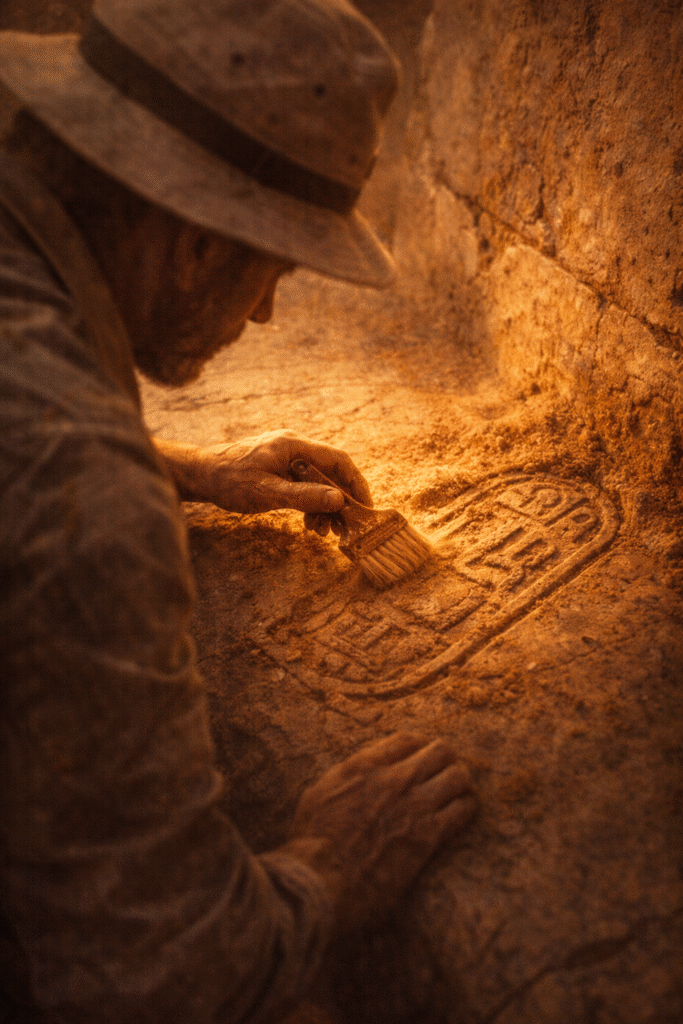
He brushed sand
from a relief.
Then stopped.
His fingers
traced a faint outline
beneath an altered carving.
A curve too soft
to belong
to a male figure.
A line too delicate
to match a general.
A profile
arched with purpose
and artistry.
He frowned.
He brushed again.
A hidden female form
emerged
under the sunlight.
He whispered
to his companions:
“There is a woman here
who does not belong
in the record.”
And just like that—
My story
began to rise
from the sand.
PART IV — The Cartouche That Refused to Die
On another day,
a scholar uncovered
a broken block
near the base
of a collapsed column.
The surface
had a jagged void
where a cartouche
had been gouged out.
But beneath—
beneath the gouges—
beneath the rough new cuts—
beneath the attempts
to hide the truth—
there remained
a single preserved groove.
The oval curve
of a royal cartouche.
Not male.
Not Thutmose.
Not any king
expected in that place.
The scholar
leaned closer.
“Who would place
a king’s cartouche here?”
someone asked.
The scholar’s eyes widened.
“Not a king,” he whispered.
“A queen.”
A century later,
another explorer—
guided by this hint—
found the faint shadow
of a name
scratched beneath the erasure.
Maatkare.
For the first time
in millennia,
my throne name
was spoken aloud.
The future
had found me.
PART V — The Whisper That Became a Question
At first,
I was a curiosity.
A mystery.
A puzzle.
A question
that did not fit
Egypt’s lineage.
A female king.
Unusual.
Unthinkable
to some early scholars.
But the evidence—
stone, relief, draft,
temple alignment—
piled up.
And with each piece,
the world’s whisper grew louder:
“Who was she?”
They found:
- statues reshaped
but still unmistakably mine - inscriptions half-erased
but recoverable - foundation texts
referencing the king
whose origins did not match
Thutmose - duplicate relief layers
with my form beneath - clay jars containing
incomplete drafts
of my narratives
The same drafts
saved by scribes
centuries before.
The world began to see
what the workers
of my time
had always known:
I existed too fully
to be erased.
PART VI — The Day the Future Spoke My Name Correctly
It came slowly.
One scholar
proposed it first:
“Hatshepsut,” he breathed.
“Not princess.
Not consort.
Not regent.
King.”
Another fought the idea.
Impossible.
But the evidence
kept rising
like floodwaters.
The alignment of my temple.
The scale of my obelisks.
The enormity
of my Punt reliefs.
No regent
could have commanded this.
No queen
behind the throne
could have shaped this.
No ceremonial figure
could have built
this scale of divinity.
At last—
reluctantly at first,
then with awe—
the world said the truth aloud:
“She was Pharaoh.”
“She ruled.”
“She built.”
“She commanded.”
“She was erased—
and yet
she endured.”
For the first time
in thousands of years:
My name
was spoken as it should be.
Hatshepsut.
Not hidden.
Not diminished.
Not revised.
Restored.
Whole.
Seen.
PART VII — The Stone Spoke for Me
As excavation deepened,
scholars uncovered
one of the oldest
remaining reliefs
of my face.
Chipped.
Weathered.
But still radiant
in the way
only Egyptian artists
could carve.
A woman
in the ceremonial beard.
Confident.
Poised.
Unmistakably royal.
For a long time,
modern visitors
disbelieved their eyes.
“A woman could not—”
“She did,”
the archaeologists answered.
“A queen would not—”
“She did,”
the stones answered.
“But why would they erase—”
“Because she shook
the boundaries
of her era,”
history answered.
The stone
had waited
far longer
than any human could.
But finally—
finally—
it told my story again.
PART VIII — Modern Footsteps in My Temple
One day—
in a time far beyond mine—
a traveler stood
on the upper terrace
of Deir el-Bahari.
A woman.
She looked at the pillars
I once walked between.
She read the plaques
that bore my name
in bold letters
never carved in my lifetime.
She whispered:
“My God…
she was magnificent.”
And for the first time
in so long
that time itself felt irrelevant—
I heard a voice
that was not of my world
but spoke to me.
Through awe.
Through admiration.
Through memory renewed.
Not whispered in fear.
Not spoken in politics.
Not chanted by priests.
Spoken
by the future.
The traveler
touched the relief
of my divine birth
and said softly:
“You deserved better.”
The wind
carried her words
through the colonnade.
And I felt myself
rise.
Not as a queen.
As a legacy
finally seen.
PART IX — What the Future Taught Me
I had believed
my legacy
would be carved
into stone.
I had believed
memory
depended on temples,
reliefs,
cartouches.
But the future
taught me otherwise.
Legacy
is not stone.
Legacy
is not ink.
Legacy
is not the politics
of one dynasty
or the jealousy
of those who came after.
Legacy
is the stubbornness
with which truth
refuses to die.
Legacy
is the awe
in a traveler’s eyes.
Legacy
is the whisper
of a child
who imitates your obelisk.
Legacy
is the scholar
who risks his reputation
to speak your name correctly.
Legacy
is the worker
who carved your truth
too deep to erase.
Legacy
is the future’s ability
to resurrect
what the past
tried to bury.
Legacy
is the moment
someone kneels
in your temple—
3,400 years
after your last breath—
and says:
“I know who you are.”
If you have ever felt
misunderstood
in your own time—
If you have ever trusted
that someday,
someone,
somewhere
would finally understand
your truth—
Then this Scroll
belongs to you.
Walk with us
through the terraces
where memory
defied erasure.
Stand in the shadow
of obelisks
built by hands
that refused limitation.
Look upon walls
that waited centuries
to reveal their truth.
Journey with ENA.
The future remembers.
PART X — The Moment I Became Eternal
Not in the way
of gods.
Not in the way
of tombs.
In the way
of stories
too powerful
to stay buried.
I became eternal
the moment
the future opened its eyes
and chose
to see me.
Not the rewritten version.
Not the diminished version.
Not the version
politics tried to sculpt.
Me.
A woman
who dared
to be Pharaoh.
A ruler
who led with vision,
with innovation,
with stability,
with diplomacy,
with architectural genius.
A human being
who rose
above expectation.
The moment
the future spoke my name—
that was immortality.
Not the afterlife.
Not the halls of Osiris.
This.
Being remembered
correctly.
PART XI — The Ancient Questioner’s Desk
A student asked:
“Why did it take so long
for the world to remember her?”
The historian replied:
“Because truth
travels farther
than politics.”
Another asked:
“Did she rise again?”
The scholar wrote:
“Yes.
In every mind
that sees her clearly.”
A traveler wondered:
“What is eternity?”
The scribe answered:
“Eternity
is when the future
speaks your name.”
A final question came:
“Did she win?”
The old master smiled.
“She was remembered.
There is no greater victory.”
The Scroll ends here—
not in sorrow,
not in silence,
not in resistance.
In triumph.
In reclamation.
In resurrection.
In recognition.
If you have ever been overlooked,
underestimated,
forgotten,
or rewritten—
then her story
is your story.
Come walk
the terraces
where she rose again.
Come feel
the cliffs
that guarded her truth.
Come stand
in the temple
that waited
3,400 years
to whisper:
“She lived.
She led.
She mattered.”
Journey with ENA.
Some stories wait millennia
for the right eyes.
Yours.