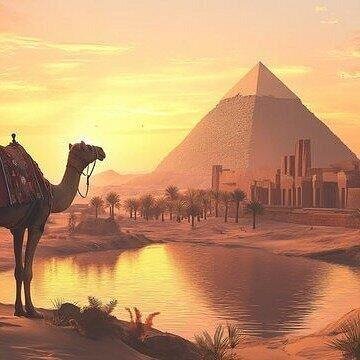
Scroll XXV – Legacy Beyond Erosion
Year: 1437 BCE — Deir el-Bahari, Karnak’s Shadows, The Valley of Kings’ Edge, and the Unwritten Future
Translated and restored for the modern traveler.
Prologue — What Survives Is Not Stone Alone
Erosion is certain.
Wind will carve.
Sand will scrape.
Time will soften every edge.
But erosion is not erasure.
Some things survive
because they are carved.
Some things survive
because they are remembered.
Some things survive
because they transform.
This Scroll is not about the fall.
Not about silence.
Not even about resistance.
This Scroll is about what remains.
What rises.
What persists
beyond what was meant to be forgotten.
Legacy beyond erosion
is not the afterlife.
It is the continuation of meaning
in the hands of those
who refuse to let you disappear.
PART I — The Wall That Outlasted Every Hand
I returned to the northern wall
of my terrace at Deir el-Bahari—
the one the sculptor’s apprentice
had secretly repaired.
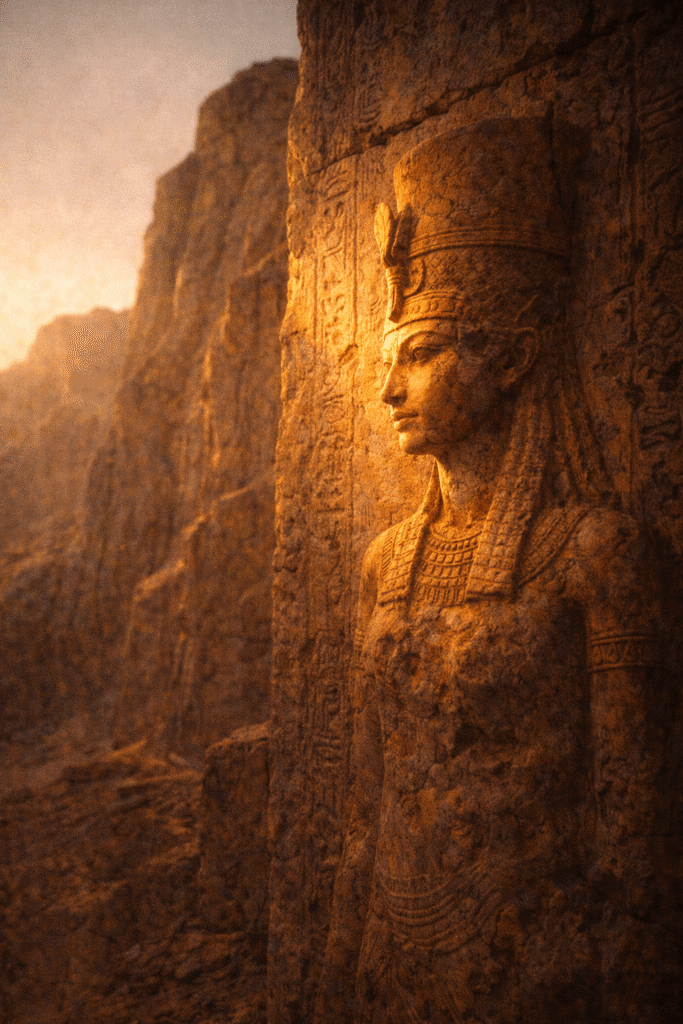
The sun hung low
behind the cliffs.
In the angled light,
the faint ghost lines
beneath the newer carvings
glowed
almost imperceptibly.
A thin outline,
a soft curve of a cheek,
a nearly vanished symbol.
Invisible in harsh midday glare.
Visible only
in the last hour of sun.
Light itself
had chosen when
I would appear.
I stepped closer.
The grooves
were shallow,
but they were deeper
than any priest’s erasure.
And in that moment
I understood:
The stone remembered
not because it was stone,
but because human hands
had decided it should.
Hands that believed
my story
belonged to more than politics.
Hands that carved deeper
than fear.
Legacy is not
what rulers demand.
Legacy is what people decide
is too important
to lose.
PART II — The Masons Who Worked at Night
That evening,
as the air cooled
and the temple shadows lengthened,
I caught sight
of two masons
moving quietly
along the western colonnade.
Not boldly.
Not secretly.
Carefully.
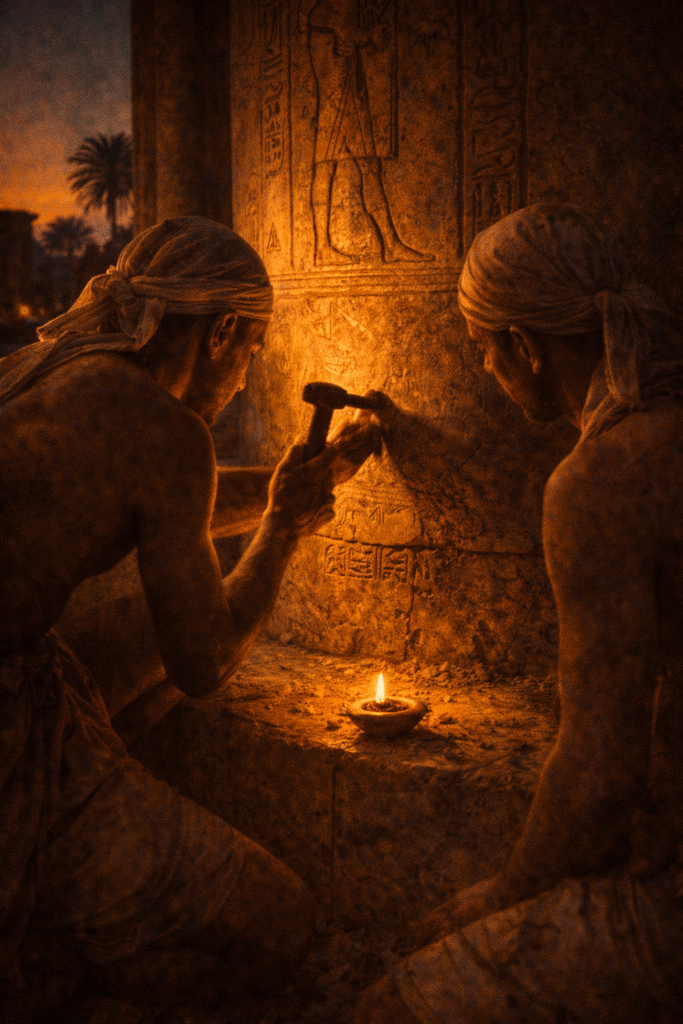
One held a small oil lamp.
Its flame flickered
against sandstone.
The other held
a slender chisel.
They were inspecting
the joins between blocks—
a routine task—
but their movements
were too deliberate
to be routine.
I stood silently
and watched.
At one block
near the base
of a pillar,
they paused.
One man lifted the lamp.
The other knelt.
He brushed away
a thin film of dust.
Beneath it—
carved in small script
at the edge of a foundational stone—
a single line:
“For the king Maatkare,
the men of the west terrace
give their hands.”
Hidden.
Small.
Unnoticed in formal inspection.
But permanent.
Never meant
for the priesthood.
Never meant
for the bureaucracy.
Never meant
for political eyes.
Carved for the future.
For anyone
with curiosity sharp enough
to kneel down
and look where few bothered to look.
The mason looked up
and saw me watching.
He froze.
Then bowed.
“Majesty,” he whispered,
“we carve truth
where it will be safe.”
I nodded.
“You carve memory.”
He placed his fist
over his heart.
“We carve you.”
PART III — The Valley That Waited for My Memory
A week later,
I traveled quietly
to the valley behind the cliffs—
the place where kings
would one day carve
their tombs.
The rock face
was untouched then,
a raw slope
of limestone
and broken shale.
Wind roared
between the cliffs
like breath trapped
between gods.
I stood there
in the silence.
The valley
did not know me.
Not yet.
But I felt something
in that stillness.
A whisper
not from the past
but from the future.
Not my burial—
for that would lie
elsewhere.
But my legacy.
This valley,
this land,
these cliffs—
they would remember me
long after men
forgot my name.
Not because they tried.
But because the shape
of what I built
cut into their memory.
My terraces
were the gateway
to this valley.
My colonnades
its heartbeat.
My obelisks
its first heralds.
I had woven myself
into the geography.
And geography
does not forget.
PART IV — The Scribe Who Spoke of Tomorrow
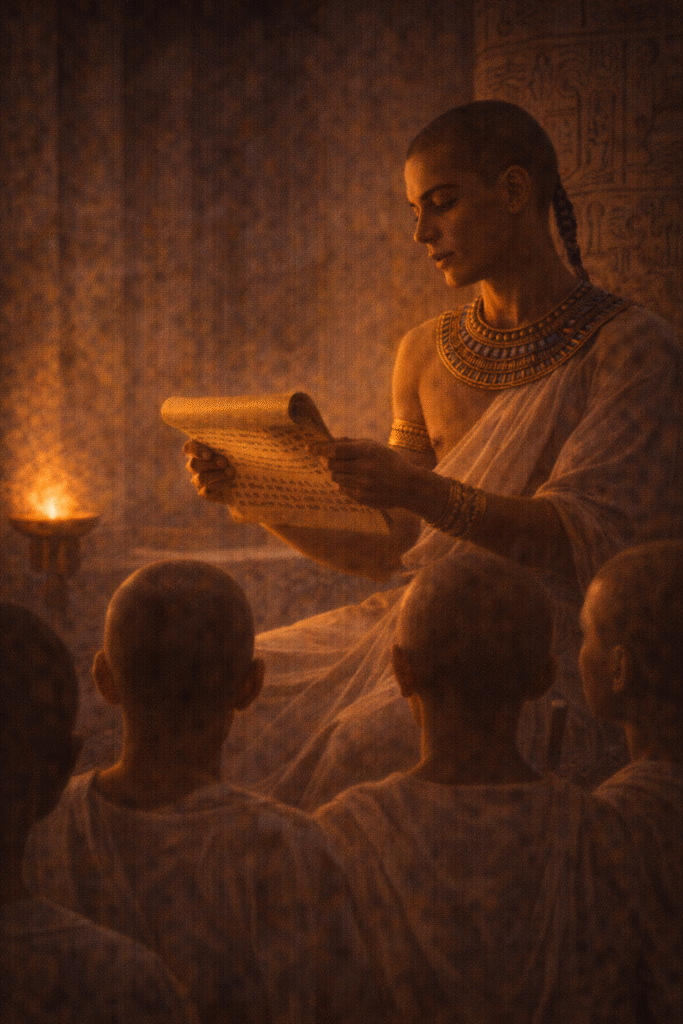
Back in the palace
a young scribe sought me out.
His name was Baki,
a boy barely grown,
with ink-stained wrists
and eyes that carried
more clarity
than fear.
He bowed deeply.
“Majesty,” he whispered,
“I have something for you.”
He handed me
a papyrus scroll.
It was not official.
Not temple legal.
Not a decree.
Not a record.
A poem.
A long, unpolished,
achingly honest poem.
He had written
of the terraces,
the ships to Punt,
the obelisks at Karnak,
the grace with which
I held power
when others clawed at it.
At the bottom,
written in hurried brushstrokes:
“Should the priests revise you
and the scribes omit you,
the people will remember.”
I touched his shoulder.
“You are bold,”
I said.
“No, Majesty,” he answered.
“Just truthful.”
“And what will you do
with this poem?”
He swallowed.
“I will read it
to the novices,”
he whispered.
“And they
will read it
to their children.”
He straightened.
“And long after
I am gone,
someone
will still whisper
your name.”
Legacy is not
what one generation records.
Legacy is what
three generations later
still speak.
PART V — The Priest Who Could Not Rewrite Me
There was one priest
I feared would bow
too easily
to political winds—
a man named Ahmose-Setek,
keeper of liturgical archives.
He had been
a quiet supporter
of the council’s revisions.
And yet—
One afternoon
I found him
sitting beside a pile
of old papyri,
rubbing his temples
with both hands.
He looked up
as I approached.
His voice cracked.
“Majesty,”
he whispered,
“I cannot do it.”
“What can you not do?”
He held up
a half-revised document.
A corrected genealogy
meant to diminish
my divine narrative.
“I am supposed to rewrite this,”
he said.
“But my hands—
they refuse.”
He set the scroll down,
fingers trembling.
“I was a novice
when you built
your obelisks,”
he said.
“I watched you
stand in the sun
and bless them.”
His eyes filled.
“When I touch this ink,”
he whispered,
“I feel I am smothering
my own memory.”
I placed my hand
on his shoulder.
“You owe me nothing,”
I said softly.
He shook his head.
“I owe truth everything.”
He pushed the papyrus
toward me.
“It is yours,” he said.
“Not the god’s.
Not the council’s.
Yours.”
This priest
who had obeyed every order
could not obey
the erasure of his own memory.
Legacy births loyalty
in unexpected places.
PART VI — When Stone Became My Witness
One evening
I sat alone
on the upper terrace.
The wind was warm.
The sky bruised purple.
I leaned
against a column
and closed my eyes.
In the cool shadow
behind my back,
I felt something—
Not vision.
Not voice.
Not omen.
Presence.
A kind of
quiet companionship.
The presence
of the workers
who carved every line.
The scribes
who preserved every draft.
The stones
that held every memory.
The dust
that carried echoes
of every artisan
who breathed life into the walls.
I whispered:
“Will I be remembered?”
The answer
came not in words
but in certainty:
You already are.
You always were.
Remembering is inevitable.
The stone
pressed warm at my back.
It was enough.
If you have ever worried
that you will be forgotten—
If you have ever feared
that your story
will be rewritten
by those who come after—
If you have ever trusted
that someone, somewhere,
would remember the true version of you—
Then this Scroll
is the one that speaks your name.
Walk with us
to the places where memory
survived erasure.
Stand at the stones
that refused to forget.
Touch the reliefs
that waited centuries
for the light
to reveal their truth.
Journey with ENA.
Legacy is what refuses to fade.
PART VII — The Child at the Base of My Temple
A few weeks later
I visited the lower terrace
in disguise—
simple linen,
no crown,
no entourage.
There,
near the gate,
I saw a small group of children
playing “temple ceremony.”
One child
stood on a stone step
and raised her hand.
“I am the king!”
she declared proudly.
Another child pointed.
“No—
you are her,”
he said.
“The queen
who sailed to Punt!”
The girl puffed her chest.
“Yes,” she said.
“I wear the white crown.
I build the tall obelisks!”
She mimed
pulling ropes
and carving stones.
The other children cheered.
None of them
had been taught this
in official lessons.
They learned it
from their parents.
Their grandparents.
The workers.
The artisans.
Those who witnessed
my reign
with living eyes.
The erasures
had not reached their homes.
Children
are always
the last line of memory.
And the strongest.
One girl saw me watching
and ran over.
“Lady,” she said,
“this temple is magic!”
“Yes,” I smiled.
“Yes, it is.”
She lowered her voice.
“They say a great queen
built it.”
I knelt beside her.
“Do you believe them?” I asked.
She nodded confidently.
“Yes.
Because the stone
looks happy.”
Out of the mouths
of children
comes unfiltered truth.
PART VIII — The Future I Could Finally See
That night
I stood alone
on the highest terrace.
The moon
was almost full.
The cliffs
glowed softly.
I inhaled deep
and slow.
This place—
this temple—
this mountain—
this city—
my dynasty—
my country—
would move on
without me.
But my story
was rooted
too deeply
to be pulled out.
No matter
how many surfaces
were scraped.
No matter
how many scrolls
were corrected.
No matter
how many rituals
were shifted.
Legacy
is not what is preserved
on a throne.
Legacy
is what is preserved
in the soul of a people.
In the hands
of those who carve.
In the ink
of those who write.
In the whispers
of those who remember.
In the laughter
of children
playing beneath a terrace
built by a woman
their textbooks
might one day omit.
I closed my eyes.
And for the first time
since the fall—
I felt peace.
Because I finally understood:
A reign ends.
A legacy becomes.
PART IX — The Ancient Questioner’s Desk
A student asked:
“How does legacy survive erosion?”
The elder replied:
“By rooting itself
in human memory
long before stone fades.”
Another asked:
“Is she remembered because she was powerful?”
The historian wrote:
“No.
Because her story
was carried
by those she touched.”
A traveler wondered:
“What is stronger—
stone or time?”
The scholar answered:
“Neither.
Story outlives both.”
A final question came:
“Who decides legacy?”
The old master smiled.
“Everyone
who refuses
to forget.”
This Scroll ends here—
in the triumph
of survival,
the quiet victory
of being remembered
despite the winds of politics,
the soft power
of stone that waits
for truth to reemerge.
If you felt this—
if you have ever hoped
to be remembered
not for authority,
but for impact—
then you carry her legacy now.
Come stand
in the terraces
where memory endures.
Come touch
the faint lines
that defied erasure.
Come feel
the cliffs
that hold her story.
Journey with ENA.
Legacy is not what remains—
it is what refuses to disappear.