Scroll XXIV – The Stone Remembers
Year: 1438 BCE — Deir el-Bahari, Waset, The Sculptors’ Yards, and the Hidden Corners of Karnak
Translated and restored for the modern traveler.
Prologue — Stone Never Forgets
People forget.
Courtiers forget.
Priests forget.
Scribes forget.
Kings forget.
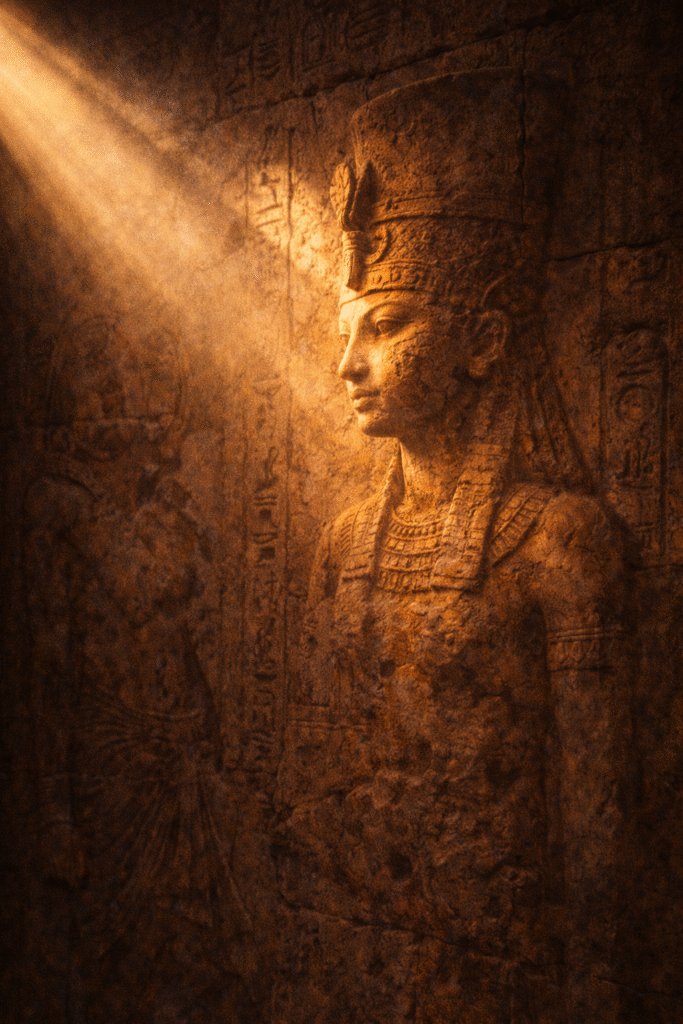
But stone—
stone is loyal in a way
humans rarely are.
Stone remembers hands.
Stone remembers chisels.
Stone remembers the weight of intention.
Stone remembers
the ones who shaped it.
Even when others try
to shape over them.
This is the Scroll
of the days after the fall—
but before the rewriting.
The days when the kingdom
quietly turned away,
yet the walls,
the workers,
and the old stonework
refused to do the same.
This is where I learned:
A reign may end—
but a legacy
carved deeply enough
into the bones of a nation
does not die.
It waits.
It remembers.
PART I — The Temple Corridor That Held Its Breath
I returned to Deir el-Bahari
at dawn.
The cliffs glowed soft rose,
the terraces long and shadowed,
the air cool in the tight spaces
between columns.
I walked
the corridor of reliefs—
the story of my birth,
divine and earthly,
carved decade by decade
by hands now dust.
Some colors had faded.
Some lines had softened.
But the stone remained.
Unmoved.
Unbothered.
Unwilling to let memory
be rewritten easily.
My sandals echoed
against the flagstones.
It was then
I noticed something strange.
A relief
I had inspected before
—one recently “adjusted”
by temple scribes—
had regained
a faint outline.
A line
where my erased cartouche
had once been.
Barely visible.
But present.
As if the stone itself
were trying to remember.
I touched the faint groove.
It was deeper
than it looked.
Deeper
than the recent sanding
performed by nervous hands.
A thought
rose in me:
They erased only the surface.
Not the truth.
PART II — The Sculptor Who Closed the Door
Later that morning
I visited the sculptors’ yard.
The smell of dust
mixed with wet clay
and old limestone.
My arrival
was met with shock—
they were not expecting me.
A young apprentice
scrambled to his feet.
“Majesty—
if we had known—”
“It is fine,” I said gently.
“Continue.”
But the sculptor in charge,
an old master named Menkh,
stepped forward
with a hurried bow.
“Majesty,” he said quickly,
“may we speak inside?”
He ushered me
into a small storeroom
and shut the wooden door
so tightly
dust fluttered from its hinges.
Only then did he exhale.
“There is something
you must see,”
he said.
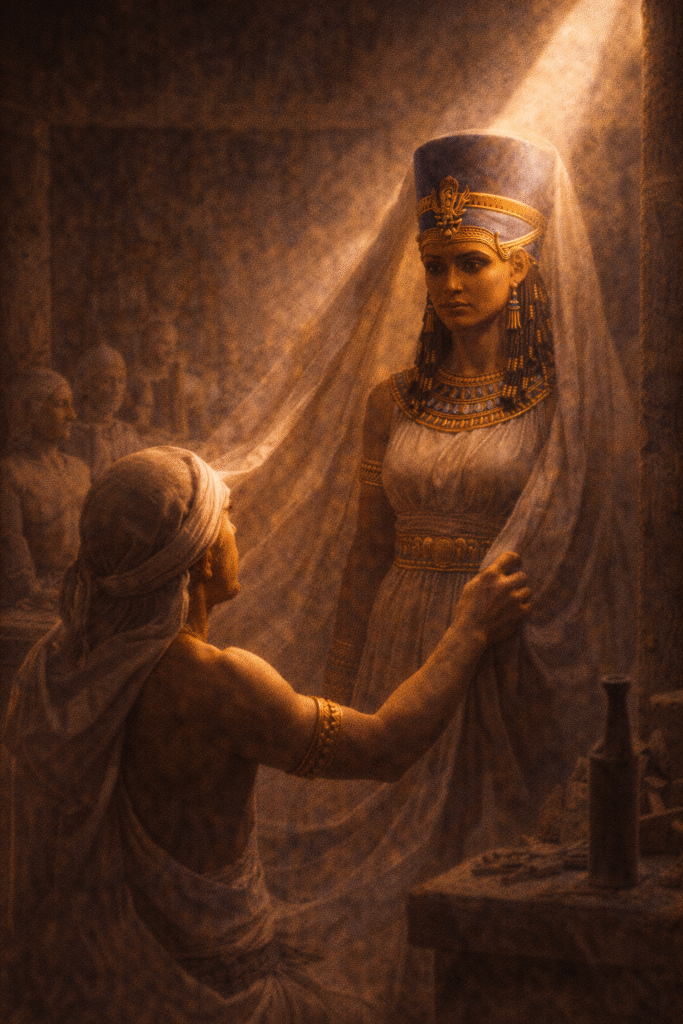
He lifted a linen cloth
from a large rectangular block.
Below it—
a statue.
My statue.
Not the modified one
the priests had ordered.
Not the “masculinized” version
they had pressured him to carve.
This was me.
My real face.
My real form.
My real presence.
Soft cheeks.
Straight nose.
The slight fullness at the mouth
he always captured
from life.
He touched the statue lovingly.
“I carved this in secret,”
he whispered.
“So they would not lose
your truth.”
I stared at him.
“Why risk this?”
I asked.
He lowered his head.
“Because I know
they will change the public ones.”
A beat.
“But this one
will live longer than all of us.”
His eyes glistened.
“The stone remembers,” he said.
“It remembers you.”
PART III — The Hidden Carving in the Northern Hall
At Karnak,
I wandered into a small hall
rarely used.
It smelled of old oil,
dry incense,
and neglect.
Scribes once stored
unused papyri here.
Now it was mostly empty.
But on the far wall—
half in shadow,
half in sunlight—
I saw a fresh glyph.
Not large.
Not public.
Tiny.
Carved in the corner
where a scribe would believe
no one ever looked.
My name.
Not a full cartouche.
Just a single glyph:
Ka.
The symbol
for life-force.
Essence.
Soul.
Remembrance.
Someone
—quietly, bravely—
had carved it
as a protest
against forgetting.
Not in defiance
of Thutmose.
But in defense
of history.
I ran my fingertips
across the small glyph.
“Whoever you are,”
I whispered,
“You carry my memory
in your hands.”
The hall
felt less empty.
PART IV — The Worker Who Waited Until No One Was Watching
The next day,
as I crossed the lower terrace
of my temple,
I saw a worker
alone by a column.
He held a chisel
and a small hammer.
But he was not carving.
He was… waiting.
When he saw me,
he startled—
then bowed
so deeply
his forehead touched stone.
“I am sorry, Majesty,”
he stammered.
“I did not know you would—”
“Why are you here alone?”
I asked.
He looked around
to ensure no one else
was listening.
Then, in a whisper:
“I came to fix a relief
that was…
incorrectly altered.”
Incorrectly.
The temple’s new euphemism
for removal.
“Which relief?”
I asked.
He swallowed.
“The one depicting
your expedition
to Punt.”
Of course.
A favorite target of erasure.
“Why fix it?” I asked.
He looked up,
eyes fierce beneath fear.
“Because I was there, Majesty.”
He clenched his chisel.
“They carve the story wrong
when they carve you out.”
His breath shook.
“I will not let them carve
my life
into a lie.”
I stepped closer.
“Will they punish you?”
“Yes,” he whispered.
“But the stone will outlive them.”
He straightened.
“And it will outlive me.”
His hammer struck
the stone once—
a single clean sound.
The truth
returning.
Even if hidden
beneath future revisions.
PART V — Deir el-Bahari at Dusk: The Resistance in Stone
That evening,
I returned to my temple
to inspect the worker’s claim.
The sun hung low
like a molten orb.
The terrace walls
glowed with warm gold.
I walked along
the Punt reliefs—
the trees,
the curling incense resin,
the boats laden with myrrh
and exotic goods.
The section
once altered
by the temple council
was different.
Not fully restored—
they could not risk that.
But the worker
had carved faint lines
beneath the new surface.
Delicate.
Ghostlike.
Hidden.
Invisible to a careless eye.
But undeniable
to anyone who cared.
A secret record.
A whispered correction.
A memory
etched just deep enough
to survive erasure
should the surface
ever be stripped away.
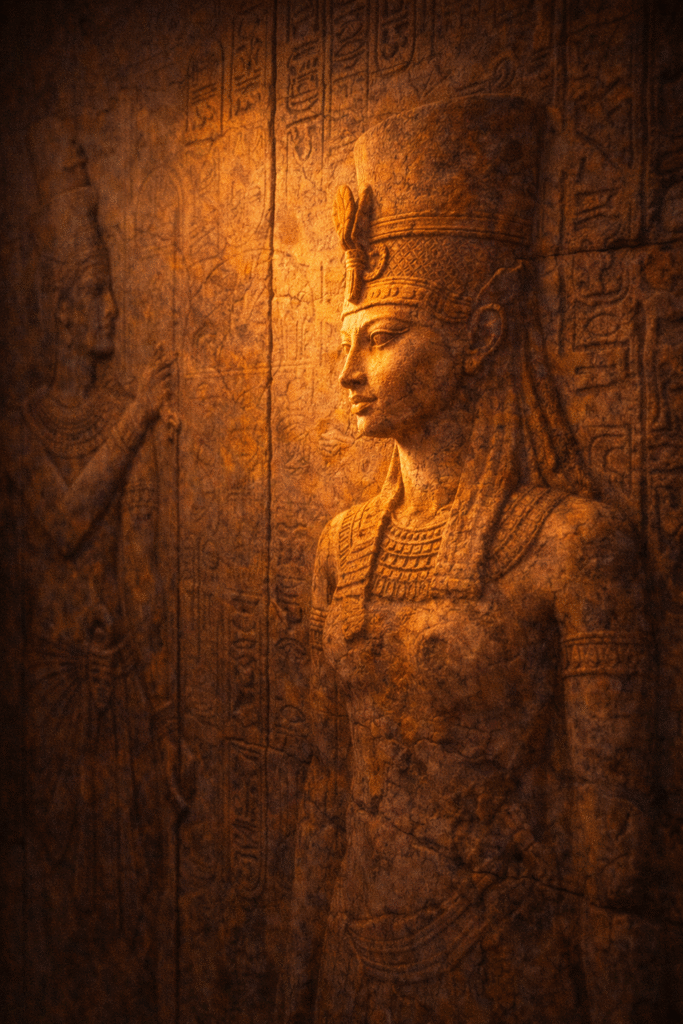
I touched the faint outline
of my own erased hand
extending an offering.
The stone
felt warm
from the sun.
“It remembers,” I whispered.
“And remembering
is resistance.”
PART VI — The Scribe Who Brought Contraband Memory
Later that night,
a scribe came to me.
Young.
Wide-eyed.
Ink still staining his fingertips.
He bowed
and placed a small linen-wrapped object
at my feet.
“What is this?” I asked.
“A copy,” he whispered.
“Of a draft
of your birth narrative.
Before the priests
‘adjusted’ it.”
He swallowed.
“And a copy
of your obelisk dedication
before they changed its phrasing.”
I stared at him.
“You risk your life,”
I said.
“Yes,” he answered.
“Why?”
He looked at me
with a trembling kind of courage.
“Because you are
the truth
of my lifetime.
And I will not let
the future
know only half of you.”
My breath caught.
He continued:
“I have hidden copies
in clay jars
in the north storeroom.
The originals
may be altered.
But the drafts—
the drafts still speak.”
He bowed again.
And fled
like a man afraid
of his own bravery.
I opened the bundle.
Inside:
My life.
In ink.
Untouched.
The stone remembers.
But ink, too,
can be made immortal
when hidden
from fearful hands.
PART VII — Thutmose’s Quiet Confession
The next morning,
Thutmose found me
in the palace gardens.
He approached slowly,
as if stepping into
hallowed ground.
“holy mother,” he said softly,
“may I sit?”
I nodded.
He sat beside me
beneath the sycamore.
There was a long,
weighted silence.
Then he spoke:
“They started removing
your name
from small inscriptions.”
“I know.”
“They have not told me.”
“I know.”
He looked down.
“I do not want this,”
he whispered.
“I know,” I repeated.
“But it happens
because I moved
into the space
they made for me.”
“Yes.”
He lifted his eyes,
pained.
“Does it hurt?”
“Yes,” I said simply.
“It hurts.”
“But I also know this—”
I turned to him fully.
“Stone remembers me.
Workers remember me.
Those who carve
and those who write
and those who lived
through these years—
they carry the truth
in their hands.”
He blinked hard.
“Do you hate them?” he asked.
“No.”
“Do you hate me?”
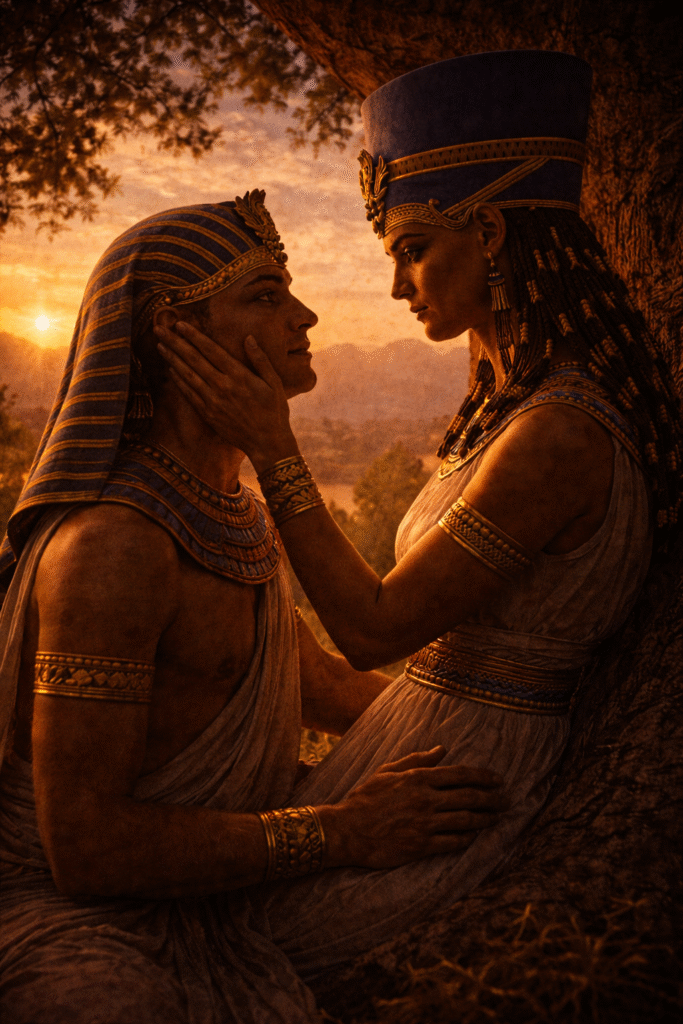
I touched his cheek.
“No,” I said.
“I am proud of you.
Even if the world
uses your ascent
to erase my lines.”
His voice broke.
“What should I do?”
I answered quietly:
“Rule well.
Rule wisely.
Rule so brilliantly
that they cannot erase
the woman
who shaped you.”
His breath trembled.
“And the stone?” he whispered.
“The stone,” I said,
“will do what stone does.
It will remember.”
PART VIII — The Stone That Spoke Back
As the last light
dipped behind the cliffs,
I walked alone
to the highest terrace.
The wind was cool.
The sky lavender.
The stone warm
from the dying sun.
I placed both hands
on a great column
and leaned in close.
In the whisper of the wind,
in the breath of the stone,
in the quiet space
between heartbeat and exhale…
I felt something.
Not a sound.
Not a message.
A certainty.
A presence.
Not of gods—
but of memory itself.
The memory of artisans
whose hands shaped my story.
The memory of workers
who hid truth under new carvings.
The memory of scribes
who tucked drafts into clay jars.
The memory of my own people
who had walked these terraces
long before politics
tried to rewrite me.
Stone remembers
because humans
teach it to.
And humans
remember
because stories
refuse to die.
I closed my eyes
against the column.
“I am still here,”
I whispered.
The stone
held my weight
as gently
as a friend.
If you have ever felt
forgotten on the surface
yet remembered deeply
by those who mattered—
If you’ve ever seen
someone protect your truth
quietly,
secretly,
bravely—
If you’ve ever been saved
by those who refused
to let your story fade—
Then this scroll
was written for you.
Come walk
the secret corners of Karnak.
Stand before the covert carvings.
Touch the walls
where painters
hid your queen
in ghost lines.
Journey with ENA.
Some memories
fight back.
PART IX — The Hidden Archive Beneath the Floor
A few days later,
a palace servant
approached me nervously.
“Majesty,” he whispered,
“there is something
I must show you.”
He led me
to a small storage chamber
beneath the palace floor.
There,
hidden beneath a false panel,
were clay jars.
Dozens.
He lifted one carefully,
poured out its contents
onto a reed mat.
Drafts.
Sketches.
Scribe marks.
Temple illustrations.
Alternate versions
of inscriptions.
All showing
my true story.
This small network
of servants and scribes
had been collecting
every version
of every text
before the priests
revised them.
A secret archive.
A counterhistory.
The servant looked terrified
as he knelt.
“We preserve it,”
he whispered.
“All of it.”
My throat tightened.
“You risk your lives.”
He nodded.
“We know.
But your story
changed ours.
We are not ready
to let it vanish.”
I knelt beside him.
The clay jars
felt warm
from the earth.
This—
this was survival.
Not of me.
But of memory.
History
living underground
like a seed.
Waiting for its season
to rise.
PART X — The Modern Traveler in the Temple’s Shadow
Traveler,
when you walk with us
through Deir el-Bahari,
Karnak,
and the workshops:
Look for:
- faint ghost lines
beneath reliefs - small glyphs
hidden in corners - draft marks scratched
into plaster
beneath paint - shallow outlines
where scribes attempted
to erase a cartouche
but carved too lightly - odd inconsistencies
in stylistic flow - mismatched paint layers
These are not accidents.
They are resistance.
The quiet rebellion
of memory
against erasure.
When we take you,
we will place your hands
on the exact stones
that refused to forget.
You will touch
the places
where history
held its breath
until it was safe
to exhale again.
PART XI — The Ancient Questioner’s Desk
A novice asked:
“Can stone remember?”
The elder replied:
“Only when humans
teach it what to hold.”
Another asked:
“Why did workers risk themselves?”
The historian wrote:
“Loyalty to truth
is older than loyalty to thrones.”
A traveler wondered:
“Could they really preserve her?”
The scholar answered:
“Yes.
That is why we know her today.”
A final question came:
“What is stronger—
erasure or memory?”
The old master smiled.
“Memory.
Because it hides
in unexpected places.”
The Scroll ends here—
not in fall,
not in silence,
but in remembrance.
In workers
who carved truth
in the shadows.
In scribes
who hid drafts in clay.
In stone
that refused
to forget her.
If you felt
the quiet hands
that preserved her—
if you have ever been saved
by people
who protected your truth
when the world tried to rewrite you—
then you walk beside her now.
Come touch the walls
where memory resisted.
Come feel the carvings
that fought back.
Come stand in the temple
that remembers her
more fiercely
than any court.
Journey with ENA.
Some legacies
are carved too deep
to erase.