
Scroll XXIII – The Silence After
Year: 1439 BCE — Waset (Luxor), The Quiet Palace, Karnak’s Shadowed Halls, and Deir el-Bahari in the Late Heat
Translated and restored for the modern traveler.
Prologue — After the Crash Comes the Hollow
Falls are loud.
Silence is louder.
This Scroll is not about losing a throne.
It is about what happens
after
the world stops needing your hands on it.
The days when the halls
are too quiet,
the rituals too far away,
the letters too few,
your own footsteps
too loud in your ears.
This is the Scroll of emptiness—
the wideness of space
after power withdraws,
the hollow places
where routine used to live.
This is not tragedy.
It is aftermath.
A quieter,
deeper thing.
PART I — The Palace with New Footsteps
The day after the fall,
I woke before sunrise
—as I always had—
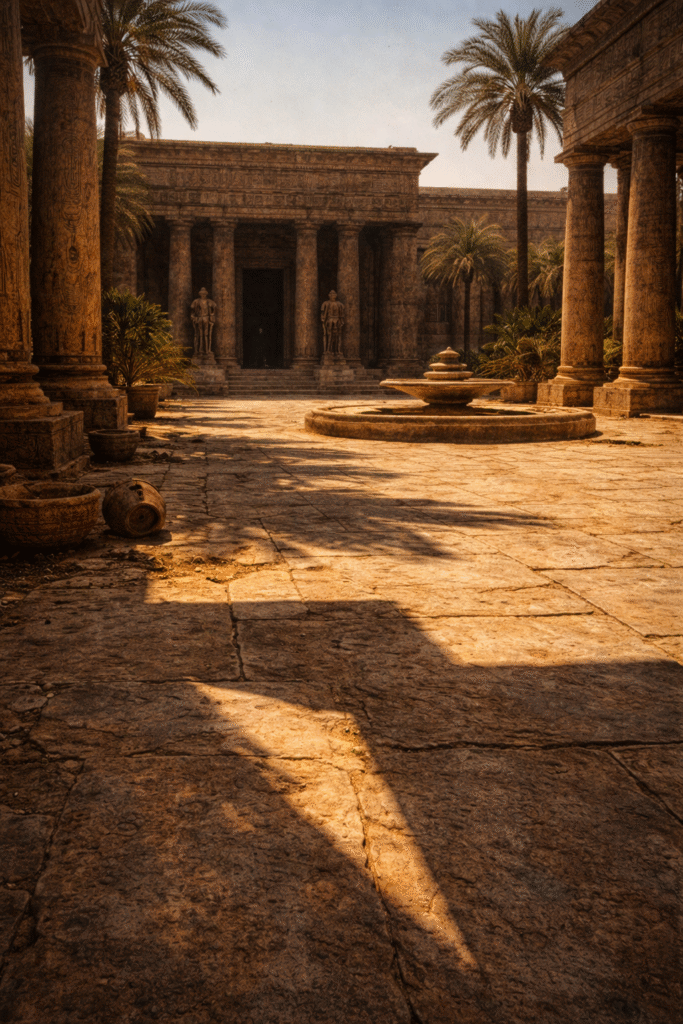
and walked into the palace courtyard.
I expected bustle.
Servants preparing basins of cool water.
Scribes unpacking scrolls.
Guards straightening formations.
Priests preparing small altars for dawn invocations.
Instead:
Silence.
A servant sweeping alone.
Two guards murmuring quietly.
A scribe carrying scrolls
—not to me—
but toward another chamber.
The palace
was not empty.
It was rearranged.
Thutmose’s footsteps
had become the new rhythm
of the building.
I stood by the lotus pool
and listened
to the palace breathing without me.
Not resisting.
Not mourning.
Simply continuing.
That is the truest silence:
continuation
without inclusion.
PART II — The Scrolls That Did Not Come
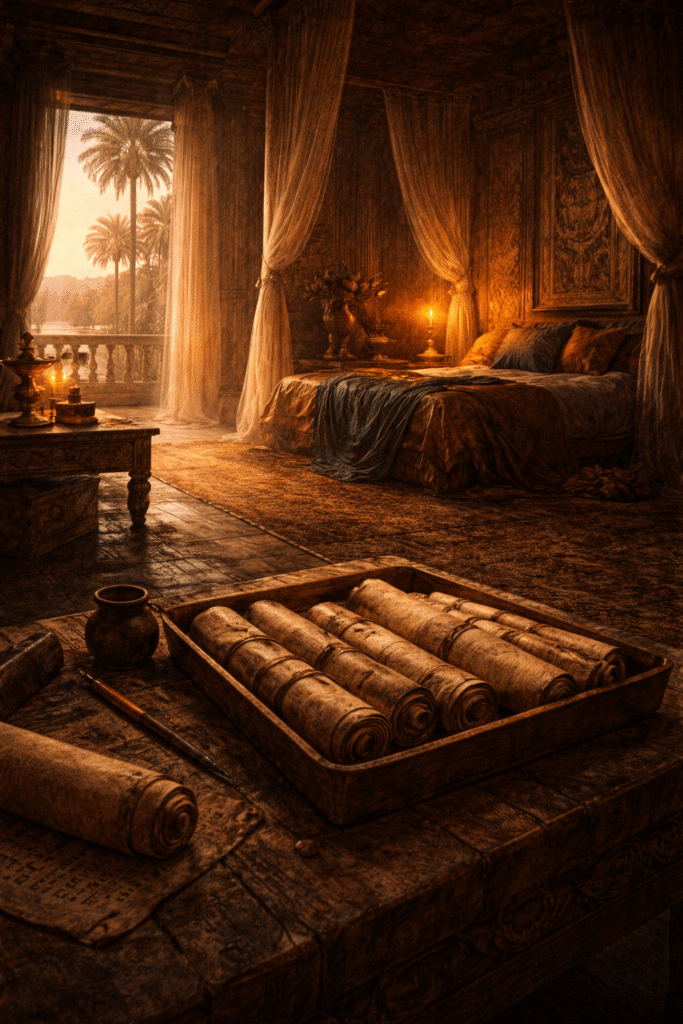
For twenty years,
every morning
a wooden tray arrived
in my chamber
holding the day’s scrolls:
- petitions
- reports
- diplomatic inquiries
- temple communications
- troop movements
- harvest counts
But on this morning,
the tray was empty.
A single scribe
bowed low.
“Majesty,” he whispered,
“The High Steward says
all matters
must now pass
to His Majesty Thutmose
first.”
“First?”
I asked softly.
He hesitated.
“Only,” he said.
There was no anger in his voice.
Only certainty.
I dismissed him kindly.
When he left,
I sat beside the tray
for a long time.
It was the first morning
in decades
where Egypt did not send me
a single word.
Silence
fills a space
formerly occupied
by responsibility.
It feels enormous.
PART III — The Day I Was Not Summoned
At midday,
a council drum sounded.
Normally,
a chamberlain would come
running to my chambers:
“Majesty,
the council awaits.”
This time,
no one came.
The drum beat once.
Twice.
A third time.
I walked to my balcony
and looked down
into the Hall of Pillars.
I saw nobles entering.
Generals.
Treasury lords.
Priests.
I saw Thutmose.
I did not see
my chair.
It was gone.
Not moved.
Gone.
I closed my eyes.
The political fall
had become
the administrative fall.
A queen
whose presence
no longer registered
as necessary.
No anger rose in me.
No heartbreak.
Just a strange,
light-headed numbness.
This is what silence does:
It protects the wound
from bleeding
too early.
PART IV — Karnak Without My Name
At the hour of mid-afternoon heat,
I walked to Karnak.
I wanted to see
whether yesterday’s oracle
had been
a single aberration.
It had not.
The priests
bowed deeply—
but their eyes darted.
My steps echoed
too loud
in the hypostyle hall.
The air felt heavy,
thick with incense
and avoidance.
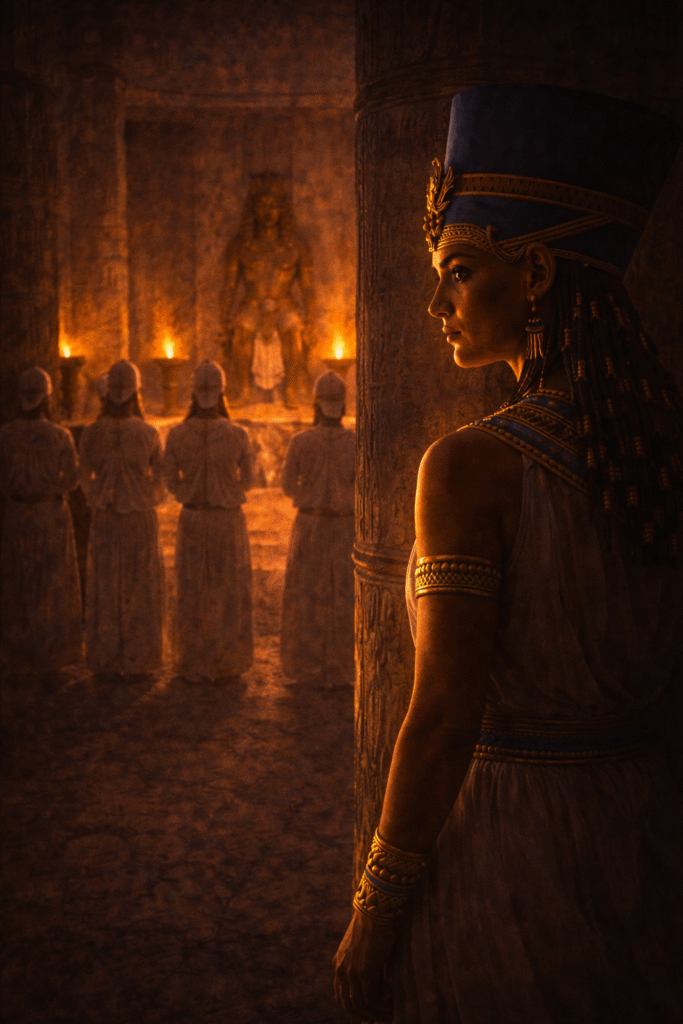
I approached the sanctuary
where Amun’s barque rested.
In the chamber,
three priests chanted.
I listened.
The invocation
should have said:
“Bless Maatkare,
daughter of Amun,
beloved of the gods,
unifier of the Two Lands.”
Today it said:
“Bless the Son of Amun,
chosen of the god,
bearer of the future.”
My name
had been removed
from the spoken liturgy.
Not struck out.
Not forbidden.
Just… omitted.
Silence
can be more cutting
than condemnation.
I touched the sanctuary door
and whispered to myself:
“The gods do not forget.
Men do.”
PART V — The Garden That Waited for Me
I retreated
to the sycamore garden.
Here,
weeds still dared
to grow between the stones.
Birds still hopped
between shade patches.
Water still trickled
from the small fountain.
Nature
is more loyal
than bureaucracy.
I sat
beneath the largest tree
and let the branches
shelter me.
After a long silence,
I whispered:
“What am I now?”
Not queen.
I was still queen
in name.
Not mother.
Thutmose was grown.
Not god’s chosen.
The priests had spoken.
Not leader.
The councils had shifted.
So what was I?
A woman
whose hands
remembered weight.
A ruler
whose shadow
still touched stone.
A legacy
not yet written
into the present.
It was in this garden
that I realized:
I had become
the past
while still alive.
PART VI — The Visit I Did Not Expect
Just before sunset,
Thutmose came to me.
He looked exhausted.
“holy mother,” he said quietly.
I nodded.
“Will you sit with me?” he asked.
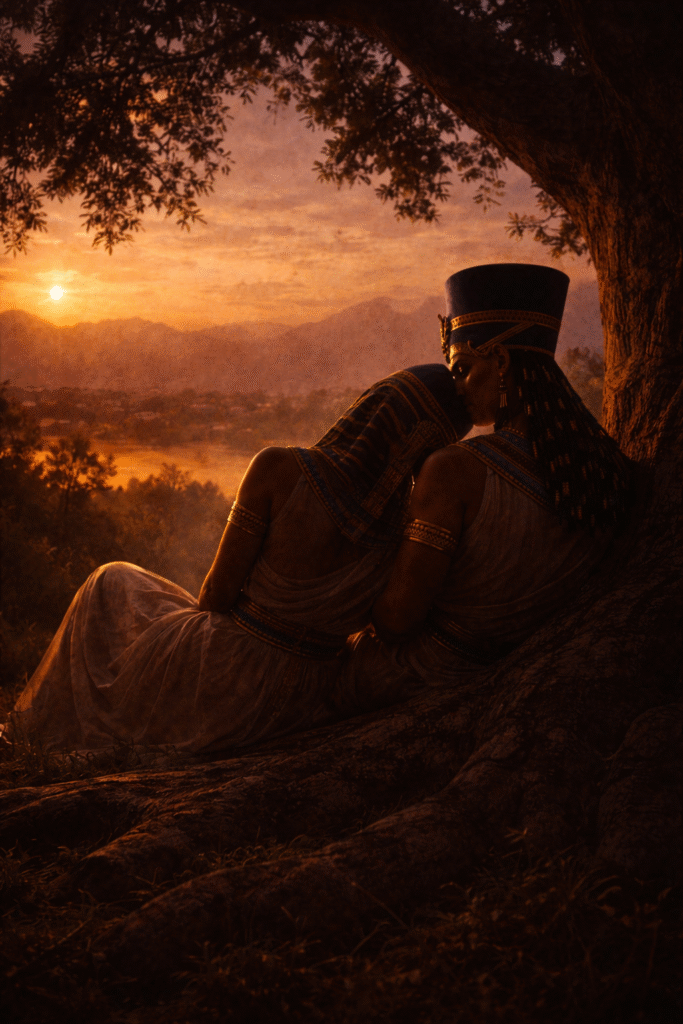
We sat
on the stone bench
beneath the sycamore.
For a long time,
we said nothing.
Finally,
he whispered:
“I thought
after yesterday
things would slow.”
“They don’t slow,”
I said.
“They rearrange.”
He swallowed.
“I do not know
if I can fill
what they expect of me.”
“You already do,”
I said softly.
“That is why
they have shifted.”
He looked at me then—
deeply,
painfully.
“Does this silence
hurt you?”
I considered my words.
“Yes,” I said.
“But not because
you have risen.”
He clenched his jaw.
“I did not want
to take anything—”
I touched his hand.
“You didn’t.”
He exhaled
through tight breath.
“What do you want now?”
Another long silence.
Then:
“I want,”
I said gently,
“to finish letting go.”
He inhaled sharply.
And then he did something
no one saw
and no scribe recorded:
He leaned
against my shoulder—
not as a king
but as a boy
mourning the end
of something sacred.
We sat like that
until the sun died.
No power.
No ritual.
No decree.
Just grief.
As quiet
as the end of a season.
PART VII — The Palace at Night
Night in the palace
had always been alive:
Servants preparing
for the next dawn.
Guards pacing
in the torchlight.
Scribes reading
through scrolls.
Priests offering
last invocations.
Tonight—
Silence.
Not a peaceful silence.
A transitional silence.
The kind that feels
like breath held
between two worlds.
I walked the corridor
past the throne room.
Thutmose’s throne
still glowed
with polished light.
My throne—
the one removed
from the council hall—
sat alone
against a wall,
covered with cloth.
Not discarded.
But stored.
The palace
had decided
what role I now held.
A relic.
Not a leader.
Not a danger.
Not an opponent.
Just… history.
History still breathing,
but no longer
affecting the world around it.
PART VIII — The Realization That Didn’t Break Me
People imagine
that silence breaks you.
But here is the truth:
Silence
does something stranger.
It reveals you.
In the hours
after the fall,
I realized:
I was not broken.
I was empty.
And emptiness
is not pain.
It is space.
Space for grief.
Space for reflection.
Space for legacy.
Space for what remains
after the throne
passes to another.
I was a queen
without a kingdom
—but not without meaning.
I was a ruler
without authority
—but not without story.
I was a voice
without ritual
—but not without truth.
The silence
did not erase me.
It made me legible
to myself.
If you have ever lived
through a moment
where everyone else
moved on
before you were ready—
If you have ever felt
your role shrink
while you were still standing in it—
If you have ever found yourself
in a chapter
that no longer needs your voice—
Then you carry this scroll.
Walk the quiet halls with us.
Stand in the empty courtyards.
Sit beneath the sycamore
where a queen
faced the echo
of her own greatness.
Journey with ENA.
Some stories whisper loudest
after the world goes quiet.
PART IX — Deir el-Bahari at Midnight
I went to my temple
after midnight.
The moon
was thin as a blade.
The terraces
shone silver.
The cliffs
loomed quiet
and ancient above.
I walked
past the columns
and sat
on the upper terrace
where the night wind
carried the scent
of cool stone.
Deir el-Bahari
had always been
my promise
to eternity.
Now it became
my refuge.
I traced the relief
of my divine conception—
still intact.
Still vibrant.
I let my fingers
rest on my own carved cheek.
The stone
did not feel sad.
Stone does not mourn.
Stone preserves.
In this place,
I did not feel
the silence of the palace
or the absence of councils
or the loss of liturgy.
In this place,
I felt continuity.
My story
etched deep enough
to survive forgetting.
Even if they tried
to rewrite parts,
the structure
was mine.
The terraces
were mine.
The narrative
was mine.
This temple
was a memory
that kings
could not unwrite.
Here,
I was still myself.
Here,
there was no silence.
Only stone
breathing softly.
PART X — The Ancient Questioner’s Desk
A novice asked:
“What does silence mean in a reign?”
The elder replied:
“It means the kingdom
has placed its ear
to another voice.”
Another asked:
“Did she despair?”
The scribe wrote:
“No.
She grieved.
Then she understood.”
A traveler wondered:
“What remains
after power leaves?”
The scholar answered:
“Memory.
Stone.
And the truth
you carry in your hands.”
A final question came:
“Is silence the end?”
The old master smiled.
“It is never the end.
Only the space
before the next sentence.”
The Scroll ends here—
not with collapse,
not with erasure,
not with bitterness.
With silence.
With the soft air
of a palace
that has rearranged itself.
With the quiet
after the world
chooses another.
With a queen
who does not resist the truth
but absorbs it.
If you felt her quiet—
if you’ve lived through
your own empty halls—
then this scroll is yours.
Come walk
the still courtyards,
the shadowed halls,
and the terraces
where silence
becomes understanding.
Journey with ENA.
Some histories echo loudest
after the noise has ended.