
Scroll XXI – The Breaking Point
Year: 1441 BCE — Waset (Luxor), The Palace Court of Pillars, Karnak, and Deir el-Bahari
Translated and restored for the modern traveler.
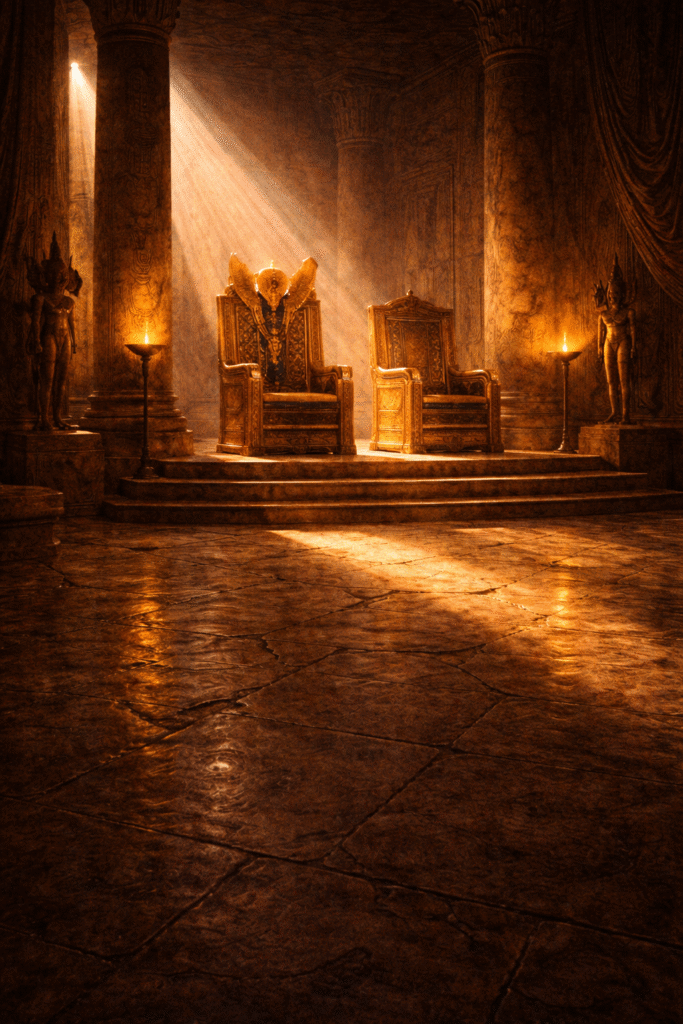
Prologue — The Sound That Isn’t Sound
Breaking is not loud.
At least,
not at first.
The truly devastating breaks—
the ones that alter kingdoms
and reweave the future—
begin in silence.
A silence so sharp
it becomes the loudest thing in the room.
A silence
that holds its breath
just long enough
for everyone present
to understand:
Something irreversible just happened.
This scroll is that moment.
The moment
when the threads loosened
not slowly
—not politely—
but suddenly,
with quiet violence.
Not a scream.
Not a coup.
Not a storm.
Just silence
that turned a queen
into a memory-in-progress.
PART I — The Festival That Should Have Been Ordinary
It began on the morning
of the Procession of Amun Min,
one of the smaller festivals—
not Opet,
not Wepet-Renpet,
nothing monumental.
A festival
that should have been routine.
Priests in white linen.
Drums slow and steady.
Incense smoke curling
like pale serpents.
The god’s barque
waiting to be lifted
by twelve chosen shoulders.
A day where every motion
was prescribed,
soft,
reverent.
I arrived early.
My throne platform
was prepared.
My canopy of gold and palm fiber
waited.
My personal retinue
stood ready.
This was my festival to lead.
It had always been.
But as I approached the courtyard,
there was a murmur—
soft,
shifting,
not disrespectful,
not shocked.
Just… adjusting.
A space widened.
People glanced toward the entrance
on the far side of the courtyard.
I followed their eyes.
Thutmose was walking in.
Not late.
Not early.
Perfectly timed
so that everyone present
would see
both of us arrive.
I smiled.
He bowed.
And nothing was wrong.
Not yet.
PART II — The Priest Who Changed One Word
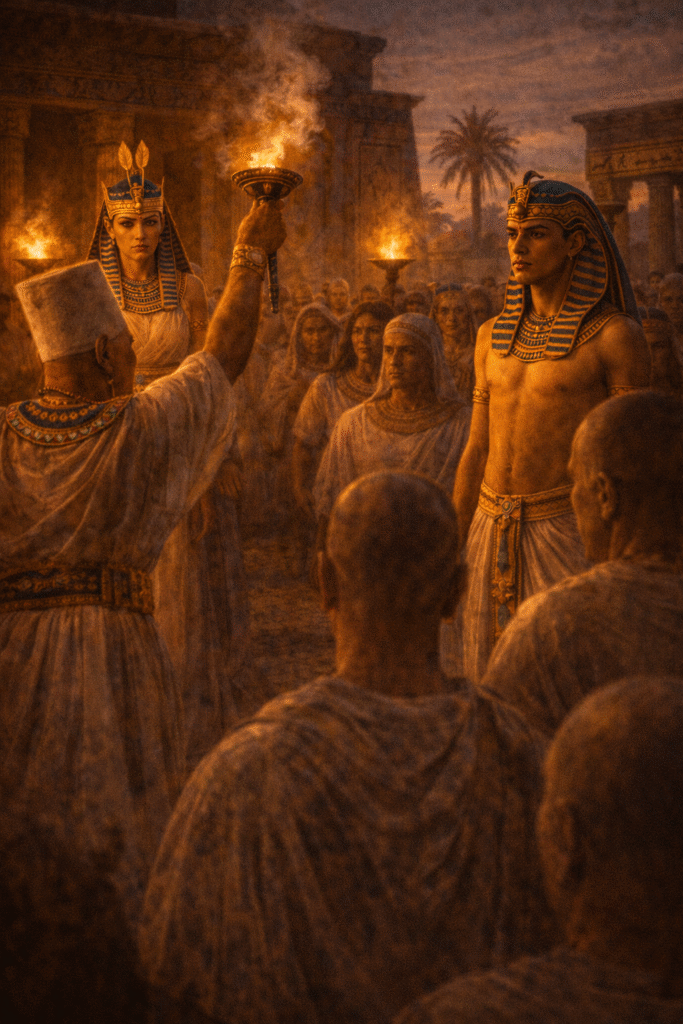
The high priest of Amun
stepped forward.
His voice carried easily
through the courtyard.
“Let the god see
his king.”
A word I had heard
a hundred times.
Except today—
he did not say kings.
Plural.
He said king.
Singular.
And he looked directly
at Thutmose.
The silence
after that word
was the kind that bruises.
A soft inward gasp
from the crowd.
A stillness
in the air.
A tightening
in the lungs of every noble present.
My retinue stiffened.
Thutmose blinked—
only once—
as if shocked.
But he did not correct the priest.
Not because he agreed.
Because he froze.
Because he didn’t know
what the correct response was anymore.
The high priest continued:
“Let the barque be lifted
and carried before His Majesty
in honor of the god’s blessing.”
Again—
singular.
Again—
directed at Thutmose.
Again—
the crowd felt the shift.
A festival that had always been ours
was being spoken
as if it were his alone.
By the time the priest
raised his scepter,
the air was already
splintering.
Not loud.
Not open.
Just breaking.
PART III — The Pause That Changed a Kingdom
Protocol demands
that when the priest
invokes the king,
that king steps forward
to touch the sacred barque.
I stepped forward first—
as I had
for over two decades.
My foot touched the stone.
My hand reached for the gilded handle.
My linen brushed the air.
And in that moment—
the high priest
hesitated.
He didn’t move.
He didn’t speak.
He simply froze.
A pause.
A pause
so small
someone else might have missed it.
But not me.
Not the nobles.
Not the priests.
Not Thutmose.
In that pause,
the entire courtyard
stopped breathing.
Every face turned—
slowly—
toward Thutmose.
He stood
half a step behind me.
Caught between tradition
and expectation.
Caught between courtesy
and inevitability.
Caught
between us.
And in that fraction of a second,
the court decided.
Not with words.
With silence.
They looked to him.
Not me.
Not intentionally.
Not cruelly.
Reflexively.
As if the world
had finally aligned itself
to the person
it believed
would carry the future.
That was the breaking point.
Not the priest’s words.
Not the changed ritual.
Not the shifting loyalties.
That pause
when the world turned its gaze
away from me
and toward him
as if pulled by gravity.
It was not defiance.
It was instinct.
PART IV — The Moment I Stepped Back
I felt it
in my bones.
The shift.
The pull.
The turning.
I withdrew my hand
from the barque handle.
Slowly.
Gracefully.
As if it were my intention
all along.
A queen should never show
the moment she realizes
the world has stopped
choosing her.
I stepped aside.
Thutmose inhaled sharply.
His eyes widened—
just slightly—
in disbelief.
He had not asked for this.
He had not wanted
to take this moment from me.
But he could not refuse it either.
Not without
shattering the ceremony.
Not without
humiliating the priesthood.
Not without
making himself look
like a child.
The world
had already placed the barque
in his hands.
He reached forward—
hesitant,
respectful—
and touched the handle.
The priests bowed.
The crowd murmured.
My retinue lowered their eyes.
And that was it.
The breaking point
is never theatrical.
It is simple.
It is quiet.
It is irreversible.
PART V — The Walk Back Through the Corridor of Pillars
After the ceremony,
I left the courtyard.
Not quickly.
Not with anger.
With poise.
A queen does not run
from silence.
But the corridor of pillars
felt different today.
The guards bowed
with perfect form—
yet their eyes
looked past me,
toward the direction
Thutmose would follow.
Two temple scribes
stepped aside—
not out of intimidation,
but out of uncertainty.
Had they just witnessed
the moment the kingdom changed?
Yes.
And they did not know
how to stand
in its aftermath.
As I walked,
a single thought
echoed in my mind:
It has happened.
Not the fall.
Not the erasure.
But the turning.
A kingdom
does not break
when the people rebel.
It breaks
when they look somewhere else.
PART VI — The Conversation That Wasn’t a Conversation
Back in the palace,
Thutmose came to find me.
He looked
horrified.
“holy mother,”
he said,
“I did not ask for that.
I did not plan—”
“I know,”
I said.
He stepped closer.
“I would have corrected the priest—”
“No,”
I interrupted gently.
“You couldn’t.”
He stared at me.
“They looked at you,”
he whispered.
“Yes.”
“They expected you.”
“Yes.”
“And still—”
“Yes.”
A painful silence
settled between us.
Then he said
the only words
that mattered:
“What do we do now?”
I studied him.
My son-in-duty.
My co-ruler.
My successor.
My eventual eraser
—though he did not know it.
I stepped closer,
placed my hand
at the back of his head,
and touched my forehead
gently to his.
“We let the world
finish its turning.”
His breath hitched.
“And you?”
“I remain,”
I said softly.
“Until I don’t.”
He closed his eyes.
We stood like that
for a long time—
a queen
and the heir
she raised
into the man
who had just taken her place
without wanting to.
Not with a dagger.
With silence.
PART VII — Sunset at Deir el-Bahari
That evening,
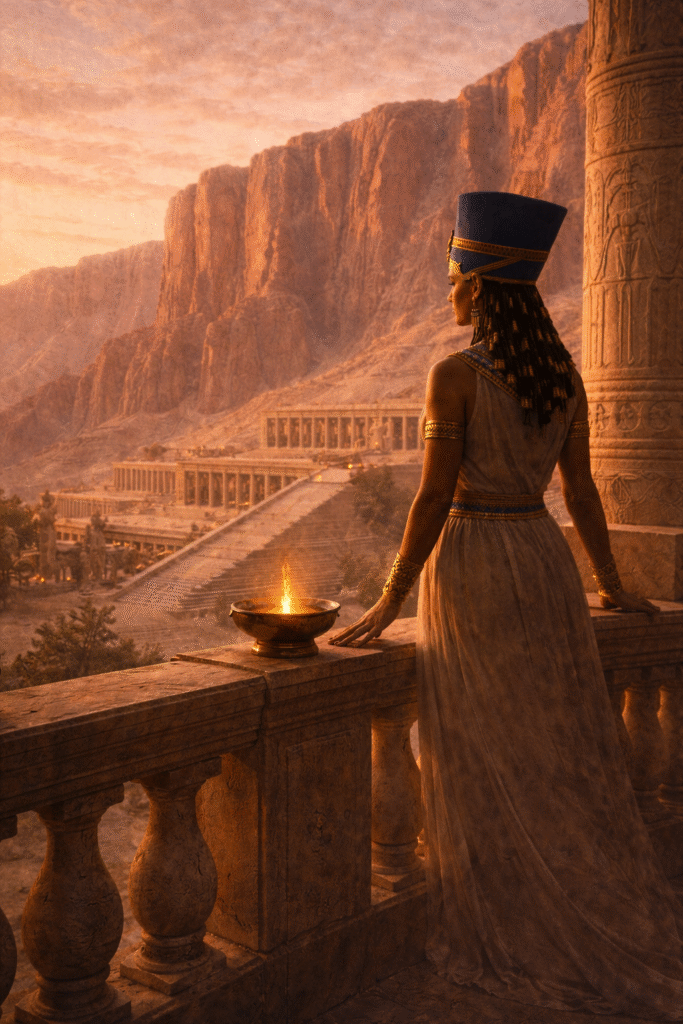
I went to my temple.
Not to mourn.
To mark
the moment.
The cliffs glowed
in deep rose-gold.
The air tasted
of dust and calm.
The terraces stood
like open hands
offering memory
to the sky.
I placed my palm
on the stone wall.
It felt steady.
Unmoving.
Unbothered.
Stone
does not care
who leads a festival.
“It has begun,”
I whispered.
Not the fall.
Not yet.
But the breaking.
The quiet shattering
of the last illusion
that I held
the center.
The beginning
of becoming peripheral
in a world
I once carried.
The sun sank.
And for the first time
in all my reign,
its warmth
felt like a farewell.
PART VIII — The Modern Traveler in the Break Between Worlds
Traveler,
if you have ever lived
through a moment
where your world
shifted around you—
not with violence,
but with silence—
then you know this scroll.
If you’ve ever stood
in a room
and felt the eyes
turn toward someone else…
If you’ve ever had a duty
taken from you
without a word…
If you’ve ever felt
a chapter end
in a heartbeat…
Then you carry
this moment
in your bones.
Walk these places with us.
Stand in the courtyard
where the barque changed hands.
Stand in the corridor
where the air froze.
Stand at Deir el-Bahari
where the sunset
spoke the truth.
We will show you
the exact stones
where the breaking point
entered history.
If you have ever lost
something sacred
without anyone
taking it from you…
If you have ever felt
the weight
of being replaced
by someone
you love…
Come with us.
We understand these stories
because history
still holds their echoes.
Journey with ENA.
Some breaks
roar in silence.
PART IX — The Ancient Questioner’s Desk
A student asked:
“What exactly broke?”
The historian replied:
“The illusion
that she still stood
at the center.”
Another asked:
“Did Thutmose betray her?”
The scribe wrote:
“No.
He simply stepped
into a space
the world opened for him.”
A traveler wondered:
“Could she have stopped it?”
The scholar smiled sadly.
“No one stops the moment
when a kingdom
decides to turn.”
A final question came:
“What is a breaking point?”
The old master answered:
“It is the moment
after which
nothing returns
to what it was—
even if all the walls
remain standing.”
The Scroll ends here.
Not with destruction.
Not with erasure.
Not with violence.
With silence
that felt like thunder.
With a single moment
that redirected history.
With a queen
who stepped back
so the world
could finish choosing.
Walk with us
to the places
where silence cracked the throne.
Journey with ENA.
Some turning points
whisper louder than storms.