
Scroll XX – The Unraveling
Year: 1442 BCE — Waset (Luxor), Karnak, The Royal Palace, The Northern Roads, and Deir el-Bahari
Translated and restored for the modern traveler.
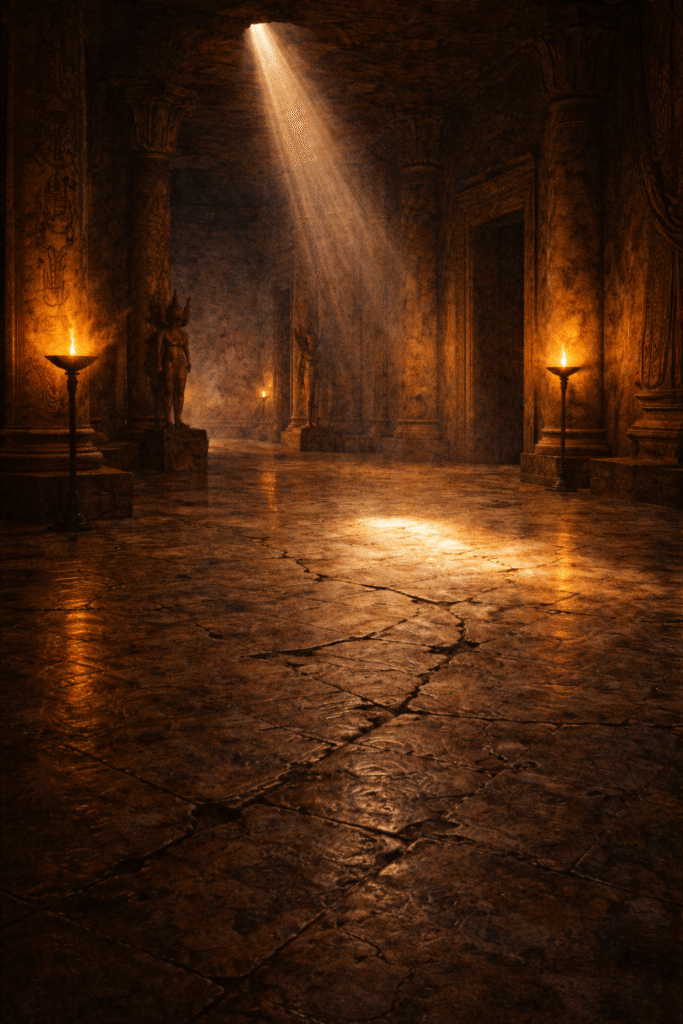
Prologue — Threads Never Break All at Once
People imagine unraveling
as a dramatic tearing—
a ripping sound,
a sudden collapse,
a violent dethreading.
But unraveling
is quieter.
It begins
with a single thread
loosening at the edge.
You ignore it.
Then another thread joins it.
And another.
By the time you look again,
the tapestry is changing shape—
not destroyed,
but no longer yours.
This scroll
is the story
of threads loosening
faster than I could tighten them.
Not because I lacked strength.
But because the tapestry
had begun to weave itself
around someone else.
PART I — The Morning of Empty Chairs
The unraveling began
with absence.
Not loud absence—
vacant seats at council.
It was the council
on temple revenues.
A meeting that once
pulled every priest,
scribe,
and noble
into the hall without fail.
But on this morning,
three seats remained empty.
One belonged to a priest
who claimed illness.
Another to a noble
whose messenger arrived late.
The third to a military advisor
who “waited upon the young king
for guidance.”
Thutmose was not present.
He had not been invited
to this session.
And yet their empty chairs
faced his shadow.
I asked the room,
“Does the absence
of these men
reflect their priorities?”
Silence.
A silence
that did not fear me.
A silence
that waited for someone else.
PART II — The General Who Answered Without Permission
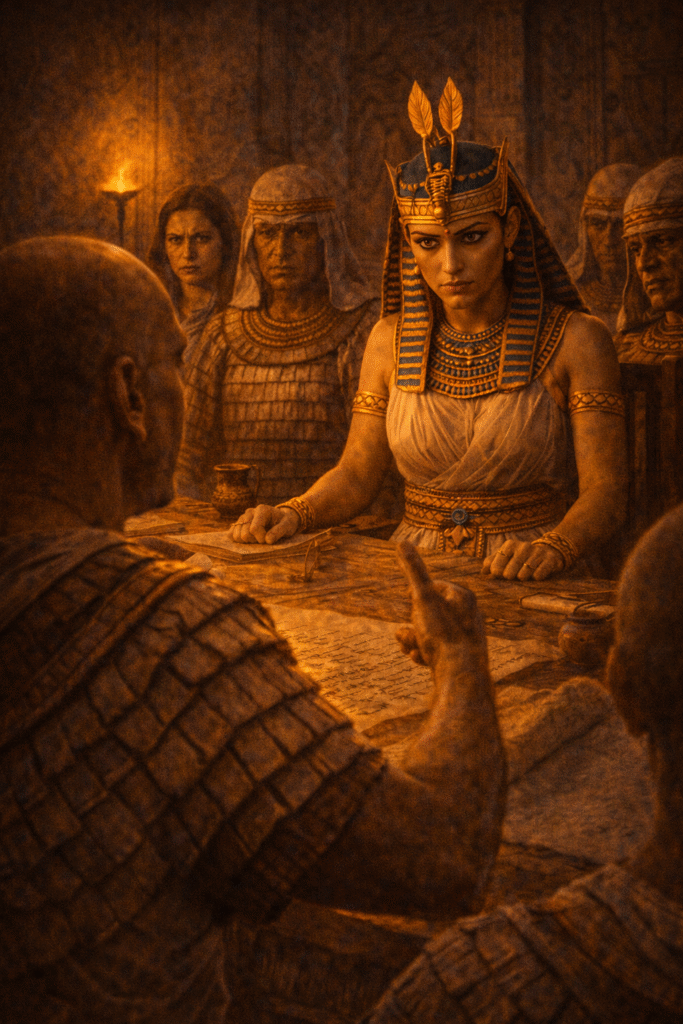
Later that same week,
a matter of border logistics
was placed before me.
A routine question:
Should the garrison at Buhen
be reinforced before the flood season?
I opened my mouth to answer.
A general—
a man who had served me faithfully
through two decades—
spoke first.
“The young king,”
he said,
“has expressed interest
in strengthening the southern fortifications.”
The room turned toward him.
I raised an eyebrow.
“And did His Majesty
issue an order?”
“No, Majesty.”
“Then why,” I asked,
“do you speak on his behalf
in my council?”
He swallowed.
“Because…
we assume
he will approve reinforcement.”
“And what do you assume
of my judgment?”
He flinched.
His answer was honest,
and therefore lethal:
“We no longer know
which judgments
will remain final.”
His words landed
like a cold stone
on warm breath.
Not cruelty.
Not rebellion.
Confusion.
The worst soil
unraveling can grow in.
PART III — The Petition That Was Redirected
Petitioners used to come
with clear understanding
of the path.
They approached me.
They bowed to me.
They sought judgment
from me.
But one hot afternoon,
a father came with a matter
of inheritance dispute.
He knelt before the dais.
“Majesty,” he said,
“I bring this matter
to the throne.”
I reached for the scroll.
He did not hand it.
He hesitated.
“Is…
is His Majesty Thutmose
available today?”
My heart did not drop.
It cooled.
“He is at the training fields,”
I said.
The man bowed deeper.
“I was told
inheritance disputes
are best handled
by the future king,
as he will oversee
the next generation’s order.”
“Who told you this?”
I asked.
“Two priests
and a temple scribe.”
I nodded.
“Give me your scroll,”
I said.
He hesitated again
—but finally surrendered it.
I judged the case
fairly,
cleanly,
with no hint of irritation.
But after he left,
I felt something shift:
a door in the people’s minds
had begun to close behind me.
PART IV — The Throne Room That Echoed Wrong
One evening,
I walked into the throne room
to attend a ceremonial audience.
The hall was lit
with long torchlines,
the gold inlays of the throne
glimmering in warm firelight.
Two thrones stood ready.
Mine—
massive,
decorated with carved deities,
the seat I had occupied
for over twenty years.
Thutmose’s—
nearby,
smaller,
but polished
so bright
it caught every flame
like a gemstone.
I stepped toward my throne.
The room echoed.
Not with the usual murmur
of voices straightening themselves
into reverence.
But with a tight,
held breath.
A waiting.
A questioning.
A shift
in expectation.
The nobles
looked at Thutmose’s throne first.
Only then
at mine.
Not because they doubted me.
Because they anticipated him.
The unraveling
had begun
in the court’s imagination.
Reality would follow.
PART V — The Day the Priests “Advised” Me
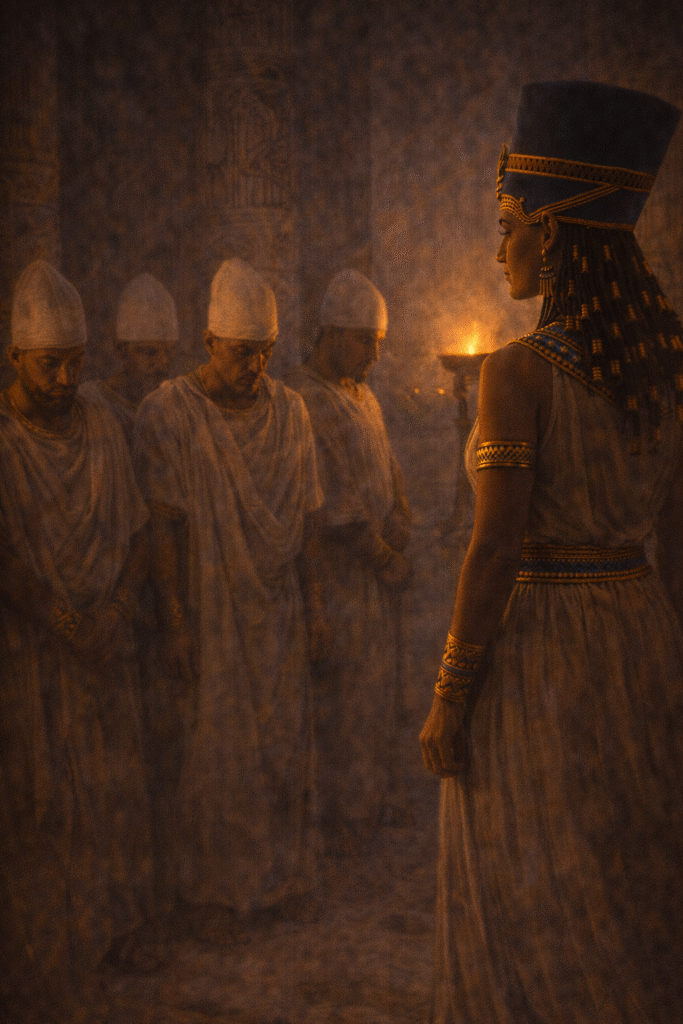
The priests of Amun
requested an audience.
Not unusual.
But their tone—
the careful phrasing—
the meticulous courtesy—
felt sharpened.
When they entered,
I recognized it immediately:
The posture
of men preparing
to say something
they do not want recorded.
“Majesty,”
the high priest began,
“the god shines favor
on both thrones.”
A statement
no one believed.
“But,” he continued,
“we ask that
during the next Opet festival,
His Majesty Thutmose
lead the procession
of the god’s barque.”
I looked at him.
“I have led
the barque of Amun
for two decades.”
“Yes, Majesty,”
he said.
“And with great blessing.”
His voice softened,
almost sorrowful.
“But the people
must see
the future.”
I raised my chin slightly.
“Have they stopped
seeing the present?”
He did not answer.
Instead:
“Majesty…
your presence
is eternal.
But the festival
must prepare
for the next reign.”
There it was.
Not erasure.
Transition.
A knife of silk.
I spoke softly.
“And is Amun
the one
who requests this?”
The high priest’s eyes
did not waver.
“Yes.”
He lied.
And we both knew it.
PART VI — The Day Thutmose Stopped Saying “We”
Of all the threads that loosened,
this one cut deepest.
Thutmose had always said “we.”
“We will review the decree.”
“We must discuss the border.”
“We will present the offerings.”
But one afternoon,
after a council meeting
in the palace library,
he said something different.
A noble bowed to him
and asked:
“What shall we prepare
for the coming campaign?”
Thutmose answered
without glancing at me.
“I
will decide
after reviewing the reports.”
I.
Not we.
The noble bowed again.
Deeper.
When the room emptied,
I approached him.
“You said ‘I,’”
I said quietly.
He turned, startled.
“Did I?”
“Yes.”
He frowned,
as if replaying the moment.
“I did not mean—”
“I know,”
I said.
“But you did.”
He breathed out slowly.
“The room
expects me
to speak that way now.”
“And do you?”
I asked.
He hesitated.
“Yes.”
There was no anger in him.
No triumph.
Only truth.
The unraveling
is not the moment
you lose influence.
It is the moment
someone else
stops needing
to share it.
PART VII — The Inscription That Named Only One
The final thread
of this scroll’s unraveling
came not from men
but from stone.
In a small chamber
at Karnak,
a new inscription
had been carved.
It recorded
a routine offering
to Amun.
Nothing momentous.
But the name
of the offering king
was singular.
Thutmose.
Mine was nowhere.
Not faded.
Not erased.
Not lost.
Absent.
The space
where my name
should have been
was filled
with additional text—
prayers,
blessings,
ritual formulas.
The absence
was deliberate.
The artisan,
when confronted,
looked terrified.
“Majesty,”
he whispered,
“I swear…
the directive
came from the temple scribes.”
“And the scribes?”
“They said,”
he swallowed,
“that the time
of dual representation
is complete.”
Dual representation.
The political term
for my existence.
Now deemed complete.
I touched the carved surface
with my fingertips.
It felt
cool,
smooth,
indifferent.
Stone does not lie.
But it can be taught
to forget.
PART VIII — A Modern Traveler in the Fading Light
Traveler,
when you stand inside Karnak
or Deir el-Bahari,
you will see grand walls
and towering columns.
But look closer.
Look for:
- the half-filled spaces
- the falsely perfect symmetry
- the sections where one figure
is carved deeper than the rest - the corners where a second cartouche
once could have been - the slight unevenness
where an artisan hesitated
Those places
are the unraveling.
That is where power
did not fall—
it slipped.
We can guide you
to the exact stones
where the unraveling began.
Where two names
became one.
Where memory
began to withdraw
its loyalty.
Where silence
became strategy.
If you’ve ever felt
your influence thinning—
not disappearing,
just drifting—
If you’ve ever watched
a room turn
to someone else first—
If you’ve ever stood
in a place
that once celebrated you
and sensed
you were now
a guest—
Then this Scroll
belongs to you.
Walk with ENA
to the walls
that remember the unraveling.
Some truths are written in stone—
and some slip between the lines.
PART IX — The Garden Where I Let Go
The garden of sycamores
had seen years
of my life unfold.
It was there
that I taught Thutmose
the geography of Egypt
in lines traced in dust.
It was there
that he first questioned
his destiny.
It was there
we had our last
unburdened conversation.
And it was there
—during the unraveling—
that I finally accepted
what the world
had been whispering.
I sat on a stone bench,
the trees shading me
from the afternoon sun.
Thutmose approached slowly.
“holy mother,”
he said,
voice soft.
“Thutmose,”
I answered.
He sat beside me.
For a moment,
we said nothing.
Then he exhaled hard.
“I feel the world pulling at me,”
he whispered.
“It is meant to,”
I said.
“And you?”
“I feel it loosening,”
I answered.
He looked at me—
worried,
vulnerable.
“I do not want this
to hurt you.”
“It does,”
I said.
“But not because of you.”
He lowered his gaze.
“Can we stop it?”
he asked.
“No,”
I said gently.
“We can only shape
how it happens.”
He closed his eyes.
“Then shape it with me.”
“I already am.”
We sat there,
under sycamores
that had witnessed
our beginning
and now witnessed
our unraveling.
Not hatred.
Not rivalry.
Just the natural parting
of two paths
that had run together
longer than fate expected.
PART X — The Ancient Questioner’s Desk
A student asked:
“Why didn’t she fight harder?”
The historian replied:
“Because she fought wisely—
a kingdom survives
when rulers know
when to hold
and when to release.”
Another asked:
“Was Thutmose impatient?”
The scribe wrote:
“No.
He was gravitational.”
A traveler wondered:
“What is unraveling?”
The scholar answered:
“It is the moment
before the fall
when nothing breaks—
it simply stops
holding together.”
A final question came:
“Could she feel it coming?”
The old master smiled.
“She felt it
long before anyone else
knew how to name it.”
The Scroll ends here—
in the tremors
before the collapse,
in the subtle shifts
of courtiers and craftsmen,
in the echo
of words no longer spoken
in unison.
If you felt the unraveling—
if you’ve stood
at the edge
of something ending
not with violence,
but with slow withdrawal—
you carry her story now.
Come walk the halls
where the unraveling began.
Stand beside the walls
that shifted names.
Trace the patterns
of a reign
coming undone
with elegance
and inevitability.
Journey with ENA.
Some endings whisper
long before they break.